Land transfer tax Canada is generally a one-time charge imposed when property ownership changes hands. However, Canada does not have a single nationwide rate. Each province establishes its own rules, while certain municipalities, including Toronto, impose an additional tax. Eligible first-time home buyers may also qualify for rebates or exemptions that reduce the amount payable. This guide explains how land transfer tax works across Canada, compares major provincial tax systems, and outlines the available first-time buyer benefits so you can prepare a more realistic home-buying budget.
1. What Is Land Transfer Tax in Canada?
Land transfer tax is a government charge applied when ownership or certain interests in real estate are transferred from one party to another. It is generally paid by the buyer as part of the property closing process. Although the name varies by jurisdiction, the underlying purpose is similar: the government collects a tax or duty when a property transaction is registered, or ownership is legally transferred.
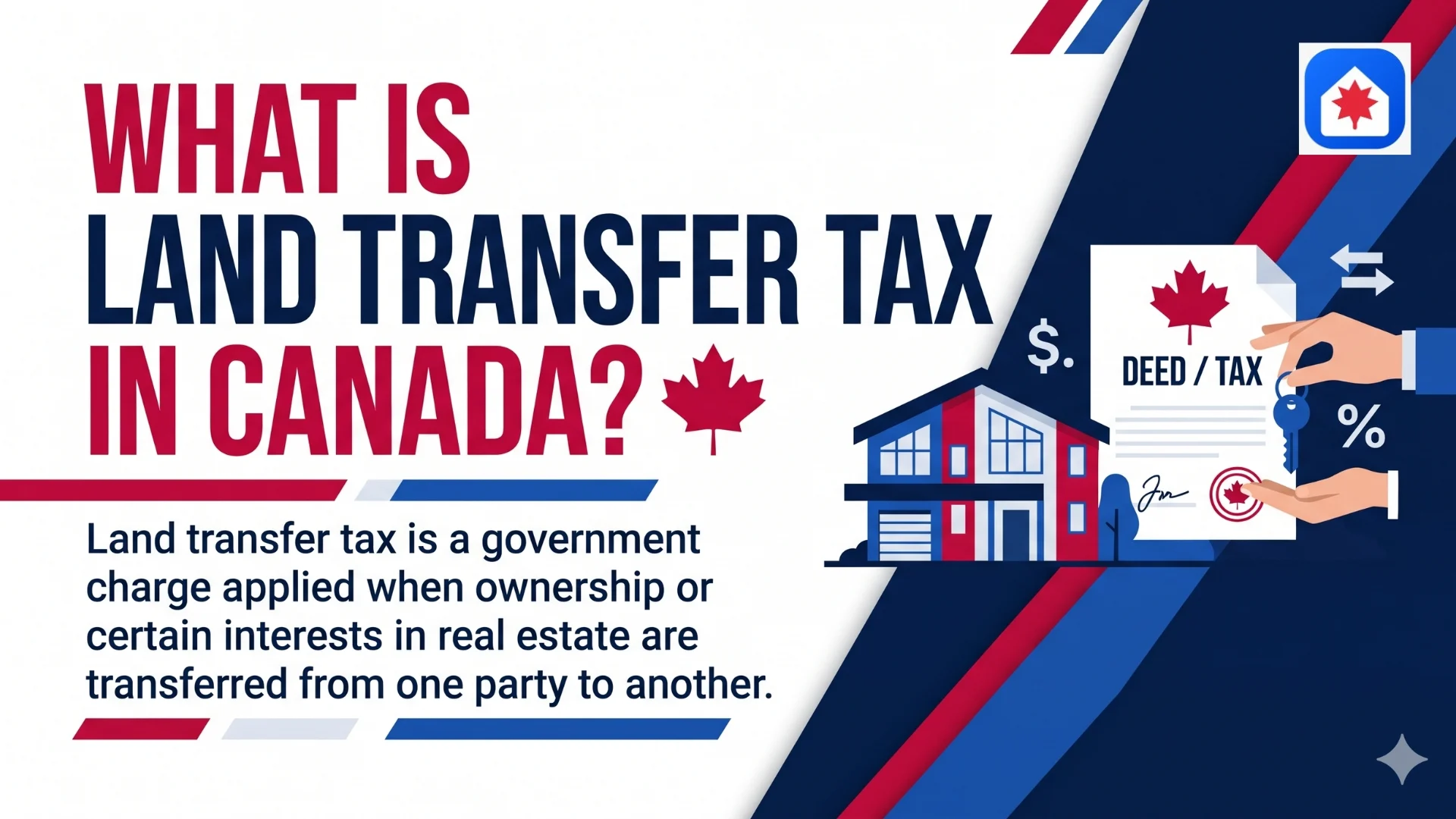
In most cases, land transfer tax Canada is due when the property transfer is registered with the relevant land registry or land titles office. For a typical home purchase, the buyer provides the required funds to their real estate lawyer or notary before closing. The legal professional then handles the applicable tax payment and property registration. The exact payment process varies by province. Buyers should ask their legal representative for a breakdown of the amount required before the closing date.
The buyer is generally responsible for paying land transfer tax when purchasing a property. This applies to most conventional residential purchases, including detached houses, townhouses, and condominiums. However, certain transactions may qualify for exemptions or special tax treatment.
2. Land Transfer Tax Rates Across Canada
The amount of tax payable depends on the province or territory where the property is located. Some jurisdictions use graduated tax brackets, while others apply a percentage to the purchase price or assessed value. There are also locations where buyers pay registration fees instead of a conventional land transfer tax.
2.1. Ontario Land Transfer Tax
Ontario applies a graduated land transfer tax system. This means that different portions of the property's taxable value are subject to different rates. For typical residential properties, the provincial rates are:
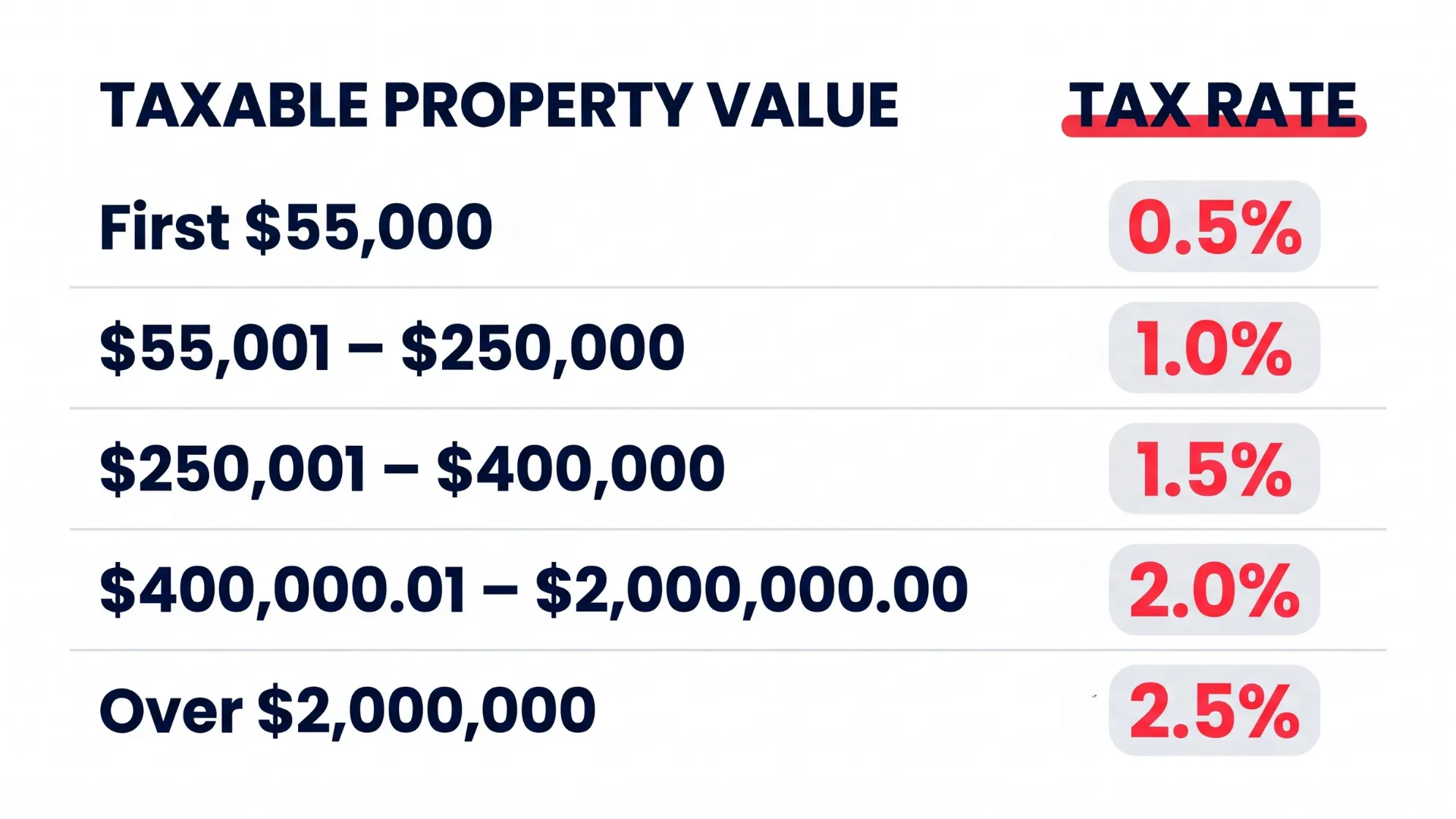
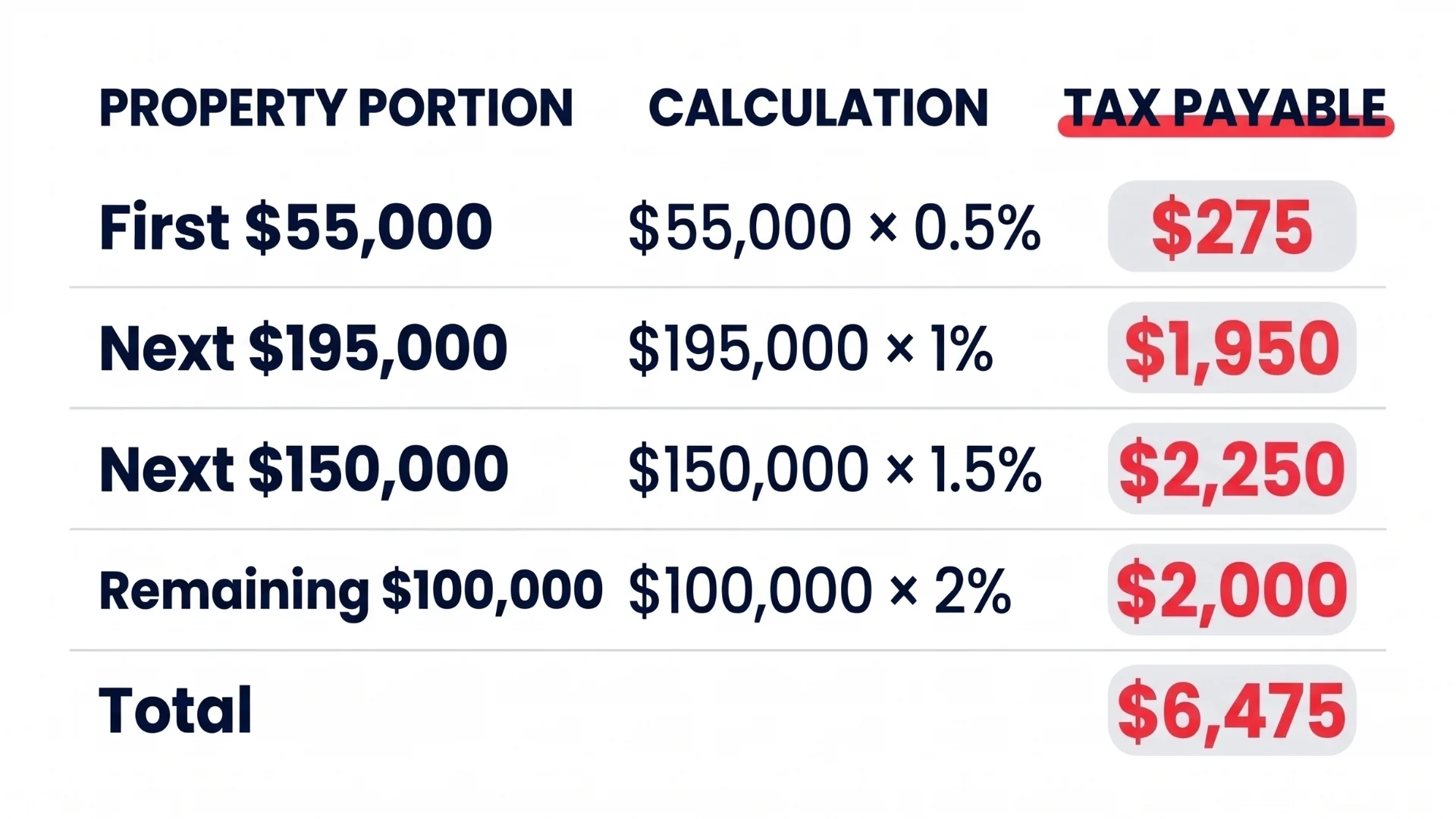
For example, suppose a property in Ontario costs $500,000. The buyer does not simply multiply $500,000 by 2%. Instead, the calculation is:
Toronto is a key exception in Ontario's property market because it charges its own Municipal Land Transfer Tax (MLTT). This means a buyer purchasing a home in Toronto may have to pay two separate transfer taxes: Ontario Provincial Land Transfer Tax and Toronto Municipal Land Transfer Tax. The two taxes use similar graduated brackets for typical residential properties valued up to $3 million. However, Toronto introduced higher municipal rates for high-value residential properties effective April 1, 2026.
2.2. British Columbia Land Transfer Tax
British Columbia uses a Property Transfer Tax (PTT) system based on the property's fair market value. The general rates are:
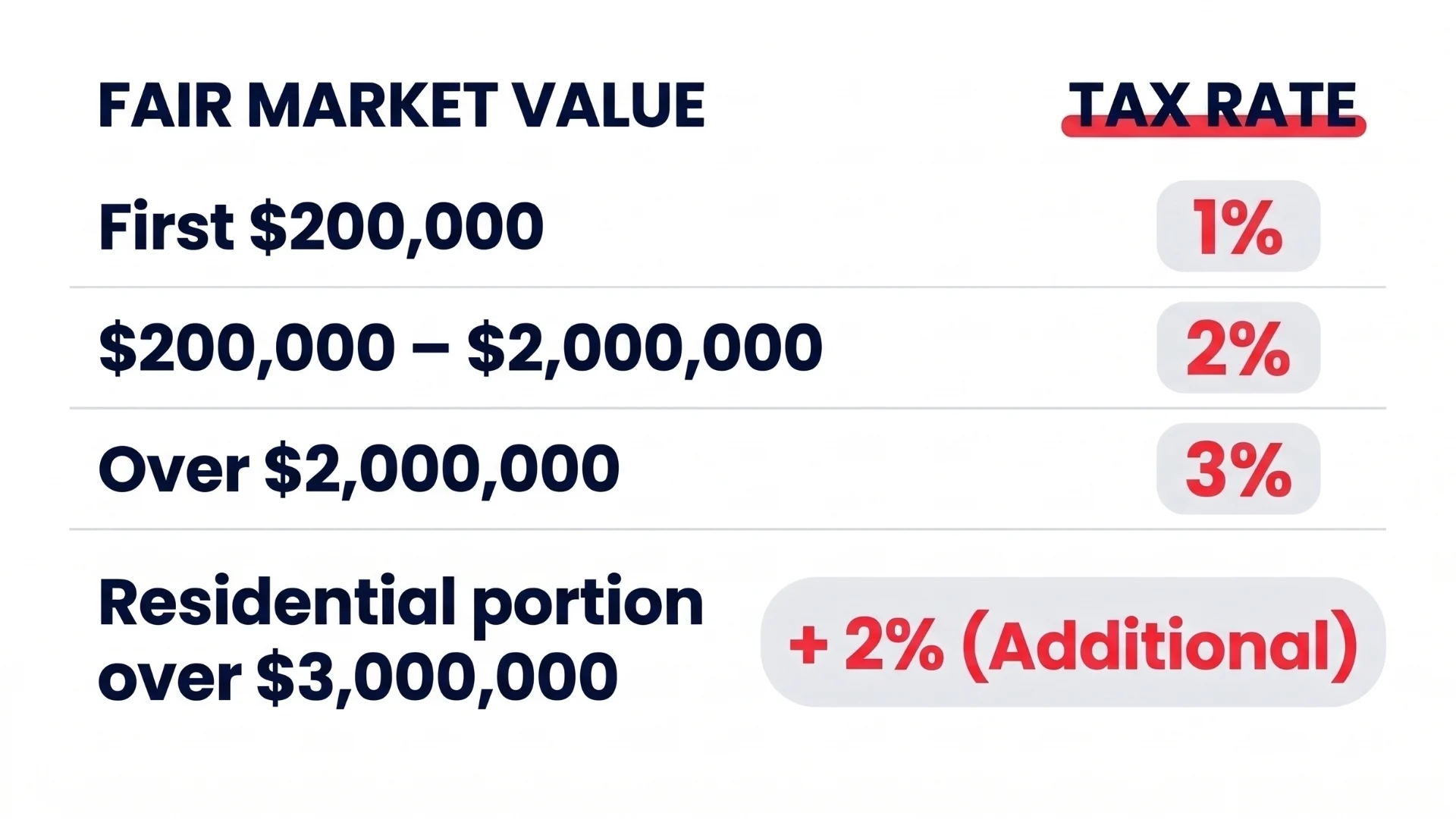
For example, a buyer purchasing a property valued at $800,000 would generally calculate the tax as follows:
- First $200,000 × 1% = $2,000.
- Remaining $600,000 × 2% = $12,000.
- Total general Property Transfer Tax: $14,000.
2.3. Manitoba Land Transfer Tax
Manitoba applies graduated land transfer tax rates based on the property's fair market value at the time of title registration. The tax is calculated using the following brackets:
- First $30,000: 0%.
- $30,001 - $90,000: 0.5%.
- $90,001 - $150,000: 1%.
- $150,001 - $200,000: 1.5%.
- Over $200,000: 2%.
2.4. Quebec Land Transfer Tax
Quebec's welcome tax is collected by municipalities when ownership of an immovable property changes. The tax base generally considers the highest applicable amount among the purchase price, the amount stated in the deed, and the property's adjusted market value.
- 0.5% on the first $52,800
- 1% on the amount between $52,801 and $264,000
- 1.5% on amounts above $264,000
2.5. New Brunswick Land Transfer Tax
The land transfer tax in New Brunswick is relatively straightforward. Currently, the transfer tax payable is 1% of the property value, according to the Real Property Transfer Tax Act.
3. First-Time Home Buyer Land Transfer Tax Rebates and Exemptions
Land transfer tax Canada can be a significant upfront expense, particularly for buyers purchasing in high-priced housing markets. To make homeownership more accessible, some Canadian provinces and municipalities offer rebates or exemptions to eligible first-time home buyers. However, these programs do not follow one nationwide definition of a first-time buyer. Eligibility requirements, maximum benefits, property-value limits, and residency conditions vary by jurisdiction.
3.1. Ontario First-Time Home Buyer Rebate
Ontario provides a first-time home buyer land transfer tax refund of up to $4,000. For qualifying buyers, the refund can eliminate provincial land transfer tax on the first $368,000 of an eligible home's value. If the tax exceeds $4,000, the buyer receives the maximum $4,000 refund rather than a full exemption.
To qualify, the purchaser generally must:
- Be at least 18 years old.
- Never have owned an eligible home, or an interest in one, anywhere in the world.
- Occupy the purchased property as their principal residence within nine months of the transfer.
- Meet the applicable spouse ownership requirements. If the purchaser has a spouse, the spouse must not have owned an eligible home anywhere in the world while they were spouses.
- Be a Canadian citizen or permanent resident under the current program requirements.
If multiple people purchase a property together, the refund may be reduced according to the ownership interest held by qualifying purchasers. Certain spouse-related situations have specific rules, so joint buyers should check their circumstances carefully.
3.2. Toronto First-Time Home Buyer Rebate
Toronto offers a separate first-time home buyer rebate of up to $4,475 on its Municipal Land Transfer Tax. This benefit is available for eligible newly constructed and resale residential properties. It does not apply to commercial, industrial, or multi-residential properties.
The main eligibility conditions include:
- The purchaser must be at least 18 years old.
- The purchaser must occupy the property as their principal residence within nine months of the transfer.
- The purchaser must never have owned a home or held an ownership interest in a home anywhere in the world.
- If the purchaser has a spouse, the spouse must not have owned a home anywhere in the world while they were spouses.
- The purchaser must be a Canadian citizen or permanent resident, subject to the program's provisions for obtaining eligible status within 18 months of the transfer.
The Toronto rebate is independent of Ontario's provincial refund. Therefore, an eligible buyer purchasing a home in Toronto may receive both benefits.
3.3. British Columbia First-Time Home Buyer Exemption
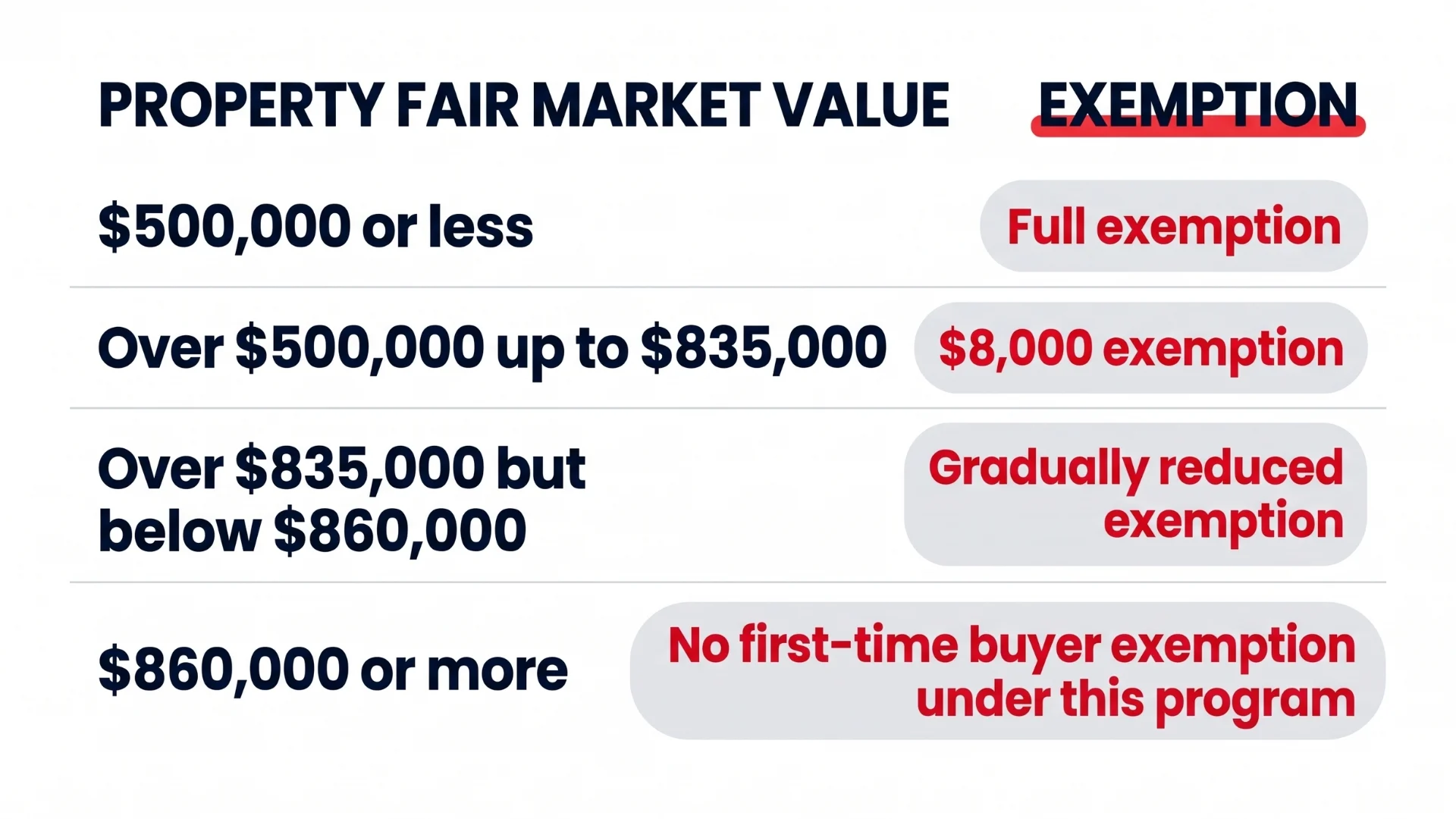
British Columbia offers a First-Time Home Buyers' Program that can reduce or eliminate general Property Transfer Tax for qualifying purchasers. Unlike Ontario's fixed-dollar refund, BC calculates the exemption based on the property's fair market value and the eligible ownership interest. For properties registered on or after April 1, 2024, the general exemption structure for a qualifying property smaller than 0.5 hectares is:
3.4. Other Provincial First-Time Buyer Programs
Ontario, Toronto, and British Columbia are not the only jurisdictions offering property transfer tax relief. Other provinces also offer programs, although their requirements can differ.
- Prince Edward Island: PEI offers a Real Property Transfer Tax exemption for qualifying first-time home buyers. Eligibility generally requires the purchaser to be a Canadian citizen or permanent resident, meet the provincial residency or income tax filing conditions, have no previous qualifying principal-residence ownership, and intend to occupy the property as their principal residence.
- Quebec: Quebec municipalities collect welcome tax under provincial legislation. Some municipalities may provide relief in particular circumstances, but buyers should not assume there is a universal provincial first-time buyer rebate equivalent to Ontario's program.
- Manitoba, Nova Scotia and New Brunswick: These jurisdictions generally do not provide the same broad first-time buyer transfer-tax refund structure as Ontario. However, individual exemptions or special transfer provisions may apply to specific transactions.
4. How to Claim a Land Transfer Tax Rebate
Finding an available rebate is only part of the process. Buyers must also follow the relevant application and documentation requirements. Although procedures differ by jurisdiction, the general process involves the following steps:
Step 1: Check your eligibility
Review the official program requirements before closing. Pay particular attention to previous property ownership, residency status, principal-residence requirements, and ownership shares.
Step 2: Prepare supporting documents
Depending on the program, you may need:
- Government-issued identification.
- Proof of Canadian citizenship or permanent residency.
- The Agreement of Purchase and Sale.
- Property transfer or registration documents.
- Evidence of principal-residence occupancy.
- Additional declarations or application forms.
Step 3: Discuss the rebate with your real estate lawyer
Ask whether the benefit can be claimed directly during registration. If it can, the rebate may reduce the amount you need to provide at closing.
Step 4: Submit a refund application if necessary
If the tax was paid in full, some programs allow eligible purchasers to apply afterward. Check the applicable deadline and required documentation.
Step 5: Keep your records
Retain copies of the purchase agreement, registration documents, proof of occupancy, and any rebate confirmation. These records may be needed if the government reviews your claim.
5. How to Estimate and Budget for Land Transfer Tax
Knowing the applicable tax rates is useful, but buyers also need a practical way to estimate the amount they will pay and understand how it fits into their overall closing costs. A reliable estimate should account for the property location, purchase price, applicable rebates, and other transaction expenses.
5.1. Using a Land Transfer Tax Calculator in Canada
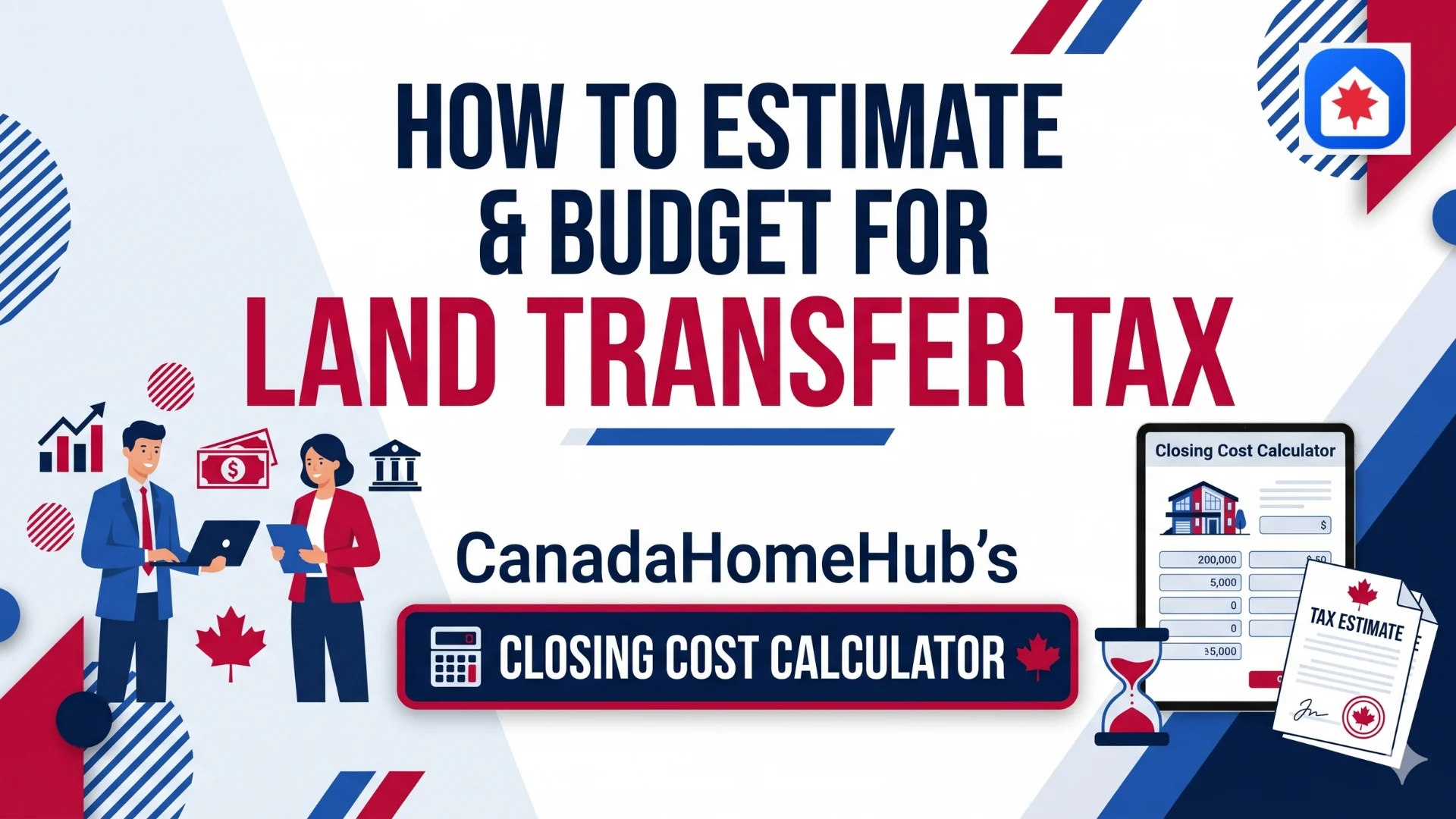
A land transfer tax calculator Canada can help buyers estimate their tax liability before making a purchase decision. Rather than manually calculating each tax bracket, an online calculator can apply the relevant rates and provide an estimated amount based on the information entered. You can also use CanadaHomeHub's Closing Cost Calculator to estimate land transfer tax and other upfront home-buying expenses, helping you prepare a more accurate budget before closing.
When using a calculator, prepare the following details:
- Property location: Select the correct province and municipality. This is especially important when buying in Toronto because two separate transfer taxes apply.
- Purchase price or fair market value: Enter the value required by the relevant tax rules.
- Property type: Identify whether you are purchasing a residential property, condominium, commercial property, or another type of real estate.
- First-time home buyer status: Indicate whether you may qualify for a provincial or municipal rebate.
- Ownership details: If multiple buyers are involved, check whether all purchasers qualify for the available benefits.
5.2. Other Closing Costs to Include in Your Budget
Land transfer tax Canada is only one component of the total cost of buying a property. Depending on the transaction, buyers may also need to budget for:
- Real estate lawyer or notary fees
- Title insurance
- Home inspection
- Property appraisal
- Property tax adjustments
- Land registration fees
- Home insurance
Some expenses are mandatory for a particular transaction, while others depend on the lender, property type, and purchase agreement. For a broader breakdown, read CanadaHomeHub's guide to closing costs in Canada.
Frequently Asked Questions
1. How much is land transfer tax in Canada?
There is no single nationwide rate. The amount depends on the province, municipality, property value, and applicable tax brackets.
2. Which provinces do not charge land transfer tax?
Alberta and Saskatchewan do not impose a conventional provincial land transfer tax. Newfoundland and Labrador and Yukon also do not have a conventional property transfer tax of this type. However, buyers may still pay land title or deed registration fees.
3. Do first-time home buyers pay land transfer tax in Canada?
They may. Some provinces and municipalities offer rebates or exemptions, but eligibility varies.
4. Is Toronto land transfer tax separate from Ontario land transfer tax?
Yes. Toronto charges its own Municipal Land Transfer Tax in addition to Ontario's provincial tax. Buyers purchasing within Toronto must calculate both amounts.
5. Is land transfer tax based on the purchase price or assessed value?
It depends on the jurisdiction. Ontario generally uses the value of consideration, while British Columbia uses fair market value. New Brunswick uses the greater of the purchase consideration or assessed value. Other provinces may have their own valuation rules.
6. When do I have to pay land transfer tax?
For a typical property purchase, the tax is generally paid during the closing and registration process. Your real estate lawyer or notary will normally calculate the amount and arrange payment as part of the transaction.
Understanding land transfer tax Canada is an important part of preparing for a property purchase. The amount you pay depends on where you buy, the property's taxable value, and whether you qualify for available rebates or exemptions. Before making an offer, calculate the applicable transfer tax, confirm your first-time home buyer eligibility, and include the amount in your closing-cost budget. You can also refer to CanadaHomeHub's tools for additional help estimating upfront expenses and preparing for your property purchase.
Thank you for taking the time to read this article.