Buying your first property is one of the most significant financial milestones you will ever achieve. However, navigating the Canadian real estate market - with changing interest rates, competitive bidding, and complex tax rules - can feel overwhelming for beginners. If you are planning to take your first step onto the property ladder, this comprehensive first time home buyer guide in Canada will walk you through everything you need to know. From federal incentives and tax credits to down payment requirements and step-by-step purchasing strategies, this guide ensures you make informed, confident decisions.
What Defines a First Time Home Buyer in Canada?
Before tapping into government grants and tax perks, it is essential to understand whether you meet the official criteria. According to the Canada Revenue Agency (CRA), you are generally considered a first home buyer in Canada if:
- You have not lived in a home that you or your current spouse/common-law partner owned in the current calendar year or during the preceding four calendar years.
- You are a Canadian citizen or permanent resident purchasing a qualifying home within Canada.
- (Exception) People with disabilities who buy a home tailored to their accessibility needs may qualify even if they don't meet the four-year ownership rule.
Understanding this definition is critical because qualifying unlocks thousands of dollars in government incentives, rebates, and tax relief designed specifically for a first time home buyer in Canada.
Key First Time Home Buyer Programs & Incentives in Canada
The Canadian government offers several financial programs to help lower the barrier to entry for new buyers. Leveraging these first time home buyer benefits in Canada can save you significant money up front and reduce your long-term tax liabilities
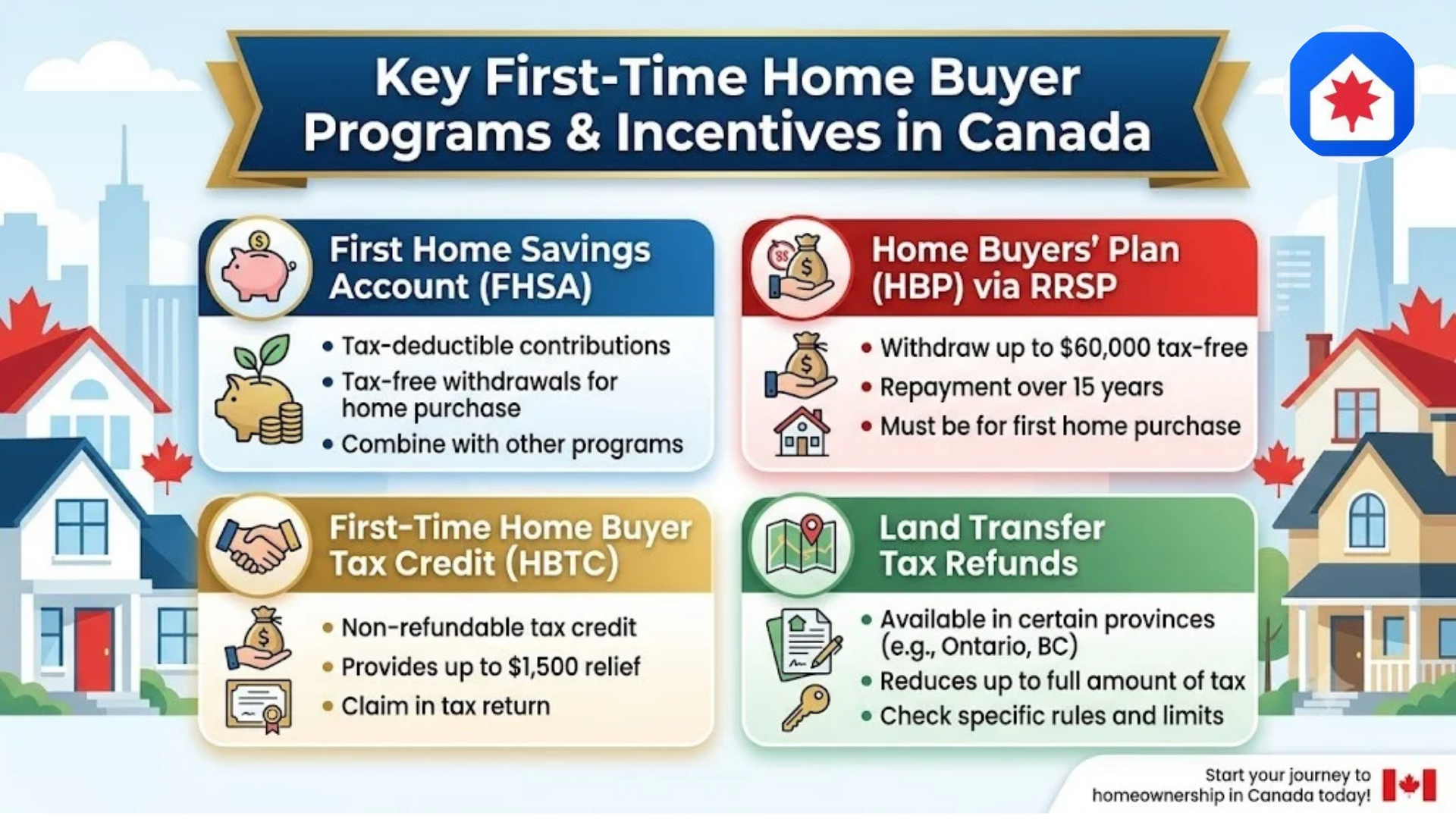
First Home Savings Account (FHSA)
Introduced to help Canadians save for down payments, the FHSA combines the best features of a Registered Retirement Savings Plan (RRSP) and a Tax-Free Savings Account (TFSA):
- Tax Deductible: Contributions lower your net taxable income for the year.
- Tax-Free Growth & Withdrawal: Earnings grow tax-free, and qualifying withdrawals used to purchase a home are completely tax-exempt.
- Limits: You can contribute up to $8,000 per year, up to a lifetime maximum of $40,000.
Home Buyers' Plan (HBP) via RRSP
The Home Buyers' Plan allows eligible buyers to withdraw funds tax-free from their Registered Retirement Savings Plan (RRSP) to build their down payment:
- Higher Withdrawal Limit: Eligible buyers can withdraw up to $60,000 tax-free from their RRSP. Couples buying together can access up to $120,000.
- Repayment Period: You have up to 15 years to repay the withdrawn amount back into your RRSP, with payments starting after a grace period set by the CRA.
First-Time Home Buyer Tax Credit (HBTC)
The first time home buyer tax credit in Canada (also known as the Home Buyers' Amount) allows buyers to claim a non-refundable tax credit on eligible home purchases.
- Value: You can claim up to $10,000, which translates into a direct tax relief of up to $1,500.
- How to Claim: You enter this credit on your income tax return for the year you purchase the property.
Land Transfer Tax (LTT) Refunds
When purchasing real estate, buyers pay a Land Transfer Tax to the provincial government (and municipally in cities like Toronto). Many provinces offer generous rebates for first-time buyers:
- Ontario: Maximum rebate of $4,000 on provincial land transfer tax.
- Toronto: Additional municipal rebate up to $4,475.
- British Columbia & Prince Edward Island: Similar exemptions and tiered relief depending on property value.
Financial Preparation: How Much Do You Really Need?
One of the biggest questions facing any first time home buyer Canada applicant is: “How much money do I actually need saved before making an offer?”
Down Payment Requirements in Canada
Your down payment depends directly on the purchase price of the property:
- Homes $500,000 or less: Minimum 5% of the purchase price.
- Homes between $500,001 and $999,999: 5% on the first $500,000 + 10% on the portion above $500,000.
- Homes $1,000,000 or more: Minimum 20% down payment required.
Example: For a $650,000 home, your minimum down payment would be $25,000 (5% of $500k) + $15,000 (10% of $150k) = $40,000.
Mortgage Loan Insurance (Default Insurance)
If your down payment is less than 20%, Canadian regulations require you to purchase mortgage loan insurance (provided by providers like CMHC, Sagen, or Canada Guaranty). This insurance protects the lender in case of default and is added directly to your mortgage total.
The Mortgage Stress Test
All federally regulated lenders require applicants to pass the Mortgage Stress Test. This determines whether you can afford mortgage payments at a rate higher than your actual contract rate - typically either 5.25% or your offered rate plus 2%, whichever is higher.
Closing Costs Budgeting
Never drain your savings entirely for the down payment. You must reserve an additional 1.5% to 4% of the purchase price for closing costs, which include:
- Legal fees and disbursements ($1,500 – $3,000)
- Home inspection fee ($400 – $700)
- Property appraisal fees ($300 – $500)
- Title insurance ($250 – $500)
- Moving expenses and immediate maintenance costs
Step-by-Step Process to Buying Your First Home in Canada
To avoid common pitfalls and keep stress levels manageable, follow this structured roadmap:
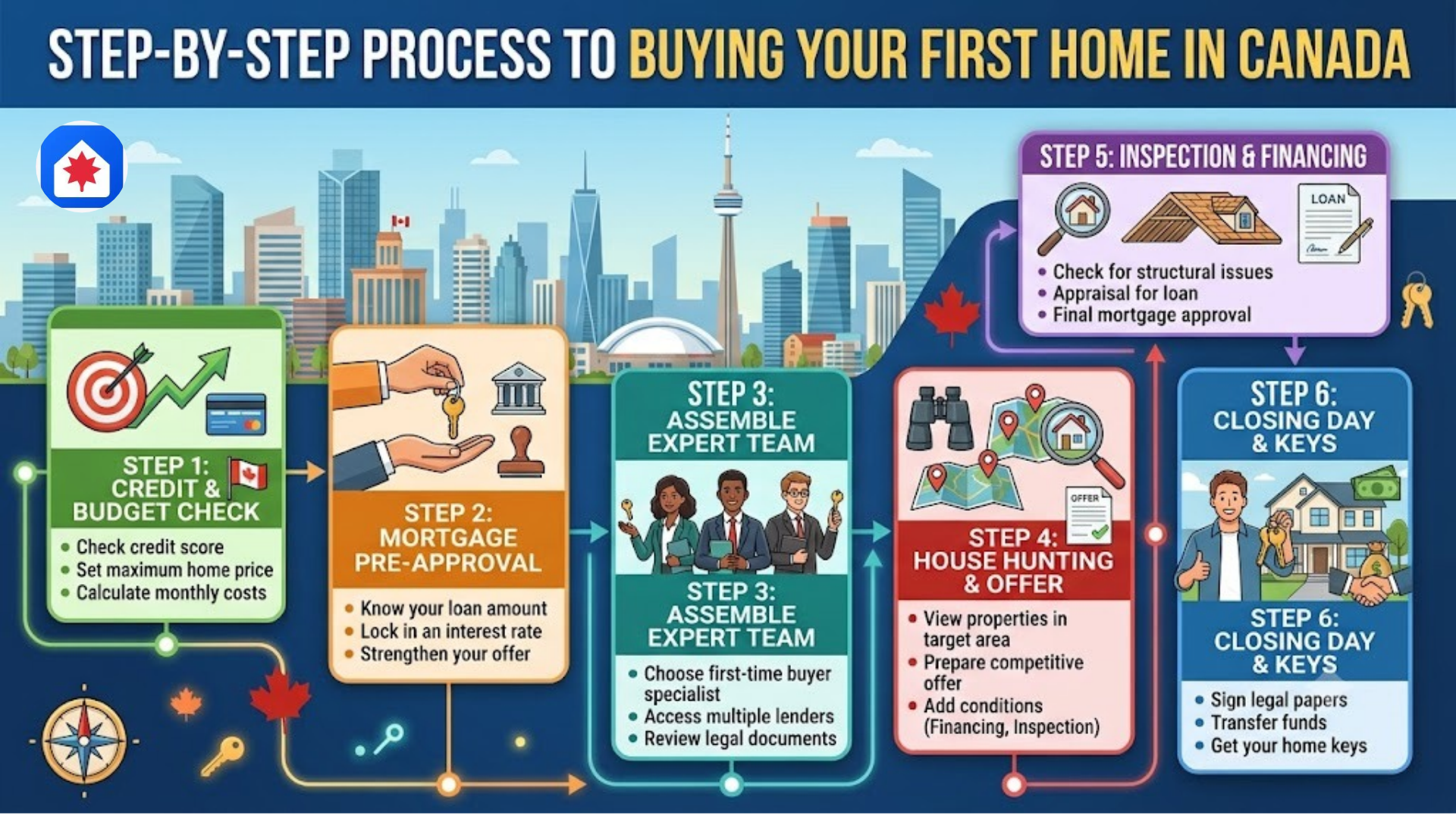
Step 1: Check Credit Score & Set a Realistic Budget
Start reviewing your financial health at least 6 to 12 months before searching. Lenders generally look for a credit score of 660 or higher for favorable mortgage rates. Pay down revolving debt, fix any credit report errors, and calculate your monthly Debt-Service Ratios (GDS/TDS).
Step 2: Obtain a Mortgage Pre-Approval
A mortgage pre-approval tells you exactly how much a financial institution is willing to lend you and locks in an interest rate for 90 to 120 days. This establishes a clear price ceiling and shows sellers you are a serious buyer.
Step 3: Assemble Your Professional Team
Surround yourself with experienced licensed experts:
- Realtor: Choose an agent who specializes in first-time buyers and knows your target neighborhood inside out.
- Mortgage Broker: Accesses multiple lenders to find competitive rates tailored to your situation.
- Real Estate Lawyer: Reviews purchase agreements, handles title transfers, and ensures clean funds closing.
Step 4: Start House Hunting & Submit an Offer
With your budget locked in, begin viewing homes that fit your criteria. When you find the right property, your Realtor will help prepare a formal Offer to Purchase (Agreement of Purchase and Sale). Ensure your offer includes key clauses (conditions) protecting your deposit:
- Condition of Financing
- Condition of Satisfactory Home Inspection
Step 5: Conduct Home Inspection & Finalize Loan Details
Once an offer is conditionally accepted, hire a certified home inspector to check the roof, foundation, plumbing, HVAC, and electrical systems. Concurrently, send the final details to your lender to secure firm mortgage approval.
Step 6: Closing Day
On closing day, your lawyer transfers funds to the seller’s lawyer, registers the property title in your name, and hands over the keys to your new home!
Common Pitfalls to Avoid for Canadian First-Time Buyers
Navigating first time home buyer programs Canada requires careful execution. Avoid these frequent mistakes:
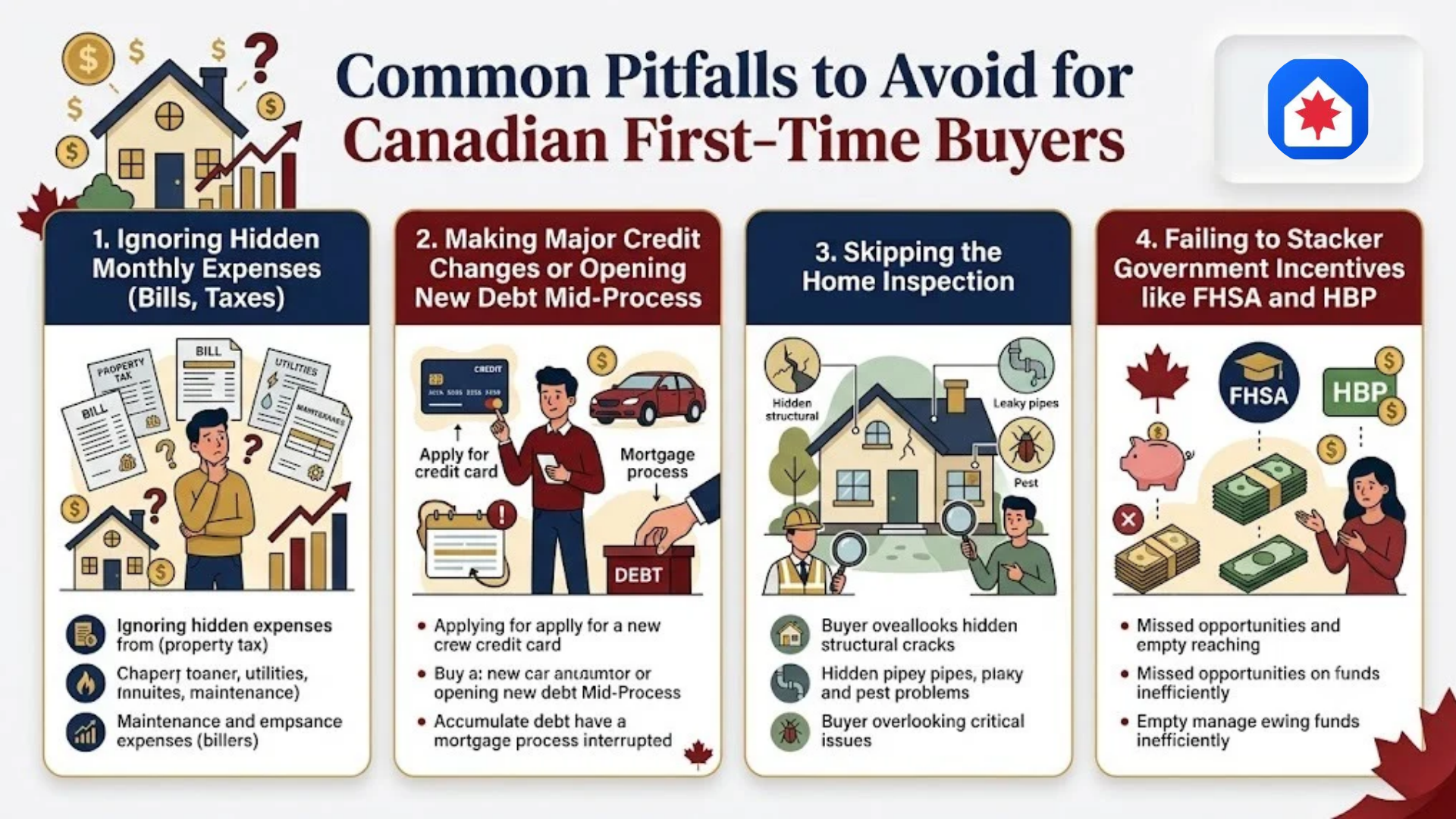
- Ignoring Hidden Monthly Expenses: Homeownership costs go beyond the mortgage payment. Always factor in property taxes, condo maintenance fees (HOA), utility bills, home insurance, and ongoing maintenance.
- Making Major Credit Changes Mid-Process: Do not apply for new credit cards, finance a vehicle, or change jobs during your home search or mortgage approval phase, as this can derail your pre-approval status.
- Skipping the Home Inspection: Waiving inspections to win a bidding war can expose you to tens of thousands of dollars in hidden structural or mechanical repairs down the road.
- Failing to Stack Incentives: Some buyers use their RRSP HBP but forget to set up an FHSA or fail to claim their first-time home buyer tax credit Canada on their annual tax return. Ensure you maximize every available incentive.
💡 Frequently Asked Questions (FAQ)
Q: Can I combine the FHSA and the Home Buyers' Plan (HBP)?
A: Yes! You can use both the FHSA and the HBP together on the same home purchase, maximizing your tax-free savings power.
Q: How much do I need saved for a closing deposit?
A: The deposit is submitted with your offer (usually within 24 hours of acceptance) and forms part of your total down payment. Depending on the local market, it typically ranges from 2% to 5% of the purchase price.
Q: Do first-time home buyer programs vary by province?
A; Yes. Federal programs are available under national rules, while provincial and municipal incentives vary by location. Always verify local requirements before relying on a benefit.
Q: Is a First-Time Home Buyer Incentive still available in Canada?
A: The federal Shared-Equity First-Time Home Buyer Incentive (FTHBI) was officially discontinued by CMHC in early 2024. Today, first-time buyers should focus on leveraging tax-advantaged accounts like the FHSA, the RRSP Home Buyers' Plan (HBP), and provincial land transfer tax rebates.
Q: Can permanent residents or work permit holders qualify as first-time buyers in Canada?
A: Permanent Residents (PR) enjoy the exact same access to first-time buyer incentives, tax credits, and minimum down payment rules as Canadian citizens. Temporary residents on valid work permits can also purchase homes and access programs, but they may be subject to specific provincial foreign buyer taxes or stricter mortgage lending criteria depending on their residency status and credit history.
Take Control of Your Real Estate Journey Today
Purchasing a property in Canada’s dynamic real estate market is a rewarding journey when approached with the right knowledge and financial preparation. By understanding the definition of a first-time buyer, taking full advantage of accounts like the FHSA and HBP, budgeting accurately for closing costs, and sticking to a clear step-by-step process, you position yourself for long-term success.
Are you ready to take your first step toward homeownership? Bookmark this first time home buyer guide in Canada, evaluate your current savings, and speak with a qualified mortgage professional to turn your dream of owning a home into reality!
Thank you for reading our article!