Vancouver consistently ranks among the world’s most livable cities, celebrated for its mild coastal climate, majestic coastal mountains, and vibrant oceanfront urban centers. However, that world-class lifestyle comes with a clear trade-off. Whether you are an inter-provincial professional relocating from Alberta or Ontario, an international newcomer to Canada through skilled immigration streams, or a prospective homebuyer weighing long-term affordability, calculating your budget beforehand is essential. This comprehensive guide delivers a transparent and realistic breakdown of the actual cost of living Vancouver. Let's dive in.
1. Monthly Cost of Living in Vancouver at a Glance
Living expenses in Metro Vancouver vary widely based on your household composition, neighborhood selection, and commute patterns.
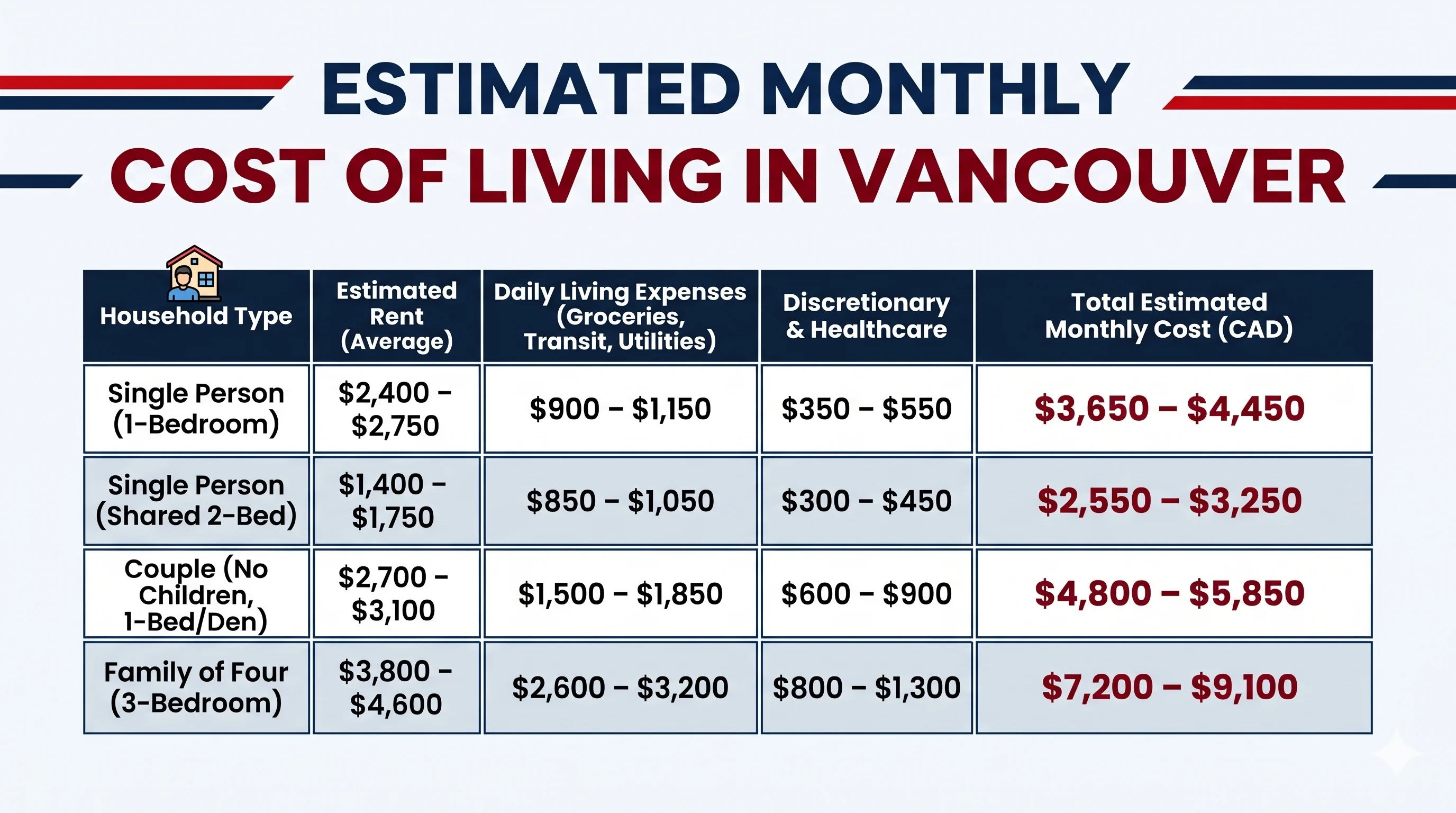
All monetary figures are in Canadian Dollars (CAD). Family estimates exclude full-time infant childcare, which requires separate budgeting.
2. Housing and Rent
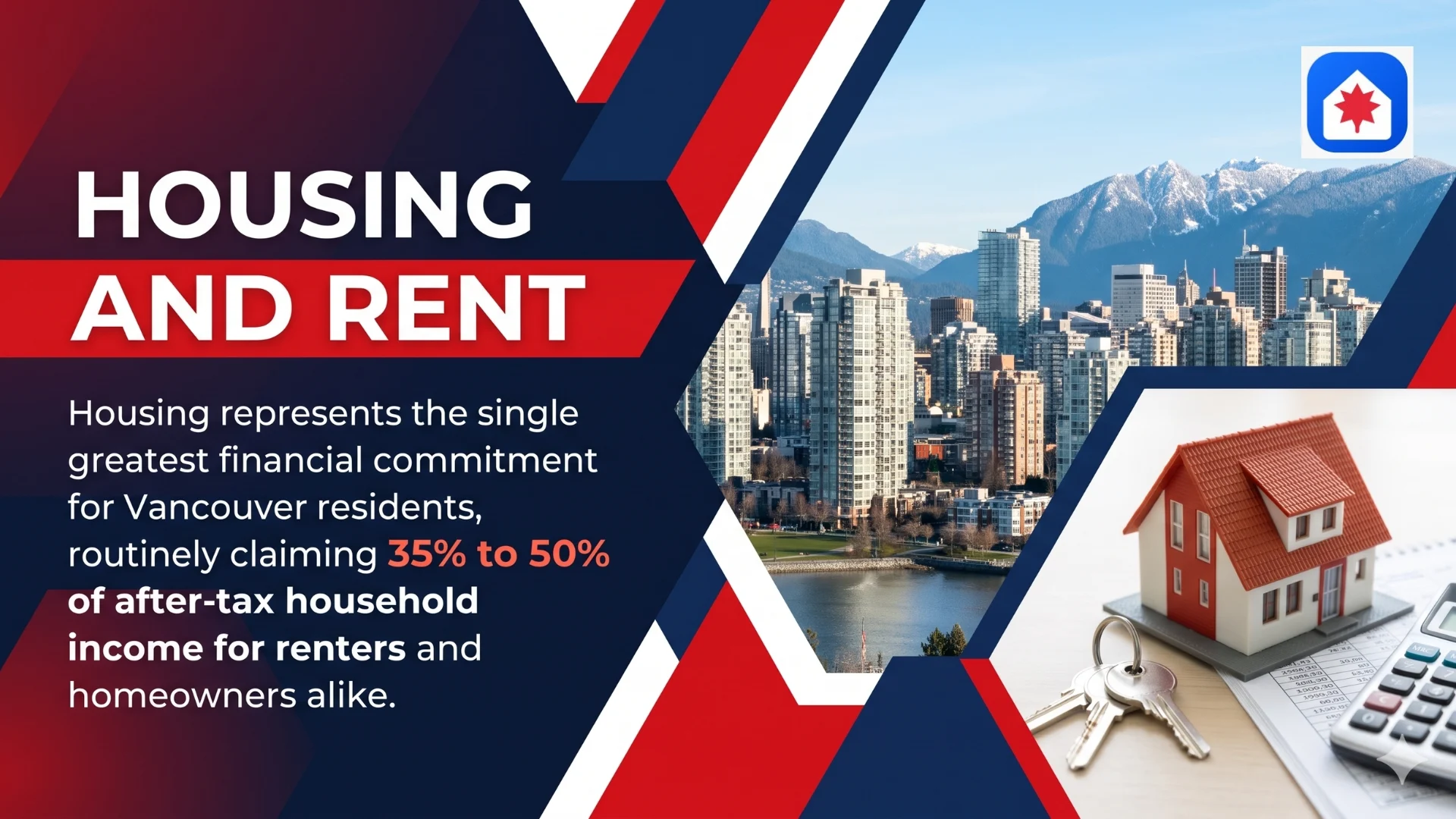
Housing represents the single greatest financial commitment for Vancouver residents, routinely claiming 35% to 50% of after-tax household income for renters and homeowners alike.
2.1. Average Rental Rates Across Metro Vancouver
Rental pricing shifts dramatically between the core downtown peninsula and outer suburban municipalities.
Downtown Vancouver & West End:
- 1-Bedroom Apartment: $2,550 - $2,850/month
- 2-Bedroom Apartment: $3,400 - $4,200/month
Mount Pleasant & East Vancouver (Commercial Drive, Main St.):
- 1-Bedroom Apartment: $2,350 - $2,600/month
- 2-Bedroom Apartment: $3,100 - $3,600/month
Burnaby & New Westminster (Centrally Located on SkyTrain):
- 1-Bedroom Apartment: $2,150 - $2,450/month
- 2-Bedroom Apartment: $2,800 - $3,300/month
Richmond (South of the Airport):
- 1-Bedroom Apartment: $2,100 - $2,400/month
- 2-Bedroom Apartment: $2,750 - $3,200/month
Surrey & Langley (Fraser Valley Suburban Core):
- 1-Bedroom Apartment: $1,800 - $2,100/month
- 2-Bedroom Apartment: $2,300 - $2,750/month
2.2. Housing Purchase Prices and Monthly Carrying Costs (CAD)
For residents evaluating homeownership, Metro Vancouver remains one of North America's highest-value real estate markets. Long-term affordability requires weighing both the initial purchase price and ongoing monthly carrying costs.
Current regional real estate benchmarks establish typical acquisition costs:
Condominium Apartments: $740,000 - $820,000 CAD
The standard entry point for first-time buyers. Entry-level units in outer suburbs like Surrey and Langley start around $520,000 to $580,000 CAD, while concrete units in Downtown Vancouver and Kitsilano routinely exceed $850,000 CAD.
Townhomes & Rowhouses: $1,050,000 - $1,150,000 CAD
A practical middle tier for growing families looking for multi-level floor plans, direct street access, and private attached garages in suburban centers.
Single-Family Detached Homes: $1,900,000 - $2,100,000+ CAD
The highest-cost segment, situated largely in outer suburban communities, Vancouver East residential pockets, and the North Shore.
Planning to buy instead of rent? Use the free mortgage and affordability calculators on CanadaHomeHub tools to calculate your required down payment and estimate exact monthly carrying costs before house-hunting.
3. Utilities, Internet, and Mobile Services
British Columbia's extensive hydroelectric grid, managed by BC Hydro, keeps basic electricity costs comparatively low compared with provinces heavily reliant on natural gas or fossil-fuel power.
3.1. BC Hydro and Heating Costs
- BC Hydro (Electricity): For a modern 600-800 sq. ft. condo unit, expect monthly electricity bills between $40 and $70. In older rental units equipped with baseboard electric heating during cold winter months, bills can spike to $100 - $140/month.
- Natural Gas (FortisBC): Detached homes and townhomes using natural gas for central heating or domestic hot water typically incur $80 to $160 per month, depending heavily on the season.
3.2. Telecom Plans: Internet and Mobile Data
- Home Fiber/Cable Internet (300 Mbps to 1 Gbps): Major carriers such as Telus and Shaw/Rogers charge between $75 and $110 per month. Smaller third-party resellers (e.g., Novus, Lightspeed, Oxio) frequently offer stable 100-300 Mbps packages starting at $45 to $65 per month.
- Mobile Phone Plan: A standard post-paid plan featuring unlimited Canada-wide calling and 30-50 GB of 5G data costs approximately $45 to $75 per month per line with major providers (Rogers, Bell, Telus) or flanker brands (Koodo, Fido, Virgin Plus).
4. Food and Grocery Costs
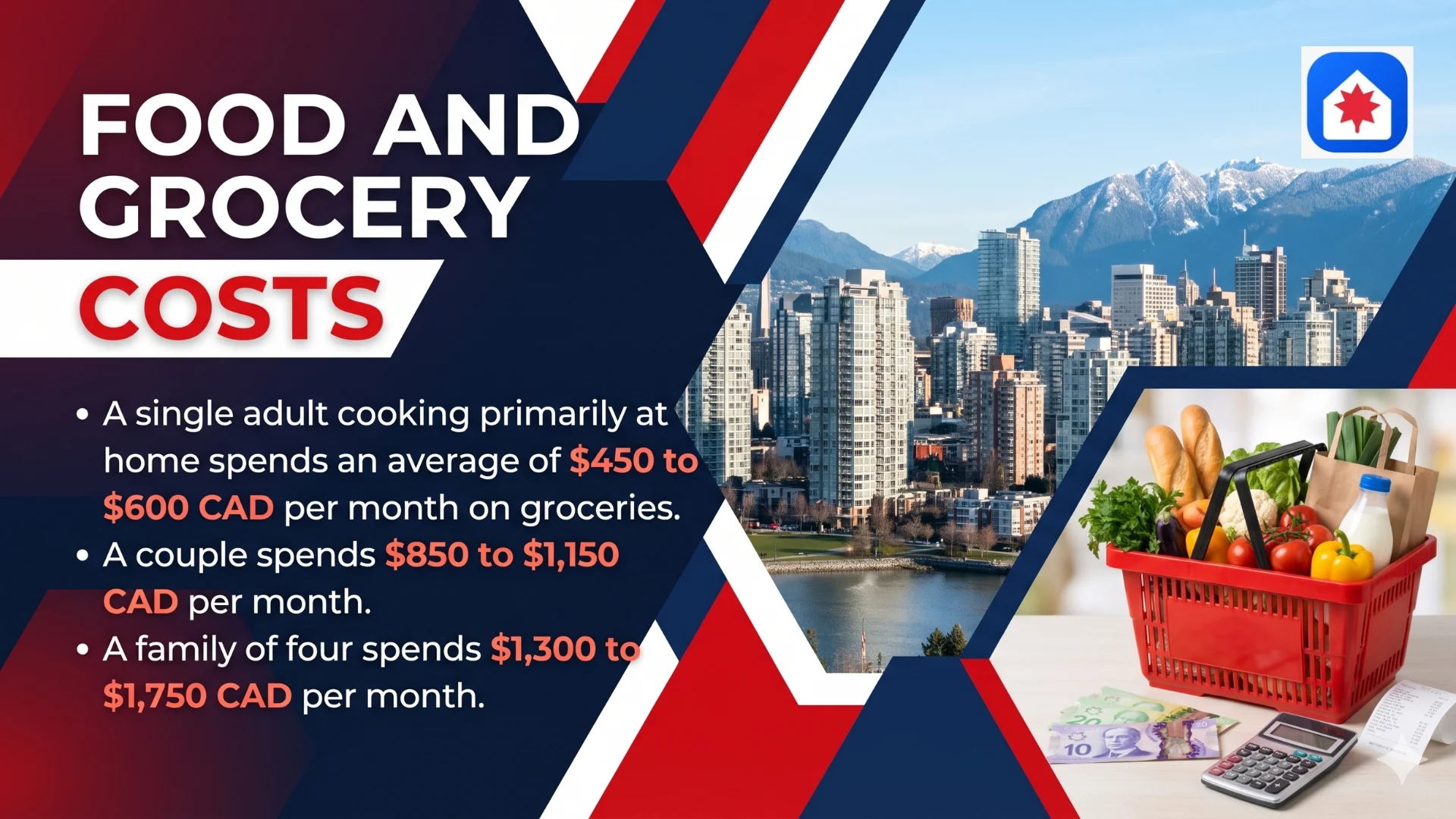
Food expenses in Vancouver represent the second-largest monthly expense after housing. A single adult cooking primarily at home spends an average of $450 to $600 CAD per month on groceries, a couple spends $850 to $1,150 CAD per month, and a family of four spends $1,300 to $1,750 CAD per month.
4.1. Vancouver Grocery Costs vs. Other Canadian Cities
Compared to other major Canadian metropolitan centers, Vancouver ranks among the most expensive markets for overall food spending:
- Vancouver vs. Toronto: Baseline supermarket costs are comparable. Toronto has slightly cheaper dairy and shelf-stable goods, while Vancouver offers lower prices on fresh produce and Asian groceries due to Pacific import channels. Total food costs differ by less than 2% to 3%.
- Vancouver vs. Calgary: Calgary benefits from cheaper domestic beef and local dairy distribution, making staple animal proteins lower in price. However, Vancouver offers lower off-season produce prices. Overall, grocery bills in Vancouver are roughly 5% to 8% higher than in Calgary.
- Vancouver vs. Montreal: Montreal remains significantly more affordable for food. Groceries and dining out in Montreal are approximately 10% to 15% cheaper than in Vancouver across virtually every category.
4.2. Average Prices for Essential Grocery Items (CAD)
Below are current average retail shelf prices for everyday household food essentials across Metro Vancouver supermarkets:
- Fresh Milk (2% or Whole, 4-liter jug): $5.85 - $6.60 CAD
- Whole-Wheat Bread (675g loaf): $3.50 - $4.50 CAD
- Large Eggs (Dozen, Grade A): $4.80 - $6.20 CAD
- Boneless, Skinless Chicken Breasts (1 kg): $16.00 - $19.50 CAD
- Lean Ground Beef (1 kg): $13.50 - $16.50 CAD
- White or Jasmine Rice (2 kg bag): $5.50 - $7.50 CAD (or $18.00 - $24.00 CAD for an 8 kg bulk bag)
- Potatoes (2.27 kg / 5 lb bag): $4.50 - $6.00 CAD
- Fresh Apples (Gala or McIntosh, 1 kg): $4.20 - $5.80 CAD
- Dry Pasta (900g package): $2.50 - $3.50 CAD
- Cheddar Cheese (400g block): $6.50 - $8.50 CAD
5. Transportation Costs
Transportation is another factor shaping the total monthly expenses Vancouver commuters face. Metro Vancouver maintains an integrated regional transportation network called TransLink, comprising the automated SkyTrain, SeaBus ferry services, West Coast Express commuter rail, and an extensive bus fleet.
5.1. Public Transit via TransLink
The TransLink system uses a reloadable contactless card known as the Compass Card. Bus trips count as a single zone across the entire region, whereas SkyTrain and SeaBus trips depend on how many zones you cross on weekdays before 6:30 PM.
- 1-Zone Monthly Pass (e.g., City of Vancouver only): $107.30/month
- 2-Zone Monthly Pass (e.g., Burnaby/Richmond to Downtown): $142.50/month
- 3-Zone Monthly Pass (e.g., Surrey, Tri-Cities, Langley to Downtown): $191.80/month
- Single Adult Fare (Stored Value Compass): $2.60 (1-Zone), $3.85 (2-Zone), $4.90 (3-Zone)
All travel across zones is automatically billed as 1-Zone on weekdays after 6:30 PM, weekends, and statutory holidays.
5.2. The True Cost of Driving in Vancouver
While public transit is efficient along major arterial corridors, owning a private vehicle provides necessary flexibility for families and outdoor enthusiasts heading into the Sea-to-Sky corridor or Fraser Valley. However, driving in Vancouver carries high fixed costs:
- Auto Insurance (ICBC): British Columbia operates under a public auto insurance model through the Insurance Corporation of British Columbia (ICBC). An experienced driver with a spotless record typically pays $150 to $230 per month for full basic and optional collision/comprehensive coverage. Newer drivers, young professionals, or those without verified driving history in Canada can expect rates between $250 and $350+ per month.
- Fuel Expenses: Vancouver consistently records some of the highest retail gasoline prices in North America due to regional transit surcharges and provincial carbon levies. Fuel prices frequently range between $1.65 and $2.05 per liter. A commuter driving 1,200 km monthly can expect fuel expenditures of $180 to $260/month.
- Parking: Monthly designated stall rentals in residential strata towers in Downtown Vancouver cost between $100 and $250/month. Daily street parking and commercial lots range from $3.50 to $7.00 per hour.
6. Healthcare, Childcare, and Miscellaneous Everyday Expenses
Beyond rent, food, and transit, the cost of living Vancouver involves recurring personal care, health coverage, and family costs. Below are the typical prices for these categories.
6.1. Healthcare Expenses
BC Medical Services Plan (MSP): $0 CAD
British Columbia does not charge monthly health premiums. Basic doctor visits, walk-in clinic consultations, diagnostic tests, and emergency hospital services are fully covered for eligible residents, work permit holders, and study permit holders.
Private Extended Health Insurance: $80 - $160 CAD/month (per person)
Required for coverage not included under basic MSP (routine dental, vision, prescription drugs, and physiotherapy). If provided through an employer, typical employee payroll co-pays run from $0 to $50 CAD/month.
Out-of-Pocket Medical Fees (Without Extended Insurance):
- Routine dental cleaning and checkup: $160 - $260 CAD
- Optometry eye exam: $90 - $140 CAD
- Physiotherapy or chiropractic session: $95 - $140 CAD per visit
- Pharmacy dispensing fee: $10 - $14 CAD per prescription (excluding medication cost)
6.2. Childcare Expenses
Licensed Infant & Toddler Care (Under 3 years old):
- Standard licensed centers: $1,000 - $1,600 CAD/month
- Unsubsidized private centers in urban cores: $1,600 - $1,850+ CAD/month
- Subsidized "$10-a-day" spaces (long waitlists): ~$200 - $250 CAD/month
Preschool-Age Care (3 years to Kindergarten): $750 - $1,200 CAD/month
- Rates reflect standard provider discounts under the BC Child Care Fee Reduction Initiative.
Before-and-After School Care: $400 - $650 CAD/month
- Supervision for public school children outside of standard class hours (8:00-9:00 AM and 3:00-5:30 PM).
Private Nanny: $20 - $26 CAD/hour
- Market hourly rate for a qualified in-home caregiver.
6.3. Miscellaneous Everyday Expenses
Fitness & Memberships:
- City of Vancouver Community Centre drop-in: $7.50 - $9.00 CAD (or $55 - $62 CAD/month pass for access to municipal gyms, rinks, and pools)
- Commercial fitness chains (Club16, Anytime Fitness, Fitness World): $40 - $75 CAD/month
- Boutique studio class (Yoga, Pilates, Spin): $25 - $35 CAD per single drop-in class
Personal Care & Grooming:
- Men’s basic haircut: $30 - $50 CAD (before tip)
- Women’s haircut and blow-dry: $65 - $130+ CAD (before tip)
Entertainment & Leisure:
- Adult general admission movie ticket: $16 - $21 CAD
- Major concert or NHL Vancouver Canucks game ticket: $85 - $220+ CAD per standard seat

7. What Salary Is Needed to Live in Vancouver Comfortably?
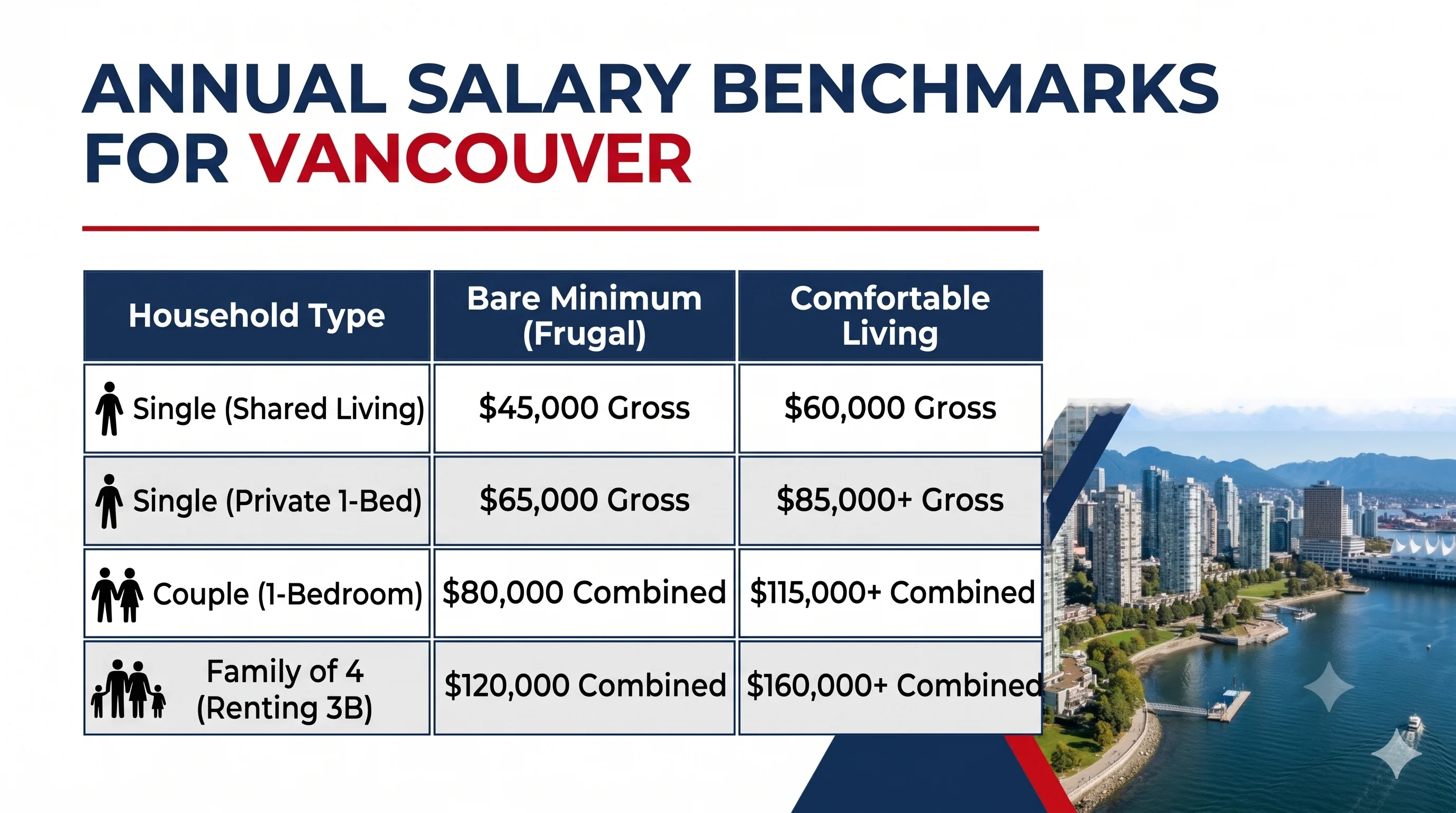
The term "comfortable" implies paying rent without financial strain, setting aside 15% to 20% into savings or investments (TFSA/RRSP), dining out occasionally, and maintaining an emergency fund.
7.1. Single Individual Living Alone
- Minimum Feasible Salary: 65,000 CAD gross (3,900 net/month). This income covers an average 1-bedroom apartment ($2,400), transit ($110), basic groceries ($450), phone/internet ($120), and modest discretionary spending, with little leftover for long-term investments.
- Comfortable Salary: $85,000 - 95,000 CAD gross (5,200 - $5,700 net/month). This tier permits comfortable personal savings, seasonal travel, gym memberships, and the ability to weather rent increases.
7.2. Dual-Income Couple Without Children
Comfortable Combined Salary: $115,000 - $140,000 CAD gross. Splitting a 1-bedroom or 2-bedroom rental drastically reduces per-person housing costs, allowing a dual-income household to build a substantial down payment for future homeownership.
7.3. Family of Four (Two Adults, Two School-Age Children)
Comfortable Combined Salary: $150,000 - $180,000+ CAD gross. A larger 3-bedroom apartment or suburban townhouse, coupled with school activities, family vehicle insurance, and higher grocery volume, requires a minimum net household income of approximately $8,000 to $9,500 monthly.
Frequently Asked Questions
1. Is Vancouver more expensive than Toronto?
When comparing the cost of living Toronto with Vancouver, the two urban centers trade places frequently as Canada’s most expensive city. While Toronto typically commands slightly higher average corporate salaries and comparable rental rates, Vancouver features higher fuel taxes, higher grocery costs, and elevated baseline real estate purchase prices per square foot. Overall, day-to-day purchasing power is remarkably comparable between the two urban hubs.
2. Can I live comfortably in Vancouver on a $60,000 salary?
A $60,000 gross annual salary provides approximately $3,900 in monthly net take-home pay. If you rent your own private 1-bedroom apartment downtown ($2,400+), housing alone will consume over 60% of your take-home pay, leaving your budget vulnerable. However, living with a roommate or renting a basement suite along the suburban SkyTrain line ($1,400-$1,700 CAD) makes managing the cost of living Vancouver on $60,000 CAD fully secure.
3. How much do groceries cost per month for one person in Vancouver?
An adult purchasing balanced groceries from standard supermarkets (Superstore, No Frills, local grocers) will spend approximately $450 to $600 per month. Prioritizing premium specialty grocers or frequently ordering meal-prep deliveries can quickly push that figure above $750 monthly.
4. How much does car insurance cost per month in Vancouver?
Through ICBC, experienced drivers with clean driving records typically pay $150 to $230 per month for full personal vehicle coverage. Rates rise significantly for novice drivers, luxury vehicles, or individuals lacking recognized prior driving history within North America.
5. Which neighborhoods in Metro Vancouver offer the best balance of affordability and transit access?
Burnaby (Metrotown, Brentwood, Lougheed), New Westminster, and East Vancouver offer an outstanding balance. They feature extensive commercial amenities, walking proximity to rapid transit stations, and rental prices that are typically 15% to 25% lower than Downtown core residences.
Living in Vancouver comes with a high price tag, especially when it comes to housing, but the city also offers plenty of ways to make the most of your budget. Taking advantage of public transit, enjoying free outdoor activities, and choosing a home that fits your needs can help balance everyday expenses with a high quality of life. Understanding the cost of living Vancouver residents face allows you to plan your finances more effectively and decide whether the city fits your budget and lifestyle. With realistic expectations and thoughtful spending, you can enjoy what Vancouver has to offer without putting unnecessary pressure on your finances.
Thank you for taking the time to read this article.
For more information, please contact us at CANADAHOMEHUB.