Moving to or living in Toronto offers undeniable perks, such as a thriving job market, world-class cultural institutions, and safe communities. However, as Canada’s financial engine, Ontario’s capital is also well known for carrying one of the highest price tags in North America. Understanding the cost of living Toronto, from housing and groceries to transit passes and municipal utilities, can mean the difference between thriving in the city and feeling constantly pinched. In this detailed guide, we break down average living expenses across key categories, illustrate sample monthly budgets, and analyze the salary you truly need to live comfortably in Toronto.
1. How Expensive Is Living in Toronto?
Toronto routinely ranks alongside Vancouver as Canada’s most expensive metropolitan area. While high wages in finance, technology, healthcare, and creative industries attract talent worldwide, high shelter costs and broad inflation have driven everyday expenses upward.
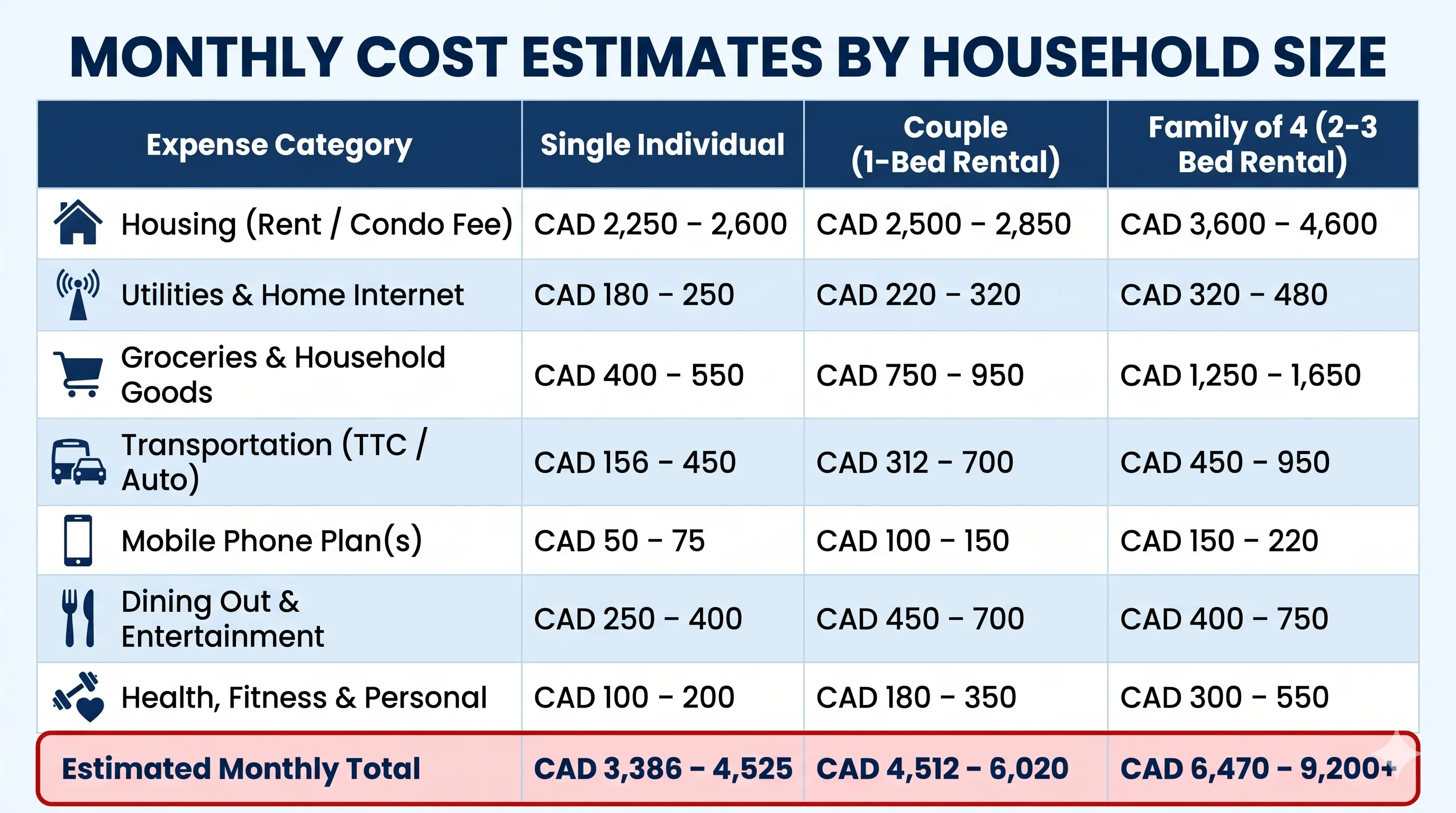
For a single working adult renting independently, baseline living expenses typically sit between CAD 3,200 and CAD 4,100 per month. For a dual-income couple sharing a one- or two-bedroom apartment, combined monthly expenditures average CAD 4,800 to CAD 6,200. A family of four with children in daycare or extracurriculars generally faces monthly costs ranging from CAD 7,500 to CAD 9,800 or more, depending heavily on childcare arrangements and housing style.
2. Housing and Accommodation: Toronto’s Biggest Expense
Housing represents the single largest factor driving up the cost of living Toronto renters experience each month. Most financial advisors recommend spending no more than 30% of your gross income on housing; however, in the GTA, many residents allocate between 40% and 50% of their net pay toward rent or mortgage payments.
2.1. Average Rental Prices Across the GTA
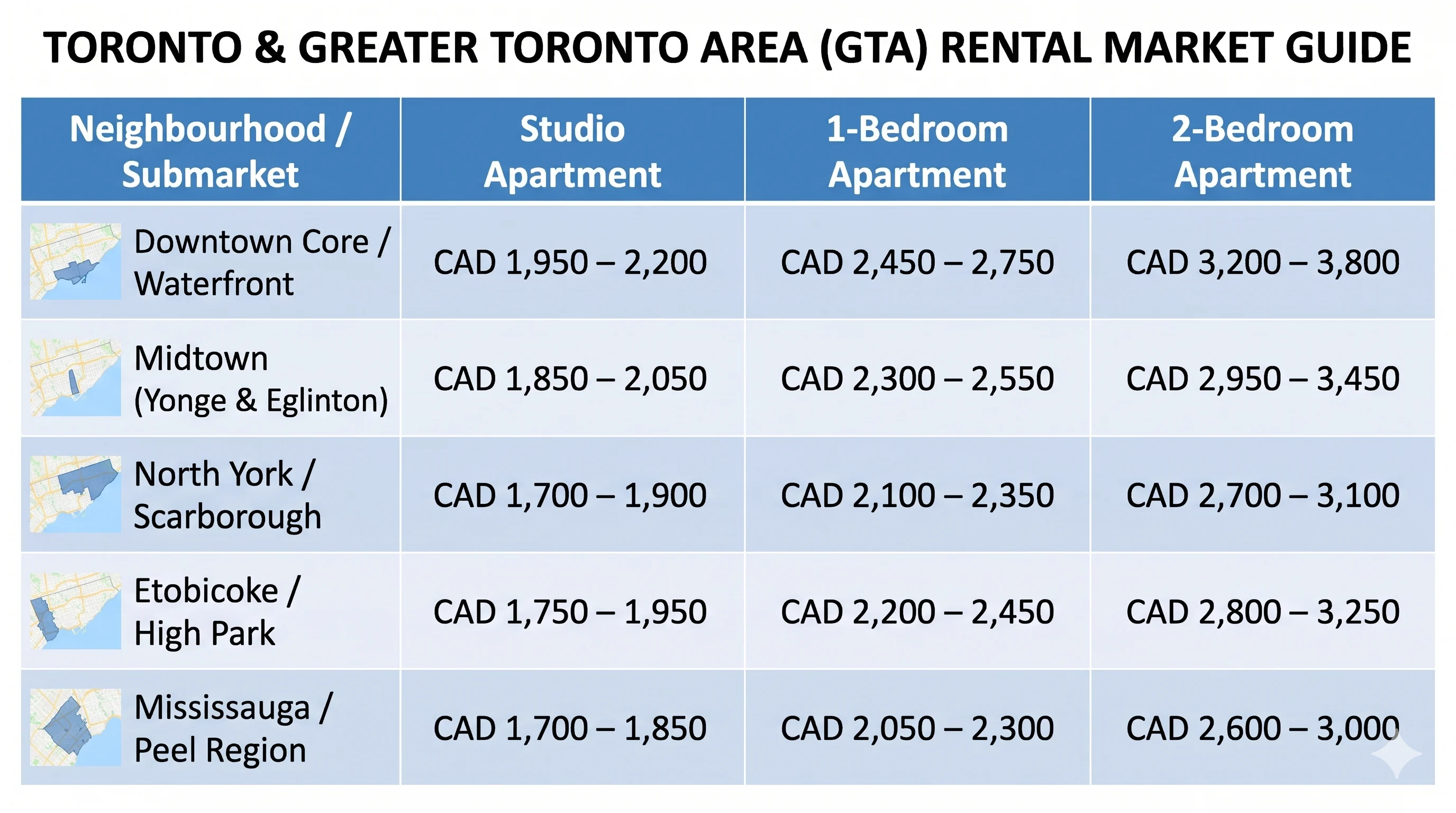
When looking to rent in Toronto, pricing varies noticeably between downtown high-rise condominiums and peripheral suburban communities. While living downtown within walking distance of Union Station or the Financial District carries a steep premium, outer boroughs often provide more square footage for a comparable price.
If you are planning a move and want to better understand the broader property landscape, exploring Canadian housing and real estate information on CanadaHomeHub.Ca provides helpful context on local market trends and accommodation across different provinces.
2.2. Renting vs. Buying: Upfront and Ongoing Costs
For prospective homebuyers, the Toronto real estate market presents a substantial hurdle. The benchmark price for a detached home in the city consistently exceeds CAD 1.4 million, while two-bedroom condominiums often hover between CAD 700,000 and CAD 900,000.
Purchasing requires:
- A Down Payment: Minimum 20% down for properties over CAD 1,000,000 (or tiered from 5% to 10% on properties below that threshold).
- Double Land Transfer Tax: Buyers purchasing within the City of Toronto boundary must pay both the Ontario Provincial Land Transfer Tax and the Toronto Municipal Land Transfer Tax, adding tens of thousands in closing expenses.
- Ongoing Carrying Costs: Condo maintenance fees (450–900+/month), annual municipal property taxes (roughly 0.65% to 0.70% of assessed value), and home insurance.
3. Utilities, Telecom, and Internet Costs
Unless utilities are bundled into your lease agreement, which is rare in newer condominiums, monthly bills add a predictable baseline to your overall cost of living Toronto.
3.1. Electricity, Heating, and Water Bills
- Electricity: In a standard 600-to-800-sq-ft one-bedroom condo, electricity generally runs between CAD 60 and CAD 110 per month.
- Natural Gas / Heating: If you rent or own a townhouse or detached home where heating runs on natural gas, monthly winter bills range from CAD 120 to CAD 220, dropping significantly during warmer seasons.
- Water, Sewage, and Garbage: Homeowners pay utility fees directly to the City of Toronto, typically 80–140/month. Most apartment and condo tenants have this cost folded into the landlord's maintenance fees.
3.2. Home Internet and Canadian Mobile Plans
Historically, Canada has had some of the highest telecommunication rates among developed nations. While regional competition has introduced better promotional offers, you should budget realistic sums:
- Home Fibre/Cable Internet: Unlimited high-speed broadband (150 Mbps to 1.5 Gbps) via major carriers like Rogers, Bell, or discount providers (TekSavvy, Fido, Virgin Plus) costs roughly CAD 65 to CAD 95 per month.
- Mobile Cellular Plans: A postpaid cell plan with 20GB to 50GB of 5G data typically costs CAD 45 to CAD 70 per month per line, excluding the hardware financing cost of a new smartphone.
4. Food and Grocery Expenses in the City
Grocery bills in Toronto have witnessed notable upward pressure in recent years, making strategic meal planning essential for budget-conscious urbanites.
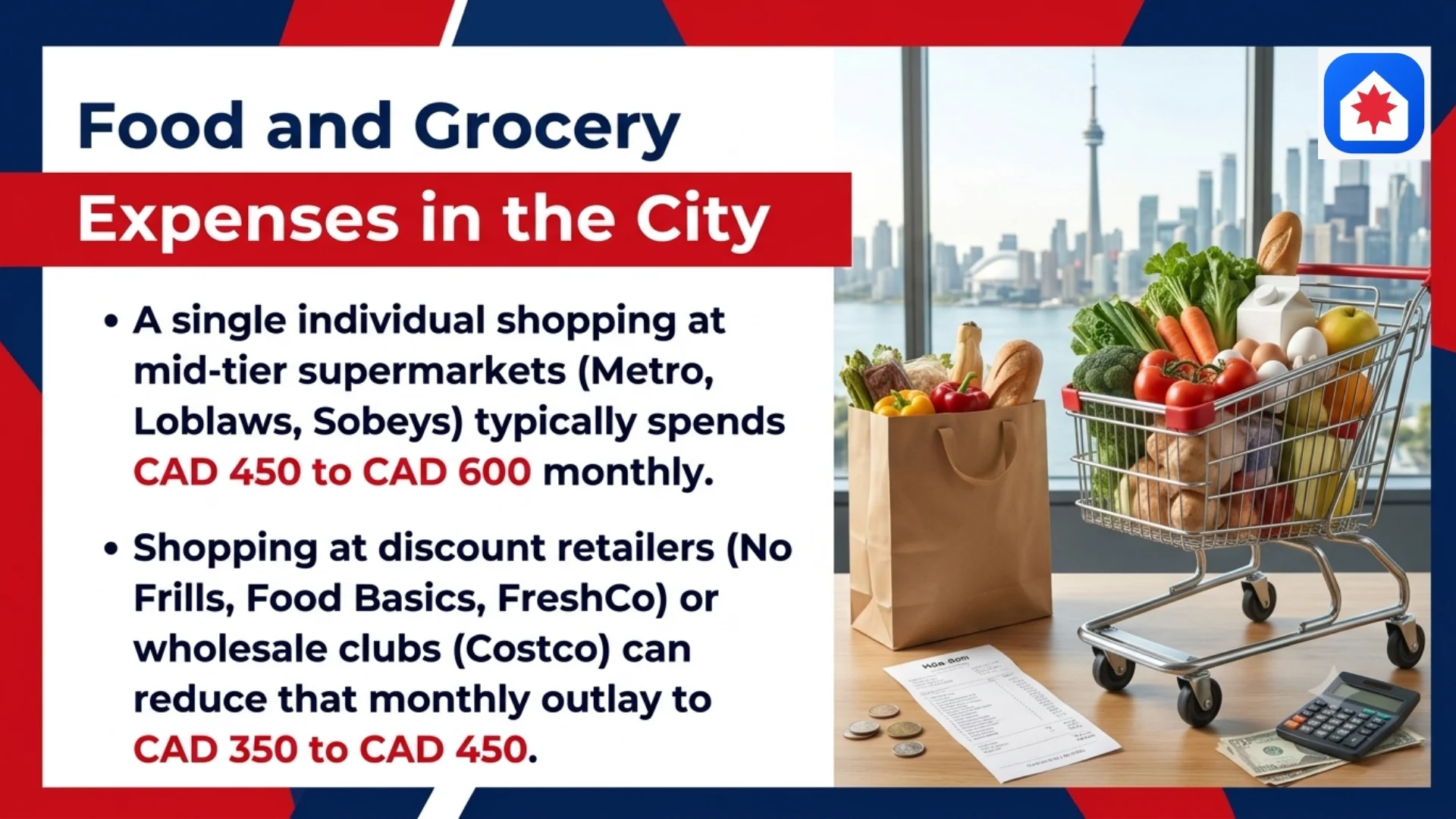
A single individual shopping at mid-tier supermarkets (Metro, Loblaws, Sobeys) typically spends CAD 450 to CAD 600 monthly. Shopping at discount retailers (No Frills, Food Basics, FreshCo) or wholesale clubs (Costco) can reduce that monthly outlay to CAD 350 to CAD 450.
In addition, budgeting for social dining requires conscious boundaries:
- Coffee & Pastry: An oat milk latte or flat white at an independent downtown cafe costs CAD 5.50 to CAD 7.00.
- Casual Lunch / Fast-Casual: A poke bowl, shawarma platter, or sandwich in the PATH or downtown food hall ranges from CAD 16 to CAD 22.
- Mid-Range Dinner for Two: A three-course meal at a neighborhood restaurant with a glass of wine or craft beer averages CAD 110 to CAD 180, inclusive of Ontario's 13% Harmonized Sales Tax (HST) and a customary 15% to 18% gratuity.
- Delivery Apps (Uber Eats, DoorDash): Delivery fees, service surcharges, and driver tips easily inflate an order by 30% to 45% compared to direct pickup.
5. Transportation: Getting Around Toronto
How you commute significantly dictates your discretionary cash flow. Whether you rely on the city's public transit network or take on the expenses of owning a car, commuting is often one of your largest recurring living costs.
5.1. Public Transit: TTC Fares and PRESTO
The Toronto Transit Commission (TTC) operates subways, streetcars, and buses across the municipal boundary.
- Single Adult Fare: CAD 3.35 using a contactless PRESTO card, credit card, debit card, or PRESTO in mobile wallets.
- TTC Monthly Pass: Cost is CAD 156.00 for an adult pass. Commuters taking more than 47 one-way trips per month benefit financially from purchasing the pass.
- Ontario One Fare Program: Commuters transferring between the TTC and regional transit systems like GO Transit, MiWay, Brampton Transit, and York Region Transit (YRT) only pay the single transit agency fare, eliminating double-fare penalties across municipal borders.
5.2. The Real Cost of Car Ownership in Ontario
Maintaining a passenger vehicle in Toronto is notoriously costly, largely driven by Ontario’s elevated private auto insurance rates.
- Car Insurance: Average rates in Toronto range from CAD 180 to CAD 320 per month, with rates climbing higher for new drivers, younger motorists, or residents living in select postal codes in Scarborough, North York, or Brampton.
- Fuel: Gasoline averages between CAD 1.45 and CAD 1.75 per litre, depending on seasonal refining adjustments and global crude pricing.
- Downtown Parking: A reserved condo parking stall typically rents for CAD 150 to CAD 275 per month. Commercial municipal lots (Green P) charge daily rates between CAD 15 and CAD 30.
- Maintenance & Wear: Budgeting roughly CAD 100 to CAD 150 monthly for seasonal tire swaps, oil changes, and annual maintenance is standard practice.
Overall, operating a vehicle in Toronto adds CAD 550 to CAD 900+ per month over and above any monthly vehicle financing or lease payment.
6. Healthcare, Childcare, and Lifestyle Expenses

6.1. OHIP Coverage and Supplemental Health Insurance
Permanent residents, Canadian citizens, and eligible full-time foreign workers on qualifying permits receive core medical coverage under the Ontario Health Insurance Plan (OHIP). OHIP covers physician consultations, emergency hospital visits, and diagnostic testing at zero out-of-pocket cost.
However, OHIP does not cover:
- Routine adult dental cleanings and restorations (CAD 180 - 350 per visit).
- Prescription medications for working adults under age 65 (unless covered through special programs).
- Optometry exams and prescription eyeglasses.
- Physiotherapy, massage therapy, and mental health therapy (CAD 120 - 220 per session).
6.2. Childcare and Early Learning Costs
While Canada’s national CAD 10-a-day childcare program (Canada-Wide Early Learning and Child Care - CWELCC) continues to expand, waitlists for subsidized spots across Toronto remain extensive.
- Subsidized CWELCC Spaces: Where accessible, daily rates for children under age six sit between CAD 20 and CAD 35 per day (roughly 450–750/month).
- Non-Subsidized Private Daycare: Full-time private infant and toddler care frequently costs between CAD 1,200 and CAD 1,850 per month.
- Before & After School Care: For school-age children, public school extended programs average CAD 350 to CAD 550 per month.
6.3. Fitness, Entertainment, and Discretionary Spending
Maintaining a balanced lifestyle in the city involves standard recurring personal costs:
- Gym Memberships: Budget gym chains (Planet Fitness, Fit4Less) run CAD 15 to CAD 30 per month. Full-service facilities (GoodLife Fitness, YMCA) cost CAD 65 to CAD 95 monthly, while specialized boutique fitness and Pilates studios command CAD 180 to CAD 280 monthly.
- Entertainment & Culture: Movie tickets run roughly 16-19 CAD. Admission to major attractions like the Royal Ontario Museum (ROM), Ripley’s Aquarium, or the Art Gallery of Ontario (AGO) costs 25–45 CAD per adult ticket.
7. What Salary Do You Need to Live Comfortably in Toronto?
Having established baseline expenditures, the natural question follows: how much income must you earn before taxes to comfortably sustain this standard of living? Identifying the true salary needed to live in Toronto requires comparing statutory minimums against actual urban cost-of-living benchmarks.
7.1. Minimum Wage vs. Toronto Living Wage
- Ontario Minimum Wage: Ontario's statutory minimum wage sits at CAD 17.20 per hour (as of October 2024, subject to standard provincial indexation). A full-time worker logging 37.5 hours per week at minimum wage earns approximately CAD 33,540 gross annually, leaving an estimated take-home net income of roughly CAD 2,250 per month. In Toronto, this falls significantly short of the funds required to rent a private self-contained apartment.
- The Toronto Living Wage: Calculated annually by the Ontario Living Wage Network (OLWN), the living wage represents the hourly earnings required for full-time workers to cover actual living expenses in their region. The calculated living wage for the Greater Toronto Area hovers at over CAD 25.00 per hour (approximately CAD 48,750 gross annually) merely to meet subsistence living with shared housing or strict budgeting.
7.2. Realistic Income Benchmarks
To avoid living paycheck to paycheck against the elevated cost of living Toronto is known for, consider these target income brackets based on your lifestyle profile:
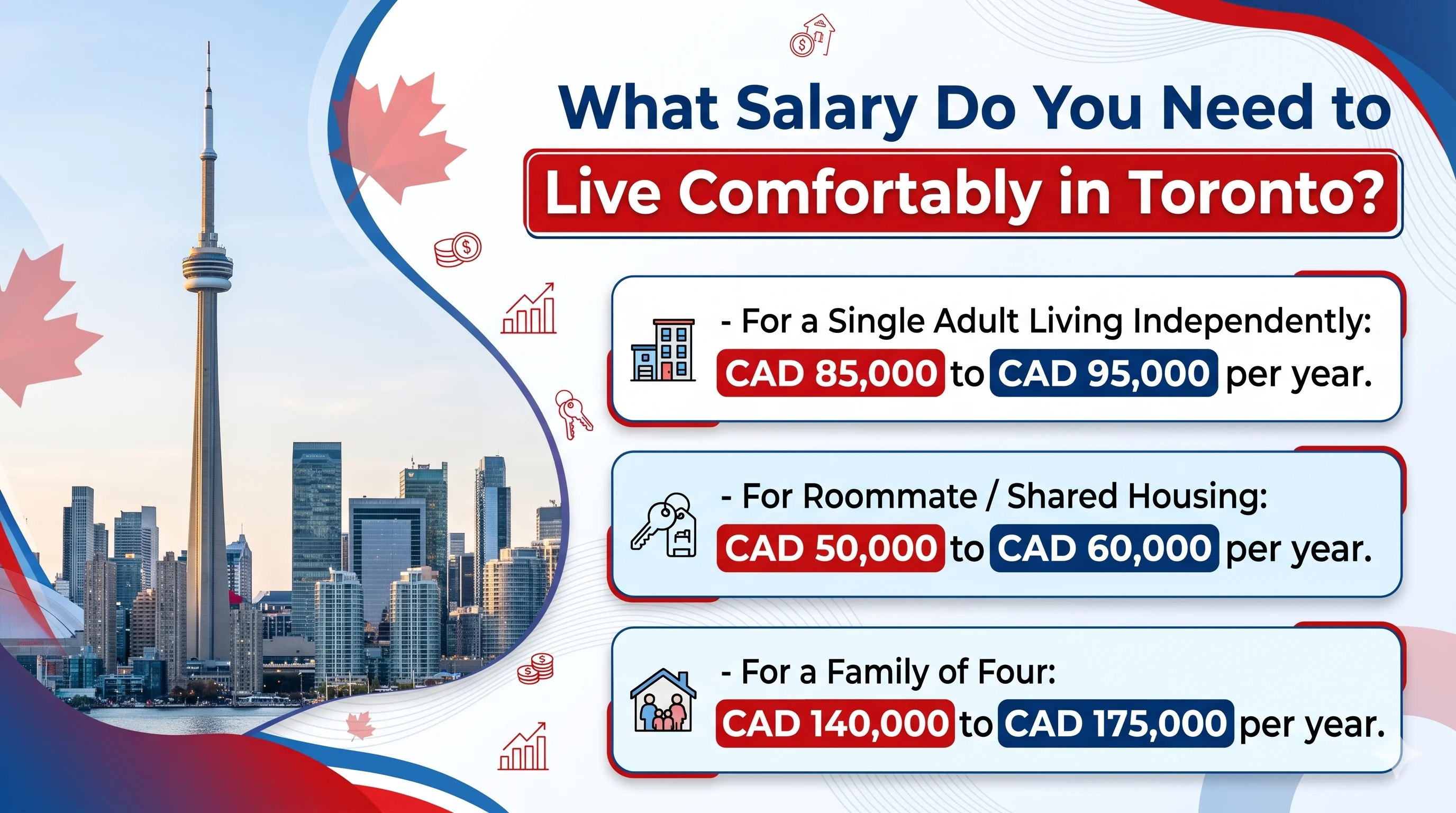
- For a Single Adult Living Independently: To comfortably afford a median one-bedroom apartment CAD 2,400/month), allocate 30% of gross pay to rent, cover standard expenses, and maintain personal savings; a gross individual salary of CAD 85,000 to CAD 95,000 per year is strongly recommended.
- For Roommate / Shared Housing: Individuals earning between CAD 50,000 and CAD 60,000 per year can live comfortably in Toronto if they share rental expenses with one or two roommates.
- For a Family of Four: A combined gross household income of CAD 140,000 to CAD 175,000 per year is generally necessary to manage a multi-bedroom home, vehicle operation, and family recreation.
To avoid living paycheck to paycheck against the elevated cost of living Toronto is known for, maintaining a safe shelter-to-income ratio is critical. If you want to estimate what kind of home matches your specific income and monthly obligations, using CanadaHomeHub’s affordability calculator can help you determine a realistic housing budget before you begin searching.
8. Practical Ways to Lower Your Monthly Expenses in Toronto
While living in Toronto requires discipline, practical strategies can materially decrease your monthly burn rate:
- Select Locations Along Transit Corridors: Choosing housing along transit corridors (e.g., Line 1, Line 2, or GO Transit rail links) in Etobicoke, Scarborough, or East York often yields 15% to 25% lower rent compared to the downtown core, without necessitating a private vehicle.
- Rethink Vehicle Ownership: Eliminating a private car saves between CAD 6,000 and CAD 10,000 net per year. Pairing a TTC monthly pass with car-share programs (like Enterprise CarShare or Zipcar) for weekend trips provides mobility without monthly insurance and parking fees.
- Audit Telecom and Internet Annually: Don't hesitate to negotiate promotional rates with internet service providers or switch to flanker telecom brands (such as Koodo, Fido, or Public Mobile) that offer budget-friendly data packages.
- Embrace Discount Grocers and Ethnic Markets: Shopping at independent green grocers in Chinatown, Kensington Market, or Little India, along with discount supermarkets like No Frills, routinely saves CAD 100 to CAD 200 per month on household produce and dry pantry goods.
- Leverage Free Cultural Access: The Toronto Public Library (TPL) is one of the world's most robust public library systems. Through TPL's Museum + Arts Pass (MAP) program, cardholders can reserve free admission passes to premier Toronto venues, including the ROM, Toronto Zoo, and Ontario Science Centre.
Frequently Asked Questions
1. How much money do I need to move to Toronto initially?
You should plan to arrive with at least three to four months’ worth of living expenses in liquid savings. Because Ontario landlords require first and last month’s rent upon signing a lease, upfront shelter acquisition alone requires CAD 4,500 to CAD 5,500. Factoring in moving logistics, utility connection fees, groceries, and basic furnishings, a baseline cushion of CAD 8,000 to CAD 12,000 is advisable for a solo newcomer.
2. Why is car insurance so expensive in Toronto?
Ontario operates under a private auto insurance framework combined with mandatory statutory accident benefits. Elevated collision rates in heavy traffic corridors, higher incidents of vehicle theft, and medical compensation claims in urban areas lead insurers to assign higher risk profiles to the GTA, particularly in postal codes located in Scarborough and North York.
3. Are utilities usually included in Toronto rent?
In older purpose-built rental apartments constructed before 1990, heat and water are frequently included in the base rent, with hydro (electricity) occasionally billed separately. However, in newer condominium buildings (condo rentals), tenants are almost universally responsible for setting up their own electricity accounts, as well as home internet and occasional hot water tank or heat pump rental fees.
4. What is the average cost of groceries per month for one person in Toronto?
A realistic grocery budget for a single adult ranges between CAD 400 and CAD 550 per month. Achieving the lower end of this bracket requires preparing meals at home, purchasing seasonal produce, and frequenting discount supermarket chains.
5. Can a couple live comfortably on CAD 100,000 combined income in Toronto?
Yes. A combined gross household income of CAD 100,000 yields approximately CAD 6,100 to CAD 6,300 in net monthly take-home pay. With a shared one-bedroom apartment costing around CAD 2,500, a couple can easily cover rent, utilities, food, public transit, and casual dining, while still retaining CAD 1,000 to CAD 1,500 monthly for investments, emergency savings, and leisure travel.
There is no sugarcoating the reality: the cost of living Toronto requires meticulous budgeting and realistic expectations about personal space. Yet despite high rental rates and everyday expenses, Toronto remains the premier economic and cultural hub of Canada. By establishing an accurate budget, prioritizing your primary spending categories, and choosing your living arrangements strategically, you can successfully balance personal aspirations with financial stability in Canada’s dynamic metropolis.
Thank you for taking the time to read this article.
For more information, please contact us at CANADAHOMEHUB.