
When planning to save and invest in Canada, choosing the right account can significantly affect how much tax you pay and how easily you can access your money in the future. TFSA and RRSP accounts are both popular options, but each has different rules for contributions, taxes, and withdrawals. So, TFSA vs RRSP: what are the main differences? Which account should you prioritize? This guide explains each option and helps you choose a savings strategy that fits your financial situation.
1. TFSA
1.1. What Is a TFSA?

TFSA stands for Tax-Free Savings Account. Introduced by the Canadian government to encourage saving and investing, it allows eligible Canadians to work toward different financial goals. The main advantage of a TFSA is that contributions are not tax-deductible, but eligible investment earnings and withdrawals are generally tax-free. In other words, contributing to a TFSA does not reduce your taxable income, but you generally do not pay income tax on interest, dividends, or capital gains earned within the account, subject to applicable rules.
A TFSA Canada is not limited to cash. Depending on your financial institution and account type, you may be able to hold eligible savings and investments such as:
- Cash and interest-bearing savings accounts.
- Guaranteed Investment Certificates (GICs).
- Stocks and exchange-traded funds (ETFs).
- Other eligible investment funds.
This flexibility makes a TFSA useful for a range of goals, including building an emergency fund, saving for home buying in Canada, preparing for a major expense, or investing for the long term to supplement retirement income. However, investing still involves risk. A TFSA does not guarantee investment returns or protect you from losses.
1.2. TFSA Contribution Limit
The annual TFSA contribution limit for 2026 is CAD 7,000. However, this is the annual limit, not necessarily the maximum amount each person can contribute during the year. Your actual TFSA contribution room also depends on unused room from previous years, your past contributions, and withdrawals made in the previous year.
To determine how much you can contribute, consider three main factors:
- Current-year limit: In 2026, eligible individuals receive an additional CAD 7,000 in TFSA contribution room.
- Unused contribution room: Any room you did not use in previous years can generally be carried forward.
- Withdrawals from the previous year: Amounts withdrawn from your TFSA in 2025 are added back to your contribution room on January 1, 2026. Withdrawals made in 2026 are generally added back on January 1, 2027.
For example, suppose you have CAD 5,000 in unused contribution room at the beginning of 2026, made no withdrawals in 2025, and have not contributed to your TFSA in 2026. Your available contribution room would be:
- Unused contribution room: CAD 5,000
- New 2026 contribution room: CAD 7,000
- Total available contribution room: CAD 12,000
You should also avoid contributing more than your available limit. Under Canada Revenue Agency (CRA) rules, excess TFSA contributions may be subject to a 1% tax per month for as long as the excess amount remains in the account.
1.3. TFSA Withdrawal Rules
One major advantage of a TFSA Canada is that you can generally withdraw money when needed without paying income tax on the withdrawal. There are also no restrictions on how you use the money, so you can put it toward unexpected expenses, a major purchase, or personal financial goals. However, the amount you withdraw does not immediately become new contribution room.
Under the rules, withdrawn amounts are generally added back to your TFSA contribution room on January 1 of the following year. This is especially important if you plan to withdraw money and contribute it again within the same year.
For example, suppose you have used all your available TFSA contribution room for 2026. You then withdraw CAD 3,000 to cover an expense. If you contribute that CAD 3,000 back into your TFSA during 2026, you could exceed your limit because the withdrawn amount has not yet been added back. If you have no unused contribution room, you should generally wait until January 1, 2027, to contribute that amount again.
2. RRSP
2.1. What Is an RRSP?

RRSP stands for Registered Retirement Savings Plan. It is a registered retirement savings plan in Canada that allows individuals to contribute money and invest in eligible assets, such as investment funds, stocks, or savings products offered by financial institutions. The main advantage of an RRSP is that eligible contributions can be deducted when calculating taxable income. If you contribute to an RRSP Canada and claim the deduction according to the applicable rules, your taxable income may be reduced. The actual tax benefit depends on your income, tax rate, and the amount you are eligible to deduct. Investment earnings within an RRSP are generally not taxed while they remain in the account. However, when you withdraw money, the amount is usually included in your taxable income for that year.
For example, if you contribute CAD 5,000 to an RRSP and are eligible to deduct the full amount, your taxable income may be reduced by CAD 5,000. This does not mean you will receive a CAD 5,000 tax refund. The amount of tax you save depends on your applicable tax rate.
2.2. RRSP Contribution Limit
Unlike a TFSA, the RRSP contribution limit is based on your income and individual retirement savings circumstances. For 2026, the maximum RRSP contribution limit under federal rules is CAD 33,810. However, not everyone can contribute the maximum amount.
Your personal RRSP contribution room is typically determined by the following factors:
- Previous-year earned income: New contribution room is generally based on 18% of your earned income from the previous year, up to the applicable annual maximum.
- Unused contribution room: Any unused room from previous years can generally be carried forward.
- Pension adjustment: If you participate in certain employer-sponsored pension plans, a pension adjustment may reduce the amount of new RRSP room you accumulate.
Therefore, although the maximum limit for 2026 is CAD 33,810, your actual contribution room may be lower. It may also be higher than your new annual limit if you have unused room from previous years.
For example, suppose your personal RRSP contribution limit for 2026 is CAD 12,000, and you have CAD 3,000 in unused contribution room from previous years. If you have not made any contributions during the year, your total available contribution room would be:
- 2026 RRSP contribution limit: CAD 12,000
- Unused contribution room from previous years: CAD 3,000
- Total available contribution room: CAD 15,000
2.3. RRSP Withdrawal Rules
You can generally withdraw money from an RRSP Canada when needed, although some accounts may have specific withdrawal restrictions. Unlike a TFSA, however, an RRSP withdrawal is usually included in your taxable income for the year in which you receive the money. This means you may owe income tax Canada on the amount withdrawn.
When you withdraw money, your financial institution will generally withhold some tax before transferring the funds to you. The withholding rate depends on the withdrawal amount and your province or territory of residence. However, withholding tax is only an advance payment and may not equal your final tax liability. When you file your tax return, the withdrawal is included in your income, and the actual tax you owe may be higher or lower than the amount withheld.
Another important difference is that money withdrawn from an RRSP does not normally create new contribution room. For example, if you withdraw CAD 5,000 to cover a personal expense, you do not automatically receive another CAD 5,000 in contribution room. You would need to have sufficient available room to contribute that money back into your RRSP.
3. TFSA vs RRSP: Key Differences
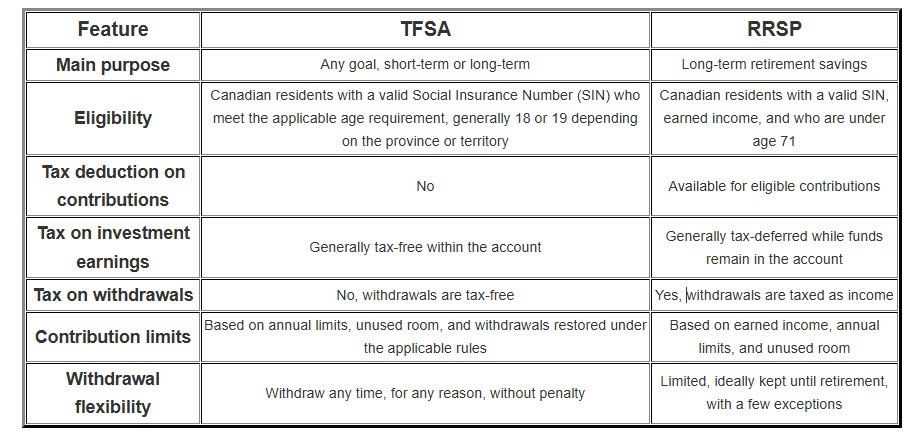
Both TFSA and RRSP accounts help Canadians save and invest for the future, but their tax treatment and withdrawal rules are different. A TFSA stands out for its flexibility and generally tax-free withdrawals. An RRSP lets you deduct eligible contributions from taxable income, potentially reducing your current tax bill, but withdrawals are usually taxable. When comparing TFSA vs RRSP, consider not only the tax benefits but also when you may need the money, your current income, and your long-term financial plans.
3.1. TFSA vs RRSP Comparison
3.2. Tax-Free vs Tax-Deferred Growth: The Key Difference
The key difference between TFSA vs RRSP is when you receive the tax benefit and whether withdrawals are taxable.
With a TFSA, you contribute money you have already paid tax on, so contributions are not deductible from your taxable income. In return, investment earnings and eligible withdrawals are generally tax-free. You can access your savings without increasing your taxable income simply because you withdraw money from the account.
With an RRSP, eligible contributions can be deducted to reduce your taxable income in the current year or another year when you claim the deduction. Investment earnings are tax-deferred while they remain in the account, but withdrawals are generally included in your taxable income for the year you receive them.
Consider a simple example. Suppose you have CAD 5,000 to save or invest.
- If you choose a TFSA: You contribute CAD 5,000 from after-tax income. If your investment grows to CAD 6,000, you can generally withdraw the full CAD 6,000 without paying income tax on the withdrawal.
- If you choose an RRSP: You contribute CAD 5,000 and may be able to deduct the contribution if you qualify. If your investment grows to CAD 6,000, you generally do not pay tax while the money remains in the account. However, when you withdraw the CAD 6,000, the amount is usually included in your taxable income.
This example assumes no investment fees or other changes. The actual benefits of each account depend on your tax rate, when you contribute, when you withdraw, and how your investments perform.
In short, a TFSA does not provide an immediate tax deduction on contributions, while an RRSP may offer an upfront tax benefit but usually involves tax when you withdraw money. Understanding this distinction can help you decide which account better suits your financial situation.
4. When Should You Choose a TFSA?
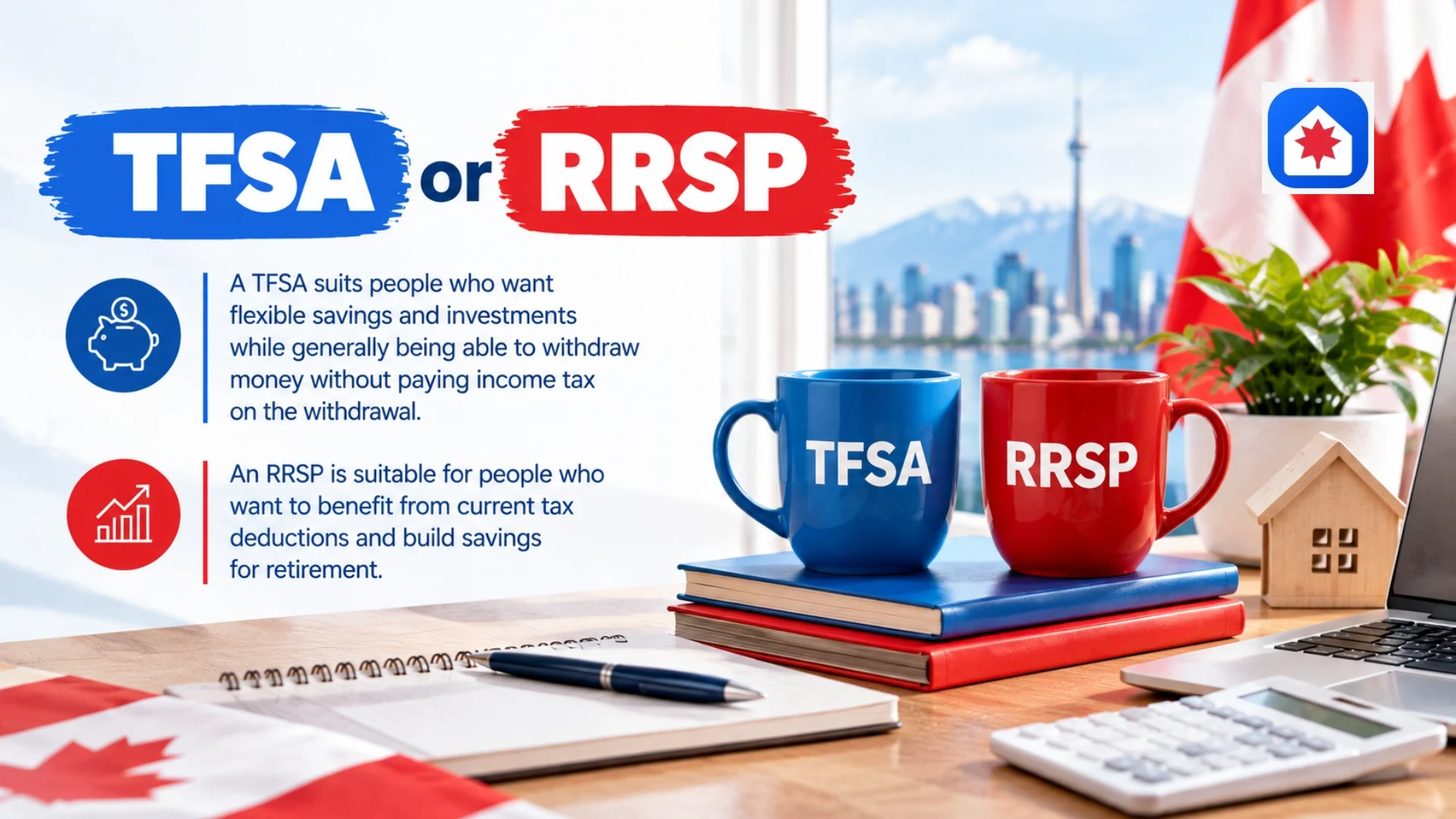
A TFSA suits people who want flexible savings and investments while generally being able to withdraw money without paying income tax on the withdrawal. Consider a TFSA if:
- Your current income is relatively low: An RRSP deduction may provide less immediate tax benefit. You could prioritize your TFSA and consider contributing to an RRSP as your income increases.
- You are saving for short-term goals: A TFSA can help you build an emergency fund, save for a home, or prepare for major expenses.
- You want more financial flexibility: You can generally withdraw money when needed without increasing your taxable income, including during retirement.
5. When Should You Choose an RRSP?
An RRSP is suitable for people who want to benefit from current tax deductions and build savings for retirement. Consider an RRSP if:
- Your current taxable income is high: Eligible contributions may reduce your taxable income. For example, if you contribute CAD 5,000 and your marginal tax rate is 35%, you could save approximately CAD 1,750 in income tax.
- You expect a lower tax rate in retirement: You may benefit from claiming deductions while your income is higher and paying tax at a lower rate when you withdraw money later.
- Your employer offers matching contributions: If your employer contributes to your RRSP based on how much you contribute, consider taking advantage of this benefit according to the plan's terms.
- You plan to use the Home Buyers' Plan (HBP): If eligible, you may be able to withdraw money from your RRSP to buy or build a qualifying home without paying tax immediately, but you must follow the program's repayment rules.
You do not have to choose only one account. You can combine a TFSA and an RRSP based on your income, financial needs, and goals at different stages of life.
Ultimately, choosing between a TFSA and an RRSP depends on your income, savings goals, and when you expect to need your money. TFSA vs RRSP: Understanding the key differences between them can help you make an informed decision based on your financial situation. A TFSA offers flexibility, while an RRSP may provide valuable tax benefits when you make eligible contributions, particularly if your current income is high. Consider your financial circumstances and available contribution room to determine how to use each account effectively.
Thank you for taking the time to read this article.
For more information, please contact us at CANADAHOMEHUB.