Rent is one of the biggest expenses to plan for when moving to Canada, whether you are arriving for work, studying, or starting a new life with your family. However, the average rent in Canada can vary significantly depending on where you live, the size of your apartment, and the type of property you choose. This guide compares average rent in Canada by province and city, breaks down typical prices by apartment size, and explains how to choose a rental that fits your budget.
1. What Is the Average Rent in Canada in 2026?
As of September 2026, the average asking rent in Canada was CAD 2,034 per month across all property types, including apartments, condominiums, houses, and townhouses. This was 7.3% lower than the average in September 2024, although rents remained higher than they were five years earlier.
It is important to understand what this figure measures. Asking rent refers to the monthly price advertised for an available rental property. It is not necessarily the amount paid by households that have lived in their homes for several years.
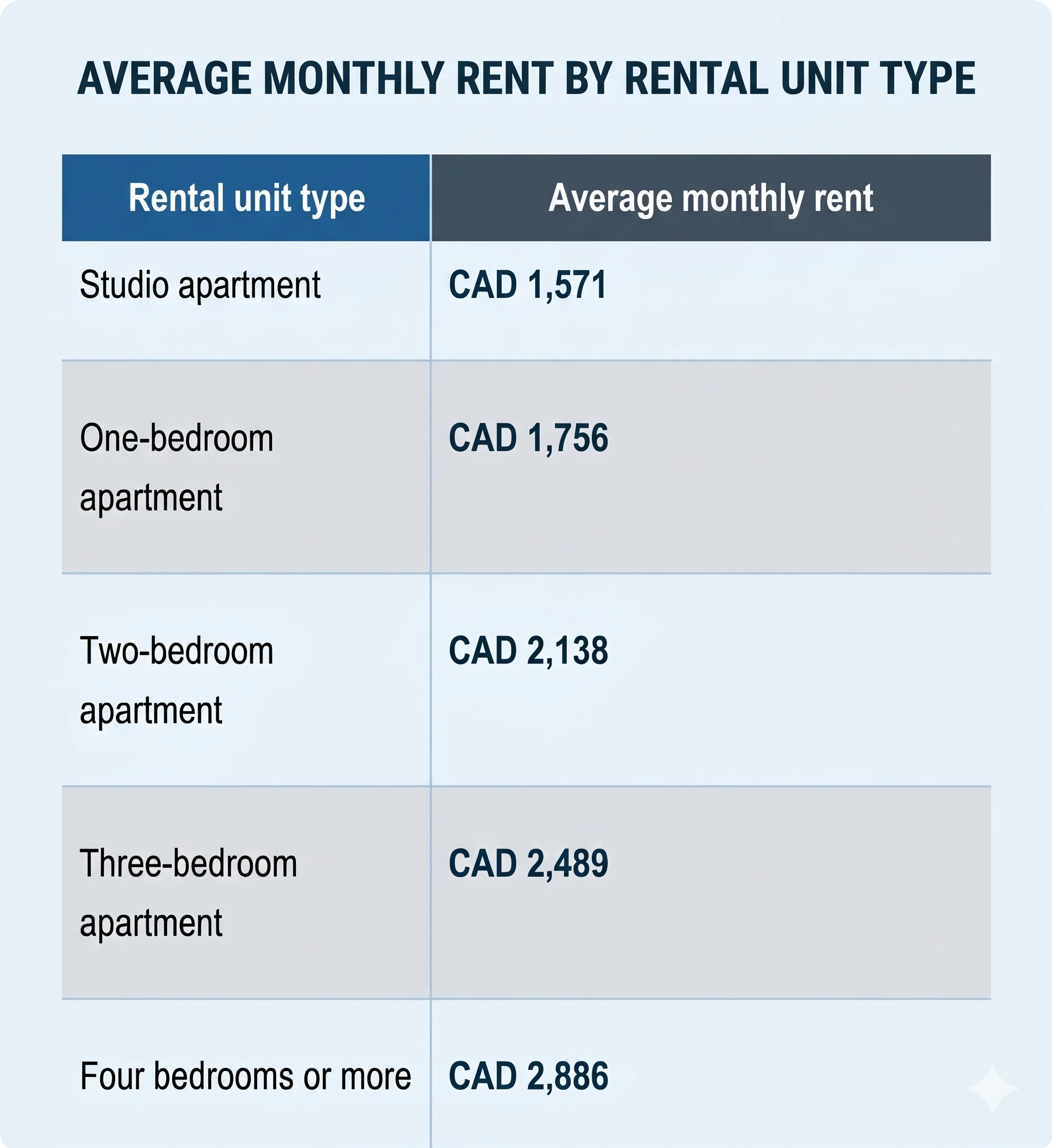
The following table shows the average asking rent by bedroom count across Canada in September 2026.
2. Average Rent in Canada by Province
2.1. British Columbia
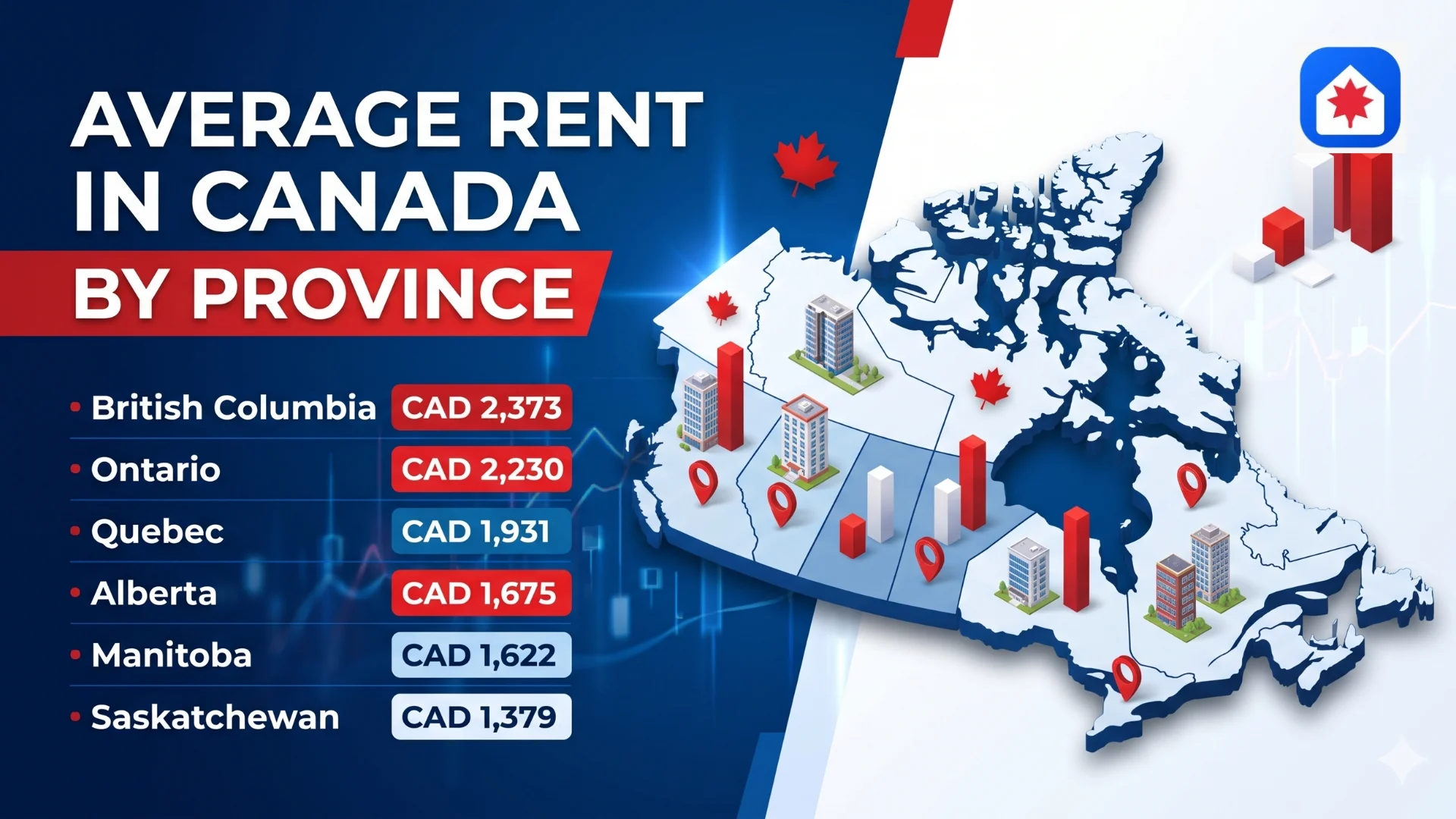
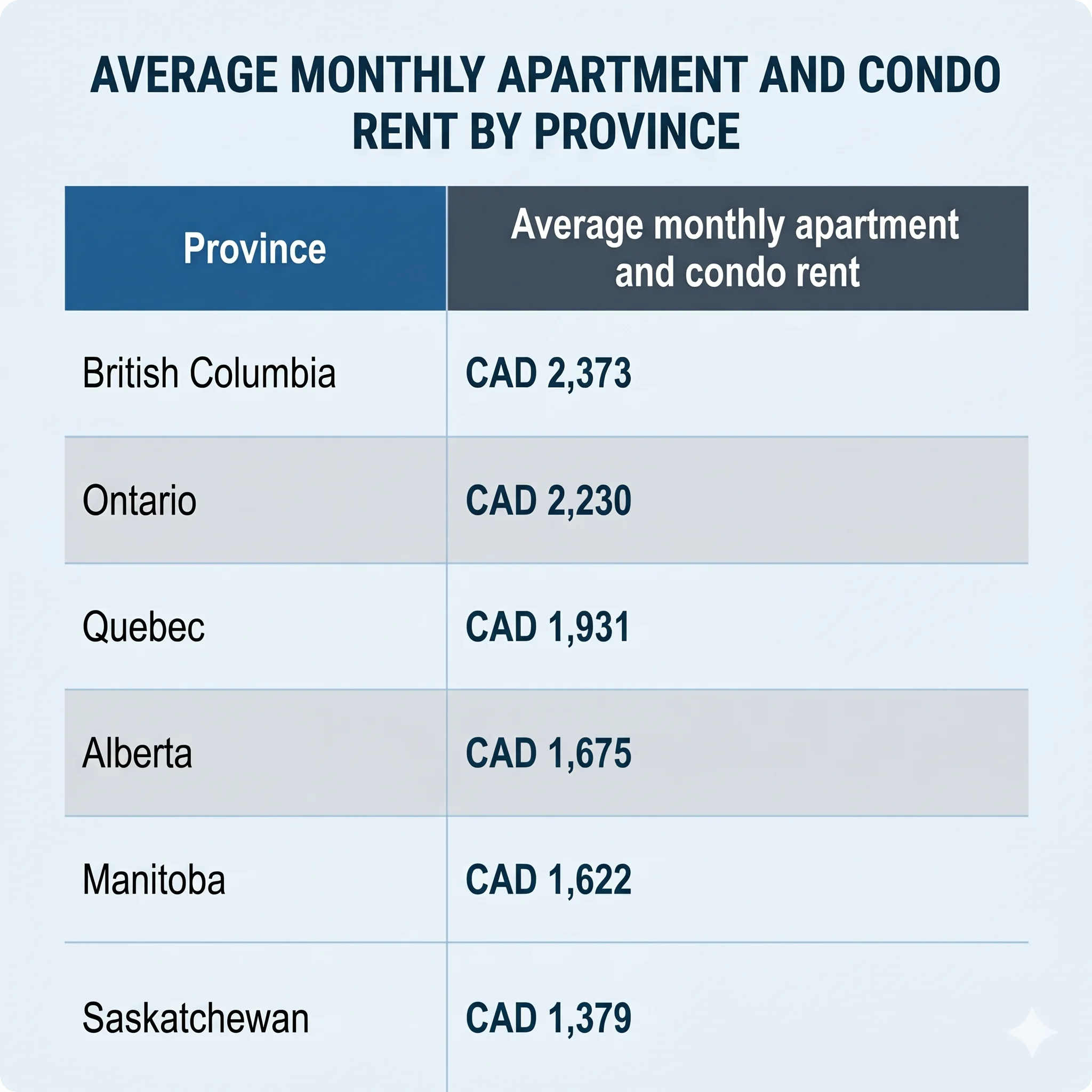
British Columbia (B.C.) had the highest average apartment and condominium asking rent among the provinces included in the September 2026 comparison, at CAD 2,373 per month. Its expensive rental market Canada is particularly evident in Metro Vancouver, where rents in several surrounding municipalities are also high.
If you plan to live in the Lower Mainland, Vancouver, Burnaby, North Vancouver, and Coquitlam are worth comparing. Moving outside Vancouver's central neighbourhoods may offer different options, but savings depend on the property and commuting requirements.
2.2. Ontario
Ontario's average apartment and condo asking rent was CAD 2,230 in September 2026. The market varies considerably, from expensive Toronto neighbourhoods and nearby municipalities to comparatively lower-cost options in cities such as Windsor, London, and Hamilton.
Toronto may be convenient for people seeking jobs in a large metropolitan market, but its rental cost can put pressure on a single income. Ottawa is another option for people interested in government, professional services, and other employment sectors. If you are considering the Greater Toronto Area, compare the rent with your commuting expenses. A lower-priced apartment farther from work may not produce meaningful savings if you need a car or pay substantially more for transportation.
2.3. Alberta
Alberta's average apartment and condo asking rent was CAD 1,675 per month in September 2026. Calgary and Edmonton are two of the main markets to compare, while smaller cities may offer lower average rents.
Calgary appeals to renters who desire a large city with access to employment and outdoor activities. Edmonton may be worth considering if the cost of buying a house in Canada is a higher priority: its average apartment and condo rent was lower than Calgary's in September 2026.
2.4. Quebec
Quebec's average apartment and condominium asking rent was CAD 1,931 per month in September 2026. Montreal had a higher average than Quebec City in the same month's report, making both cities useful to compare for renters who are flexible about location.
Montreal offers a large urban environment, while Quebec City may be attractive to renters seeking lower housing costs. French-language ability can also influence employment and day-to-day life, depending on the area and the type of work you plan to do.
2.5. Manitoba and Saskatchewan
Manitoba and Saskatchewan had some of the lowest average apartment and condominium asking rents among the provinces listed in the September 2026 report.
Manitoba averaged CAD 1,622 per month, while Saskatchewan averaged CAD 1,379. Winnipeg, Regina, and Saskatoon are useful starting points for anyone comparing lower-cost urban rental markets.
3. Average Rent in Canada by City
Average rent by province Canada is useful for a broad comparison, but city-level prices are more helpful when you are deciding where to live.
3.1. Vancouver
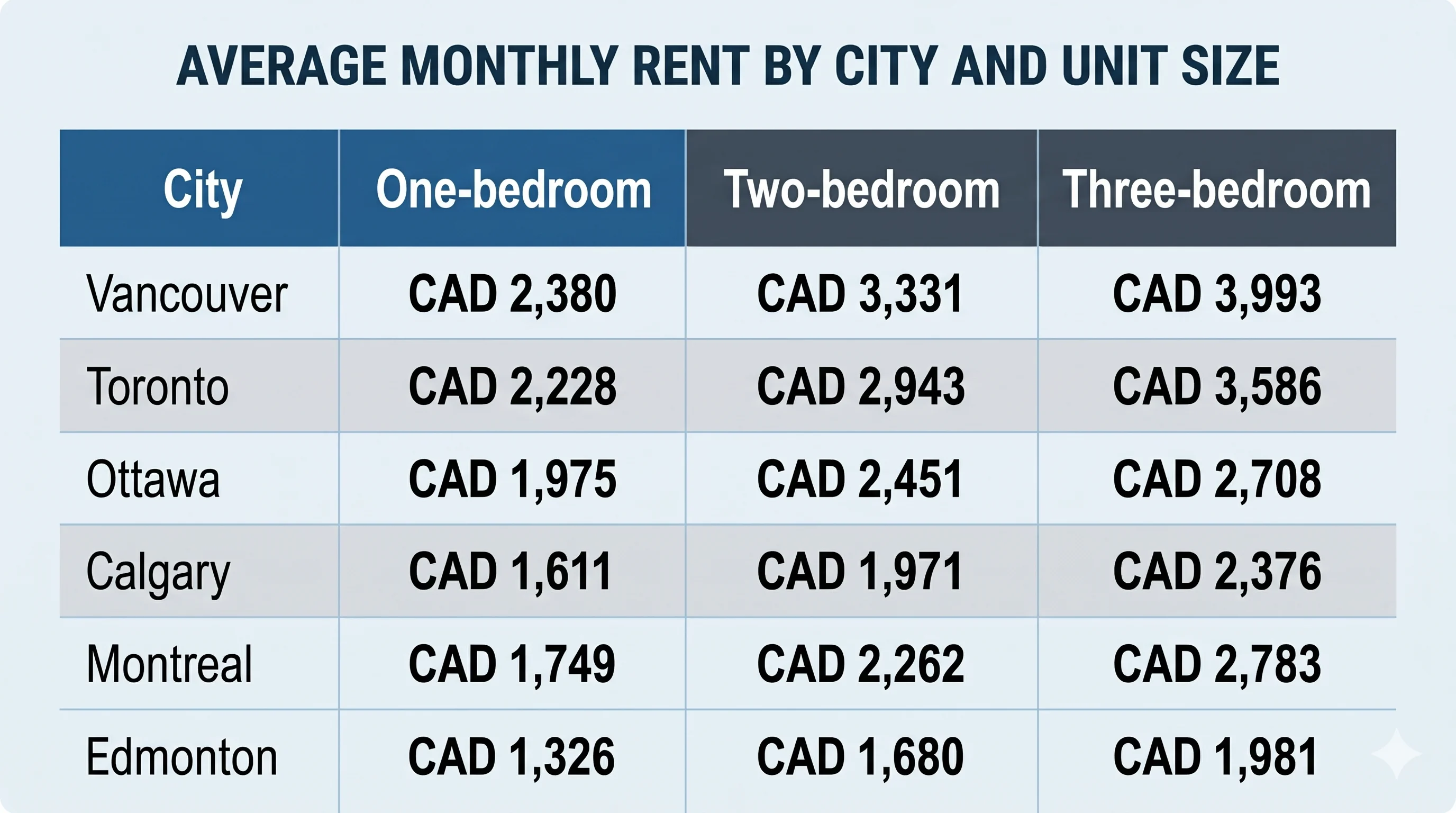
Vancouver is the most expensive city in this comparison for all three apartment sizes. In September 2026, the average asking rent was CAD 2,380 per month for a one-bedroom apartment, CAD 3,331 for a two-bedroom unit, and CAD 3,993 for a three-bedroom unit.
The main advantage of renting in Vancouver is access to a large job market, public transit, and outdoor recreation, including beaches, parks, and nearby mountains. However, housing costs can make it difficult to save money, particularly for newcomers to Canada and families who need more space.
3.2. Toronto
Toronto has the second-highest average asking rents among the six cities in this comparison. A one-bedroom apartment averaged CAD 2,228 per month, while two-bedroom and three-bedroom units averaged CAD 2,943 and CAD 3,586, respectively.
Toronto may make the most sense for renters whose careers benefit from being in Canada’s largest urban employment centre. Its range of industries, professional networks, and cultural communities can be valuable for people building a career or arriving without an established network. The challenge is that moving farther from the city centre to reduce rent can create a longer commute, particularly when work and home are not well connected by transit.
3.3. Ottawa
Ottawa offers lower average asking rents than Toronto and Vancouver in this comparison. In September 2026, a one-bedroom apartment averaged CAD 1,975 per month, a two-bedroom unit CAD 2,451, and a three-bedroom unit CAD 2,708.
Ottawa is worth considering for renters who want access to government-related employment and a city with a more measured pace than Toronto. It may also suit families who prioritize residential neighbourhoods and access to parks. One important consideration is the local job market: opportunities can be particularly attractive for people whose experience aligns with public administration, technology, or related professional services, but may be less suitable for those seeking certain industries concentrated in larger commercial centres.
3.4. Calgary
Calgary's average asking rents were lower than those in Vancouver, Toronto, and Ottawa. A one-bedroom apartment averaged CAD 1,611 per month in September 2026, compared with CAD 1,971 for a two-bedroom unit and CAD 2,376 for a three-bedroom unit.
Calgary can appeal to renters who want to balance housing costs with the possibility of having more living space. Its location also makes weekend trips to the Rocky Mountains more accessible than from many other major Canadian cities. The trade-off is the city’s climate and urban layout. Winter conditions can affect daily travel, and some rental locations are much easier to manage with a car.
3.5. Montreal
Montreal had an average asking rent of CAD 1,749 per month for a one-bedroom apartment in September 2026. Two-bedroom units averaged CAD 2,262, while three-bedroom units averaged CAD 2,783.
Montreal offers a different rental experience from Toronto and Vancouver, combining a distinctive cultural scene, established neighbourhoods, and a strong student population. It can be particularly appealing to renters who value cafés, local shops, cultural events, and neighbourhood life. French is an important part of daily life, however, and can influence employment opportunities and interactions with local services.
3.6. Edmonton
Edmonton had the lowest average asking rents among the six cities listed. A one-bedroom apartment averaged CAD 1,326 per month, a two-bedroom unit CAD 1,680, and a three-bedroom unit CAD 1,981 in September 2026.
Edmonton stands out in this comparison for its lower average asking rents. That difference may be especially meaningful for renters who want to limit housing expenses, save toward another financial goal, or rent a larger home. The decision requires looking beyond rent, though: Edmonton’s long, cold winters can affect heating needs and daily routines, while the convenience of a particular address may depend on access to transit or a personal vehicle.
3.7. More Affordable Cities Outside Major Markets
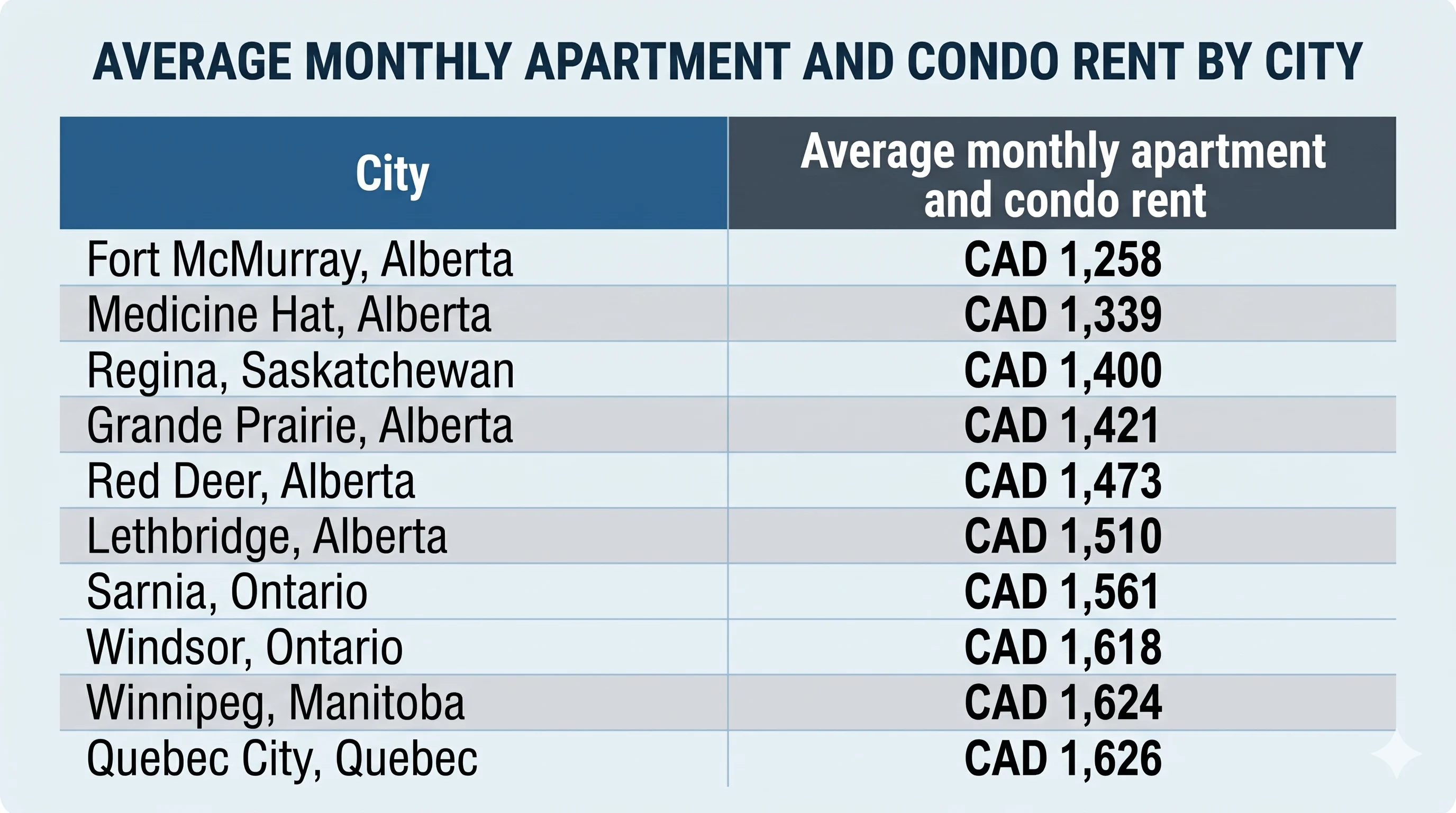
If you are flexible about where you live, smaller cities may offer more affordable rental options than Canada's largest urban centres.
Rentals.ca reported the following average asking rents for purpose-built and condominium apartments in selected markets outside the six largest cities in September 2026:
4. What Affects Rental Prices in Canada?
The average rent in Canada is a useful starting point, but several factors determine the price of a specific rental property.
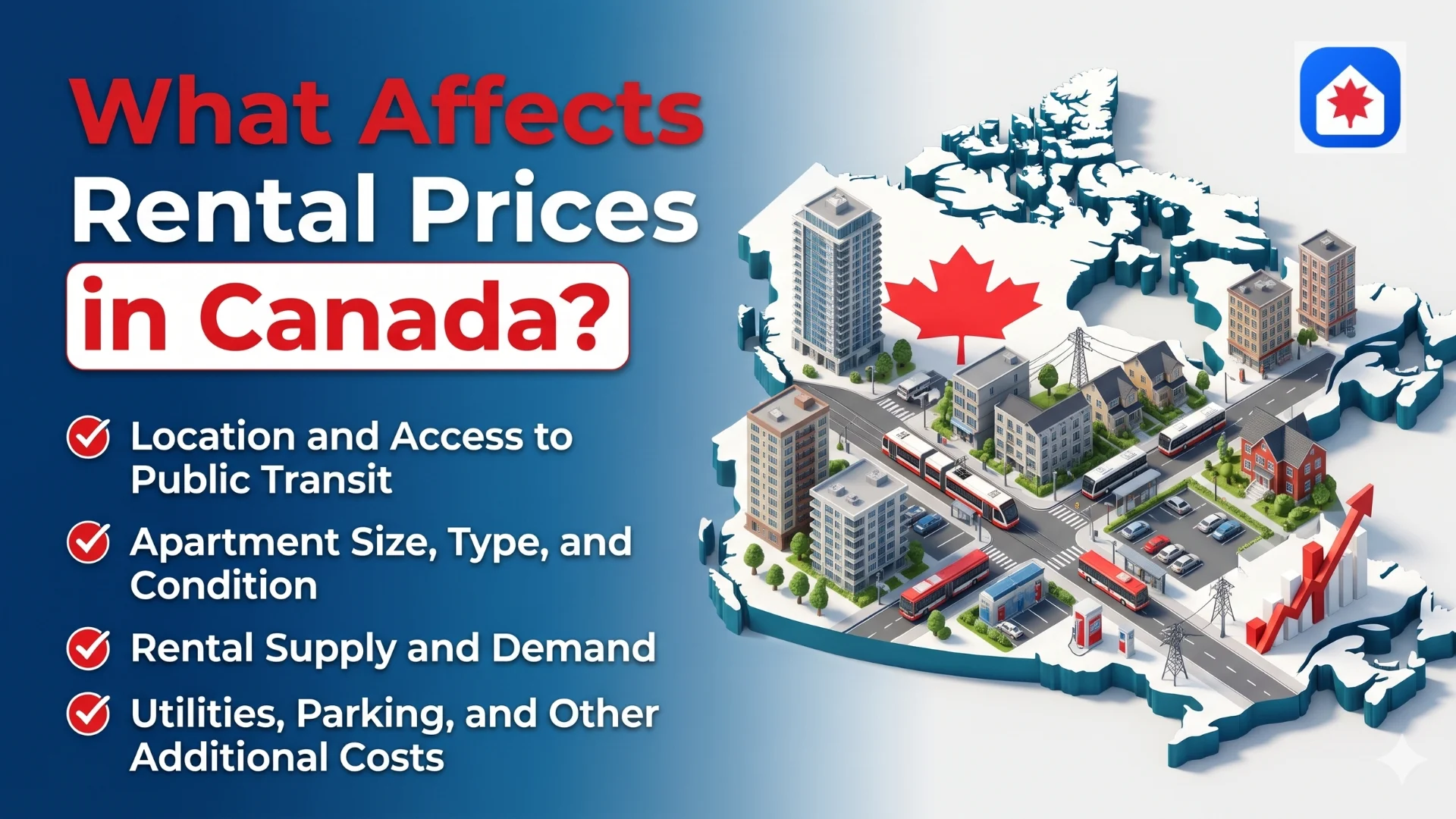
4.1. Location and Access to Public Transit
Apartments close to employment centres, universities, hospitals, shopping areas, and major transit routes may cost more than comparable properties farther away. However, paying more to live near work can sometimes reduce the need for a car, parking, fuel, and lengthy commutes.
When comparing neighbourhoods, estimate the combined monthly cost of rent prices Canada and transportation rather than treating them as separate decisions.
4.2. Apartment Size, Type, and Condition
The size of the rental unit is one of the most obvious factors affecting its price. Studio apartments generally cost less than larger units, while houses and townhouses may offer more space at a higher total monthly rent.
Property type matters, too. In September 2026, the national average asking rent was CAD 2,036 for purpose-built rental apartments and CAD 2,052 for condominium rentals. Other secondary-market properties, including houses and townhouses, averaged CAD 2,016.
Condition, included appliances, parking, outdoor space, and the age of the building can also influence the price.
4.3. Rental Supply and Demand
Rental prices respond to the balance between available homes and the number of people looking for them.
A city with strong employment growth, limited vacancies, or a large student population may experience more competition for certain types of accommodation. An increase in available rental units can create more choice for tenants and put downward pressure on asking prices.
4.4. Utilities, Parking, and Other Additional Costs
The advertised rent prices Canada may not include every expense associated with living in the property. Depending on the lease, you may need to budget separately for:
- Electricity, heating, and water.
- Internet and mobile service.
- Parking or storage.
- Laundry facilities.
- Tenant insurance.
- Moving expenses and household essentials.
5. What Newcomers Should Know Before Renting in Canada
Finding a rental can be more challenging when you have just arrived and do not yet have Canadian credit history, employment records, or references from previous landlords. The Government of Canada notes that landlords may request proof of income, employment information, references, or permission to check credit history. If you do not have a Canadian credit history, a newcomer settlement service may be able to explain the options available in your area.
Before beginning your search, prepare the following, where available:
- Identification documents.
- Proof of income, an employment letter, or other evidence of your financial circumstances.
- References from previous landlords or employers.
- A realistic monthly housing budget.
- Funds for permitted upfront rental payments and moving expenses.
You should also learn the tenancy rules that apply in your province or territory. Canada does not have one universal set of residential tenancy rules for every location, and requirements for deposits, rent increases, notice periods, and lease termination can differ.
If you are still planning your move, use CanadaHomeHub.ca as a starting point for practical Canadian housing and financial guidance. The site offers housing-related calculators and guides that can help you assess your broader financial plans.
The most useful next step is to compare actual listings in your intended city, confirm what is included in each rent, and calculate how much you can comfortably spend after accounting for other essential expenses.
Frequently Asked Questions
1. Which province has the highest rent in Canada?
In the September 2026 comparison of purpose-built rental apartments and condominium rentals, British Columbia had the highest average rent among the provinces reported, at CAD 2,373 per month. Individual cities and neighbourhoods can be more or less expensive than the provincial figure.
2. Is rent cheaper in Toronto or Vancouver?
In September 2026, the average asking rent for purpose-built apartments and condominiums was lower in Toronto than in Vancouver. A one-bedroom apartment averaged CAD 2,228 in Toronto and CAD 2,380 in Vancouver, while a two-bedroom unit averaged CAD 2,943 and CAD 3,331, respectively. Individual listings can differ considerably.
3. How much is a one-bedroom apartment in Canada?
Across all property types, the average asking rent for a one-bedroom unit in Canada was CAD 1,756 per month in September 2026. For purpose-built rental apartments alone, the average was CAD 1,799. These figures use different property groupings, so it is important to check which measure a report uses.
4. Is CAD 2,000 enough for rent in Canada?
CAD 2,000 may be enough for a one-bedroom apartment in some Canadian cities, including certain listings in Edmonton, Regina, and Winnipeg. It may not be enough for a comparable apartment in Vancouver or Toronto, where average asking rents are higher. Whether the amount is sufficient also depends on the property, neighbourhood, and whether utilities are included.
5. Are utilities included in Canadian rent?
Sometimes. The lease determines whether utilities such as electricity, heating, and water are included in the rent. Internet, parking, and laundry may also be charged separately. Ask the landlord or property manager for written confirmation of the included services and any additional monthly fees before signing.
The average rent in Canada varies widely by province, city, apartment size, and property type. Vancouver and Toronto tend to be more expensive than Edmonton, Regina, and Winnipeg. However, the best location for you depends on more than rent alone. Employment opportunities, transportation, utilities, and the availability of suitable homes all affect the overall cost of living in Canada. Before choosing a rental, compare current listings for similar properties, calculate your total monthly housing costs, and review the applicable tenancy rules. With a realistic budget and careful research, you can make a more informed decision about where to live in Canada.
Thank you for taking the time to read this article.
For more information, please contact us at CANADAHOMEHUB.