
Your mortgage may have made sense when you first bought your home, but your financial circumstances, interest rates, and borrowing needs can change over time. If your current mortgage no longer fits your situation, a mortgage refinance Canada could help you adjust its terms, access your home equity, or manage existing debt more effectively. This guide explains when to refinance a mortgage in Canada, the requirements you need to meet, the costs involved, and how to refinance. Let's find out.
1. What Is a Mortgage Refinance Canada?
Mortgage refinancing is the process of replacing an existing mortgage with a new mortgage agreement. The new mortgage pays off the outstanding balance of your current loan, allowing you to establish different borrowing terms with the same lender or another financial institution.
Depending on your circumstances, refinancing may allow you to:
- Secure a different interest rate.
- Increase or decrease your mortgage amount.
- Access some of the equity built up in your property.
- Change your amortization period.
- Consolidate higher-interest debts into one mortgage.
For example, suppose your home is currently worth $700,000, and your outstanding mortgage balance is $350,000. You may have enough equity to qualify for a larger mortgage, depending on the lender's assessment and applicable borrowing limits. However, the amount you can borrow depends on more than your property's market value. Your income, credit history, existing debts, and ability to make the new payments also matter.
2. When Should You Refinance Your Mortgage in Canada?
A mortgage refinance Canada can be useful when your current mortgage no longer supports your financial goals. However, the right timing depends on your mortgage contract, interest rates, remaining balance, and expected borrowing needs. Here are 4 situations in which refinancing may be worth considering.

2.1. When You Can Secure a Better Interest Rate
One common reason homeowners consider refinancing is the opportunity to obtain a lower mortgage interest rate. For example, if you originally secured a fixed mortgage at a higher rate and market rates have since decreased, refinancing could reduce your interest expenses and potentially lower your regular payments. However, the difference between your current rate and the new rate is only one part of the calculation. You also need to consider:
- How much time remains in your current mortgage term.
- Whether your lender charges a prepayment penalty.
- The remaining mortgage balance.
- The costs of registering the new mortgage.
- How long you expect to keep the property or mortgage.
A lower interest rate may not justify refinancing if the cost of breaking your current agreement is too high. For homeowners approaching the end of their mortgage term, comparing renewal offers may be a more cost-effective option.
2.2. When You Need Access to Home Equity
Your home's value may increase over time as you repay your mortgage and benefit from changes in the housing market. The difference between your property's current market value and the outstanding mortgage balance is your home equity.
For example:
- Current property value: $800,000
- Outstanding mortgage balance: $400,000
- Estimated home equity: $400,000
If you need a substantial amount of money for a renovation, education expenses, or another major financial goal, refinancing may allow you to borrow against part of this equity. This option is commonly known as a cash-out refinance. However, your available equity is not necessarily the amount you can withdraw. Lenders apply loan-to-value limits and assess whether you can afford the increased mortgage payments.
2.3. When You Want to Consolidate High-Interest Debt
Managing multiple debts can become difficult, particularly when credit cards and personal loans carry relatively high interest rates. A mortgage refinance Canada may allow you to combine eligible outstanding debts into a larger mortgage, replacing several payments with one regular mortgage payment.
For example, suppose you have:
- $15,000 in credit card debt.
- $20,000 in personal loans.
- $300,000 remaining on your mortgage.
If you qualify for a larger mortgage, you may be able to use part of the additional borrowing to repay those debts. This can reduce your interest expenses if the new mortgage rate is substantially lower than the rates on your existing debts. However, debt consolidation does not eliminate the money you owe. It transfers unsecured debts into borrowing secured by your home. If you extend repayment over a longer amortization period, you could also pay more interest overall despite receiving a lower interest rate.
2.4. When Your Financial Situation or Long-Term Plans Change
Your original mortgage agreement may no longer match your current financial circumstances. For example, you may have experienced an increase in household income, started a family, changed employment, or decided to renovate your property. Refinancing may allow you to adjust your mortgage structure to reflect these changes. It can also be worth considering when you want to:
- Shorten your amortization period to repay your mortgage sooner.
- Extend the amortization period to reduce regular payments, if approved.
- Change from a variable-rate mortgage to a fixed-rate mortgage, or vice versa.
- Borrow additional funds for a major financial expense.
The key is to determine whether the new mortgage supports your long-term financial position rather than simply making your immediate payments more manageable.
3. Mortgage Refinancing Requirements in Canada
Before approving a mortgage refinance Canada, lenders generally assess your property, financial situation, and ability to repay the new loan. Although specific requirements vary between financial institutions, the following factors are commonly considered.
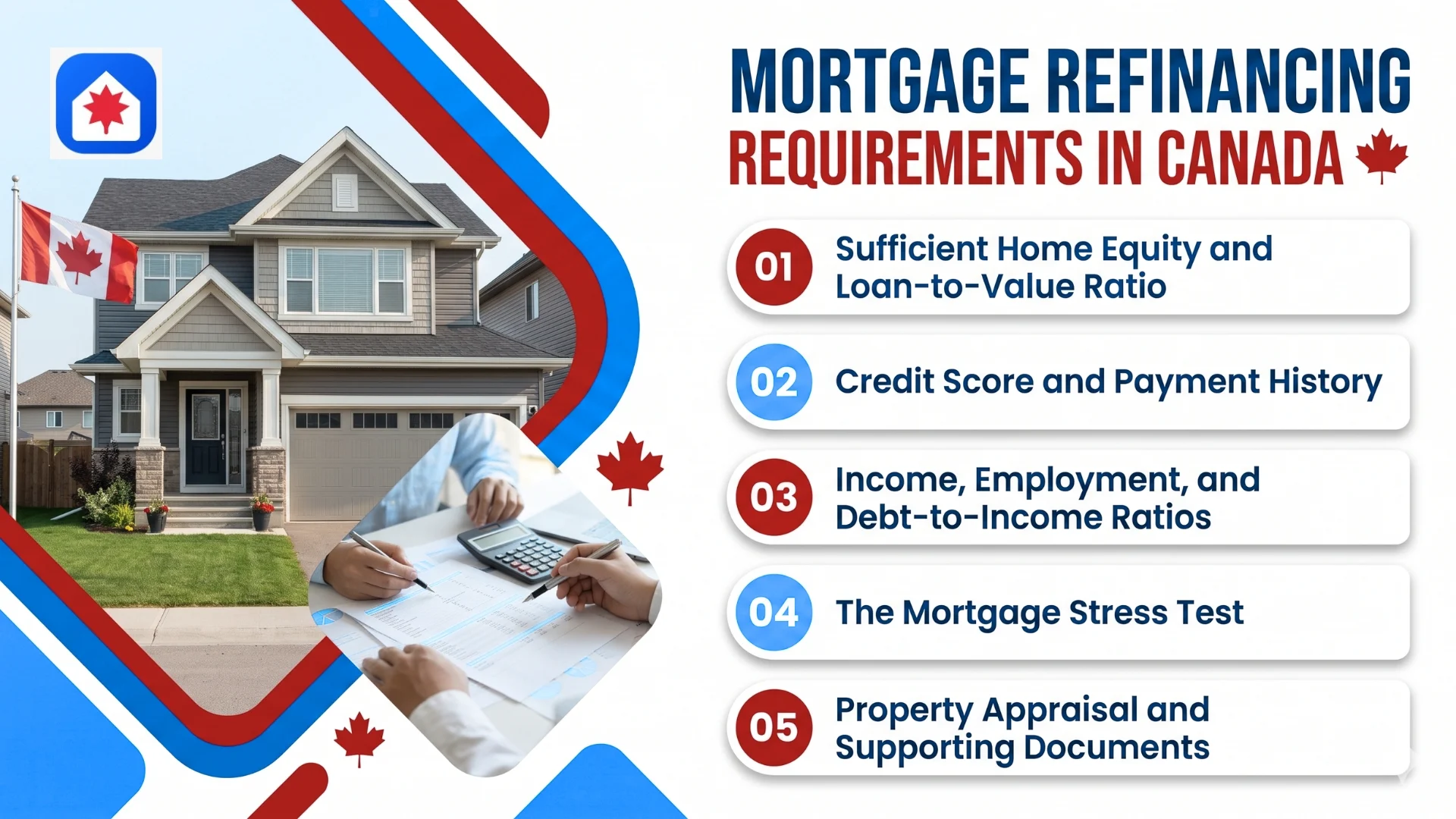
3.1. Sufficient Home Equity and Loan-to-Value Ratio
Home equity is one of the most important factors in determining how much you can borrow through refinancing. For many conventional mortgage refinances with federally regulated banks, the combined mortgage borrowing is generally limited to 80% of the property's appraised value. The 80% threshold is an important general limit, not a guarantee that a lender will approve the full amount. Other registered debts against the property and the lender's underwriting policies may reduce the available borrowing amount. The federal Bank Act also establishes an 80% limit for relevant residential mortgage lending by banks, subject to specified exceptions.
3.2. Credit Score and Payment History
Your credit history helps lenders evaluate how consistently you manage debt. When reviewing a mortgage refinancing application, lenders may consider:
- Your credit score.
- Previous late or missed payments.
- Outstanding credit card balances.
- Existing personal loans and lines of credit.
- Recent credit applications.
- Any collections, defaults, or bankruptcies.
A stronger credit profile can improve your chances of qualifying for competitive mortgage terms. If your credit history has deteriorated since you obtained your original mortgage, refinancing may be more difficult or come with less favourable terms.
3.3. Income, Employment, and Debt-to-Income Ratios
Having sufficient home equity does not automatically mean you can refinance. Lenders also need to determine whether your income can support the proposed mortgage payments alongside your other financial obligations. They may review:
- Employment status and income stability.
- Recent pay stubs and employment letters.
- Tax documents or financial statements for self-employed borrowers.
- Existing mortgage and housing expenses.
- Credit card, vehicle loan, and personal loan payments.
- Other recurring debt obligations.
Two important measures used in Canadian mortgage underwriting are Gross Debt Service (GDS) and Total Debt Service (TDS). GDS ratio measures the proportion of your gross household income used for housing costs, including mortgage payments, property taxes, heating expenses, and applicable condominium fees. TDS ratio measures the proportion of gross household income used for housing expenses and other debt obligations. Lenders use these ratios alongside other financial information to evaluate affordability. The applicable thresholds can vary according to the lender and mortgage type.
3.4. The Mortgage Stress Test
The mortgage stress test is another important part of mortgage refinancing requirements. For most newly underwritten mortgages at federally regulated lenders, borrowers must demonstrate that they can afford payments at a qualifying rate higher than the actual mortgage rate.
Not every mortgage transaction is subject to the same stress-test treatment. A qualifying uninsured straight switch at renewal, without increasing the mortgage amount or amortization period, is not expected to undergo the minimum qualifying rate assessment under OSFI guidance. A conventional refinance that increases borrowing generally involves new underwriting and the applicable qualifying-rate assessment.
3.5. Property Appraisal and Supporting Documents
Lenders need an accurate estimate of your property's current value to calculate the loan-to-value ratio. Depending on the lender and property, you may need a professional appraisal. You may also be asked to provide:
- Government-issued identification.
- Your current mortgage statement.
- Recent pay stubs or proof of income.
- Employment verification.
- Recent tax returns or Notices of Assessment.
- Bank statements and information about other debts.
- Property tax statements.
- Details of any existing loans secured against the property.
4. How Much Does It Cost to Refinance a Mortgage in Canada?
The cost of refinancing can vary considerably depending on your existing mortgage contract, lender, property, and province or territory.
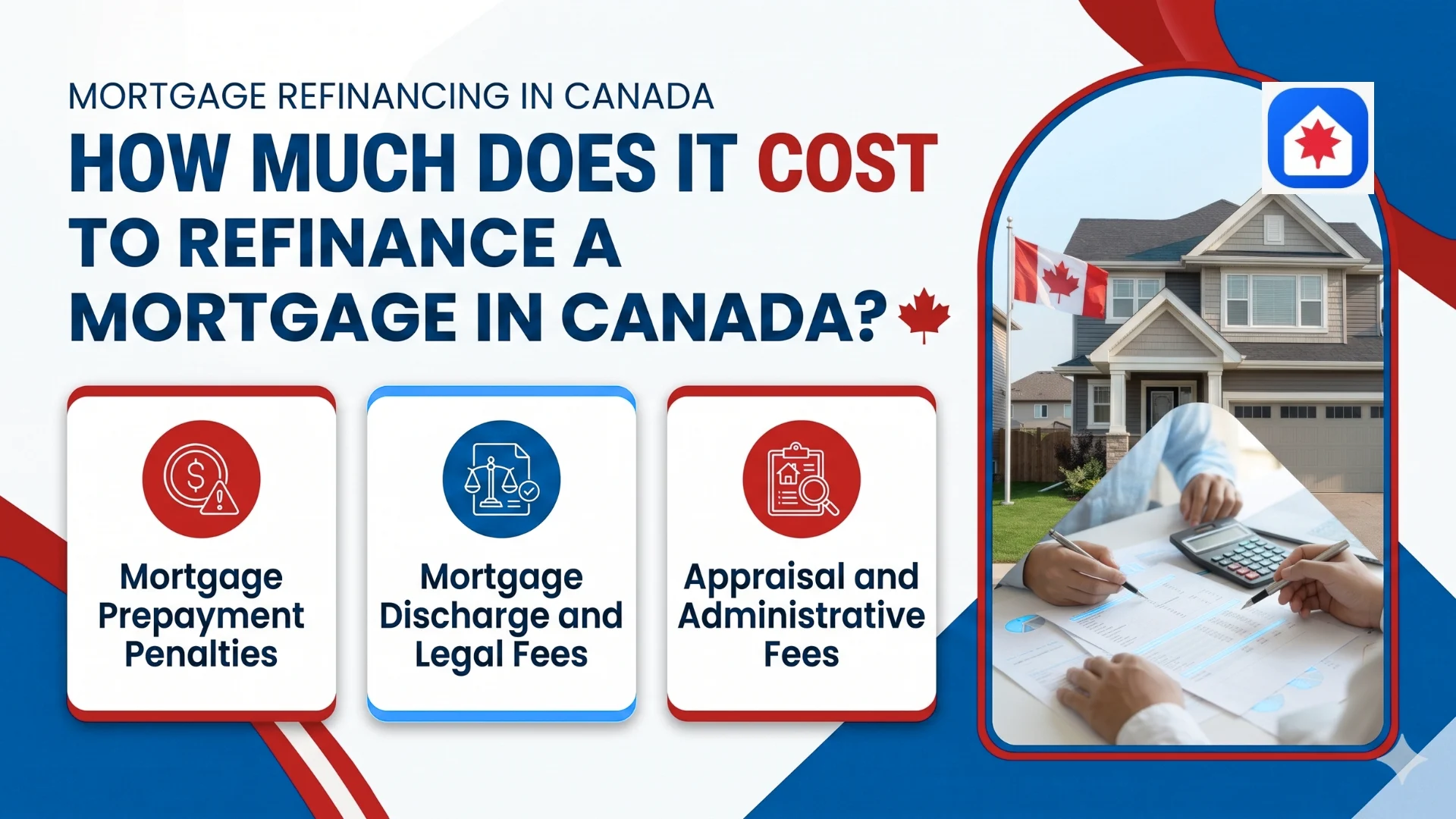
4.1. Mortgage Prepayment Penalties
If you refinance before your mortgage term ends, your lender will likely charge a prepayment penalty for ending your current mortgage early. For variable-rate mortgages, this is usually equal to three months' interest. For fixed-rate mortgages, the penalty is generally the greater of three months' interest or the interest rate differential (IRD).
In some cases, the prepayment penalty can cost thousands of dollars, making early refinancing less attractive. Always request an official payout statement or written penalty estimate from your current lender before making a decision.
4.2. Mortgage Discharge and Legal Fees
When you refinance with a different lender, the existing mortgage may need to be discharged from the property title and the new mortgage registered.
This process may involve:
- Mortgage discharge fees.
- Lawyer or notary fees.
- Title search expenses.
- Mortgage registration fees.
- Title insurance, where applicable.
The exact charges depend on your lender and provincial or territorial requirements. The Financial Consumer Agency of Canada notes that mortgage discharge fees can range from no charge to approximately $400 in jurisdictions where they are not otherwise regulated. Professional fees for mortgage discharge can also vary substantially.
4.3. Appraisal and Administrative Fees
Your new lender may require an appraisal to confirm the property's market value.
Other possible expenses include:
- Property appraisal fees.
- Mortgage administration fees.
- Application or processing fees.
- Title-related expenses.
Some lenders offer promotions that cover certain refinancing expenses. However, you should confirm which fees are included and whether other conditions apply.
4.4. Other Costs to Consider
There are additional financial considerations that may not appear as direct transaction fees. For example, extending your amortization period can reduce your regular mortgage payments but increase the total interest paid over the life of the loan. Similarly, if you consolidate credit card debt into your mortgage, you may be paying that debt over many more years.
5. How to Refinance a Mortgage in Canada: Step-by-Step
Once you understand the potential benefits and expenses, it is time to refinance a mortgage in Canada. Following a structured process can help you avoid unnecessary costs and make a more informed decision.
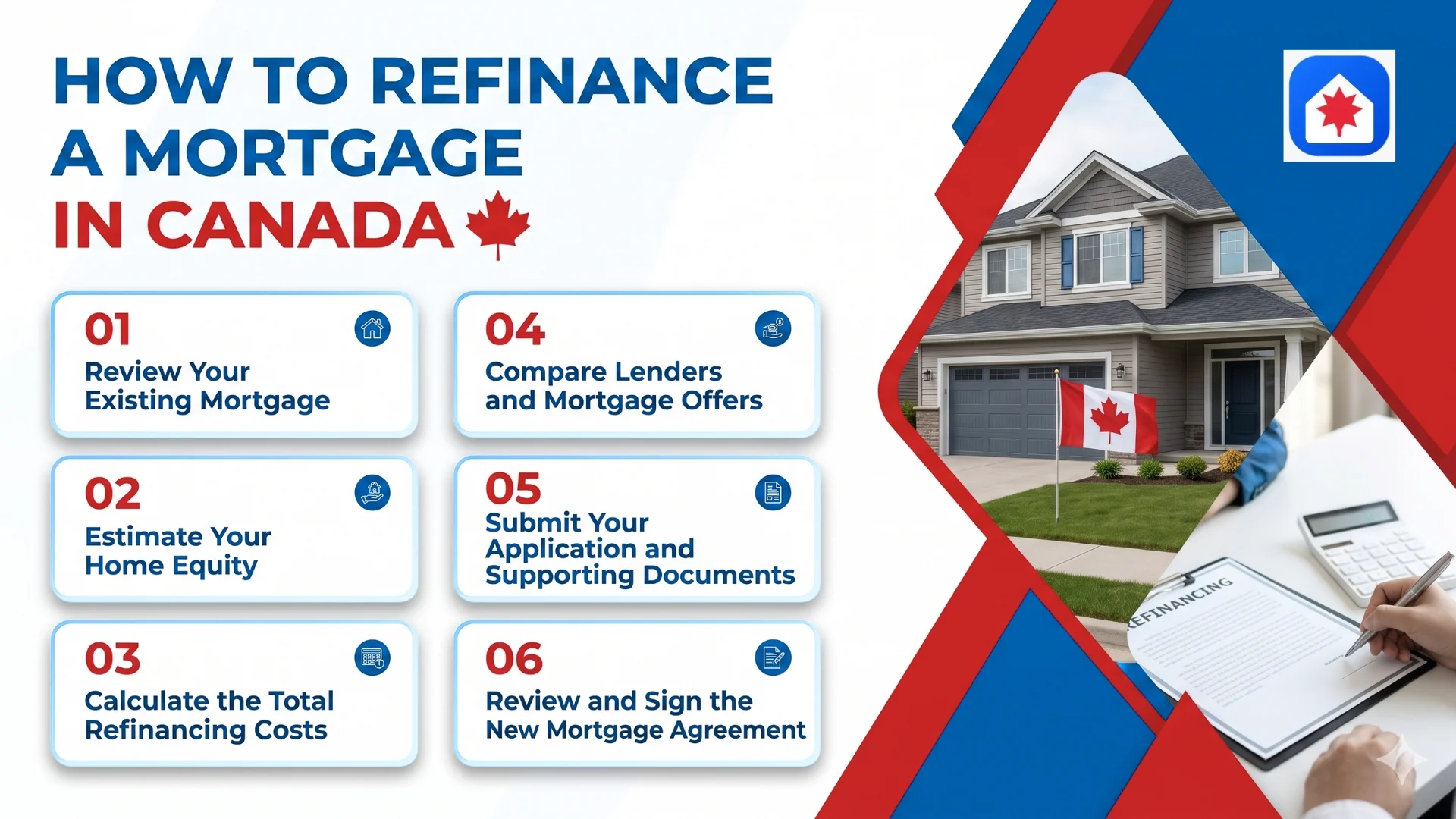
5.1. Review Your Existing Mortgage
Start by examining your current mortgage agreement.
Identify the following information:
- Outstanding mortgage balance.
- Current interest rate.
- Remaining mortgage term.
- Remaining amortization period.
- Fixed or variable interest rate.
- Prepayment privileges.
- Early repayment penalties.
- Portability options.
Pay particular attention to the prepayment conditions. If your current mortgage has a substantial penalty, refinancing immediately may not be the most economical option. You should also ask your lender whether it offers alternatives such as blend-and-extend. This arrangement combines your existing interest rate with a new rate when extending the mortgage term, potentially allowing you to change your agreement without paying a standard prepayment penalty. Administrative fees may still apply.
5.2. Estimate Your Home Equity
Next, determine how much equity you have accumulated. You can estimate this amount by subtracting your outstanding mortgage balance from your property's current market value.
For example:
- Property value: $750,000.
- Mortgage balance: $420,000.
- Estimated home equity: $330,000.
If the applicable borrowing limit is 80% of the property's value, the maximum mortgage amount would be $600,000. After deducting the existing mortgage balance, the potential additional borrowing would be $180,000, before accounting for other secured debts and transaction costs. This estimate gives you a starting point when discussing refinancing options with lenders.
You can also use a mortgage refinance calculator Canada tool to compare estimated payments under different mortgage amounts and interest rates. Combine these estimates with the actual refinancing fees to assess the overall financial impact.
5.3. Calculate the Total Refinancing Costs
Before applying, identify every expense associated with replacing your existing mortgage.
Request a prepayment penalty estimate from your current lender and obtain information about discharge, appraisal, legal, and administrative fees. Then compare these expenses with the potential savings or financial benefits of the new mortgage.
5.4. Compare Lenders and Mortgage Offers
Do not assume your existing lender automatically offers the most competitive refinancing option. Compare offers from banks, credit unions, and licensed mortgage brokers where appropriate. Consider more than the advertised interest rate. Review:
- Fixed versus variable interest rates.
- Mortgage term and amortization.
- Prepayment privileges.
- Payment flexibility.
- Portability options.
- Discharge and administration fees.
- Conditions attached to the mortgage agreement.
You should also confirm whether the new lender will cover certain transaction expenses. A mortgage with a slightly higher interest rate may offer better overall value if it provides more flexibility or lower upfront costs.
If you need professional guidance when reviewing mortgage offers, you can explore CanadaHomeHub's directory of verified mortgage professionals in Canada.
5.5. Submit Your Application and Supporting Documents
Once you identify a suitable option, submit your refinancing application. Your lender will review your financial information, assess your credit history, and evaluate your property's value.
You may need to provide additional documents if your income has changed, you are self-employed, or you have other significant financial obligations.
5.6. Review and Sign the New Mortgage Agreement
If your application is approved, carefully review the proposed mortgage agreement before signing. Confirm that the following details match your expectations:
- Approved mortgage amount.
- Interest rate and rate type.
- Mortgage term.
- Amortization period.
- Payment frequency and amount.
- Prepayment privileges.
- Penalties and other applicable fees.
If you are changing lenders, your lawyer or notary may coordinate the discharge of the existing mortgage and registration of the new one. Do not sign the agreement until you understand the financial obligations and conditions attached to it.
6. Common Mortgage Refinancing Mistakes to Avoid
A mortgage refinance Canada can provide financial flexibility, but overlooking important details may lead to unnecessary costs or a less favourable mortgage arrangement. Here are five common mistakes to avoid.
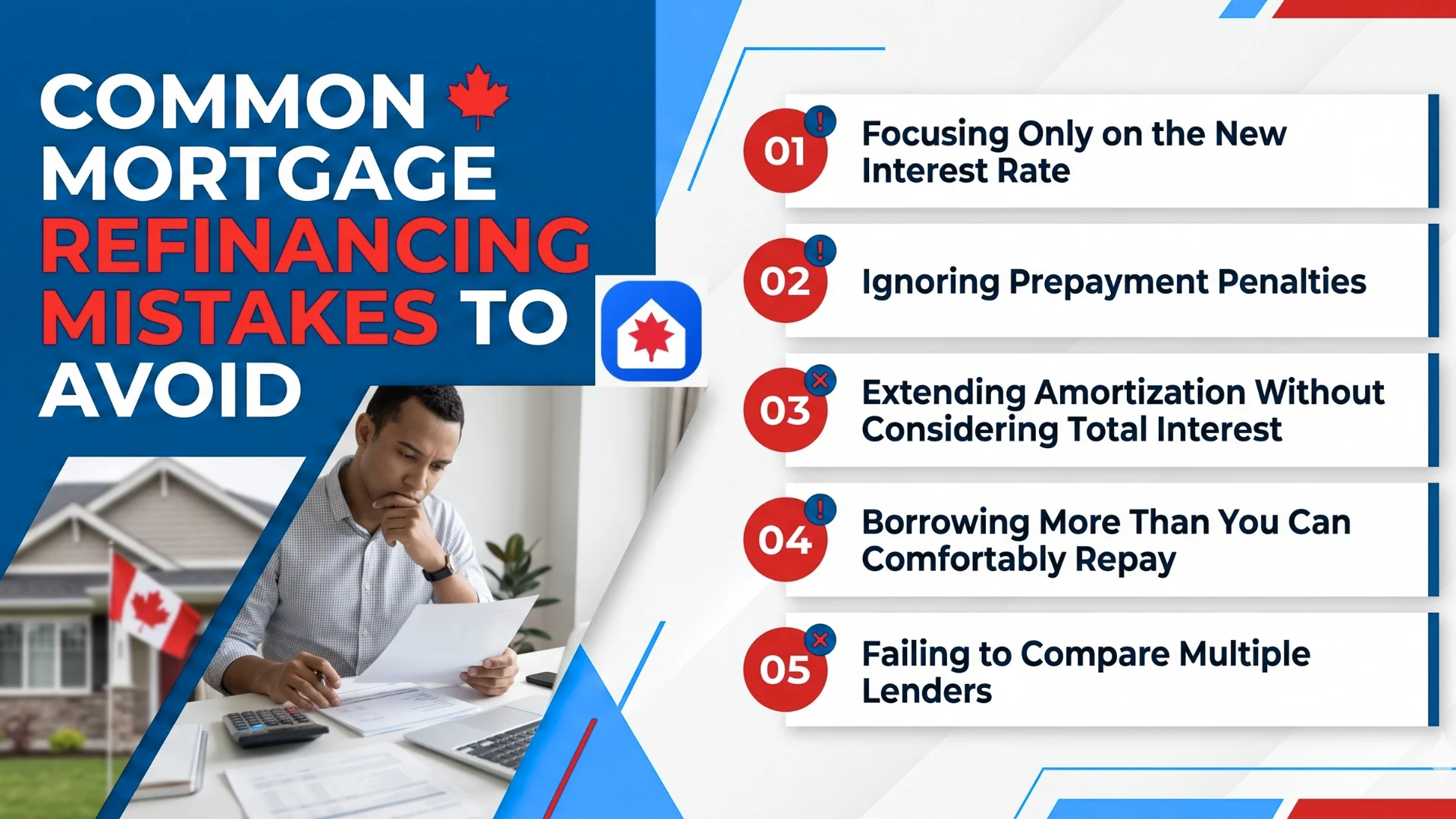
6.1. Focusing Only on the New Interest Rate
A lower interest rate can make a refinancing offer look attractive, but it does not necessarily mean you will save money. If the prepayment penalty and other expenses are substantial, the savings may take years to recover. So, always compare the total cost of the existing mortgage with the expected cost of the new agreement.
6.2. Ignoring Prepayment Penalties
Some homeowners underestimate the cost of breaking a closed mortgage before the end of its term. The penalty may be much higher than expected, particularly when the lender uses an IRD calculation. Request a written estimate before proceeding and check whether waiting until renewal would be more economical.
6.3. Extending Amortization Without Considering Total Interest
A longer amortization period can reduce regular mortgage payments, but it also means paying interest over a longer period. If your main objective is to reduce monthly expenses, make sure you understand how the new amortization affects the total repayment cost. Do not evaluate a mortgage solely by whether its monthly payment fits your current budget.
6.4. Borrowing More Than You Can Comfortably Repay
Accessing home equity can be tempting, especially when your property's value has increased. However, additional borrowing increases your financial obligations and puts more of your property equity at risk. Only borrow what you genuinely need and ensure the new payments remain manageable under less favourable financial circumstances.
6.5. Failing to Compare Multiple Lenders
Accepting your current lender's first refinancing offer may mean missing out on better terms elsewhere. Different lenders can offer different interest rates, prepayment privileges, mortgage features, and fee structures. Compare multiple options and evaluate the full agreement rather than choosing based on one advertised rate.
Frequently Asked Questions
1. Can I refinance my mortgage at any time in Canada?
You can generally apply to refinance before your mortgage term ends, but your lender must approve the new arrangement. If you have a closed mortgage, breaking the agreement early may trigger a prepayment penalty. You should compare that expense with the potential benefits before proceeding.
2. How much equity do I need to refinance my mortgage?
For many conventional mortgage refinances, lenders generally allow total borrowing of up to 80% of the property's appraised value. This means you typically need to retain at least 20% equity. However, the actual amount you can borrow depends on your existing secured debts, income, credit history, and lender requirements.
3. Can I refinance my mortgage with bad credit?
It may be possible, but a lower credit score or negative payment history can make approval more difficult.
4. Can I refinance my mortgage to pay off credit card debt?
Yes. If you have sufficient home equity and meet your lender's requirements, you may be able to use a cash-out refinance to consolidate credit card balances into your mortgage.
5. Is refinancing better than renewing my mortgage?
It depends on your financial goals and the condition of your existing mortgage. Mortgage renewal Canada is generally more straightforward when your current mortgage term expires. Refinancing may be more appropriate if you need to increase the mortgage amount, access home equity, or make substantial changes to the loan structure.
Mortgage refinance Canada options can help homeowners secure different mortgage terms, access home equity, or consolidate higher-interest debts. Before deciding to refinance mortgage Canada homeowners should review their existing mortgage agreement, calculate available equity, compare lender offers, and account for prepayment penalties and other transaction expenses. Most importantly, evaluate the break-even point and total interest costs to determine whether the new arrangement supports your long-term financial goals. With careful planning, you can make a more informed refinancing decision.
For additional support with mortgage payments, affordability estimates, and other Canadian housing expenses, explore the financial planning tools available at CanadaHomeHub.
Thank you for taking the time to read this article.