
Renewing your mortgage is an important financial decision that can affect your monthly payments, interest costs, and long-term homeownership budget. As your current mortgage term approaches its maturity date, you have an opportunity to review your borrowing arrangements, compare interest rates, and decide whether to stay with your existing lender or move to another financial institution. Understanding mortgage renewal Canada can help you avoid accepting unfavourable terms simply because your lender sends you a renewal offer. This guide explains the mortgage renewal process in Canada, when to start preparing, how to compare mortgage renewal rates, and tips for a successful mortgage renewal in 2026.
1. What Is a Mortgage Renewal in Canada?
A mortgage renewal Canada happens when your existing mortgage term ends, and you enter into a new agreement with your lender to continue repaying the outstanding balance. In Canada, most homeowners do not repay their entire mortgage within one term. Instead, they choose a mortgage term, such as one, three, or five years, while the full repayment period, known as the amortization period, may extend over 25 or 30 years.
When reviewing your mortgage or preparing for renewal, you may come across several terms that sound similar but have different meanings:
- Mortgage term: The length of time your current mortgage agreement, interest rate, and conditions remain in effect.
- Amortization period: The estimated total time required to repay your mortgage in full, assuming payments are made as scheduled.
- Mortgage maturity date: The date your current mortgage term ends. You will generally need to renew the mortgage, pay off the remaining balance, or arrange another solution by this date.
- Mortgage renewal: The process of continuing your existing mortgage under a new term, interest rate, and potentially updated conditions.
- Mortgage refinancing: Replacing or restructuring your existing mortgage, often to borrow additional funds, access home equity, or change the amortization period.
For example: Suppose you purchase a home with a $400,000 mortgage, a 25-year amortization period, and a five-year mortgage term. After five years, your initial mortgage term ends, but you will likely still have an outstanding balance. At this point, you can renew the remaining mortgage with your current lender or explore offers from other lenders. If you want to increase the mortgage balance to $400,000 again to finance renovations, you may need to consider refinancing instead.
2. When Should You Start Preparing for Mortgage Renewal?
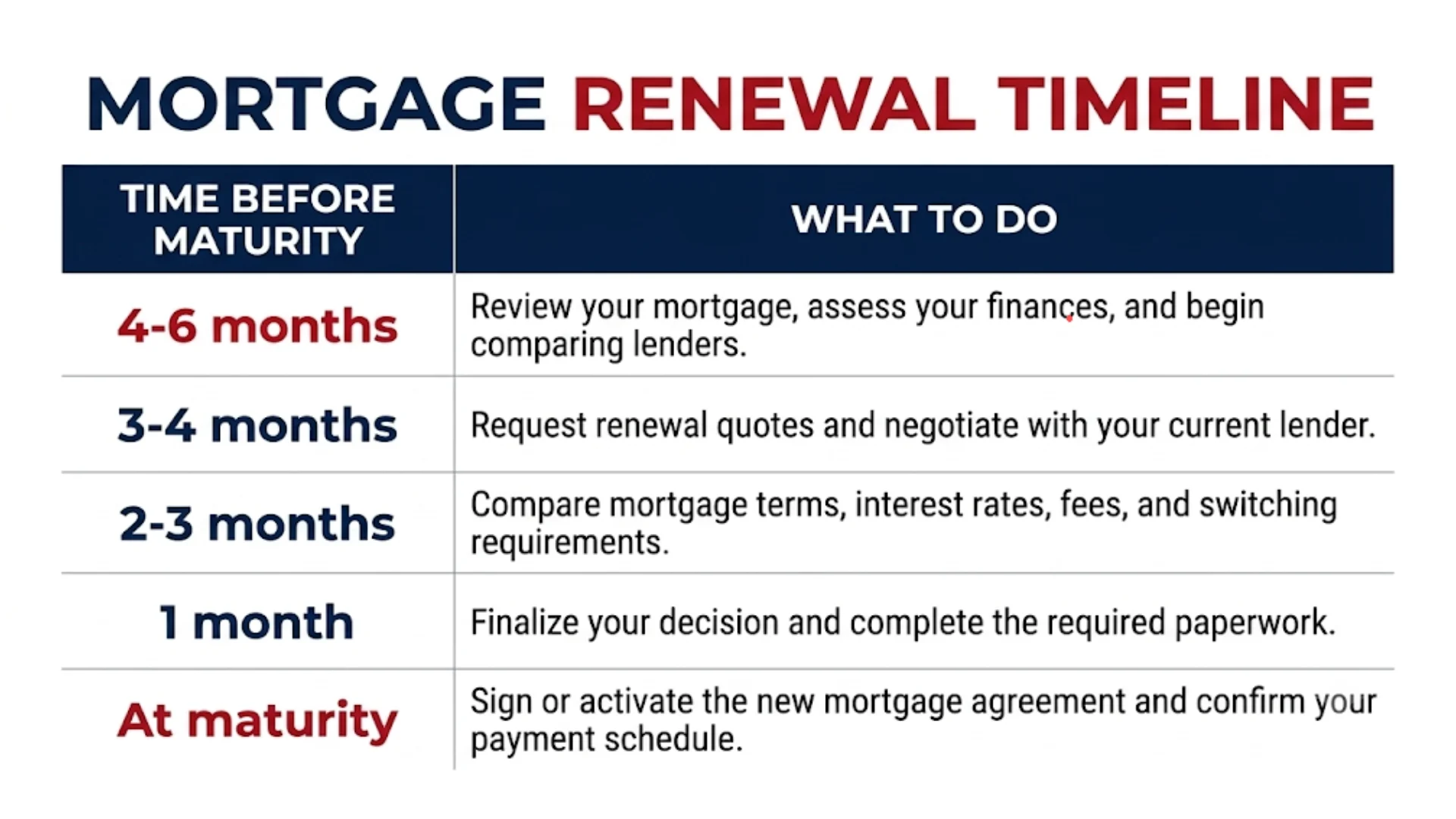
It is better to prepare several months before your mortgage maturity date rather than wait for your lender's renewal letter. The Financial Consumer Agency of Canada (FCAC) recommends shopping around a few months before the end of your mortgage term. The Canadian Mortgage Charter also sets expectations for lenders to contact homeowners four to six months before renewal to explain available options.
Starting early gives you more time to compare mortgage renewal rates, negotiate with lenders, and complete any paperwork required to switch financial institutions. The following timeline can help you organize your preparation:
3. How Does the Mortgage Renewal Process Work in Canada?
The mortgage renewal process Canada homeowners follow is generally straightforward, especially when they stay with their existing lender. However, switching financial institutions may involve additional application and registration steps. Here is how to approach the process.
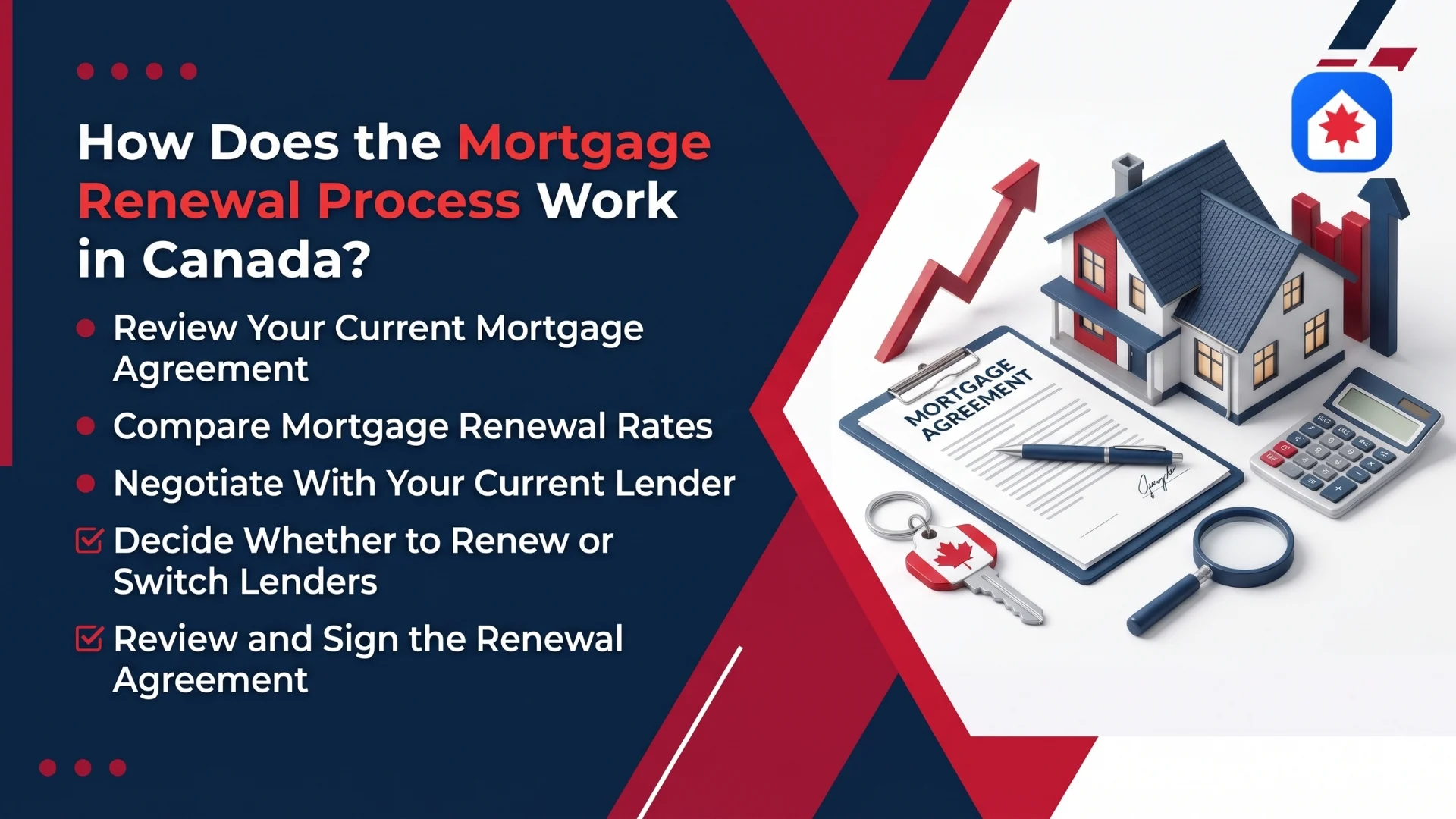
3.1. Review Your Current Mortgage Agreement
Start by checking your existing mortgage documents and recent statements.
Identify:
- Your mortgage maturity date.
- The remaining principal balance.
- Your current interest rate.
- Your payment amount and frequency.
- The remaining amortization period.
- Prepayment privileges and other contractual conditions.
You should also check whether your mortgage is registered as a standard charge or collateral charge. This distinction may affect the costs and procedures involved if you switch lenders.
3.2. Compare Mortgage Renewal Rates
Once you understand your current mortgage renewal Canada, research the rates available from different financial institutions.
Compare offers from banks, credit unions, and mortgage brokers where appropriate. Pay attention to the mortgage term, fixed or variable rate, payment flexibility, and eligibility conditions. Do not assume that the first renewal offer from your existing lender represents its best available rate.
The Bank of Canada publishes mortgage interest rate statistics that can help you understand broader lending trends. However, these figures are market benchmarks rather than personalized mortgage offers.
3.3. Negotiate With Your Current Lender
Contact your lender and ask whether it can improve the renewal offer. You can use competing mortgage quotes as supporting evidence during negotiations. If another institution offers a more attractive rate or better terms, share that information and ask your current lender whether it can match or improve the offer.
You may also negotiate other conditions, including:
- Mortgage term length.
- Payment frequency.
- Annual lump-sum payment privileges.
- Options to increase regular payments.
- Portability if you plan to move.
A successful negotiation should consider the overall mortgage agreement rather than the interest rate alone.
3.4. Decide Whether to Renew or Switch Lenders
After comparing offers, decide whether remaining with your current lender or moving to another institution makes more financial sense.
Staying with your existing lender is generally simpler because you may avoid some administrative and legal procedures. Switching can provide access to better rates or mortgage features, but you should account for any applicable transfer, discharge, appraisal, and legal costs. The new lender must also approve your application.
3.5. Review and Sign the Renewal Agreement
Before signing, carefully review the new mortgage agreement. Check that the interest rate, term, payment amount, payment frequency, amortization period, and prepayment privileges match what you negotiated.
For mortgages with federally regulated financial institutions, the lender must generally provide a renewal statement at least 21 days before the existing term ends. This statement must include the remaining principal balance, interest rate, payment frequency, term, and applicable fees. Do not sign until you understand the conditions and any changes to your original agreement.
4. Mortgage Renewal Options: Which One Is Right for You?
When your mortgage term expires, you have several options. The right choice depends on your financial position, plans, and borrowing priorities.
4.1. Renew With Your Current Lender
This is often the most convenient approach. You continue working with your existing financial institution and agree to a new mortgage term. Depending on your lender, you may be able to complete the process online, by phone, or through a mortgage specialist.
Advantages:
- Usually involves less paperwork.
- May avoid certain legal and appraisal costs.
- Offers a relatively straightforward renewal process.
- May allow you to negotiate a better rate without changing lenders.
Disadvantages:
- Your lender's initial offer may not be the most competitive.
- You may miss better mortgage products elsewhere if you do not compare offers.
- Your available options depend on your lender's products and policies.
4.2. Switch to a New Mortgage Lender
You are not required to renew with the same financial institution. Switching lenders at maturity allows you to move your outstanding mortgage balance to another lender offering more suitable terms.
Advantages:
- Access to potentially lower mortgage renewal rates.
- More opportunities to compare mortgage products.
- Potentially better payment flexibility and customer service.
Disadvantages:
- Requires approval from the new lender.
- May involve legal, discharge, registration, or appraisal fees.
- Collateral-charged mortgages can make transferring more complicated.
4.3. Refinance Your Mortgage
Refinancing involves changing your existing mortgage structure, often by increasing the loan amount or extending the amortization period.
For example, a homeowner with a $300,000 outstanding mortgage may want to borrow an additional $40,000 for renovations. Instead of simply renewing the original balance, the homeowner could explore refinancing.
Advantages:
- Allows access to home equity.
- May help consolidate higher-interest debts.
- Provides an opportunity to restructure mortgage payments.
Disadvantages:
- Requires a new mortgage qualification assessment.
- May involve legal, appraisal, and administrative expenses.
- Could increase total interest costs over time.
4.4. Early Mortgage Renewal and Blend-and-Extend
Some lenders allow borrowers to renew their mortgage before the maturity date. One option is a blend-and-extend mortgage, which combines your existing interest rate with a new rate for an extended term.
For instance, if your current mortgage renewal Canada rate is higher than the rate now available, your lender may offer a blended rate to help you access lower borrowing costs before maturity.
However, the calculation depends on your lender's terms. Administrative fees may apply, even when there is no prepayment penalty.

5. Understanding Mortgage Renewal Rates in Canada
Interest rates are among the most important factors to consider when renewing your mortgage. Even a relatively small difference in the rate can affect your regular payments and the total interest you pay throughout the next mortgage term.
However, the rate you receive depends on several factors, including the mortgage product, outstanding balance, loan-to-value ratio, credit profile, lender policies, and prevailing market conditions.
Several factors influence the mortgage renewal rates available to Canadian homeowners.
- Bank of Canada interest rate environment: The Bank of Canada's monetary policy influences borrowing costs across the Canadian financial system. Changes to the policy rate can affect variable mortgage rates, while fixed mortgage rates are also influenced by bond market yields and lenders' funding costs.
- Your credit and financial profile: Your income, credit history, existing debts, and overall financial situation may influence the mortgage offers available to you, particularly when switching lenders or refinancing.
- Mortgage type and term: Fixed-rate and variable-rate mortgages have different pricing structures. Shorter and longer mortgage terms may also come with different interest rates.
- Property value and outstanding mortgage balance: Your loan-to-value ratio, which compares the outstanding mortgage balance with the property's estimated market value, can affect your eligibility for certain mortgage products and rates.
6. How to Use a Mortgage Renewal Calculator in Canada
A mortgage renewal calculator Canada homeowners can use helps estimate how a new interest rate, mortgage term, or remaining amortization period may affect their payments. Rather than relying only on the lender's proposed payment amount, you can compare different scenarios before making a decision.
6.1. Information Needed for a Mortgage Renewal Calculation
To estimate your mortgage payments, prepare the following information:
- Outstanding mortgage balance: The principal remaining when your current term ends.
- New interest rate: The rate offered by your existing or potential new lender.
- Mortgage term: The length of the new agreement.
- Remaining amortization period: The time left to repay the mortgage.
- Payment frequency: Monthly, semi-monthly, biweekly, or another available schedule.
You can then compare how different renewal rates affect your estimated payments.
6.2. Calculate Your Mortgage Payments Before Renewing
CanadaHomeHub offers a mortgage payment calculator that can help homeowners estimate monthly or biweekly payments, total interest over the mortgage term, and amortization schedules. You can use it to explore how different interest rates and repayment arrangements may affect your budget.
For additional calculations, the Financial Consumer Agency of Canada also provides an official Mortgage Calculator to estimate mortgage payments and interest costs.
A mortgage payment calculator is a planning tool, not a lender's approval decision or a guarantee of the rate you will receive.
7. Mortgage Renewal Costs and Potential Fees
Renewing with your current lender is often less complicated than switching institutions. However, changing lenders or restructuring your mortgage may involve additional expenses. Before accepting an offer, compare the total cost of the transaction rather than focusing only on the advertised interest rate.
7.1. Common mortgage switching costs
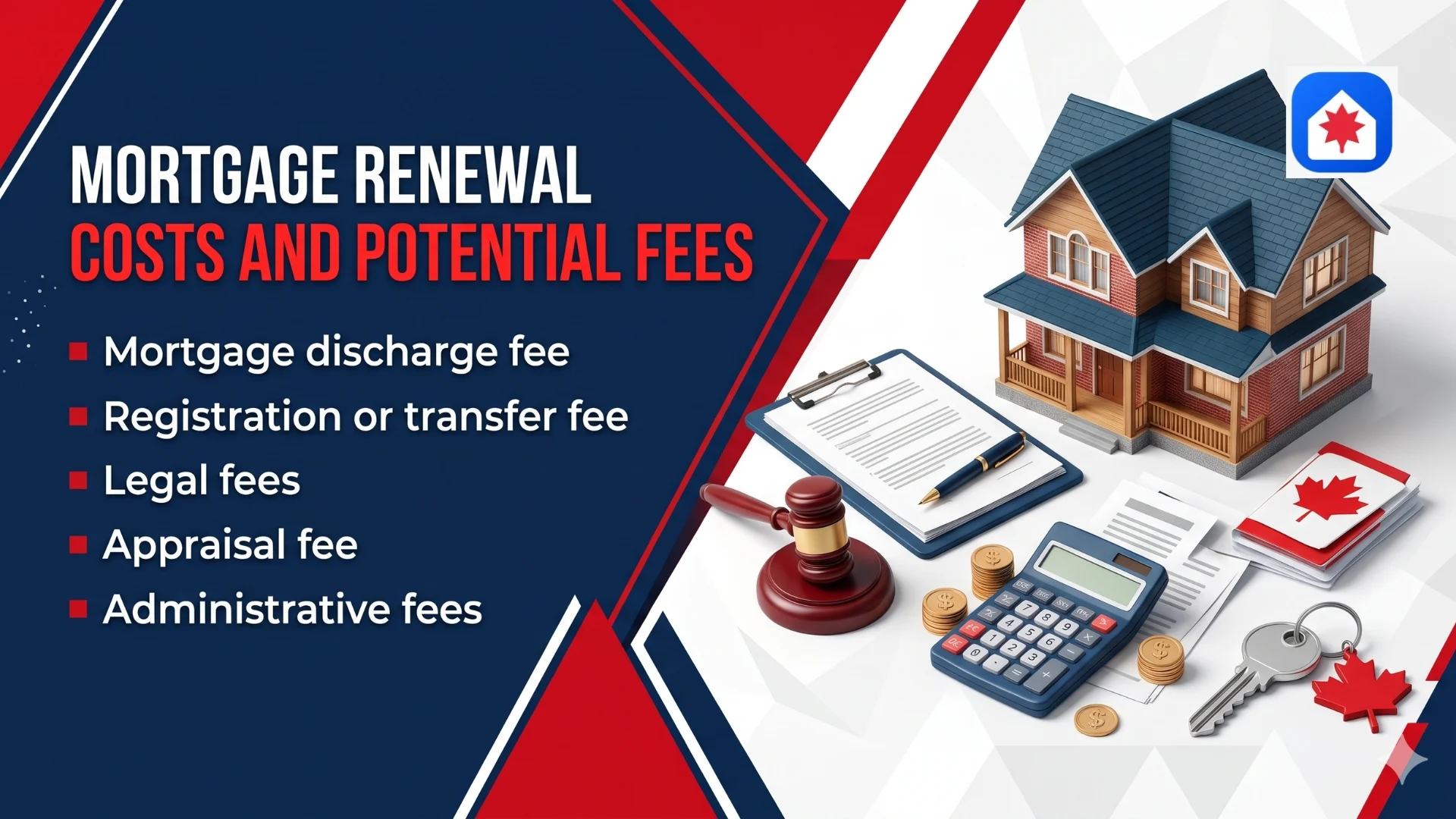
- Mortgage discharge fee: Removing the existing lender's mortgage registration from the property title.
- Registration or transfer fee: Registering the new mortgage or transferring the applicable charge.
- Legal fees: Professional services required to complete mortgage registration and related documents.
- Appraisal fee: Assessing the property's current market value when required.
- Administrative fees: Processing and other lender-related expenses.
The actual fees depend on the lender, property, mortgage registration, and applicable provincial or territorial requirements. Some new lenders may offer to cover certain switching expenses.
7.2. Mortgage Insurance Considerations
If your existing mortgage has mortgage loan insurance, inform your new lender before switching. You may need to pay a new mortgage loan insurance premium if you increase the mortgage amount or extend the amortization period.
However, providing details of your existing insurance may help prevent unnecessary duplicate premiums when you transfer an eligible mortgage. Ask your current lender for your mortgage insurance certificate number and confirm the transfer requirements with the new lender.
7.3. Costs of Extending Your Amortization Period
Extending your amortization period can reduce your regular mortgage payments, but it may increase the total interest you pay over the life of the mortgage.
For example, a homeowner who extends the remaining repayment period from 15 to 20 years may experience lower monthly payments. However, the outstanding principal will take longer to repay, potentially increasing borrowing costs.
Consider this option carefully, particularly if your goal is to reduce short-term financial pressure without significantly increasing long-term expenses.
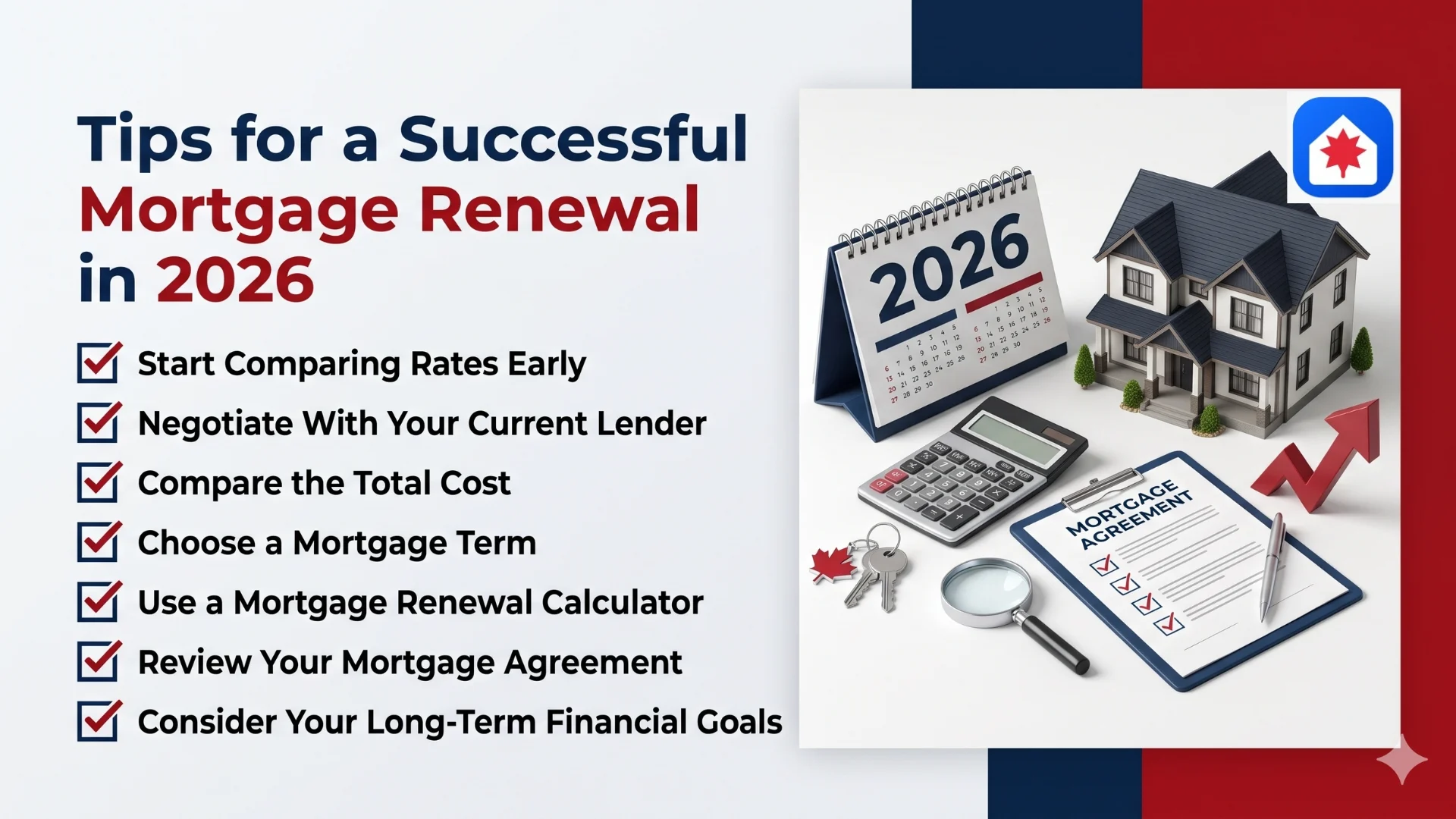
8. Tips for a Successful Mortgage Renewal in 2026
A successful mortgage renewal Canada involves more than finding a lower interest rate. Homeowners should compare available offers, review their financial priorities, and understand the conditions of their new mortgage agreement before making a decision. Here are some practical tips to help you approach your mortgage renewal in 2026.
8.1. Start Comparing Rates Early
Do not wait until your mortgage maturity date to explore your options. Start researching mortgage renewal rates around four to six months in advance. This gives you enough time to compare lenders, request quotes, and negotiate better terms.
8.2. Negotiate With Your Current Lender
Your lender's initial renewal offer may not be its most competitive rate. Contact your mortgage specialist and ask whether they can offer a better deal. If you have received lower quotes from other lenders, use them as leverage during negotiations.
8.3. Compare the Total Cost, Not Just the Interest Rate
A lower interest rate does not always mean a more affordable mortgage. Review additional factors such as:
- Prepayment privileges and penalties.
- Mortgage transfer and discharge fees.
- Payment frequency and flexibility.
- Mortgage term and amortization period.
Consider the overall borrowing cost before choosing an offer.
8.4. Choose a Mortgage Term That Matches Your Plans
Think about how long you expect to stay in your current home and whether your income or financial circumstances may change.
For example, a shorter mortgage term may offer flexibility if you plan to move within a few years, while a longer fixed-rate term may provide greater payment stability.
8.5. Use a Mortgage Renewal Calculator
Before signing a new agreement, use a mortgage renewal calculator Canada homeowners can access to estimate payments at different interest rates.
Compare monthly payments and total interest costs to understand how each option could affect your household budget.
8.6. Review Your Mortgage Agreement Carefully
Read the renewal documents before signing. Check the interest rate, payment schedule, term, amortization period, prepayment privileges, and any additional conditions.
If anything is unclear, ask your lender for an explanation or seek independent professional advice.
8.7. Consider Your Long-Term Financial Goals
Your mortgage renewal Canada is an opportunity to reassess your financial priorities. If you expect major expenses, plan to renovate, or want to pay off your mortgage sooner, discuss suitable options with your lender.
Choose an agreement that supports your financial goals rather than focusing exclusively on securing the lowest available rate.
Frequently Asked Questions
1. Can I negotiate my mortgage renewal rate?
Yes. You can negotiate with your existing lender before signing your renewal agreement. Comparing offers from other financial institutions or mortgage brokers can give you useful leverage.
2. Can I renew my mortgage early?
Yes, some lenders allow homeowners to renew before the maturity date. Depending on the lender, you may be able to lock in a new rate several months in advance or use a blend-and-extend option.
3. What happens if I do not renew my mortgage?
When your mortgage term ends, the outstanding balance must be repaid or placed under a new mortgage agreement. Depending on your existing contract, your mortgage may be automatically renewed under specified conditions if you do not take action. Contact your lender before the maturity date to understand your options and avoid unexpected payment arrangements.
4. Can I change my amortization period at renewal?
You may be able to request a shorter or longer amortization period, depending on your lender's approval and applicable requirements. Shortening the period generally increases regular payments but can reduce total interest costs. Extending it may lower payments but increase the overall cost of borrowing.
5. Is refinancing better than renewing?
Neither option is universally better. Renewal is generally more suitable when you want to continue repaying your existing mortgage under a new term. Refinancing may be appropriate when you need additional funds, want to consolidate debts, or need to restructure your borrowing. Compare qualification requirements, fees, and long-term interest costs before deciding.
6. How long does mortgage renewal take?
Renewing with your current lender may be completed relatively quickly, depending on its procedures and your agreement. Switching lenders or refinancing generally takes longer because the new institution may need to review your application, verify documents, arrange an appraisal, and complete legal registration.
Mortgage renewal Canada is an opportunity for homebuyer to reassess their financial priorities and secure mortgage conditions that better match their current circumstances. Rather than automatically accepting your lender's first offer, take time to compare rates, negotiate terms, and evaluate whether renewing, switching lenders, or refinancing is the most appropriate choice. Start preparing several months before your mortgage maturity date, review all associated costs, and calculate how different interest rates and amortization periods could affect your payments.
For additional support with Canadian home financing decisions, explore CanadaHomeHub, where you can access practical financial calculators and resources to help you plan your next steps.
Thank you for taking the time to read this article.