Opening a bank account is one of the first financial steps when settling in Canada. Whether you have recently become a permanent resident, arrived as an international student, or moved for work, having a reliable bank account makes it easier to receive your income, pay bills, manage everyday expenses, and transfer money. However, choosing the best bank for newcomers Canada involves more than comparing welcome bonuses. You should also consider account fees after promotional periods, branch accessibility, transaction limits, and the services you are likely to use. This guide compares 6 major Canadian banks and explains their newcomer banking options. Let's find out.
1. Understanding Banking Options for Newcomers in Canada
Before comparing banks, it is helpful to understand the main types of accounts available in Canada.
1.1. Chequing Accounts vs. Savings Accounts
Canadian banks generally offer two main types of personal deposit accounts:
- Chequing accounts are designed for everyday banking. You can use them to receive your salary, pay rent and utility bills, make debit card purchases, withdraw cash, and send money through Interac e-Transfer. Most newcomer banking packages include a chequing account as their primary product.
- Savings accounts are intended for setting aside money and earning interest. They can help you build an emergency fund, save for future expenses, or keep money separate from your regular spending balance. Depending on the bank and account, interest rates and withdrawal conditions may vary.
For example, someone who has just moved to Toronto might use a chequing account to receive their first paycheque and pay monthly rent, while keeping several months of living expenses in a separate savings account. Opening both accounts can make budgeting easier, but you do not necessarily need to use the same bank for both.
1.2. What Makes a Newcomer Bank Account Different?
A newcomer bank account Canada is a banking product or package designed to help eligible newcomers establish their finances without meeting every requirement that may apply to existing Canadian customers.
These packages commonly provide:
- Reduced or waived monthly account fees for a promotional period.
- Unlimited or higher transaction allowances.
- Access to a debit card and online banking.
- International money transfer services.
- Opportunities to apply for a newcomer credit card.
- Financial guidance and additional welcome benefits.
One important advantage is that some newcomer programs allow eligible applicants to access banking services without an established Canadian credit history.
Opening a bank account is just one part of getting established in a new country. Newcomers can also explore CanadaHomeHub to learn more about essential steps, financial considerations, and other practical aspects of life in Canada.
2. Best Banks for Newcomers Canada in 2026
Several major Canadian banks offer dedicated programs for immigrants, international students, and foreign workers. The following institutions are worth comparing based on their account benefits, accessibility, and newcomer services.
2.1. RBC - Royal Bank of Canada
RBC (Royal Bank of Canada) offers the RBC Newcomer Advantage, a banking package designed to help eligible newcomers manage their finances and access essential financial services. Its main everyday banking option is the RBC Advantage Banking account.
Key benefits include:
- No monthly account fee for the first 12 months for eligible newcomers.
- Unlimited debit transactions in Canada.
- Access to online and mobile banking.
- International money transfer services with eligible transfer-fee waivers.
- Opportunities to apply for a newcomer credit card without an established Canadian credit history, subject to eligibility and approval.
RBC also offers banking support in multiple languages, making it a convenient option for newcomers who may not yet feel comfortable handling complex financial matters in English or French. Its newcomer credit card program may offer a credit limit of up to $15,000 to eligible applicants, although approval and the actual limit depend on the bank's criteria.
RBC may be suitable for newcomers who want a traditional bank with everyday banking services, credit-building opportunities, and access to in-person support.
2.2. TD - TD Canada Trust
TD Canada Trust provides the TD New to Canada Banking Package, which combines everyday banking products with services designed for people who have recently moved to Canada. One main option is the TD Unlimited Chequing Account.
Key benefits include:
- No monthly account fee for the first 12 months for eligible newcomers.
- Unlimited transactions with the selected chequing account.
- Access to TD ATMs in Canada without TD ATM fees under the applicable offer.
- Free Interac e-Transfers under the account conditions.
- Savings account options and promotional interest offers.
- Access to credit card products designed for newcomers.
TD may be a good choice for newcomers who value in-person banking, need regular access to ATMs, or prefer keeping their everyday financial services with one institution.
2.3. Scotiabank
Scotiabank offers the StartRight program designed for permanent residents, international students, and foreign workers. Its banking package includes access to chequing and savings accounts, credit cards, international transfers, and financial advice.
Key benefits include:
- No monthly account fee on the Preferred Package chequing account for the first year under the newcomer offer.
- Access to international money transfer services with eligible transfer-fee waivers.
- Credit card options for newcomers.
- Financial guidance from Scotiabank advisors.
- Additional banking and financing options as customers establish themselves in Canada.
One of the program's notable features is its international money transfer service. The current StartRight information advertises transfers to 73 countries with no transfer fees, subject to applicable conditions. Currency exchange rates and other applicable charges may still affect the amount received.
Scotiabank may be worth considering if you regularly send money to family overseas, maintain financial commitments in another country, or want access to a range of newcomer banking services.
2.4. BMO - Bank of Montreal
BMO (Bank of Montreal) offers the NewStart program to eligible newcomers who have arrived in Canada within the last five years. One of its main advantages is the extended introductory banking period.
Key benefits include:
- No monthly plan fee for two years with the Performance Chequing Account under the NewStart program.
- Unlimited transactions with the eligible Performance Plan.
- No-fee BMO Global Money Transfers under applicable conditions.
- Access to credit card options for newcomers.
- Financial guidance through BMO branches.
- Additional promotional benefits that may include cash bonuses and partner offers.
BMO may be a suitable option for permanent residents and eligible foreign workers who want an extended period of no-fee everyday banking.
2.5. CIBC - Canadian Imperial Bank of Commerce
CIBC (Canadian Imperial Bank of Commerce) provides the CIBC Smart Account for Newcomers, which combines everyday banking benefits with additional offers for eligible new customers.
Key benefits include:
- No monthly account fee for two years under the newcomer offer.
- Unlimited transactions with the eligible account.
- Access to newcomer credit card options.
- Additional promotional benefits through eligible banking bundles.
- Digital and in-branch banking services.
CIBC may appeal to newcomers who want an extended fee-free banking period and prefer combining everyday banking with additional promotional benefits.
2.6. National Bank of Canada
National Bank of Canada offers a dedicated newcomer account with benefits that can be particularly attractive to people settling in Quebec.
Key benefits include:
- No fixed monthly account fee during the first year.
- Reduced account fees in the second and third years, subject to conditions.
- Unlimited eligible online transactions and Interac e-Transfers.
- Access to branches and ATMs.
- International money transfer services.
- Twelve months of telephone legal assistance through its partner, subject to the program terms.
To maintain the maximum fee savings during the second and third years, customers may need to maintain a minimum daily balance of $4,500 or meet specific product and transaction requirements.
National Bank is worth considering for newcomers settling in Quebec, particularly those who prefer French-language banking services and want access to a local branch network.
3. Comparing the Best Canadian Banks for Immigrants
After reviewing individual newcomer programs, comparing their main benefits side by side can make the decision easier.
3.1. Monthly Fees and Promotional Periods
One of the most important differences between newcomer banking packages is how long the monthly account fee is waived.
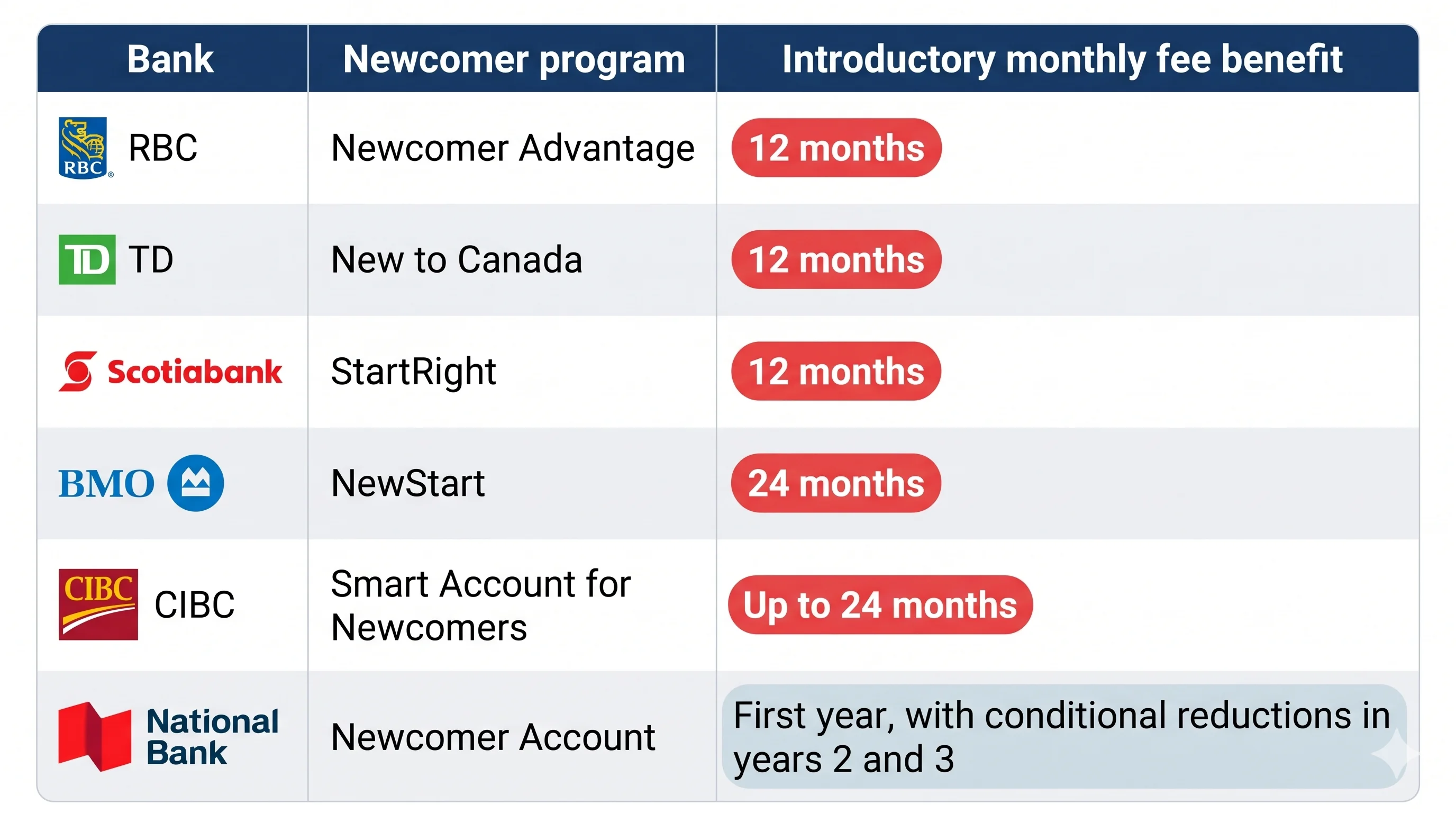
A longer fee waiver can reduce your banking expenses during the first years in Canada. However, it does not automatically make an account the cheapest option over the long term.
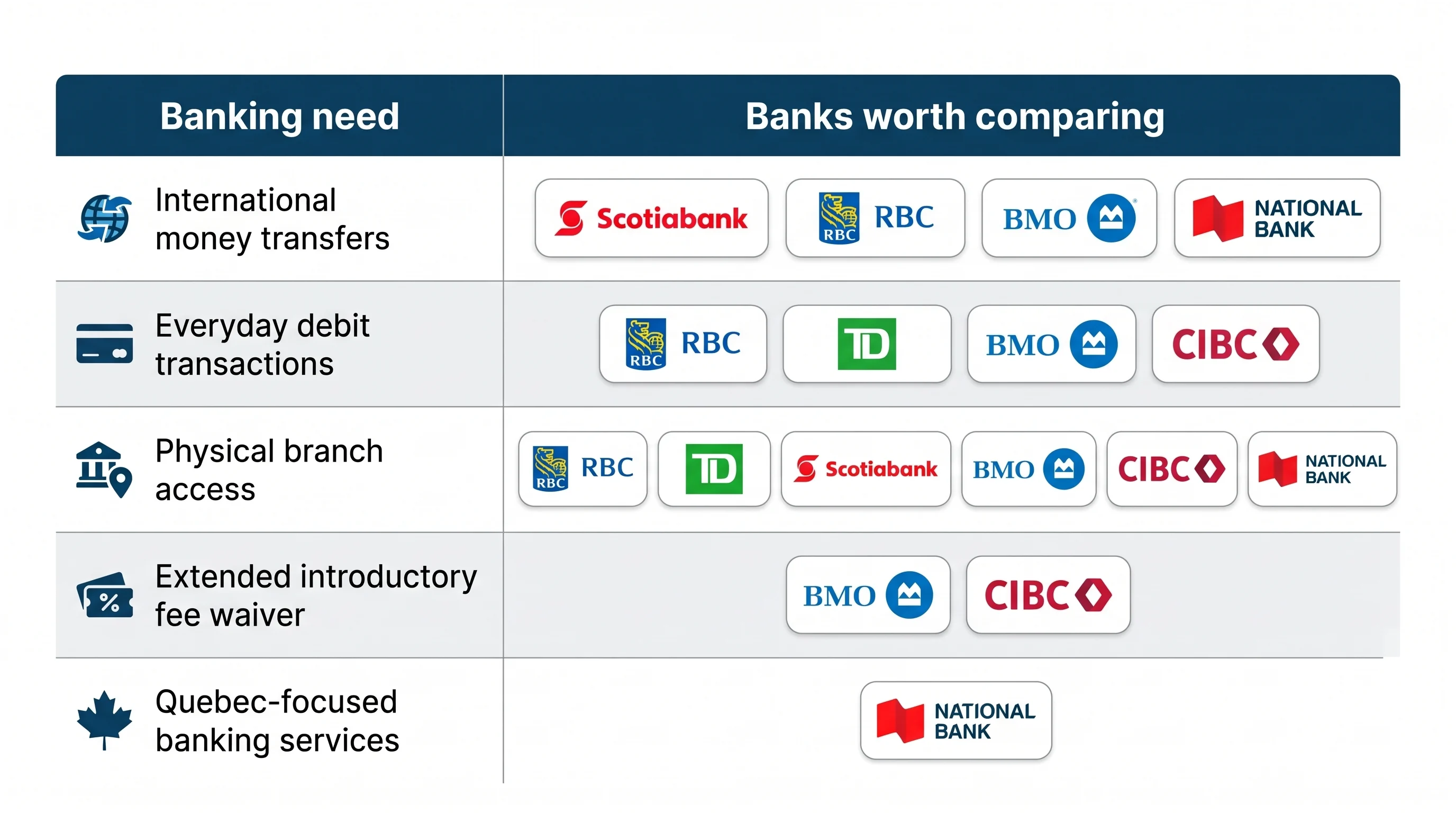
3.2. International Transfers, ATM Access and Digital Banking
Your banking habits should also influence your choice. The best bank for newcomers Canada depends on where you live, how frequently you withdraw cash, and whether you need to transfer money internationally.
3.3. Credit Cards and Building a Canadian Credit History
Opening a chequing account helps establish your everyday financial routine, but it does not automatically build a credit history. To start developing a Canadian credit profile, you may want to consider applying for a newcomer credit card.
Some major banks provide credit card options for eligible permanent residents, international students, and temporary foreign workers who do not have an established Canadian credit history.
When comparing these cards, consider:
- Annual fees.
- Interest rates.
- Credit limits.
- Eligibility requirements.
- Rewards and cashback benefits.
- Whether a security deposit is required.
4. How to Choose the Right Bank Account for Newcomers
Finding the best Canadian bank for immigrants means identifying an account that matches your current financial situation and remains affordable as your circumstances change.
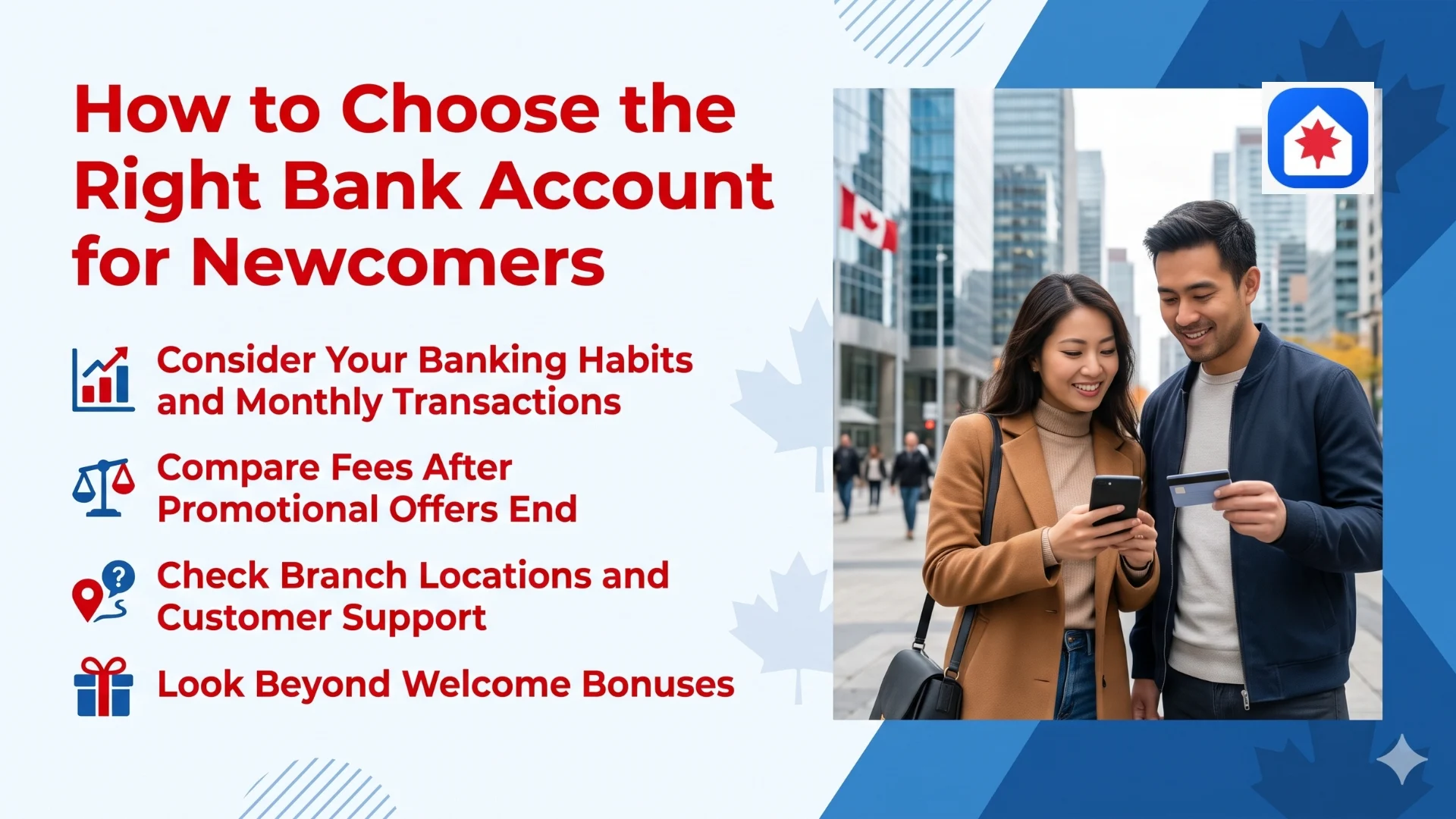
4.1. Consider Your Banking Habits and Monthly Transactions
Start by identifying how you expect to use your account. If you receive regular employment income, make frequent debit purchases, and pay bills online, an account with unlimited transactions may be convenient. On the other hand, if you mainly receive money and make a few withdrawals each month, a basic or low-cost account may be sufficient.
Think about whether you need:
- Unlimited debit transactions.
- Free Interac e-Transfers.
- Regular ATM withdrawals.
- International money transfers.
- Mobile cheque deposits.
- Access to a savings account.
Choosing features based on actual usage can prevent you from paying for services you rarely need.
4.2. Compare Fees After Promotional Offers End
A newcomer account may have no monthly fee initially, but the regular fee can become an ongoing expense once the promotional period expires.
Check the following costs before opening an account:
- Regular monthly account maintenance fees.
- Minimum balance requirements for fee waivers.
- ATM withdrawal charges outside the bank's network.
- Interac e-Transfer fees, if applicable.
- Overdraft and insufficient-funds charges.
- Foreign currency transaction and international transfer costs.
Canada also has a federal framework for low-cost and no-cost bank accounts. A low-cost account has a monthly fee of no more than $4, while eligible newcomers can access a no-cost account during their first year in Canada at participating institutions. These accounts may be worth considering if you do not need the additional features included in premium newcomer packages.
Managing banking fees is only one part of planning your finances as a newcomer. You can visit CanadaHomeHub to explore more resources on everyday financial matters, housing costs, and other expenses involved in settling in Canada.
4.3. Check Branch Locations and Customer Support
Although online banking is convenient, in-person assistance can be useful when you are opening your first Canadian account. You may need help verifying your identity, activating a debit card, understanding account conditions, or applying for a credit card.
Before choosing a bank, check:
- Whether there is a branch near your home, school, or workplace.
- Whether the bank offers multilingual customer support.
- Whether appointments are required to open an account.
- Whether you can complete routine transactions through its mobile app.
The availability of services can vary by location, so checking nearby branches before making a decision is worthwhile.
4.4. Look Beyond Welcome Bonuses
Cash rewards and promotional gifts can make a banking package attractive, but they should not be your only deciding factor. A welcome bonus may require several steps, such as setting up payroll deposits, paying bills through the account, or maintaining a minimum balance.
Consider a simple example.
Two newcomers are comparing different accounts. Bank A offers a $500 cash reward but requires multiple qualifying activities. Bank B offers no cash reward but provides a lower ongoing monthly fee and the services they regularly use. If Bank B results in lower total banking expenses over several years, it may be the more practical choice.
The right account should support your financial routine rather than encourage you to purchase unnecessary services simply to receive a promotional reward.
5. Practical Banking Tips for Your First Year in Canada
Choosing the right account is only the first step. Developing good banking habits can help you manage your money more effectively while adjusting to a new financial environment.
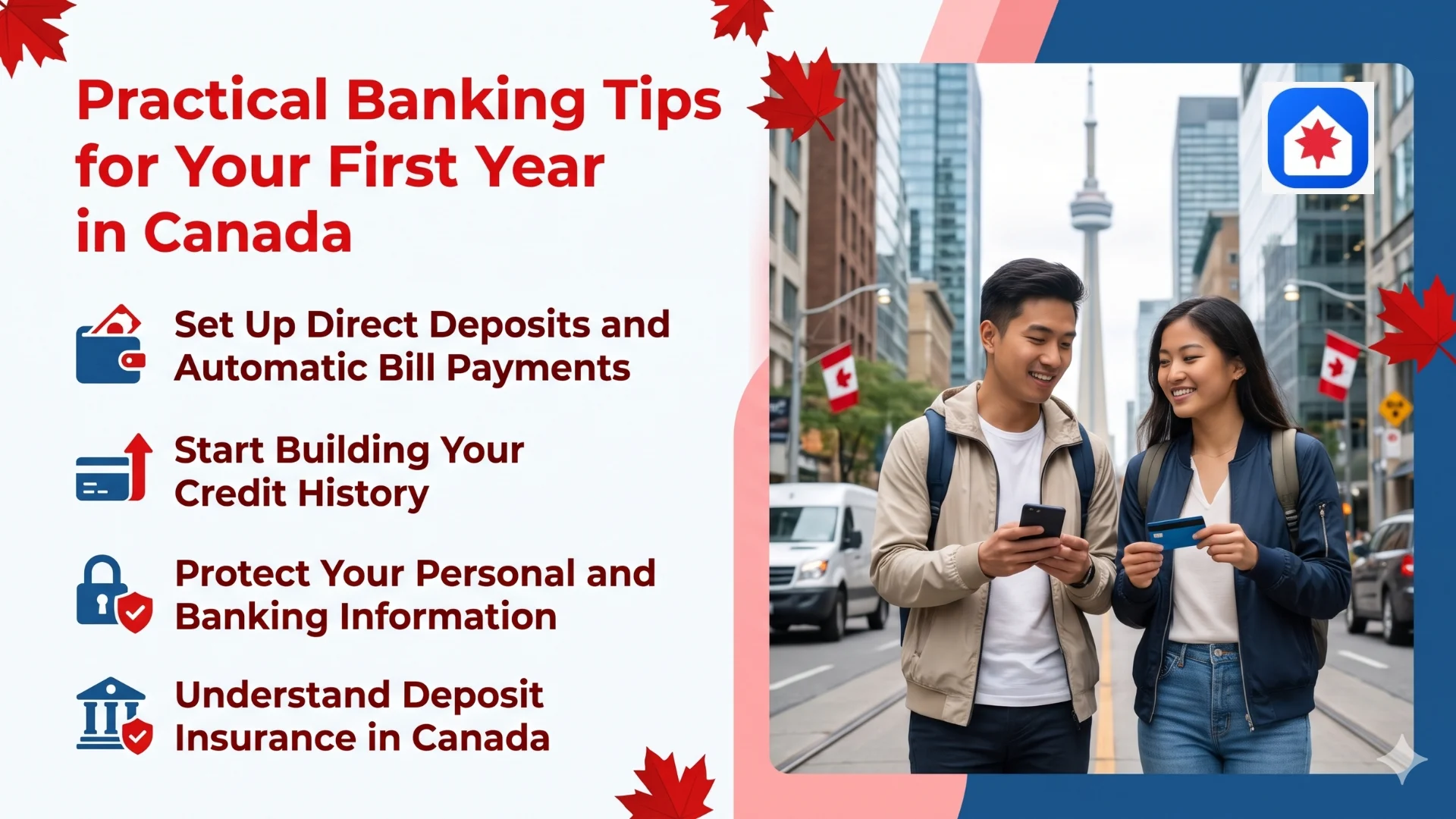
5.1. Set Up Direct Deposits and Automatic Bill Payments
If you start working in Canada, provide your employer with the appropriate direct deposit information so your salary can be deposited directly into your account.
You can also arrange automatic payments for recurring expenses such as rent, electricity and internet bills, mobile phone plans, insurance premiums, and subscription services. Before authorizing automatic withdrawals, make sure your account has sufficient funds. Otherwise, you may face insufficient-funds fees or missed payments.
It is also important to review your statements regularly to identify unexpected transactions.
5.2. Start Building Your Credit History
A Canadian credit history can become important when you apply for a credit card, rent certain properties, finance a vehicle, or eventually seek a mortgage.
If you qualify for a newcomer credit card, use it responsibly. Pay your bills on time, avoid consistently using most of your available credit, and review your statements for errors. A useful starting point is to keep your credit card spending within an amount you can comfortably repay in full each month.
Remember that opening a bank account alone does not establish a credit score. Your credit activity must be reported to Canada's credit bureaus through eligible credit products.
5.3. Protect Your Personal and Banking Information
Newcomers may be unfamiliar with Canadian banking procedures, which can make it easier for scammers to exploit their lack of experience.
To protect your finances:
- Never share your online banking password or one-time verification codes.
- Use official bank websites and mobile applications.
- Avoid clicking suspicious links in emails or text messages.
- Enable transaction notifications when available.
- Contact your bank immediately if you notice unauthorized activity.
- Avoid sending money to people or organizations you cannot independently verify.
5.4. Understand Deposit Insurance in Canada
Another important part of choosing a bank is understanding how your deposits are protected.
The Canada Deposit Insurance Corporation (CDIC) provides automatic deposit insurance for eligible deposits held at member institutions. Coverage is up to $100,000 per insured category, per member institution, including principal and interest. Eligible products include chequing accounts, savings accounts, and certain Guaranteed Investment Certificates (GICs). Mutual funds, stocks, bonds, exchange-traded funds, and cryptocurrencies are not covered by CDIC deposit insurance.
For example, if you hold $40,000 in an eligible chequing account and $30,000 in an eligible savings account in your own name at the same CDIC member institution, the combined $70,000 falls within the $100,000 coverage limit for deposits held in one name.
Before depositing a large amount, verify that your financial institution is a CDIC member and that your particular product qualifies for protection.
Frequently Asked Questions
1. What is the best bank for newcomers Canada?
There is no single bank that is best for everyone. BMO and CIBC offer up to two years of fee-free newcomer banking, while RBC, TD, and Scotiabank provide one-year introductory fee waivers. National Bank offers a different fee-reduction structure that may be attractive to newcomers in Quebec. Your decision should depend on account fees, eligibility, branch access, international transfer needs, and the services you expect to use.
2. Can I open a bank account in Canada without a SIN?
A SIN is not universally required as an identification document for opening a basic personal bank account. Banks must verify your identity using acceptable identification, and their requirements can vary.
3. Can newcomers open a Canadian bank account before arriving?
Yes. Some Canadian banks offer pre-arrival banking services for eligible newcomers, allowing them to begin the application process before moving. However, you may still need to visit a branch after arriving to complete identity verification, activate your account, or receive your debit card.
4. Can international students open bank accounts in Canada?
Yes. International students can generally open personal bank accounts in Canada if they meet the bank's identification and application requirements.
5. What documents do immigrants need to open a bank account in Canada?
Commonly accepted documents include a valid passport, Permanent Resident Card, Confirmation of Permanent Residence, work permit, or study permit. You may also need additional identification or proof of address, depending on the bank's verification process. Contact your chosen institution before visiting to confirm the exact documents required for your immigration status.
Choosing the right bank is an important step toward managing your finances after moving to Canada. RBC, TD, Scotiabank, BMO, CIBC, and National Bank each offer newcomer banking options with different benefits, fee structures, and eligibility requirements. When comparing the best bank for newcomers Canada, look beyond introductory promotions. Consider the regular monthly fees, international transfer costs, transaction limits, branch accessibility, and opportunities to build your Canadian credit history. Taking time to compare these factors can help you choose an account that supports both your immediate needs and longer-term financial goals.
Ready to take the next step in your life in Canada? Visit CanadaHomeHub to explore practical financial tools, helpful newcomer guides, and trusted resources that can help you make informed decisions about your finances, housing, and everyday life in Canada.
Thank you for taking the time to read this article.