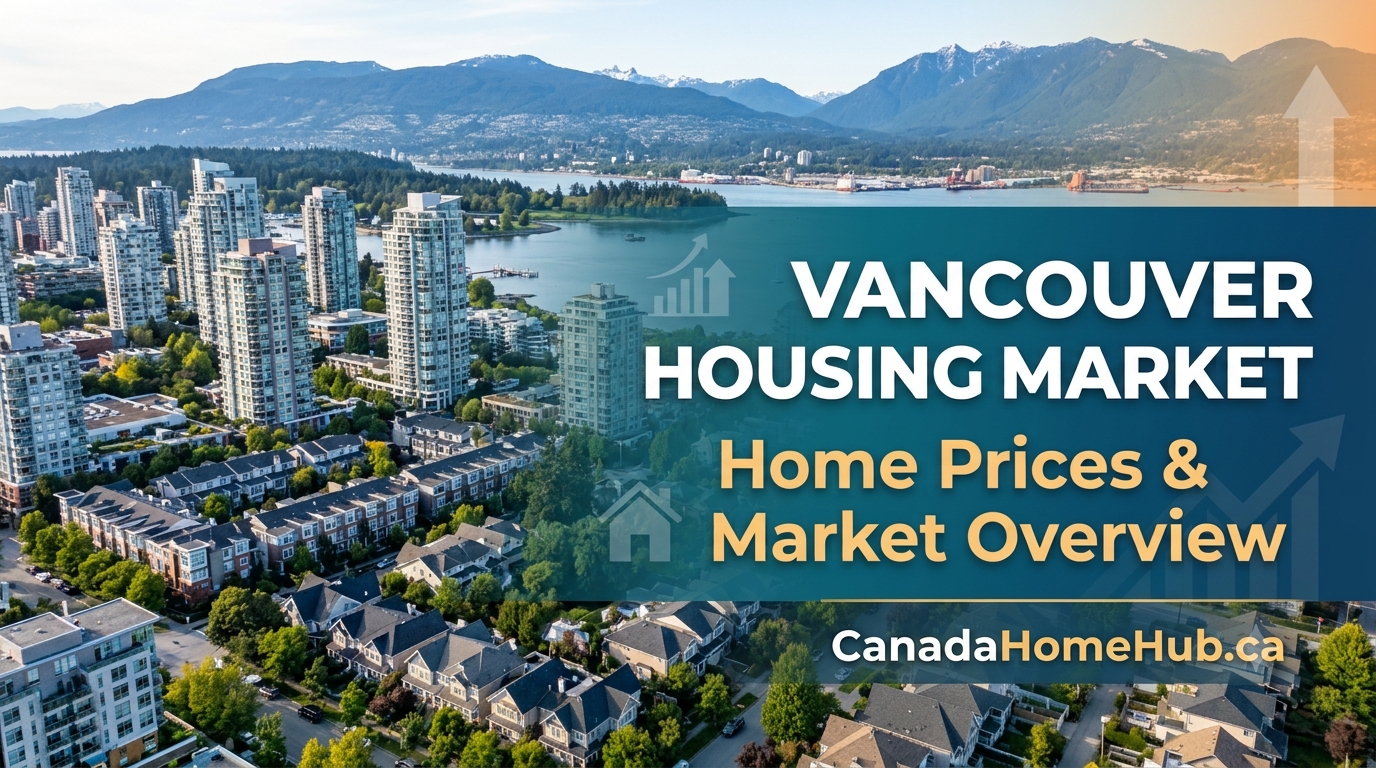
Navigating the housing market Vancouver offers requires understanding a landscape shaped by severe geographic boundaries, layered municipal and provincial taxes, and wide price gaps between housing types. As one of Canada's highest-priced urban real estate markets, Vancouver operates differently from most other North American cities.
Whether you are a first-time buyer evaluating an entry-level condominium, a growing household comparing townhomes across Metro Vancouver, or a homeowner tracking equity trends, headline average prices rarely tell the full story. This overview examines how Vancouver home prices are structured across property types and neighbourhoods, the policies influencing affordability, and the practical steps required to buy or sell in British Columbia.
Understanding the Vancouver Housing Market Landscape
To interpret Vancouver real estate market statistics accurately, buyers and sellers must first understand the physical and administrative boundaries governing local housing supply.
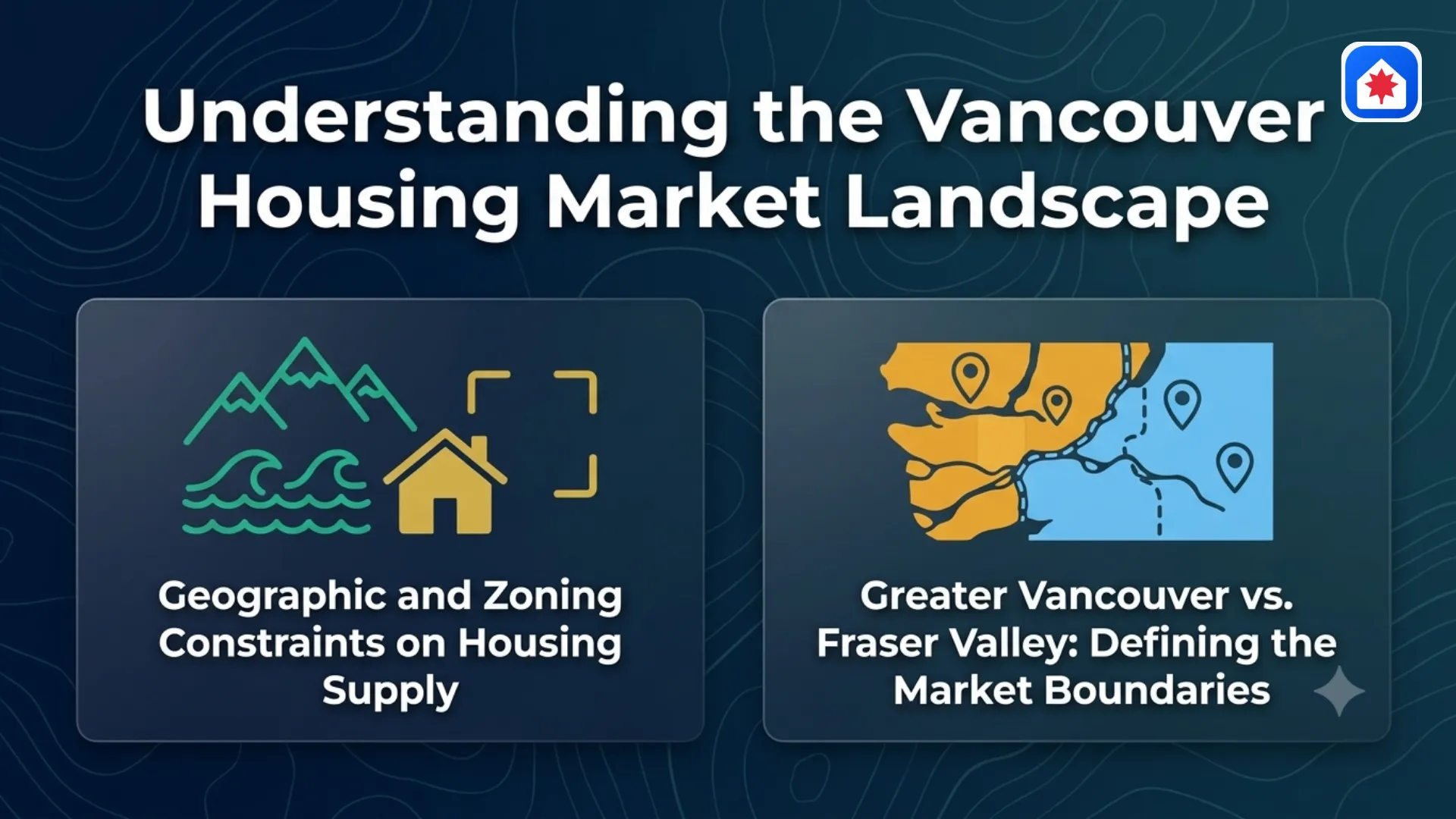
Geographic and Zoning Constraints on Housing Supply
Vancouver sits on a peninsula bounded by the Pacific Ocean to the west, the Coast Mountains to the north, the Fraser River and the U.S. border to the south, and the protected Agricultural Land Reserve (ALR) to the east. Established in the 1970s to preserve farmland across British Columbia, the ALR restricts outward suburban sprawl onto valley land.
Because developable land is scarce, land value frequently accounts for the majority of a detached home's price. Historically, large portions of the City of Vancouver and neighbouring municipalities were also zoned exclusively for single-family detached homes, concentrating multi-family density along major transit corridors and downtown towers.
Greater Vancouver vs. Fraser Valley: Defining the Market Boundaries
Two separate real estate boards track residential sales across the Lower Mainland:
- Greater Vancouver Realtors (GVR): Formerly the Real Estate Board of Greater Vancouver (REBGV), GVR covers the City of Vancouver, Burnaby, Richmond, North Vancouver, West Vancouver, New Westminster, the Tri-Cities (Coquitlam, Port Coquitlam, Port Moody), Maple Ridge, Pitt Meadows, Squamish, and the Sunshine Coast.
- Fraser Valley Real Estate Board (FVREB): Covers communities immediately south and east, including Surrey, North Delta, White Rock, Langley, Abbotsford, and Mission.
Although commuters treat Metro Vancouver and the Fraser Valley as one connected region, their statistical reports are published separately. Comparing composite numbers across boards without adjusting for geography can distort market trends.
Vancouver Home Prices by Property Type
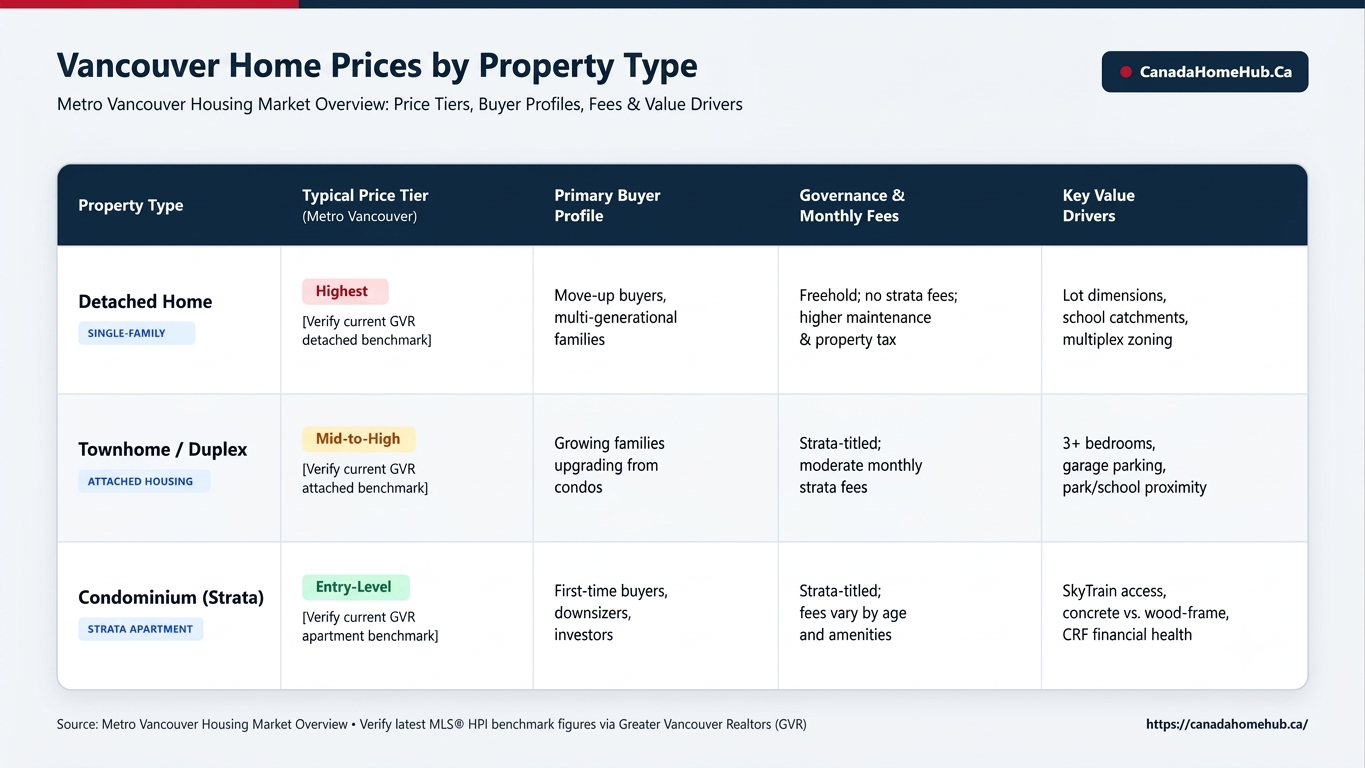
British Columbia real estate boards rely on the MLS® Home Price Index (HPI) benchmark price rather than simple arithmetic averages. A handful of ultra-luxury waterfront sales in West Vancouver can skew an average price upward in a single month, whereas the HPI benchmark tracks the estimated value of a "typical" home with standardized attributes (floor area, age, lot size, and bedroom count).
Editorial note: Before publishing, verify and insert current monthly MLS® HPI figures from Greater Vancouver Realtors (gvrealtors.ca).
Detached Single-Family Homes
Detached houses sit at the top of the Vancouver house prices hierarchy and represent a shrinking share of housing stock inside the urban core.
- Market dynamics: As older single-family lots are redeveloped into multiplexes, townhomes, or mid-rise buildings, traditional detached inventory in Vancouver continues to tighten.
- Buyer profile: High-equity move-up buyers, multi-generational families, and custom builders.
- Ongoing costs: Owners avoid monthly strata fees but bear full responsibility for roof, drainage, exterior maintenance, and municipal property taxes.
Townhomes and Attached Housing
Townhomes (including row houses and duplexes) bridge the gap between high-rise condos and single-family houses, remaining chronically undersupplied relative to family demand.
- Market dynamics: Townhomes often hold steady demand even when interest rates rise, as families priced out of detached houses compete for ground-oriented three-bedroom layouts.
- Buyer profile: Young families upgrading from one- or two-bedroom condos who want direct street or courtyard access.
- Ongoing costs: Most BC townhomes operate under strata corporations governed by the Strata Property Act. Monthly strata fees cover building insurance, landscaping, and contingency reserve contributions, usually at a lower rate per square foot than high-rise towers with elevators and concierge services.
Condominiums and Strata Apartments
Condominiums serve as the primary entry point into Metro Vancouver homeownership and account for the largest share of annual transactions.
- Market dynamics: Values depend heavily on building age, concrete versus wood-frame construction, proximity to SkyTrain stations, and air conditioning or amenities. Older 1970s and 1980s low-rise wood-frame buildings in East Vancouver or Burnaby cost significantly less than new concrete high-rises near transit hubs, though buyers must budget for upcoming building envelope or plumbing upgrades.
- Buyer profile: First-time buyers, downsizers, students, and long-term investors.
- Ongoing costs: Monthly strata fees can add several hundred dollars to carrying costs, particularly in amenity-rich towers or older buildings rebuilding their Contingency Reserve Funds (CRF).
Price Variations Across Metro Vancouver Neighbourhoods
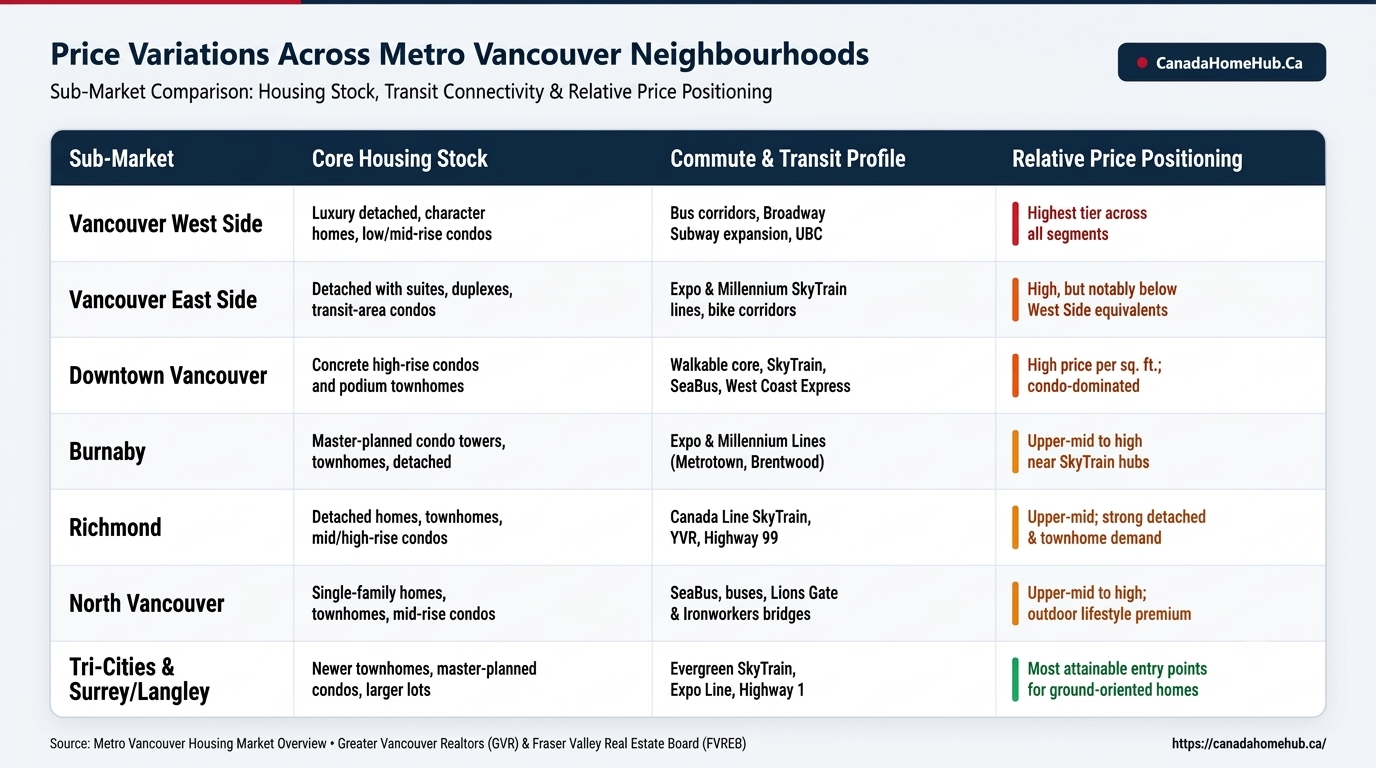
Location creates steep price differences across short distances in the Lower Mainland. Crossing a single bridge or arterial boundary can shift values by hundreds of thousands of dollars.
City of Vancouver: West Side, East Side, and Downtown
-
Vancouver West Side: Covering Kitsilano, Kerrisdale, Dunbar, Point Grey, Arbutus Ridge, and Shaughnessy, the West Side commands the city's highest prices, supported by proximity to the University of British Columbia (UBC), beaches, and top-ranked schools.
- Vancouver East Side: Encompassing Commercial Drive, Mount Pleasant, Hastings-Sunrise, Renfrew-Collingwood, Killarney, and Victoria-Fraserview, the East Side offers lower prices than equivalent West Side properties and features character homes with secondary rental suites, laneway houses, and transit-oriented condos.
- Downtown & False Creek: Including Yaletown, Coal Harbour, the West End, and Olympic Village, this sub-market is predominantly high-rise condominiums priced around waterfront views, walkability, and central business district access.
Inner-Ring Suburbs: Burnaby, Richmond, and the North Shore
-
Burnaby: Anchored by four SkyTrain town centres—Metrotown, Brentwood, Lougheed, and Edmonds—Burnaby features modern high-rise towers rivaling Vancouver condo prices alongside more attainable older low-rises.
- Richmond: Located south of Vancouver across the Fraser River, Richmond offers flat terrain, Canada Line SkyTrain access, and proximity to Vancouver International Airport (YVR). Detached buyers should verify flood-plain insurance requirements and municipal elevation bylaws.
- North Shore (North Vancouver & West Vancouver): Across Burrard Inlet, West Vancouver holds some of Canada's highest detached home prices, while North Vancouver provides a broader mix of condos, townhomes, and family homes near mountain trails—balanced against daily bridge traffic on the Lions Gate and Ironworkers Memorial bridges.
Outer Metro Communities: Tri-Cities, Surrey, and Langley
-
Tri-Cities (Coquitlam, Port Coquitlam, Port Moody): Linked via the Millennium Line's Evergreen Extension, these communities attract families seeking newer townhomes and larger lots within commuting distance of downtown Vancouver.
- Surrey & Langley: Tracked by the Fraser Valley Real Estate Board, Surrey and Langley absorb substantial spillover demand from Metro Vancouver, accelerated by the SkyTrain expansion along Fraser Highway toward Langley City.
Key Economic and Policy Factors Shaping Vancouver Real Estate
Because Vancouver home prices sit at a high multiple of local household incomes, borrowing rules and government policies strongly influence market activity.
Bank of Canada Interest Rates and Mortgage Qualification
Canadian variable-rate mortgages track the Bank of Canada (BoC) overnight policy rate, while fixed-rate mortgages follow Government of Canada bond yields. Federally regulated lenders also enforce the OSFI minimum qualifying rate (the mortgage stress test), requiring borrowers to qualify at either 5.25% or their contract rate plus 2%, whichever is higher.
Editorial note: Verify and insert the current Bank of Canada policy rate before publication.
Provincial and Municipal Real Estate Taxes
Buying and holding property in Vancouver involves several layers of taxation:
- BC Property Transfer Tax (PTT): Calculated on a tiered scale at closing: 1% on the first $200,000 of fair market value, 2% between $200,000 and $2,000,000, 3% above $2,000,000, plus an extra 2% on residential value over $3,000,000. Eligible Canadian citizens and permanent residents may qualify for exemptions under the First-Time Home Buyers' Program or Newly Built Home Exemption (verify current BC Ministry of Finance price thresholds).
- Federal Foreign Buyer Ban: Under Canada's Prohibition on the Purchase of Residential Property by Non-Canadians Act, most non-Canadians cannot purchase residential real estate in Census Metropolitan Areas like Vancouver unless they meet narrow exemptions—in which case BC also applies a 20% Additional Property Transfer Tax in Metro Vancouver.
- BC Speculation and Vacancy Tax (SVT): An annual provincial tax targeting vacant homes in designated urban regions, including Metro Vancouver. Principal residences and properties rented at least six months per year are generally exempt, though annual declarations are mandatory for all owners.
- City of Vancouver Empty Homes Tax (EHT): A separate municipal tax levied on residential properties within the City of Vancouver left unoccupied for more than six months in a calendar year without an exemption.
Supply-Side Policy Shifts and Multi-Unit Zoning Reforms
British Columbia's Bill 44 (Small-Scale Multi-Unit Housing) and Bill 47 (Transit-Oriented Areas) are reshaping long-term supply. Bill 44 requires municipalities to permit three to four units on single-family lots (and up to six near frequent transit), while Bill 47 sets minimum allowable heights and densities within 800 metres of SkyTrain stations and major bus exchanges. Together, these rules encourage duplex, multiplex, and mid-rise infill across established neighbourhoods.
Practical Examples: Total Ownership Costs for Vancouver Buyers
Sticker price tells only part of the financial story. The scenarios below illustrate how upfront and ongoing costs vary by buyer profile.
Scenario 1: First-Time Buyer Purchasing an Inner-Suburb Condo
-
Profile: A buyer purchasing a one-bedroom wood-frame condo near a SkyTrain station in East Vancouver or Burnaby.
- Financial considerations: Homes under $500,000 require a minimum 5% down payment; homes between $500,000 and $1,499,999 require 5% on the first $500,000 and 10% on the remainder (plus mortgage default insurance when putting down less than 20%). Combining the First Home Savings Account (FHSA), Home Buyers' Plan (HBP), and BC's first-time buyer PTT exemption significantly reduces upfront cash needs. Reviewing two years of strata minutes and the Depreciation Report is vital to avoid unexpected special levies.
Scenario 2: Growing Family Upgrading to a Metro Vancouver Townhome
-
Profile: Homeowners selling a two-bedroom Vancouver condo to buy a three-bedroom townhome in Coquitlam, Richmond, or North Vancouver.
- Financial considerations: Repeat buyers pay full provincial PTT—meaning a $1,150,000 townhome incurs $21,000 in PTT alone ($2,000 on the first $200,000 + $19,000 on the remaining $950,000), plus legal fees, inspection costs, and selling commissions. Short-term bridge financing is often necessary if the townhome closes before the existing condo sale completes.
Scenario 3: Out-of-Province Buyer Evaluating Carrying Costs and Taxes
-
Profile: A buyer relocating from Calgary or Toronto purchasing a Vancouver property either as a primary home or part-time residence.
- Financial considerations: Using a Vancouver unit only part-time without renting it long-term can trigger both the provincial SVT and the municipal EHT. Additionally, BC's Short-Term Rental Accommodations Act restricts platforms like Airbnb and Vrbo strictly to a host's principal residence (plus one secondary suite or laneway home) in communities over 10,000 residents, preventing standalone condos from operating as vacation rentals.
Navigating the Vancouver Real Estate Market: Actionable Steps
Essential Steps for Buyers
-
Obtain Written Mortgage Pre-Approval: Confirm your stress-tested borrowing limit and rate-hold period with a lender before submitting offers.
- Reserve 1.5% to 3.5% for Closing Costs: Budget separately for BC Property Transfer Tax, legal/notary fees, title insurance, and property tax adjustments.
- Account for BC's Home Buyer Rescission Period (HBRP): Buyers have a mandatory three-business-day cooling-off period after offer acceptance to rescind a residential contract, subject to a 0.25% statutory rescission fee paid to the seller. Standard subject clauses (financing, inspection, strata document review) remain essential because they allow penalty-free withdrawal if a condition fails.
- Benchmark Sold Comparables: Base offers on recent sold prices rather than asking prices. Consulting Canadian housing resources like CanadaHomeHub.Ca alongside local MLS® statistics helps contextualize regional price trends and ownership expenses across Canada.

Strategic Considerations for Sellers
-
Price to Current Micro-Market Liquidity: Accurate pricing based on recent neighbourhood sales attracts stronger initial offers than overpricing and chasing the market downward.
- Assemble Strata and Permit Records Early: Ordering the Form B Information Certificate, bylaws, financial statements, and engineering reports prior to listing accelerates buyer due diligence.
- Align With Seasonal Listing Windows: Metro Vancouver typically sees its highest inventory and buyer activity in spring (March–June) and a secondary wave in September–October.
Frequently Asked Questions
Why are Vancouver home prices among the highest in Canada?
Severe geographic barriers—the Pacific Ocean, Coast Mountains, U.S. border, and protected Agricultural Land Reserve—limit developable land. Combined with steady population growth and decades of single-family zoning, scarce land pushes prices up across every housing segment.
What is the difference between a benchmark price and an average price in Vancouver?
An average price divides total dollar sales by units sold, meaning a few luxury sales can skew monthly numbers. Greater Vancouver Realtors' MLS® HPI benchmark price tracks a typical home with standardized features, offering a far more accurate market indicator.
How much are closing costs when buying a home in Vancouver, BC?
Closing costs generally run 1.5% to 3.5% of the purchase price. For repeat buyers, the largest cost is BC's tiered Property Transfer Tax (1% on the first $200,000, 2% up to $2,000,000, and 3% above), plus legal and inspection fees.
Is it better to buy a condo or a townhome in Metro Vancouver?
Condos offer a lower entry price, SkyTrain proximity, and simpler maintenance, suiting first-time buyers and downsizers. Townhomes cost significantly more but deliver three or more bedrooms and ground-oriented living for families priced out of detached houses.
What is the Home Buyer Rescission Period in British Columbia?
BC's mandatory Home Buyer Rescission Period gives buyers three business days after offer acceptance to cancel a residential contract for any reason, subject to a statutory 0.25% rescission fee paid to the seller.
Which Metro Vancouver areas offer more affordable housing options?
Within Vancouver, East Side neighbourhoods like Renfrew-Collingwood and Killarney cost less than the West Side. Across the broader region, Burnaby, New Westminster, Port Coquitlam, Surrey, and Langley offer substantially more space per dollar with transit access.
Conclusion
The Vancouver housing market rewards buyers and sellers who look beyond headline numbers and evaluate hyper-local fundamentals. Because prices, strata health, municipal vacancy rules, and transit access vary widely across neighbourhoods, aligning your budget with the right property type and sub-market is critical.
Before making an offer or listing your property, secure written mortgage pre-approval, calculate full closing and carrying costs, and review recent comparable sales. To explore broader regional housing insights and real estate considerations across Canada, visit CanadaHomeHub.Ca as you plan your next step.