Finding a rental home in Canada is an exciting milestone, whether you are leasing your first studio apartment in Toronto, sharing a basement suite in Calgary, or renting a downtown condo in Vancouver. However, amidst packing boxes and signing tenancy agreements, one critical question frequently surfaces: Do you actually need tenant insurance in Canada?
A widespread misconception among Canadian renters is that the landlord's insurance policy extends to protect the tenant. In reality, your landlord’s insurance covers only the physical structure of the building—not your personal belongings, and certainly not your legal liability if an accident occurs inside your rental unit.
This comprehensive guide breaks down how tenant insurance works in Canada, what it covers, average costs across provinces, legal requirements, and practical tips to secure the right coverage for your budget.
What Is Tenant Insurance in Canada?
Tenant insurance (also widely referred to as renters insurance) is a specialized home insurance product designed specifically for individuals who lease residential property. Rather than insuring the exterior walls, roof, or communal hallways, a tenant policy protects what matters to the occupant: your personal property, your financial security against accidental damages to others, and your living costs if your home suddenly becomes unlivable.
How Tenant Insurance Works
When you purchase a policy, you pay a monthly or annual premium to an insurance provider. In exchange, the insurer agrees to financially protect you against specified hazards—often referred to in Canadian insurance contracts as covered perils. These perils typically encompass:
- Fire and smoke damage
- Theft and residential break-ins
- Certain types of sudden water damage (such as burst indoor plumbing)
- Vandalism and civil disturbance
- Windstorm and lightning
If a covered event occurs, you file a claim with your provider, pay an agreed-upon out-of-pocket amount called a deductible (commonly $500 or $1,000 in Canada), and the insurer covers the remaining financial loss up to your policy limits.
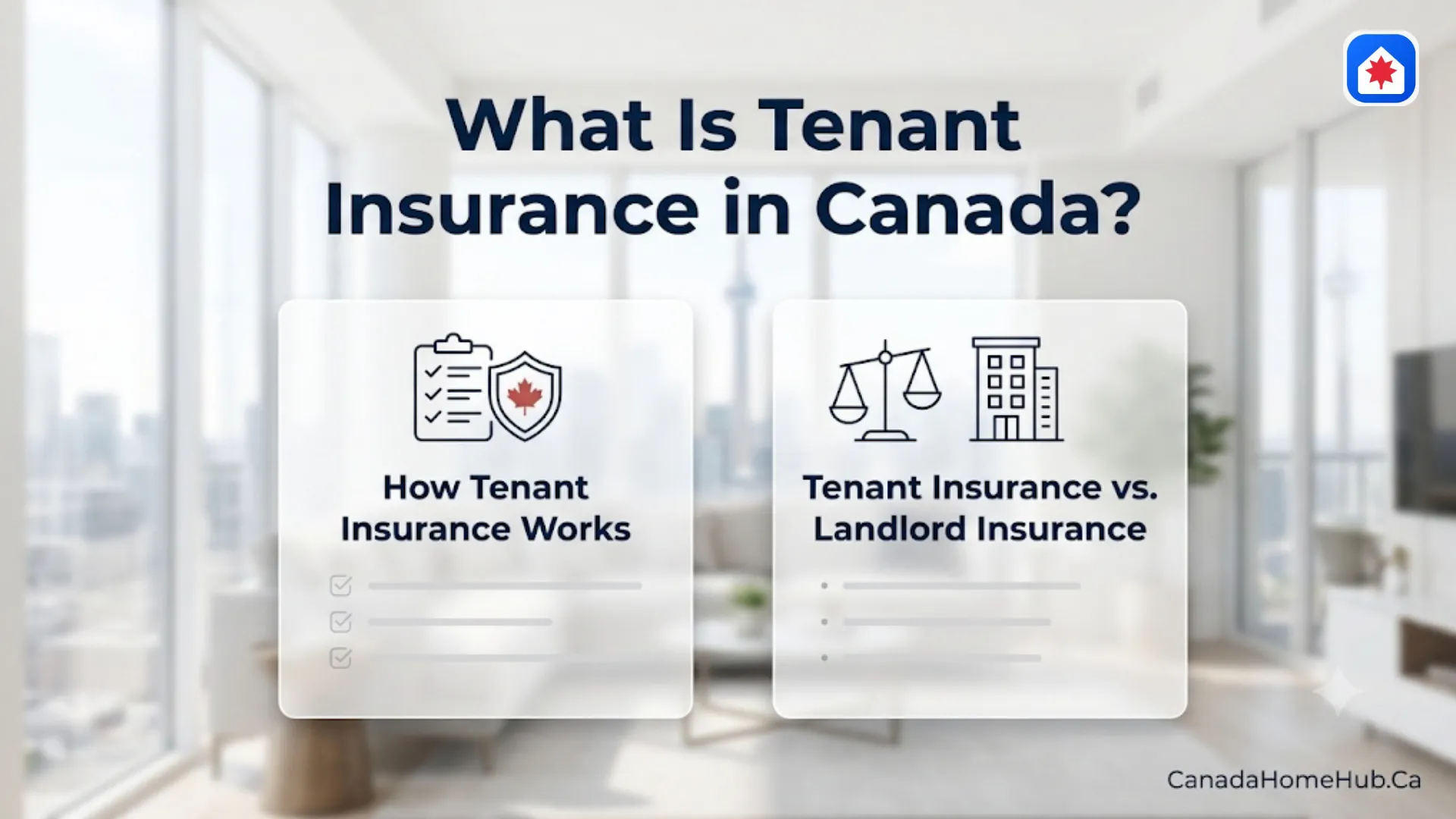
Tenant Insurance vs. Landlord Insurance: The Critical Difference
Understanding where the landlord's responsibility ends and yours begins is essential for every Canadian renter:
- Landlord Insurance: Protects the physical building, structural fixtures, building systems (plumbing, electrical), appliances owned by the landlord, and the owner’s liability for common areas like lobbies, stairwells, and elevators. It offers zero protection for personal items belonging to tenants.
- Tenant Insurance: Protects your personal wardrobe, electronics, furniture, books, kitchenware, and sports gear. More importantly, it safeguards your personal liability if you accidentally cause damage to the building or adjacent rental suites.
What Does Tenant Insurance Cover? (And What It Doesn't)
A standard Canadian tenant insurance policy is built on three core pillars:
Contents & Personal Property Coverage
Contents insurance covers the repair or replacement value of your personal possessions if they are stolen, damaged, or destroyed by a covered peril. Interestingly, standard Canadian policies often protect your personal belongings even when they are temporarily away from your home—such as a laptop stolen from your backpack while studying at a local library or luggage lost during a domestic flight.
Personal Liability Coverage
Personal liability is arguably the most critical component of your policy. If an accidental mishap inside your apartment causes property damage or bodily injury to a third party, you can be held legally and financially responsible.
- Real-life scenario: You leave a bathtub running and it overflows, causing $40,000 worth of ceiling and drywall damage to the two condominium units beneath yours.
- Another scenario: A visitor slips on a wet kitchen floor inside your suite and suffers an injury that prevents them from working.
In both cases, your personal liability coverage pays for legal defence costs, court settlements, or repair charges up to your policy ceiling (typically between $1 million and $2 million across Canada). Without this coverage, you would be forced to cover these expenses entirely out of pocket.
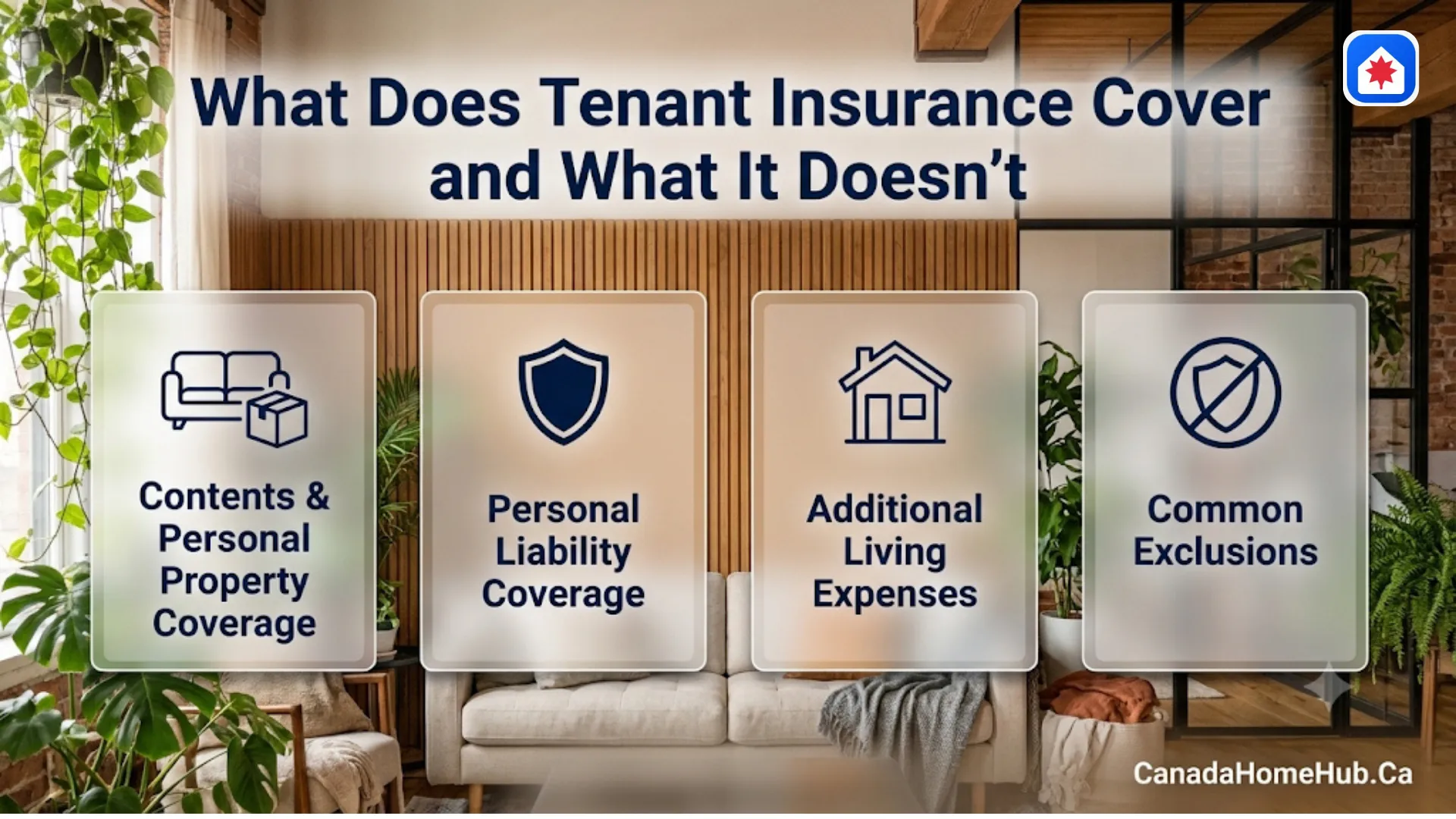
Additional Living Expenses (ALE)
If an unexpected emergency—such as an electrical fire in your building—renders your rental suite temporarily uninhabitable, where will you live while repairs take place?
Additional Living Expenses coverage pays for necessary, reasonable temporary living costs above your normal living expenses. This includes:
- Hotel bills or short-term furnished rental accommodation
- Additional restaurant or meal expenses if your temporary lodging lacks cooking facilities
- Emergency storage fees for saved belongings
- Moving costs and emergency boarding for domestic pets
Common Exclusions You Must Watch Out For
While tenant insurance offers robust protection, no standard policy covers everything. Standard Canadian policies routinely exclude:
- Overland flooding: Water entering from overflowing lakes, rivers, or intense external rainfall runoff (often requires an optional policy rider).
- Sewer backup: Sudden backup of municipal sewer systems into your basement suite (frequently available as an add-on endorsement).
- Earthquakes: Seismic ground shaking damage is excluded by default in seismically active regions like coastal British Columbia.
- Intentional or criminal acts: Any damage deliberately caused by you or an occupant of your suite.
- High-value luxury categories without scheduled endorsements: Bicycles, expensive jewelry, high-end fine art, or specialized musical instruments usually carry internal sub-limits (e.g., maximum $1,000–$2,000 per category) unless specifically itemized.
Is Tenant Insurance Legally Required in Canada?
From a strictly statutory standpoint, tenant insurance is not legally mandatory under provincial or federal law in Canada. There is no government statute in Ontario, Alberta, British Columbia, or Quebec that automatically forces a tenant to hold a policy.
Provincial Regulations vs. Lease Agreements
However, Canadian provincial residential tenancy acts (such as the Residential Tenancies Act in Ontario or British Columbia) grant landlords and property management companies the legal right to establish reasonable conditions within the lease contract.
If a landlord includes a mandatory tenant insurance clause in your tenancy agreement before you sign, that clause is legally binding. Landlords have the full legal right to request a formal Certificate of Insurance before handing over keys, as well as proof of annual renewal throughout your tenancy.
What Happens If You Refuse or Cancel Your Policy?
If your signed lease mandates tenant insurance and you either refuse to furnish proof or quietly cancel the policy after moving in, you are committing a material breach of your tenancy contract. In provinces such as Ontario, British Columbia, and Alberta, a breach of a material lease condition can serve as valid legal grounds for eviction proceedings before the provincial tenancy dispute tribunal.
How Much Does Tenant Insurance Cost in Canada?
Compared to other essential expenses like rent, groceries, and utilities, tenant insurance is remarkably affordable. On average, Canadian renters spend between $15 and $40 per month (approximately $180 to $480 per year) for a well-rounded policy.
The exact rate varies depending on geographic location, building characteristics, and personal coverage preferences.
Average Monthly Costs Across Major Canadian Markets
- Ontario (Toronto, Ottawa, Hamilton): $20 – $35 / month
- British Columbia (Vancouver, Victoria, Kelowna): $22 – $40 / month
- Alberta (Calgary, Edmonton): $20 – $35 / month
- Quebec (Montreal, Quebec City): $15 – $25 / month (frequently lower due to regional market dynamics)
- Atlantic Canada (Halifax, Moncton, St. John's): $18 – $30 / month
Replacement Cost vs. Actual Cash Value
When selecting your policy, you will encounter two fundamental valuation methods for your contents:
- Replacement Cost (Recommended): The insurer reimburses you the actual cost to purchase a brand-new, equivalent item today, without deducting depreciation for age or wear and tear.
- Actual Cash Value (ACV): The insurer compensates you based on the depreciated market value of the item at the moment of destruction. If your five-year-old laptop is destroyed, an ACV policy will pay only what a five-year-old laptop sells for today, leaving you to pay the gap for a modern replacement.
While policies with Replacement Cost carry slightly higher premiums, the extra few dollars per month are well worth avoiding out-of-pocket deficits after a catastrophic loss.
Coverage Tiers & Price Breakdown
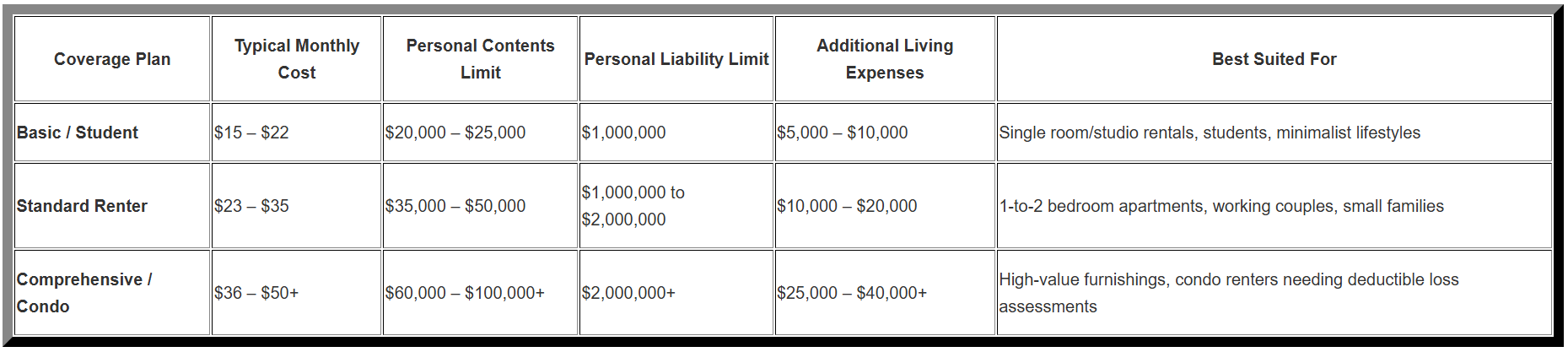
Note: The figures in the table above reflect typical market rate ranges across major Canadian urban centres and can fluctuate based on building age, fire proximity, and claims history.
Key Factors That Influence Your Insurance Premium
Insurers calculate your tenant insurance premium by weighing several specific risk factors:
- Location & Postal Code: Rental properties situated in urban cores with historically higher property crime rates, or areas prone to severe storm activity, face adjusted rates.
- Building Construction & Age: Concrete high-rise towers generally benefit from lower risk profiles than century-old wooden walk-ups with older knob-and-tube electrical wiring or aging plumbing.
- Proximity to Fire Infrastructure: Your unit’s distance to the nearest municipal fire hydrant and responding fire station directly affects risk ratings.
- Your Selected Deductible: Choosing a $1,000 deductible rather than a $500 deductible lowers your recurring monthly bill.
- Claims and Credit History: In provinces where credit-based insurance scoring is permitted, a favourable credit rating combined with a clean claims track record delivers significant premium discounts.
- Roommate Arrangements: Adding multiple unrelated roommates to a single policy often increases premiums, and some insurers limit policies to immediate family or a maximum of two co-tenants.
How to Lower Your Renters Insurance Costs
Securing robust protection does not mean overspending. Use these practical strategies to reduce your monthly expenses:
- Bundle with Auto Insurance: Pairing your auto insurance and tenant insurance with the same Canadian provider is the single easiest way to unlock discounts of 10% to 15% across both policies.
- Increase Your Deductible: If you have an established emergency fund, raising your deductible from $500 to $1,000 or $1,500 immediately shrinks your recurring payments.
- Install Verified Safety Devices: Units equipped with monitored fire alarms, monitored burglar alarms, or automatic water shut-off systems frequently qualify for protective device discounts.
- Maintain a Claims-Free Record: Avoid filing minor claims that cost only slightly more than your deductible, as preserving a claims-free status pays dividends over time.
- Ask About Group Discounts: Many Canadian insurers offer preferred group discounts for alumni of Canadian universities and colleges, union members, or professional associations.
How to Choose and Buy a Policy: Step-by-Step for Canadian Renters
Purchasing tenant insurance in Canada is straightforward and can typically be completed online in under 15 minutes. Follow these practical steps:
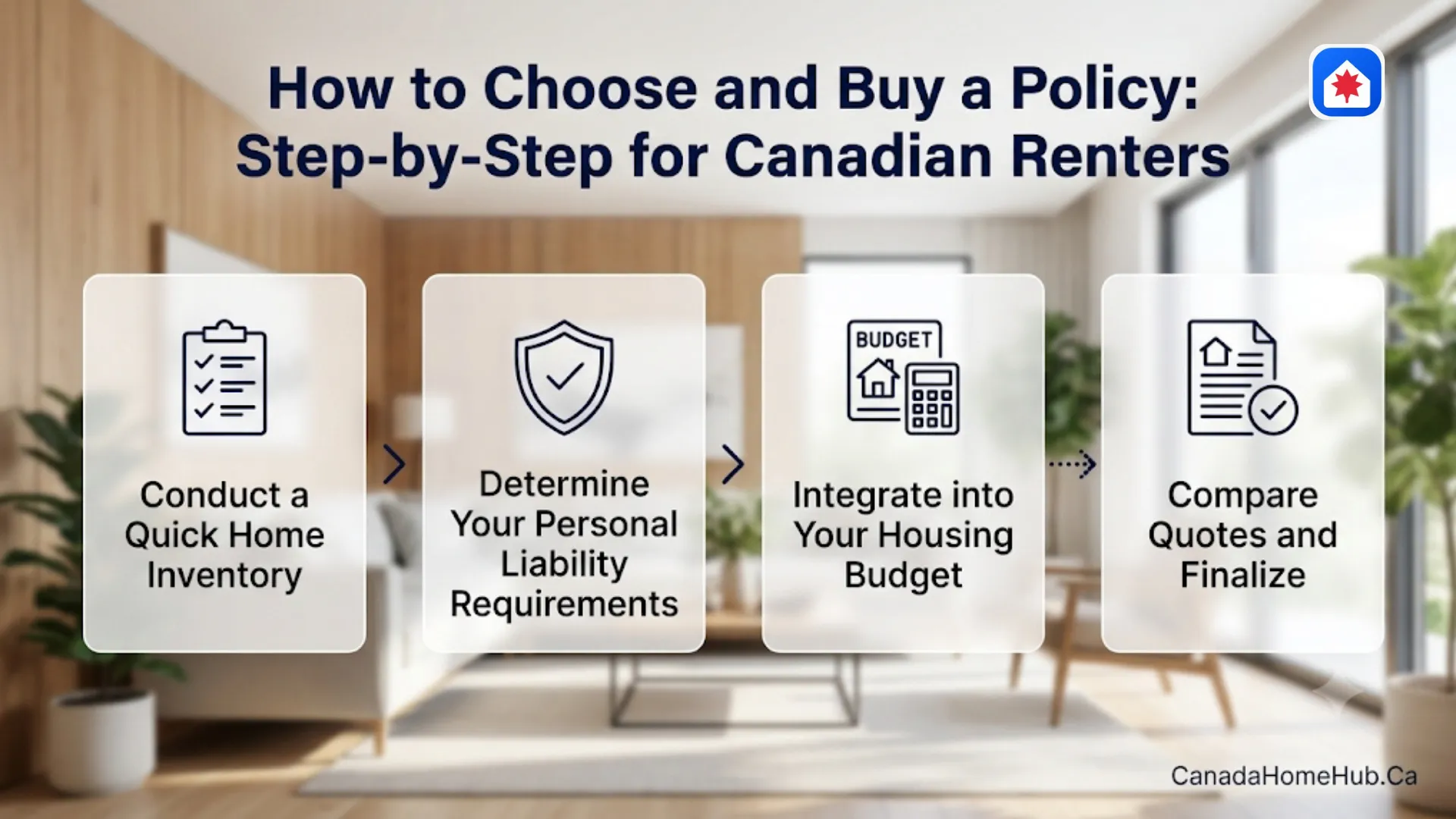
Step 1: Conduct a Quick Home Inventory
Take a walk through your apartment with your smartphone camera. Record a continuous video opening closets, drawers, and electronics setups. Estimate the replacement cost of your wardrobe, work technology, kitchen gadgets, and furniture. Most renters are surprised to discover their everyday possessions easily total $25,000 to $40,000 in replacement value.
Step 2: Determine Your Personal Liability Requirements
While $1 million in liability coverage is standard, upgrading to $2 million usually costs only $2 to $4 extra per month. Given the steep costs of water damage in modern multi-unit high-rises, this nominal upgrade provides immense peace of mind.
Step 3: Integrate Insurance into Your Broader Housing Budget
Whether you are renting temporarily or actively saving up a down payment to transition into homeownership, tenant insurance is a predictable, modest component of your total cost of living. To understand how recurring housing expenses, savings goals, and future financing intersect, explore the financial and housing resources on CanadaHomeHub.
If you plan to transition from renting to owning a home in Canada within the next few years, you can also test different down payment and interest rate scenarios using our calculator to see how monthly mortgage obligations compare to rental living costs.
Step 4: Compare Quotes and Finalize
Gather quotes from at least three different Canadian insurers or digital insurance brokers. Verify that your policy specifies Replacement Cost rather than Actual Cash Value, verify any required water protection endorsements, and download your Certificate of Insurance to provide to your landlord.
Frequently Asked Questions About Tenant Insurance in Canada
1. Does my landlord's insurance cover my belongings if the building burns down?
No. Your landlord's insurance policy exclusively protects the building's physical structure and the landlord's personal liability. It will not reimburse you for your lost clothes, furniture, computers, or the hotel costs you incur while displaced.
2. Can my landlord legally evict me for not having tenant insurance?
If tenant insurance was clearly stipulated as a condition of your tenancy in your signed lease agreement, failing to obtain or maintain it constitutes a breach of your contractual obligations. In most Canadian provinces, an unrectified breach of a material lease clause allows a landlord to initiate formal eviction proceedings through the provincial rental housing board.
3. Can roommates share a single tenant insurance policy?
Yes, many Canadian insurance companies allow unrelated roommates to share a single policy, which can split costs. However, doing so means your roommates share your coverage limits and your claims history. If your roommate files a claim for a stolen bicycle, that claim remains on your joint insurance record. Furthermore, some insurers limit policies to only two unrelated tenants, requiring additional roommates to purchase separate individual policies.

4. Are my belongings protected when I travel outside of Canada?
In most cases, yes. Standard Canadian tenant policies include "off-premises" property coverage, meaning your personal items (such as a laptop, camera, or clothing) remain covered against theft or fire worldwide, subject to a sub-limit (often 10% to 20% of your total personal property limit). Always check your specific policy wording for international travel limitations.
5. Does tenant insurance protect against damage caused by pets?
Tenant insurance generally covers accidental physical injury or property damage your pet causes to third parties under your personal liability umbrella (for instance, if your dog accidentally bites a visitor in the park). However, personal tenant insurance almost never covers damage your pet does to your own suite, such as scratched hardwood floors or chewed baseboards.
6. What should I do immediately after experiencing property damage or theft?
First, ensure your safety and contact local emergency services if necessary. If a theft occurred, file a police report immediately and obtain the case occurrence number. Next, document all damage thoroughly with high-resolution photos and video before discarding anything. Finally, notify your insurance provider’s 24/7 claims hotline to initiate the claim and retain receipts for any emergency temporary accommodations.
Final Thoughts: Protecting Your Living Space with Confidence
Tenant insurance in Canada is not an unnecessary administrative hurdle—it is an accessible, low-cost safety net that protects your personal financial future. For the price of a couple of takeout lunches each month, you protect yourself against life-altering liabilities, severe property damage, and unexpected displacement.
As you manage your rental home and plan for long-term personal finance goals across Canada, taking control of your monthly expenses and securing comprehensive protection ensures you can build your life with absolute peace of mind.