Choosing someone to represent you in a real estate transaction is one of the highest-stakes financial decisions most Canadians ever make. Naturally, one of the first steps buyers and sellers take is searching for realtor reviews in Canada. Yet anyone who has browsed agent profiles in Toronto, Vancouver, Calgary, Montreal, or Halifax quickly notices a frustrating pattern: almost everyone appears to have a 4.9- or 5.0-star rating.
When nearly every profile looks spotless, star averages alone cannot tell you who will protect your interests in a multiple-offer situation, spot red flags in a condo status certificate, or price your home accurately in a shifting local market. Online ratings are valuable, but only when you know which platforms verify real transactions, what details separate authentic feedback from generic praise, and how to cross-check an agent's standing with your provincial regulator.
This guide explains how real estate agent reviews in Canada actually work, where to find credible feedback, how to spot unreliable ratings, and how to combine online research with provincial licence checks and structured interviews so you can hire with confidence.
Why Realtor Reviews Matter - and Why Star Ratings Alone Can Mislead You
Client reviews remain a useful starting point because real estate is a service business built on trust, communication, and local execution. Thoughtful past-client feedback can reveal how an agent handles unexpected inspection issues, communicates across time zones with relocating buyers, or navigates slow-moving listings.
However, relying solely on an overall rating score creates blind spots that can cost you money or peace of mind.
The Problem With "Rating Inflation" in Canadian Real Estate
Across many Canadian review sites, top-performing and average agents alike often hold ratings between 4.8 and 5.0 stars. Several structural factors drive this clustering:
- Selective review requests: Agents naturally invite their happiest clients to leave public feedback immediately after a smooth closing, while difficult or collapsed transactions rarely result in a review link being sent.
- Relationship hesitation: Because buyers and sellers often spend weeks or months touring homes closely with an agent, disappointed clients sometimes choose not to leave a negative review to avoid awkward confrontation or fear of pushback.
- Lack of transaction gating on general sites: On open platforms, friends, family members, or colleagues can leave glowing five-star ratings without ever buying or selling a property through that agent.
- Team-level pooling: Large real estate teams sometimes collect hundreds of reviews under a team leader's profile, even when day-to-day work is handed off to junior associates.
The takeaway is simple: treat a high star rating as a basic screening filter—not proof that an agent is right for your specific property, budget, or neighbourhood.
Understanding Canadian Terminology: REALTOR®, Real Estate Agent, and Broker
As you compare realtor ratings in Canada, it helps to understand the exact titles you will encounter, because licensing rules and terminology vary across the country:
- Real estate agent / salesperson: A general term for an individual licensed by a provincial regulatory body to trade in real estate on behalf of a brokerage.
- REALTOR®: A trademarked designation in Canada owned by the Canadian Real Estate Association (CREA). Only licensed professionals who are members of CREA and a local/provincial real estate board—and who agree to abide by the REALTOR® Code—can legally use the title REALTOR®.
- Real estate broker: Depending on the province, this title means different things. In provinces such as Ontario, British Columbia (managing broker), and Alberta, a broker holds additional education and can manage a brokerage, though they may still represent clients directly. In Quebec, however, real estate broker (courtier immobilier) is the standard official title for all licensed practitioners regulated by the OACIQ.
Understanding these distinctions keeps you from misinterpreting credentials when comparing profiles across provincial borders.
Where to Find Realtor Reviews in Canada
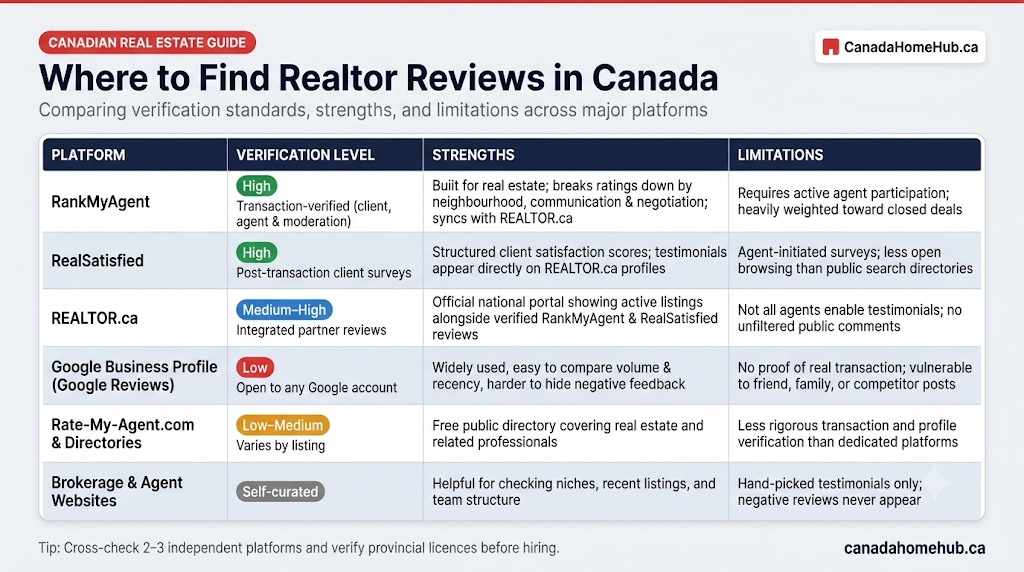
Not all review websites use the same verification standards or moderation rules. Reviewing an agent across at least two or three independent sources gives you a far clearer picture than relying on a single page.
Transaction-Verified Platforms (RankMyAgent, RealSatisfied, and REALTOR.ca)
If you are specifically searching for verified realtor reviews, start with real-estate-focused platforms that tie feedback to actual transactions. RankMyAgent, for instance, verifies reviews across the client, the agent, and a moderation team before publishing, and allows consumers to search by city, neighbourhood, or specialty. Similarly, RealSatisfied gathers structured client feedback after transactions.
A major advantage for Canadian consumers is that CREA allows REALTORS® to display their RankMyAgent and RealSatisfied testimonials directly on their official REALTOR.ca profiles. Checking an agent's REALTOR.ca page lets you cross-reference their active listings with verified client commentary in one place.
Open Review Platforms (Google Business Profile, Facebook, and General Directories)
Google Reviews remain indispensable because they are less curated by the agent than a personal website and often capture broader, unfiltered experiences—including clients whose deals fell through or who had poor initial consultations. Look at Google Reviews alongside a verified real estate platform. If an agent has 80 glowing reviews on Google from generic accounts with no other review history, yet zero presence on verified transaction platforms or MLS® activity, investigate further.
Brokerage Websites and Personal Agent Pages
Treat testimonials on an agent's own website as marketing copy rather than independent proof. Still, personal sites are worth skimming to check whether the agent works solo or on a team, what neighbourhoods they actively cover, and whether they publish market data relevant to your property type.
Verified Realtor Reviews vs. Red Flags: How to Spot Unreliable Feedback
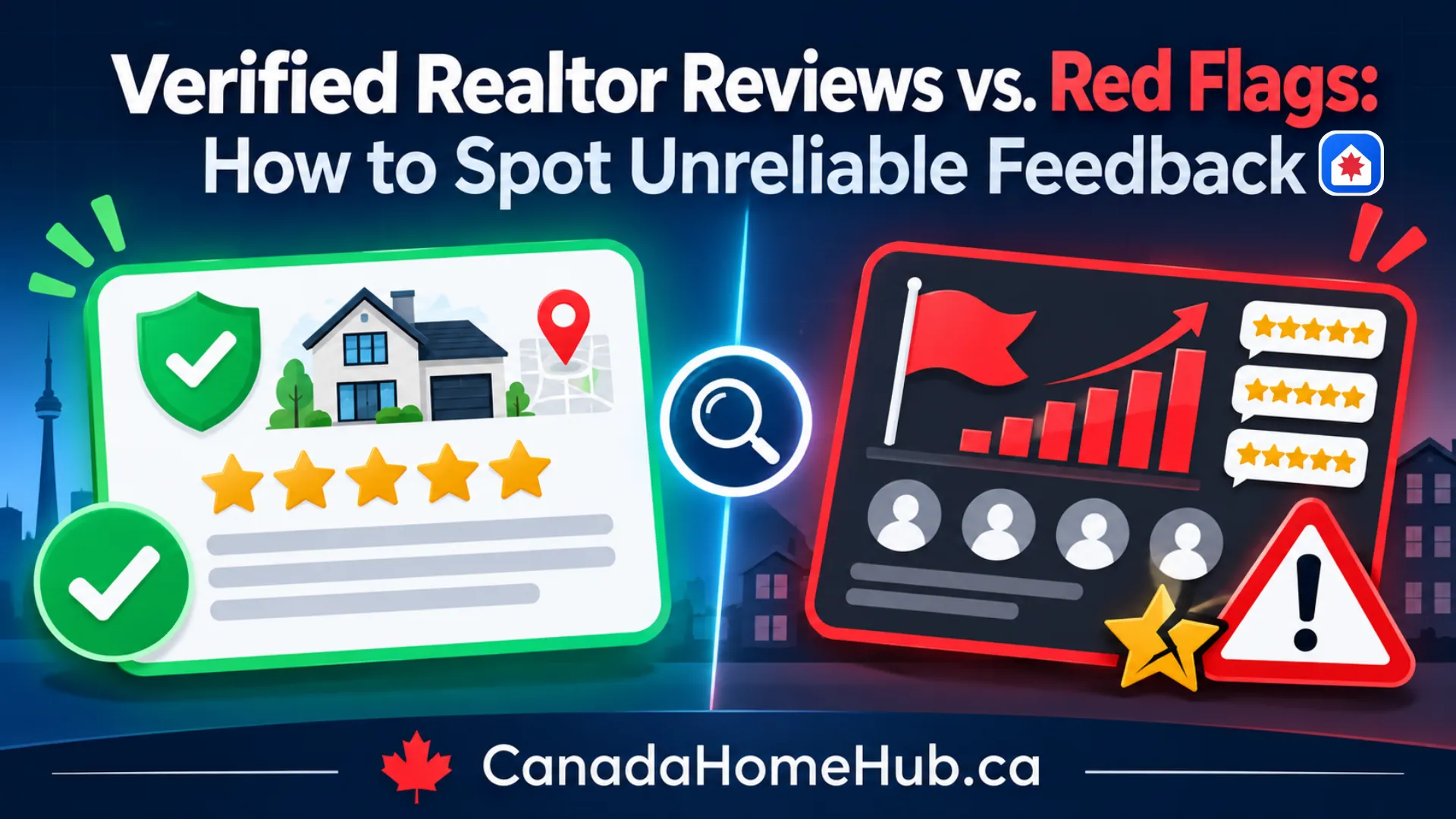
Even on mainstream platforms, consumers need a sharp eye to distinguish genuine client experiences from inflated or manipulated praise.
What Makes a Review Truly "Verified"
A credible, verified review typically reflects three things:
- Confirmation of a real transaction: The platform checks property details, closing status, or mutual confirmation between parties rather than accepting anonymous comments.
- Contextual specificity: The reviewer references concrete elements—such as buying a townhouse in Mississauga, selling a detached home in Kelowna, navigating a pre-construction condo assignment, or dealing with a rural septic inspection.
- Balanced realism: Real human experiences rarely read like brochure copy. Genuine reviews often mention a real challenge the agent helped solve, such as a tight closing timeline, financing hurdle, or tough counter-offer.
Warning Signs of Fake, Incentivized, or Astroturfed Reviews
Watch closely for the following red flags when evaluating realtor ratings in Canada:
- Sudden bursts of reviews: Twenty 5-star reviews posted within a single 48-hour window after months of silence can indicate a coordinated push or solicited favour reviews rather than steady closing volume.
- Vague, repetitive phrasing: Phrases like "Best realtor in the city! Highly recommend! 10/10!" repeated across multiple reviewers without mentioning buying, selling, leasing, or any neighbourhood detail offer almost no evidence of real work.
- Single-review accounts: On Google, clicking a reviewer's profile often shows whether they regularly review local businesses in your region. Dozens of five-star ratings from accounts with only one lifetime review warrant scepticism.
- Unclear relationship disclosure: Reviews written by mortgage brokers, staging partners, family members, or fellow agents at the same brokerage should never be mistaken for impartial homebuyer or seller experiences.
- Mismatch with actual market activity: If an agent's reviews claim they closed dozens of luxury waterfront sales this year, yet public listing history or brokerage records show minimal recent activity, ask direct questions during your interview.
How Canadian Law Treats Fake Online Reviews
Canada takes deceptive online endorsements seriously. Under the federal Competition Act, making false or misleading representations to the public is prohibited. The Competition Bureau Canada specifically flags astroturfing—creating fake consumer reviews or testimonials that masquerade as authentic, impartial opinions, or failing to disclose material connections such as paid or incentivized endorsements—as a deceptive marketing practice.
While enforcement actions typically target egregious commercial schemes, provincial real estate regulators also enforce strict advertising and professional conduct rules prohibiting false or misleading claims. Still, regulators cannot police every online comment in real time, which is why consumer due diligence remains essential.
A 6-Point Framework for Reading Real Estate Agent Reviews
Rather than scanning star scores from top to bottom, read the actual text of the 15 to 20 most recent reviews using a structured evaluation checklist.
Match the Transaction Type and Property Class
A brilliant listing agent for suburban detached homes is not automatically the right choice for a downtown condo buyer, a rural acreage with a well and septic system, or a multi-unit investment property. As you read real estate agent reviews in Canada, tally how many recent reviewers completed the same type of transaction you are planning:
- First-time home purchase vs. upsizing/downsizing
- Selling in a competitive market vs. selling a niche or luxury property
- Freehold detached/semi-detached vs. strata/condominium (which involves reviewing strata minutes, reserve fund studies, or status certificates)
- Relocation or remote buying from another province
Look for Hyper-Local Neighbourhood Knowledge
Real estate in Canada is hyper-local—even two postal codes ten minutes apart can have very different pricing dynamics, school catchments, zoning bylaws, or condo corporation track records. Strong reviews mention concrete local insight: pointing out flood-plain concerns, advising against a poorly funded condo building, knowing typical bidding patterns on specific streets, or pricing a listing based on recent comparable sales rather than guesswork.
Evaluate Communication and Problem-Solving Under Pressure
Anyone can appear friendly during an easy showing. Look for reviews that describe what happened when something went wrong:
- Did the agent explain paperwork and conditions clearly without rushing the client?
- How quickly did they respond during offer deadlines?
- When a home inspection uncovered roof, electrical, or foundation problems, did the agent help renegotiate or walk away calmly—or did they pressure the client to close anyway?
Mentions of patience, responsiveness, and candid warnings ("they actually talked us out of overpaying on a flawed house") are among the strongest green flags you can find.
Check for Specific Negotiation Outcomes—Not Just Friendly Personality
Being pleasant is nice, but you are hiring a fiduciary advisor and negotiator. Scan reviews for evidence of strategic skill: structuring clean conditions, navigating multiple offers, recommending strategic pre-listing repairs or staging, or negotiating post-inspection credits and favourable closing dates.
Weigh Recency, Volume, and Consistency Over Time
Canadian housing markets shift quickly with interest rate changes, inventory swings, and regulatory updates. An agent with 45 glowing reviews from 2021's seller-dominated boom—and almost nothing from the past 18 months—may not be actively navigating today's pricing and buyer-financing realities. Prioritize steady, recent feedback from the past 6 to 24 months over outdated volume.
Read How the Agent Responds to Criticism
A handful of 3- or 4-star reviews among dozens of strong ratings is often a sign of authenticity, not failure. Pay close attention to how the agent responds to a critical review:
- Professional response: Calm, respectful, protects client confidentiality, acknowledges frustration, and offers to resolve the issue offline.
- Red-flag response: Defensive, sarcastic, blaming the client publicly, or revealing private financial or personal details from the transaction.
How an agent behaves when criticized publicly tells you a great deal about how they will handle conflict during a tense negotiation.
Beyond Reviews: Checking Provincial Licences and Disciplinary Records
One of the most important steps in evaluating a Canadian real estate professional has nothing to do with star ratings: verifying that the person is actively licensed in good standing and checking for past disciplinary actions.
Why Real Estate Regulation Differs Across Canadian Provinces
Canada does not have a single national real estate licence. Real estate trading is provincially regulated, meaning licensing requirements, continuing education, brokerage supervision, disclosure rules, and disciplinary databases are managed separately in each province and territory.
For example, British Columbia banned most forms of dual agency in 2018 to curb conflicts of interest, while Ontario modernized its framework under the Trust in Real Estate Services Act (TRESA), introducing updated representation disclosures and allowing open-offer processes if a seller chooses. Quebec operates under civil law rather than common law, with its own mandatory forms and strict brokerage oversight.
Official Provincial Registries to Check Before You Hire
Before signing any representation agreement, look up the agent's legal name on your provincial regulator's public registry. Most regulators allow you to confirm active status, brokerage affiliation, licence category, and public disciplinary decisions free of charge:
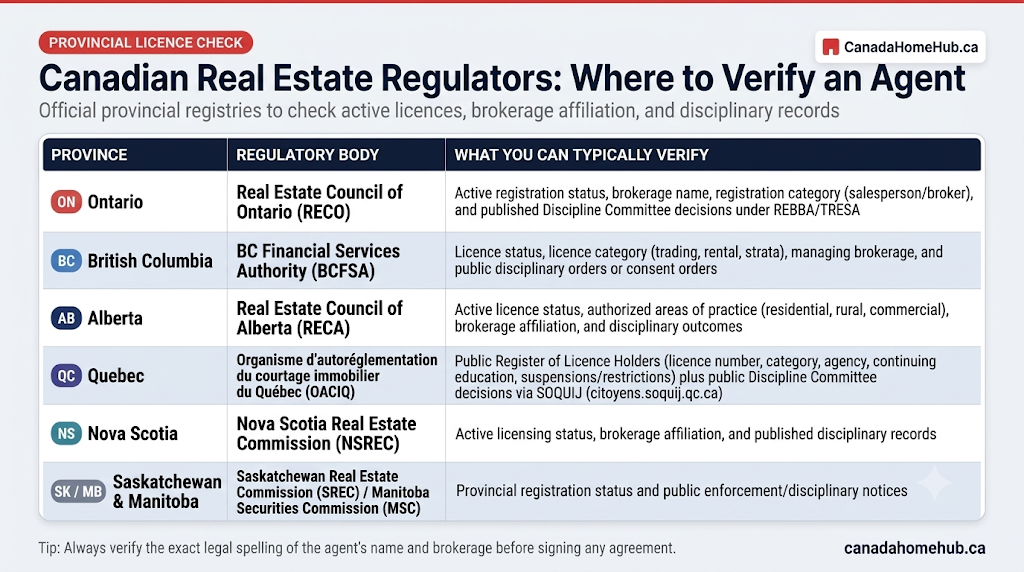
Tip: Always verify the exact spelling of the agent's name and brokerage—especially in major metro areas where multiple registrants may share common names. Also read any disciplinary decision to the end to see the actual outcome and context.
Practical Example: Comparing Two Hypothetical Agent Profiles Side by Side
To see how this framework works in practice, consider two illustrative, hypothetical agent profiles that a first-time condo buyer in a major Canadian metro area might compare online.
- Profile A: "Jordan — 5.0 Stars (140 Google Reviews)"
- What looks good: High review count, perfect 5.0 average, polished social media presence.
- What deeper inspection reveals: 95 of the reviews mention "Jordan's Team" rather than Jordan personally; many reviewers thank a different junior agent who actually handled their showings. Most recent reviews are from suburban home sellers, not condo buyers. Fifteen reviews were posted in the same week with one-line generic praise. On the provincial registry, Jordan is actively licensed with a clean record.
- Profile B: "Priya — 4.8 Stars (34 RankMyAgent Verified Reviews + 22 Google Reviews)"
- What looks good: Smaller total volume, but 24 reviews in the past 18 months specifically describe buying or selling condos in the exact downtown and midtown neighbourhoods you are targeting. Multiple reviewers mention Priya catching reserve-fund red flags in status certificates and negotiating firm price reductions after inspection.
- What deeper inspection reveals: One 3-star Google review complains that Priya was unavailable on a Sunday evening; Priya replied politely, explaining she had scheduled coverage with a colleague and had adjusted her weekend communication protocol since. Her provincial licence is active with no disciplinary history.
The takeaway: On star score and volume alone, Profile A looks stronger. Once you apply transaction verification, niche relevance, recency, and team-handoff scrutiny, Profile B is almost certainly the stronger candidate for that specific condo buyer—though both still warrant an in-person or video interview before deciding.
How to Choose a Realtor After Reading Reviews: The Shortlist Interview
Online reviews should narrow your field to two to four strong candidates. The final decision on how to choose a realtor should happen during live consultations where you test their knowledge, communication style, and transparency directly.
Prepare Your Numbers Before You Interview Agents
Walking into an agent consultation with a clear picture of your budget makes your interview far more productive—and helps you immediately tell whether an agent gives realistic pricing advice or tells you what you want to hear. Before scheduling calls, review your estimated monthly payments, Canada's OSFI mortgage stress-test affordability thresholds, down payment tiers, and provincial land transfer taxes. You can run these scenarios ahead of time using the free tools on CanadaHomeHub.ca, so you arrive prepared with concrete numbers.
Essential Questions to Ask During a Consultation
Ask every shortlisted agent the same core set of questions so you can compare answers fairly:
- "Will I be working directly with you from start to finish, or with other members of your team?" (Crucial if reviews mention team associates.)
- "How many transactions similar to mine (property type, price bracket, and neighbourhood) have you closed in the past 12 months?"
- "Can you walk me through a recent deal that hit a snag—and how you resolved it?"
- "How are you compensated, how is commission structured in my province, and what happens if I want to end our representation agreement early?"
- "How do you communicate during fast-moving negotiations, and what is your typical response time?"
- "Can you share two or three recent client references who completed a similar transaction?" (While references are hand-picked, a 5-minute phone call often reveals nuances people won't write publicly.)
- For sellers: "How did you determine this suggested list price, and what is your specific marketing and pricing adjustment plan if the home doesn't sell in the first three weeks?"
- For buyers: "How do you advise clients on inspection, financing, and status-certificate/strata conditions in today's local market?"
Understanding Representation and Dual Agency Rules in Your Province
Before signing a Buyer Representation Agreement or Listing Agreement, make sure the agent clearly explains agency representation under your province's rules.
- In British Columbia, dual agency (where one agent represents both buyer and seller in the same transaction) is generally banned except in very narrow, remote-area exemptions.
- In Ontario, multiple representation (where the same brokerage represents both buyer and seller) requires informed written consent from all parties, and TRESA rules distinguish between brokerage representation and designated representation.
- In Quebec, recent legislative reforms significantly restricted double representation in residential transactions to protect consumers.
A trustworthy agent will explain these rules plainly, hand you your province's mandatory consumer information guide before asking you to sign anything, and give you time to review the contract without pressure.
Common Mistakes Canadians Make When Relying on Realtor Ratings
Even diligent buyers and sellers fall into predictable traps when researching agents online:
- Choosing solely based on the highest review count: High volume often reflects a large team or decades in the industry rather than the personal attention you will receive today.
- Ignoring neighbourhood and property-type fit: Hiring a top-rated suburban listing agent to help you buy a heritage condo or rural acreage can lead to costly blind spots.
- Skipping the provincial licence check: Assuming that an active Instagram account or glossy website guarantees a clean regulatory record is a preventable risk.
- Interviewing only one agent: Comparing at least two or three agents quickly exposes inflated pricing promises ("buying a listing"), vague marketing plans, or weak local knowledge.
- Signing a long-term exclusive contract prematurely: Never sign a binding representation agreement at an open house or first coffee meeting before you have checked reviews, verified credentials, and compared options.
Frequently Asked Questions About Realtor Reviews in Canada
Are online realtor reviews in Canada trustworthy?
Online reviews are a useful screening tool, but their reliability depends heavily on the platform. Reviews on transaction-verified sites—where a closed deal is confirmed before publication—are significantly more reliable than unverified comments on open social platforms. Always cross-check reviews across multiple sources and verify the agent's provincial licence.
What is the most reliable website for real estate agent reviews in Canada?
No single site tells the whole story, so combining two or three sources works best. Dedicated Canadian real estate review platforms such as RankMyAgent and RealSatisfied verify reviews against real transactions and integrate with REALTOR.ca profiles. Pairing those with Google Business Profile reviews helps you see both verified transaction feedback and broader public sentiment.
Can a real estate agent remove negative reviews in Canada?
On reputable third-party platforms like Google or RankMyAgent, agents generally cannot delete legitimate negative reviews simply because they disagree with them. Platforms typically remove reviews only if they violate content policies—such as spam, defamation, hate speech, or reviews proven not to involve a genuine client interaction. By contrast, agents have complete control over testimonials displayed on their own personal websites.
How many reviews should a good realtor have?
There is no magic number. Instead of chasing the highest total, look for consistency and recency. A solo agent with 20 to 35 detailed, verified reviews over the past two years in your specific neighbourhood can be far more attentive and relevant than a mega-team with 300 brief reviews scattered across an entire region.
Should I avoid a newer real estate agent with few reviews?
Not necessarily. Newer agents often have more time to dedicate to each client and may be backed by an experienced managing broker or mentorship team. If you are considering an agent with fewer than 10 reviews, verify their licence, ask how their brokerage supports complex negotiations, and pay extra attention to their preparation and local market analysis during your interview.
How do I check if a realtor has disciplinary actions against them?
Search the agent's full legal name on your provincial real estate regulator's public registry—such as RECO in Ontario, BCFSA in British Columbia, RECA in Alberta, or OACIQ (and SOQUIJ disciplinary decisions) in Quebec. These portals are free to use and show active registration status, brokerage affiliation, and public disciplinary orders.
Does a 5-star review guarantee a lower commission or better sale price?
No. Reviews measure past client satisfaction, not future market outcomes or fee structures. Real estate commissions in Canada are negotiable and not fixed by law, and sale prices depend heavily on property condition, timing, pricing strategy, and local supply and demand. Always discuss commission rates, included services (such as photography, staging, or floor plans), and pricing data transparently before signing an agreement.
Conclusion: Turning Online Reviews Into a Confident Hiring Decision
Reading realtor reviews in Canada is an essential first step—but the smartest homebuyers and sellers treat star ratings as a starting point rather than a verdict. By focusing on transaction-verified platforms, reading past-client commentary for neighbourhood fit and problem-solving skill, checking your provincial regulator's public registry, and interviewing two to three shortlisted candidates, you dramatically lower the risk of a mismatched representation experience.
When you are ready to move from early research to active planning, resources like CanadaHomeHub.Ca bring together free Canadian home-buying calculators, practical settlement guides, and a directory of local real estate, mortgage, and legal professionals to help you navigate each step of the process on informed footing. Take your time, verify the facts behind every five-star score, and choose an agent whose proven track record matches your exact goals.