Buying a home in Canada involves more than choosing a property and preparing a down payment. Your mortgage interest rate also plays a major role in determining how much you pay each month and how much interest you spend over time. Even a small rate difference can significantly affect your household budget. Two common options are fixed-rate and variable-rate mortgages. Each has different advantages, risks, and payment structures. This guide explains the difference between fixed and variable mortgage rates Canada and what you should know before choosing a mortgage.
1. What Are Mortgage Rates in Canada?
A mortgage rate is the interest percentage a lender charges when you borrow money to buy or refinance a property. It determines how much interest you pay alongside the principal amount borrowed.
For example, if you borrow $400,000 at an annual interest rate of 4%, the lender uses that rate to calculate the interest portion of your mortgage payments. The amount you pay toward interest and principal changes over time according to your mortgage structure and payment schedule.
Mortgage rates are not identical across lenders. Banks, credit unions, mortgage companies, and other financial institutions may offer different rates and conditions to borrowers with similar financial profiles.
2. Fixed vs. Variable Mortgage Rates: What's the Difference?
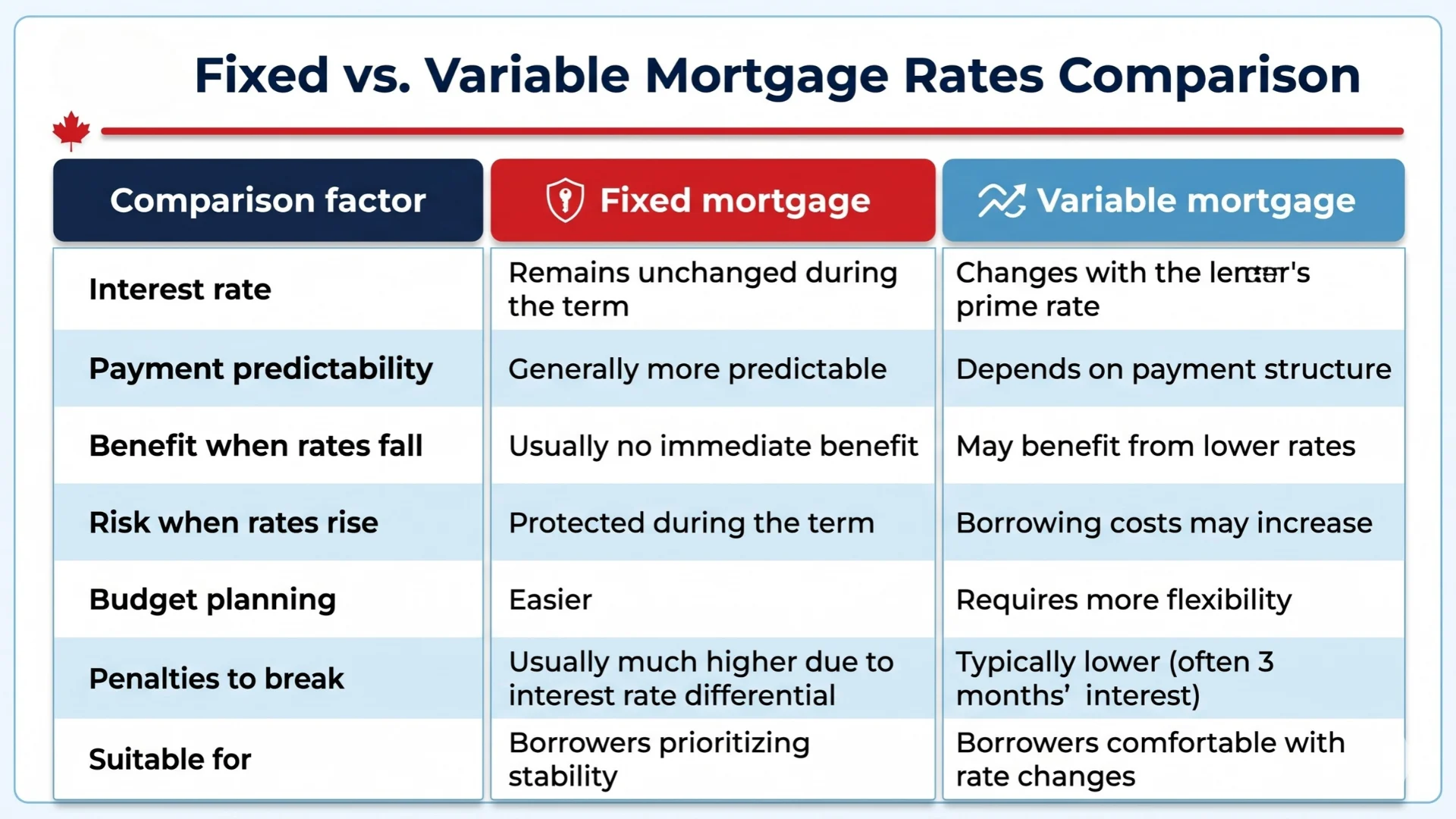
Choosing between fixed and variable mortgage rates is one of the most important decisions when arranging a home loan. The main difference is how your interest rate responds to market changes. Fixed rates provide more predictability, while variable rates expose borrowers to changing interest costs.
2.1. How Fixed Mortgage Rates Work
With a fixed-rate mortgage, your interest rate remains the same throughout the agreed mortgage term.
For example, if you secure a five-year fixed mortgage at 4.5%, the contractual interest rate will remain at 4.5% during those five years, even if market rates increase or decrease.
Advantages:
- Predictable mortgage payments, provided the payment schedule and other contract conditions remain unchanged.
- Easier household budgeting.
- Protection against rising interest rates during the term.
- More certainty about the interest portion of each payment.
Disadvantages:
- You may miss out on savings if market interest rates decline.
- Fixed-rate mortgages can have significant prepayment penalties if you break the contract early.
- The initial rate may be higher than a comparable variable-rate offer.
- Fixed mortgages may suit borrowers who value financial stability, have limited flexibility in their monthly budgets, or prefer knowing their borrowing costs in advance.
2.2. How Variable Mortgage Rates Work
Variable mortgage rates can increase or decrease during the mortgage term as the lender's prime rate changes.
For instance, a borrower with a variable mortgage initially paying 3.7% may see the rate rise to 4.2% following an increase in the lender's prime rate. However, the effect on regular payments depends on the mortgage structure.
There are two common arrangements:
- Variable rate with adjustable payments: Your regular payment changes when the interest rate changes. If rates increase, your payment generally increases. If rates decrease, your payment may become smaller.
- Variable rate with fixed payments: Your regular payment initially stays the same even when the interest rate changes. However, the split between interest and principal changes. If rates rise significantly, less of the payment may go toward principal, and the mortgage could reach a trigger point where the lender increases your payment.
Advantages:
- May offer a lower starting rate than a comparable fixed mortgage.
- Can benefit borrowers when interest rates decline.
- Some variable-rate mortgages have lower penalties for breaking the contract than fixed-rate mortgages, depending on the agreement.
Disadvantages:
- Interest costs can increase when prime rates rise.
- Adjustable payments can make budgeting more difficult.
- Fixed-payment variable mortgages may create additional repayment risks if rates rise substantially.
Variable mortgages may suit borrowers who can accommodate changing payments and are comfortable with interest rate uncertainty.
2.3. Fixed vs. Variable Mortgage Rates Comparison
3. Current Mortgage Rates in Canada
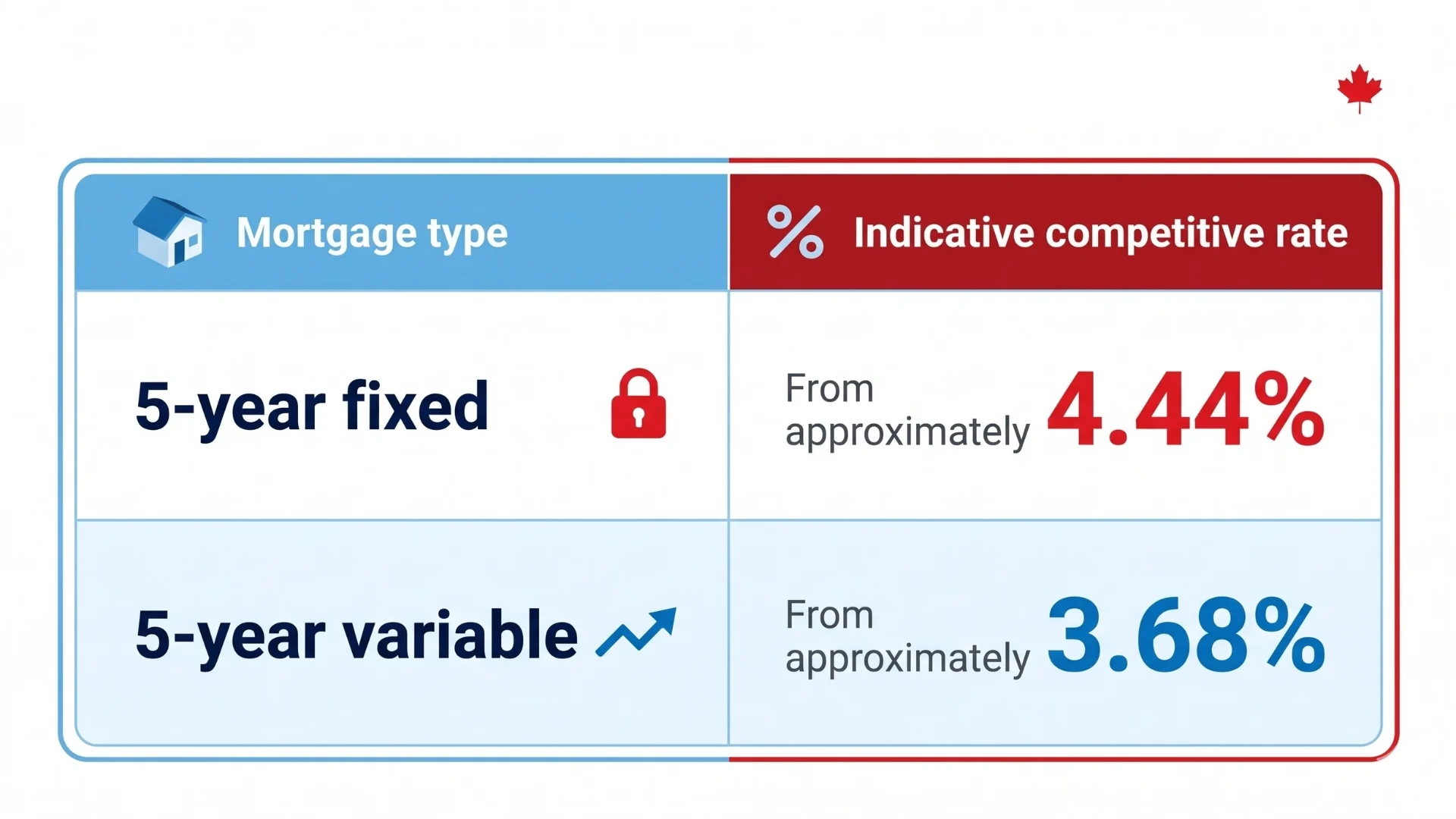
Mortgage rates change as lenders respond to economic conditions, funding costs, bond yields, and changes in the Bank of Canada's monetary policy. As of early November 2026, comparison platforms report the following competitive rates for eligible borrowers:
These figures provide a useful starting point, but they should not be treated as universal rates for every Canadian borrower. Different comparison platforms may display different offers because they work with different lenders and use different eligibility criteria.
3.1. Current Fixed Mortgage Rates Canada
In early November 2026, competitive five-year fixed offers were advertised from approximately 4.44% for eligible borrowers.
Fixed rates can differ according to the mortgage term:
- 1-year fixed: A shorter commitment that may suit borrowers who want flexibility or expect their circumstances to change.
- 3-year fixed: A middle-ground option for borrowers who want some payment stability without committing to five years.
- 5-year fixed: A common choice for homeowners who prefer longer-term payment predictability.
The lowest advertised rate is not necessarily the best choice. A shorter term may require another renewal sooner, while a longer term could involve higher penalties if you break the mortgage early.
3.2. Current Variable Mortgage Rates Canada
In early November 2026, competitive five-year variable offers were advertised from approximately 3.68% for eligible borrowers.
Variable rates are commonly expressed as a discount or premium relative to the lender's prime rate.
For example:
- Lender's prime rate: 4.70%
- Your mortgage discount: 1.00 percentage point
- Your variable mortgage rate: 3.70%
- If the lender's prime rate increases to 5.00%, your mortgage rate would rise to 4.00%, assuming the discount remains unchanged.
4. What Factors Affect Mortgage Rates in Canada?
Lenders consider several factors when determining the interest rate offered to a borrower. Understanding these factors can help you prepare a stronger application and compare mortgage products more effectively.
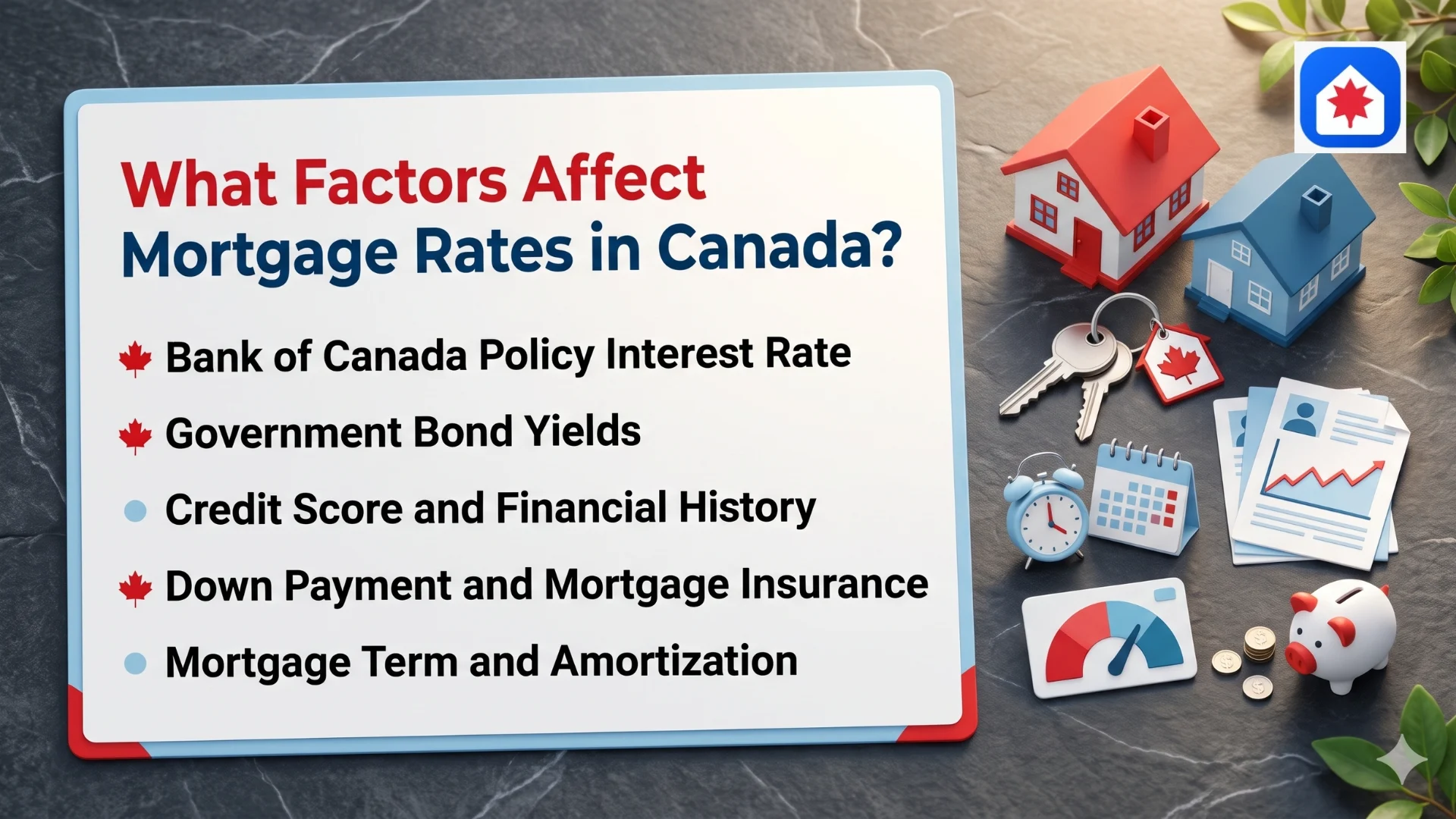
4.1. Bank of Canada Policy Interest Rate
The Bank of Canada sets the target for the overnight rate as part of its monetary policy. On October 28, 2026, the Bank increased its target overnight rate by 0.25 percentage points to 2.50%. This followed a period in which the rate had remained at 2.25%.
Changes in the policy rate can influence lenders' prime rates and therefore affect variable mortgage rates. However, fixed mortgage rates are influenced more directly by bond yields and lenders' funding conditions. This is why fixed and variable rates do not always move in the same direction or at the same pace.
4.2. Government Bond Yields
Government of Canada bond yields are an important indicator when examining fixed mortgage rates.
Lenders use bond market conditions when determining the rates they offer for fixed-term mortgages. When relevant bond yields increase, lenders may raise their fixed mortgage rates. When yields decline, fixed rates may become more competitive. However, bond yields are only one part of mortgage pricing. Lender competition, funding costs, and borrower demand also matter.
4.3. Credit Score and Financial History
Your credit profile helps lenders assess the risk of lending you money. A stronger credit history may improve your chances of receiving a competitive mortgage offer, while missed payments, high outstanding debts, or limited credit history may make qualification more difficult.
4.4. Down Payment and Mortgage Insurance
Your down payment affects the mortgage amount you need to borrow and whether mortgage default insurance is required. For eligible owner-occupied purchases below $1.5 million, the minimum down payment generally follows these rules:
- 5% on the first $500,000.
- 10% on the portion above $500,000.
A down payment of less than 20% generally requires mortgage loan insurance for eligible purchases. A home priced at $1.5 million or more is not eligible for this mortgage insurance and requires at least 20% down under the applicable purchase financing rules.
Insured mortgages may qualify for more competitive interest rates because the lender has protection against certain borrower default risks. However, borrowers must account for the insurance premium when comparing total costs.
4.5. Mortgage Term and Amortization
The mortgage term can affect the rate offered by the lender. Different terms have different pricing structures, and longer terms are not always more expensive.
Amortization also affects affordability. A longer amortization period generally lowers regular payments but increases the total interest paid.
5. How Much Does Your Mortgage Rate Affect Your Monthly Payments?
Your mortgage interest rate has a direct impact on regular payments and total borrowing costs. Even a difference of a few percentage points can change how much you pay over the mortgage's amortization period.
5.1. Example of Mortgage Payments at Different Interest Rates
Consider a borrower taking out a $400,000 mortgage with a 25-year amortization period. The following table illustrates how different interest rates can affect the estimated monthly payments.
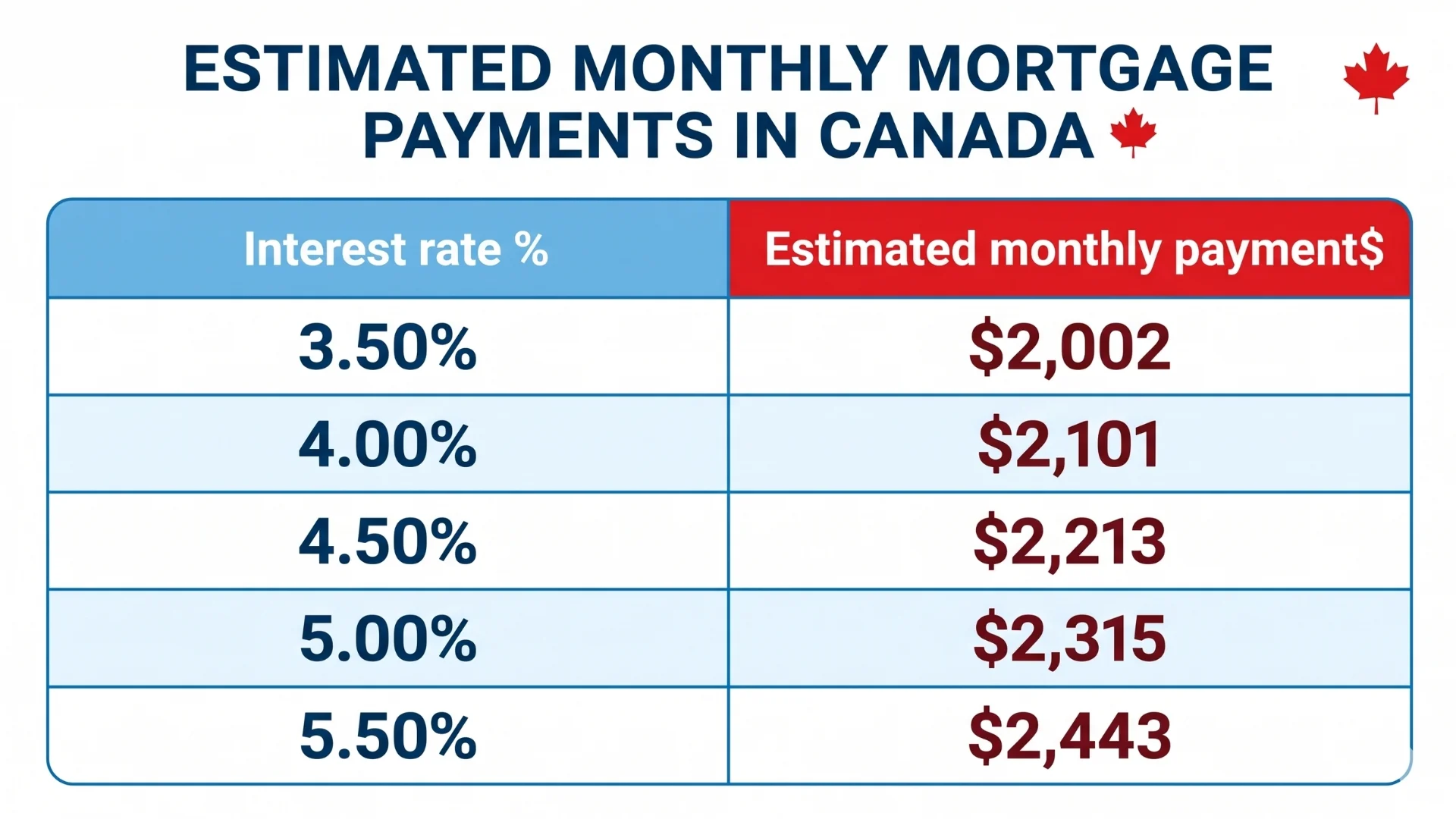
For example, the difference between a 3.5% and 5.0% mortgage rate is approximately $313 per month. Over time, this difference can have a significant effect on your household finances. If you want to estimate your own mortgage payments based on different interest rates and loan amounts, try the CanadaHomeHub Mortgage Calculator.
The example also shows why comparing mortgage rates Canada lenders offer is important. A lower rate can reduce monthly payments and the total interest paid, assuming the other mortgage conditions remain the same.
5.2. Other Costs to Consider When Budgeting for a Mortgage
Your mortgage payment is only one part of the cost of owning a home. Before deciding how much you can afford, account for:
- Property taxes: These vary depending on the municipality and assessed property value.
- Home insurance: Most homeowners need appropriate property insurance coverage.
- Utilities: Electricity, heating, water, and other services add to monthly expenses.
- Maintenance and repairs: Unexpected repairs can create substantial costs.
- Mortgage default insurance: This may apply when purchasing an eligible home with less than 20% down.
- Closing costs: Legal fees, land transfer taxes where applicable, inspections, and other transaction expenses.
A realistic budget should include these expenses alongside your mortgage payments. This helps you avoid committing to a mortgage that leaves too little room for everyday living costs.
6. How to Find the Best Mortgage Rates in Canada
Finding the best mortgage rates Canada lenders offer requires more than searching for the lowest percentage online. You should compare multiple offers, understand their conditions, and evaluate the overall cost of borrowing.
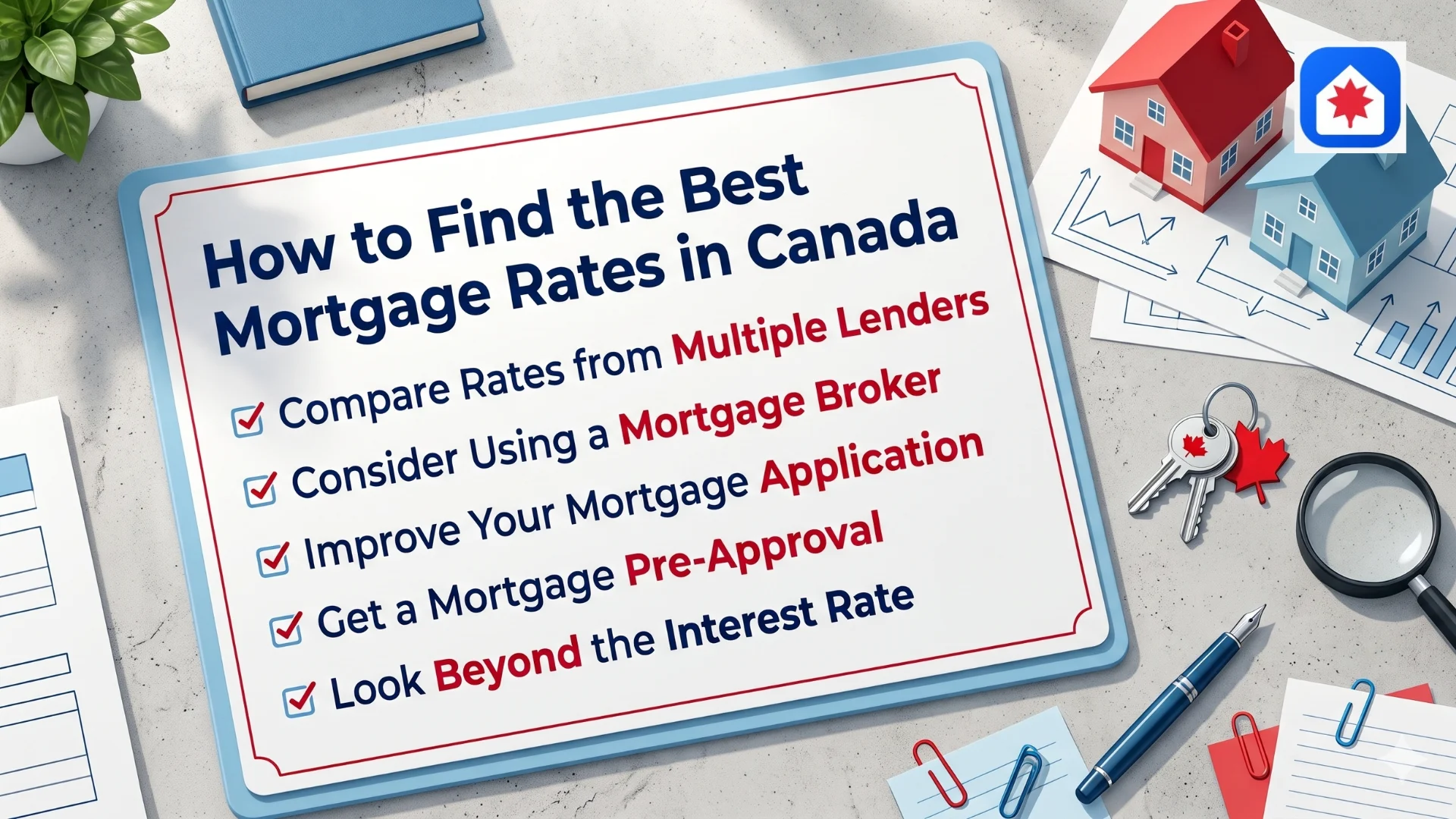
6.1. Compare Rates from Multiple Lenders
Start by checking mortgage offers from different financial institutions.
Compare:
- Interest rates for the same mortgage term.
- Fixed and variable options.
- Insured and uninsured mortgage offers.
- Payment schedules and amortization periods.
- Prepayment privileges and early termination penalties.
Make sure you compare similar mortgage products. A five-year insured mortgage should not be compared directly with a five-year uninsured mortgage without accounting for their different costs and eligibility requirements.
6.2. Consider Using a Mortgage Broker
A mortgage broker can help you compare products from multiple lenders and identify options that match your financial situation. Unlike a bank employee who generally presents products from their own institution, a broker may have access to different banks, credit unions, and mortgage companies.
Before working with a broker, ask:
- Which lenders do you work with?
- Are there any lenders or mortgage products you cannot access?
- How are your services compensated?
- Are there any fees I need to pay?
- What mortgage conditions should I pay attention to?
Mortgage brokers generally receive commissions from lenders, although fee arrangements can vary. Before proceeding, make sure you understand any potential costs. If you need help finding a suitable professional, CanadaHomeHub can help you explore mortgage broker options.
6.3. Improve Your Mortgage Application
A well-prepared application can help you access more competitive mortgage offers. Before applying, organise your financial documents and review your overall borrowing position.
Useful preparation steps include:
- Check your credit report and resolve any errors.
- Reduce high-interest outstanding debts where possible.
- Prepare proof of employment and income.
- Calculate your available down payment.
- Review your monthly expenses and existing financial obligations.
- Avoid taking on unnecessary new debt before applying.
6.4. Get a Mortgage Pre-Approval
Mortgage pre-approval helps you understand how much you may be able to borrow before making an offer on a property.
During the process, the lender or mortgage broker reviews information such as your income, assets, debts, and credit history. A pre-approval may also include a rate hold for a specified period. This can protect you against certain rate increases while you look for a home, subject to the lender's conditions.
However, a pre-approval is not a final mortgage approval. The lender may still need to review the property, verify your documents, and confirm that you meet all lending requirements before completing the mortgage.
6.5. Look Beyond the Interest Rate
A low interest rate does not automatically mean a mortgage is the most affordable option.
Before signing a mortgage agreement, review:
- Prepayment privileges: How much extra can you pay toward the principal without penalties?
- Prepayment penalties: What happens if you sell your property or break the mortgage early?
- Portability: Can you transfer your existing mortgage to another property?
- Payment flexibility: Can you change your payment frequency or amount?
- Discharge and transfer fees: What costs apply if you switch lenders?
- Mortgage insurance: Are there additional insurance costs?
Always review the full mortgage agreement rather than focusing exclusively on the advertised rate.
Frequently Asked Questions
1. What Is a Good Mortgage Rate in Canada?
A good mortgage rate is one that is competitive for your mortgage type, term, down payment, and financial profile. Compare offers from multiple lenders instead of relying on a single advertised rate. Also consider mortgage insurance, prepayment conditions, penalties, and other fees before deciding which offer provides the best overall value.
2. Is a Fixed or Variable Mortgage Better in Canada?
Neither option is always better. A fixed mortgage provides greater payment predictability because the interest rate stays unchanged during the term. A variable mortgage can become more affordable when interest rates decrease, but borrowing costs may rise when the lender's prime rate increases. Your choice should depend on your financial flexibility and tolerance for interest rate changes.
3. Can I Negotiate My Mortgage Rate in Canada?
Yes. You can negotiate with your current lender or compare offers from other financial institutions and mortgage brokers. Having written competing offers can give you a stronger starting point when requesting a better rate. You can also negotiate other conditions, including payment flexibility and prepayment privileges.
4. How Can I Qualify for the Best Mortgage Rates in Canada?
To improve your chances of receiving a competitive offer, maintain a good credit history, manage existing debts, prepare proof of income, and save an appropriate down payment. You should also compare lenders and choose a mortgage product that matches your financial circumstances.
5. Should I Choose a 3-Year or 5-Year Fixed Mortgage?
A three-year fixed mortgage offers a shorter commitment, allowing you to renegotiate sooner. A five-year fixed mortgage provides a longer period of interest rate stability. The right option depends on the rates available, your plans for the property, your expectations about future interest rates, and the penalties associated with breaking the contract early.
Fixed mortgages offer predictable interest rates, while variable mortgages provide opportunities to benefit from changing market conditions but come with greater uncertainty. Understanding the mortgage rates Canada lenders offer can help you make better decisions when purchasing a home or renewing an existing mortgage. The right choice involves more than finding the lowest advertised interest rate. You also need to consider the mortgage term, amortization period, payment flexibility, additional fees, and your ability to manage future payments.
If you are researching the Canadian housing market, CanadaHomeHub is a relevant starting point for exploring housing-related information and planning your next steps.
Thank you for taking the time to read this article.