Securing a mortgage in Canada is one of the most significant financial steps you will ever undertake. Whether you are eyeing your first condominium in Calgary, a detached family home in suburban Ontario, or a townhouse in Halifax, Canadian lenders evaluate your application against strict regulatory frameworks designed to maintain financial stability.
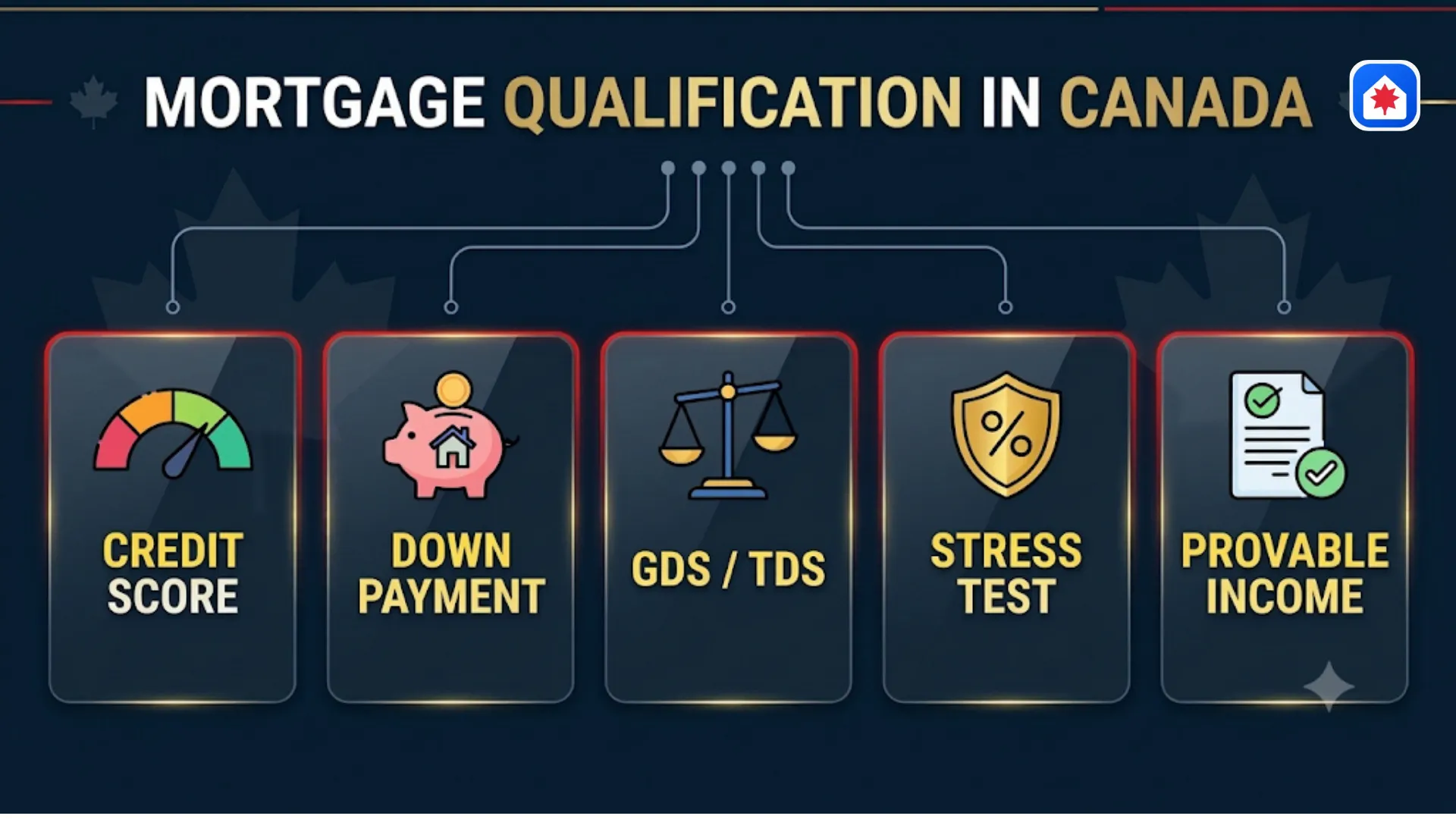
Qualifying for a home loan requires more than simply earning a steady paycheque. Canadian federally regulated financial institutions assess your financial health through five core criteria: credit history, equity contribution (down payment), debt servicing ratios, income reliability, and your ability to pass the federal mortgage stress test.
Understanding these mechanisms before submitting an application helps you avoid unexpected surprises, negotiate better interest rates, and determine your actual purchasing power.
The 5 Core Pillars of Mortgage Qualification in Canada
Canadian mortgage underwriting operates on transparent benchmarks established by the Office of the Superintendent of Financial Institutions (OSFI) and the major mortgage default insurers: Canada Mortgage and Housing Corporation (CMHC), Sagen, and Canada Guaranty.
Credit Score: What Canadian Lenders Expect
Your credit score, tracked primarily through Equifax Canada and TransUnion Canada, serves as a direct measurement of your repayment discipline. Scores range from 300 to 900:
- 720–900 (Excellent): Unlocks the most competitive fixed and variable rates from prime "A-lenders" (Chartered banks and credit unions).
- 680–719 (Good): Meets the standard threshold for prime insured and conventional mortgages without pricing penalties.
- 600–679 (Fair): May qualify for insured financing under specific conditions, though lenders review the overall profile with greater scrutiny.
- Below 600 (Challenged): Generally requires alternative "B-lenders" or specialized credit rehabilitation programs, often carrying higher borrowing fees and interest premiums.
Lenders look beyond the headline number. They evaluate your credit depth, which typically requires at least two active trade lines (such as a credit card and an auto loan) with credit limits of $2,000 or more for at least two consecutive years.
Down Payment Thresholds and Mortgage Default Insurance
Canadian regulations mandate minimum down payment thresholds structured in tiers according to the purchase price of the property:
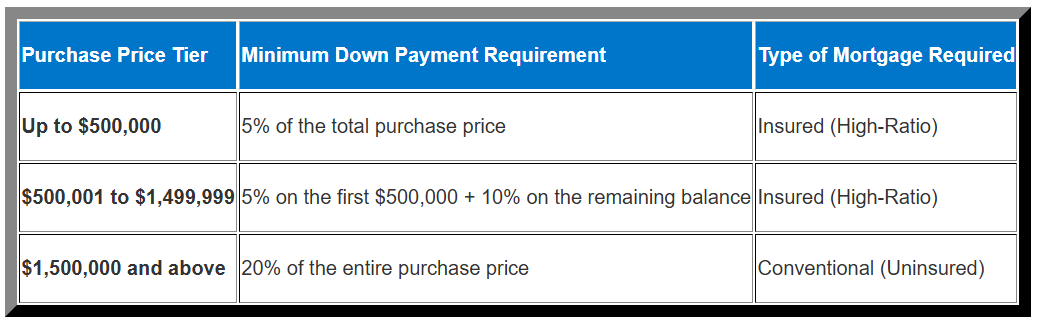
If your down payment is under 20%, Canadian law requires you to purchase mortgage default insurance (provided by CMHC, Sagen, or Canada Guaranty). This insurance protects the lender if you default on payments, and the premium (ranging from 2.80% to 4.00% of the loan balance) is rolled directly into your mortgage principal.
Debt-to-Income Limits: Understanding GDS and TDS Ratios
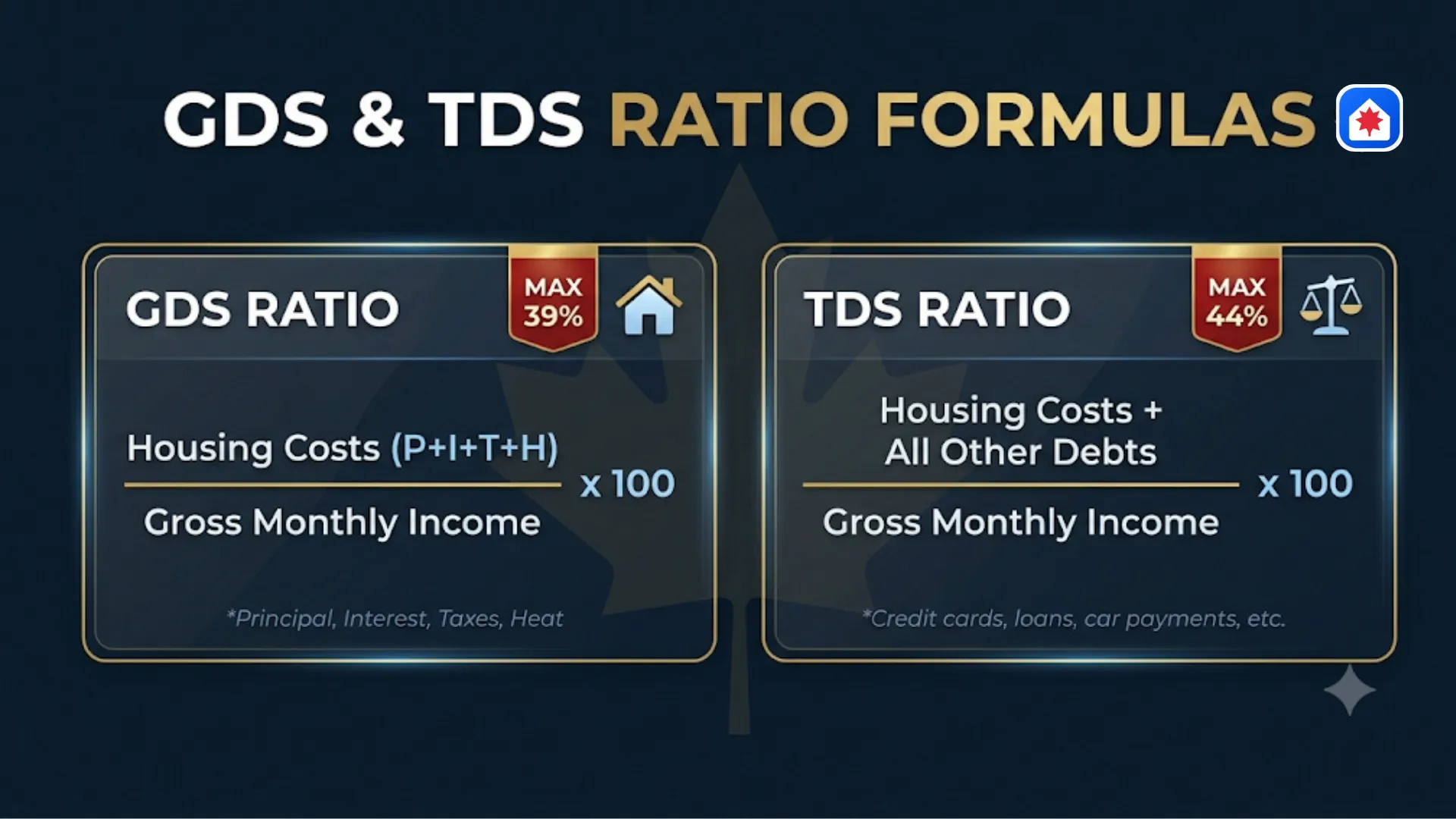
Canadian underwriters calculate two vital debt-to-income metrics to determine your borrowing limits: Gross Debt Service (GDS) and Total Debt Service (TDS).
Gross Debt Service (GDS)
The GDS ratio calculates the proportion of your pre-tax household income required to pay housing-related costs: mortgage principal, interest, property taxes, estimated heating expenses, and 50% of monthly condominium maintenance fees (if applicable). Standard Regulatory Ceiling: 39% of gross monthly income
Total Debt Service (TDS)
The TDS ratio expands upon the GDS formula by incorporating all other personal debt obligations, including auto loan payments, student loans, minimum credit card payments, personal lines of credit, and child support payments. Standard Regulatory Ceiling: 44% of gross monthly income.
Applicants with exceptional credit scores (720+) may occasionally receive minor flexibility on conventional files, but exceeding 39/44 on an insured mortgage is rarely permitted.
The Canadian Mortgage Stress Test Explained
Even if you secure a contract interest rate of 4.39%, Canadian financial regulations require you to qualify at a significantly higher interest rate. Mandated under OSFI Guideline B-20 for uninsured loans and mirrored by federal rules for insured loans, the mortgage stress test ensures borrowers can withstand future rate hikes.
Under the stress test, you must qualify at the higher of:
- Your contractual mortgage interest rate plus 2.00%.
- The Bank of Canada benchmark floor of 5.25%.
Example: If your lender offers a 5-year fixed rate of 4.60%, your debt ratios (GDS and TDS) are calculated using a qualifying rate of 6.60% (4.60% + 2.00%). If your contract rate is 3.10%, you are tested at the benchmark rate of 5.25% because 3.10% + 2.00% (5.10%) falls below the statutory floor.
Provable Income and Employment Stability
Lenders demand indisputable verification that your income will continue for the foreseeable future. A stable two-year employment history within the same company or industry serves as the gold standard. Probationary periods must generally be completed before receiving an unconditional mortgage commitment.
Income Needed for a Mortgage in Canada: How Lenders Assess Your Earnings
Your gross income sets the upper boundary for how much money you can borrow. However, lenders evaluate different types of earnings with distinct verification protocols.
Salaried and Hourly Employees (T4 & Pay Stubs)
Permanent full-time employees face the most direct path to qualification:
- Required Documentation: A formal letter of employment dated within 30 days (confirming position, tenure, salary, and guaranteed hours), recent pay stubs, and the most recent year's T4 tax slip.
- Overtime and Bonuses: Irregular earnings like overtime, bonuses, or commissions can only be factored in if you have a consistent two-year history. Lenders typically average the earnings reported on your last two years of T4 slips or Notices of Assessment (NOA).
Self-Employed and Commission Earners (NOAs & T1 Generals)
Business owners, sole proprietors, contractors, and 100% commission earners undergo rigorous scrutiny because taxable earnings can fluctuate.
- Standard Verification (A-Lenders): Underwriters average line 15000 (Total Income) from your last two years of CRA Notice of Assessment documents. If your income dropped in the second year, lenders often use the lower figure rather than the average.
- Stated Income Solutions (Alternative Lenders): Entrepreneurs who write off significant operational expenses to reduce taxable income may explore alternative lending programs. These programs assess business bank statements to determine real cash flow, though they require a larger down payment (often 15%–20%) and carry higher interest rates.
Calculating Your Debt-to-Income Ratios: A Practical Canadian Example
To see how these rules come together, consider a practical home-buying scenario.
- Purchase Target: $600,000 home
- Combined Gross Household Income: $130,000 annually ($10,833/month)
- Down Payment Saved: $35,000 (Tiered minimum: 5% on $500k = $25,000; 10% on remaining $100k = $10,000)
- Mortgage Loan Amount: $565,000 + CMHC Insurance Premium (4.00% = $22,600) = $587,600
- Contract Rate Offered: 4.75% on a 25-year amortization
- Stress Test Qualifying Rate: 6.75% (4.75% + 2.00%)
- Monthly Property Taxes: $350
- Monthly Heating Estimate: $150
- Monthly Outstanding Consumer Debt: $400 car loan + $150 student loan = $550
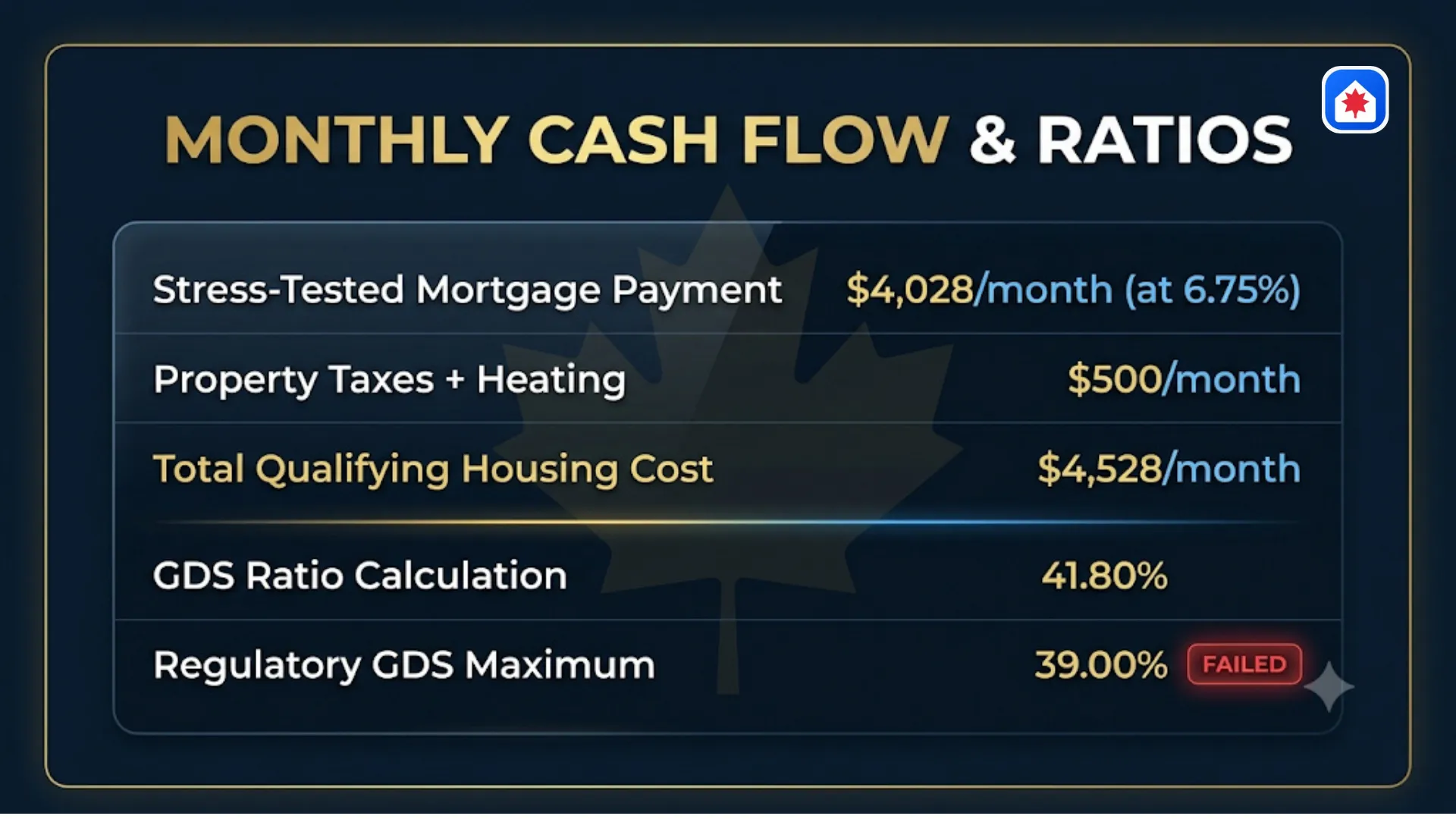
The Outcome: Even though the actual payment at 4.75% would be approximately $3,332 per month, the stress test assesses the payment at $4,028. At 41.80%, the GDS exceeds the 39% cap.
To qualify, this household must:
- Increase their down payment to reduce the loan balance.
- Target a purchase price closer to $540,000.
- Pay off the car and student loans to free up overall debt capacity (though the GDS constraint remains primary).
Before touring properties, running your exact numbers through the debt-to-income mortgage Canada tool allows you to model both contract payments and stress-tested thresholds accurately across varying down payment tiers.
A-Lenders vs. B-Lenders vs. Private Lenders: Where Do You Fit?
If you cannot satisfy the strict requirements of major Canadian financial institutions, alternative lending paths exist across the Canadian lending spectrum.
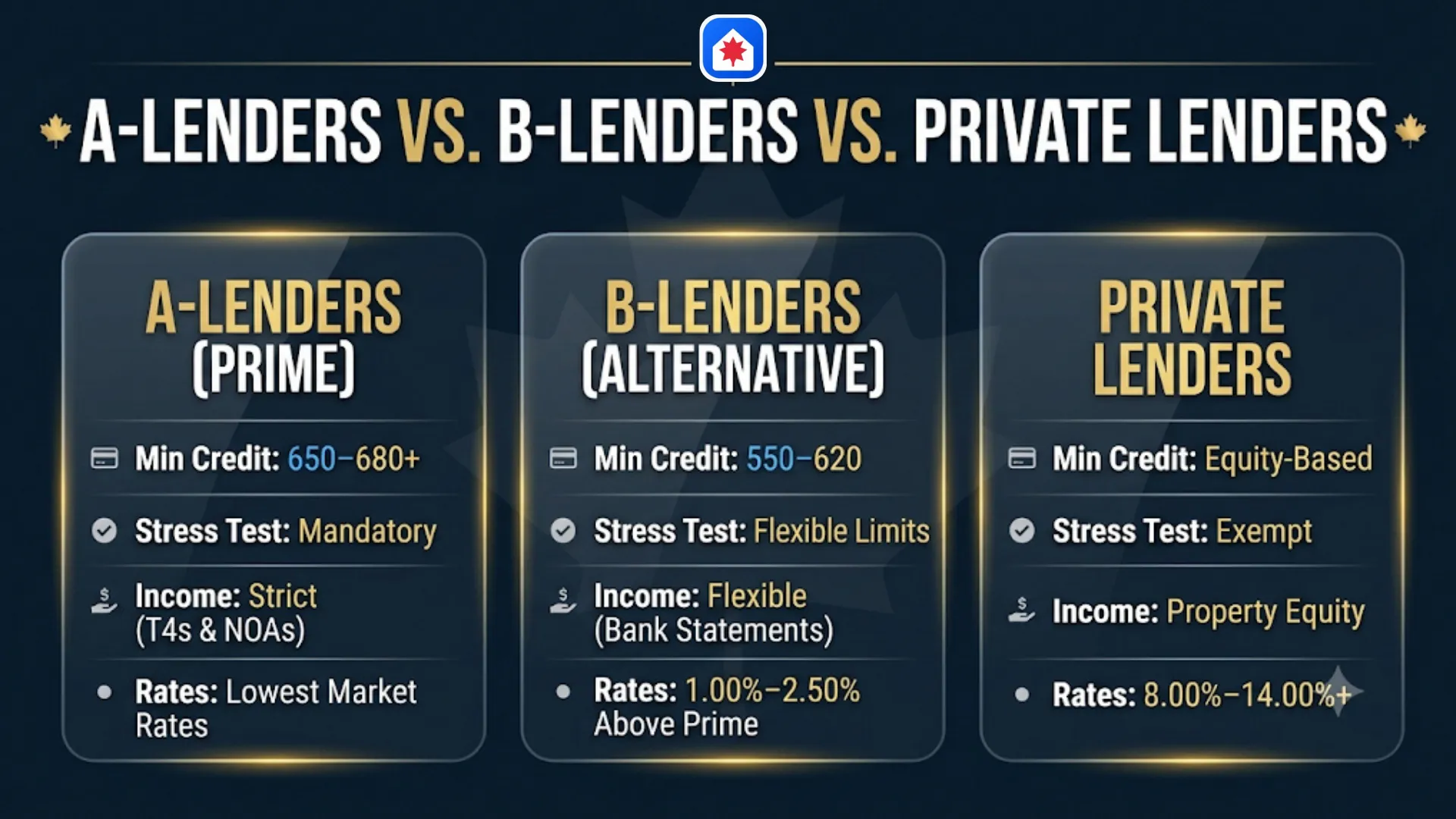
Borrowers with bruised credit or undeclared self-employed earnings often utilize B-lenders as a transitional 1- to 3-year solution, rebuilding their credit profile before refinancing back to an A-lender.
Step-by-Step Roadmap to Get Approved for a Canadian Mortgage
Securing an approval letter requires methodical preparation well in advance of making an offer on a home.
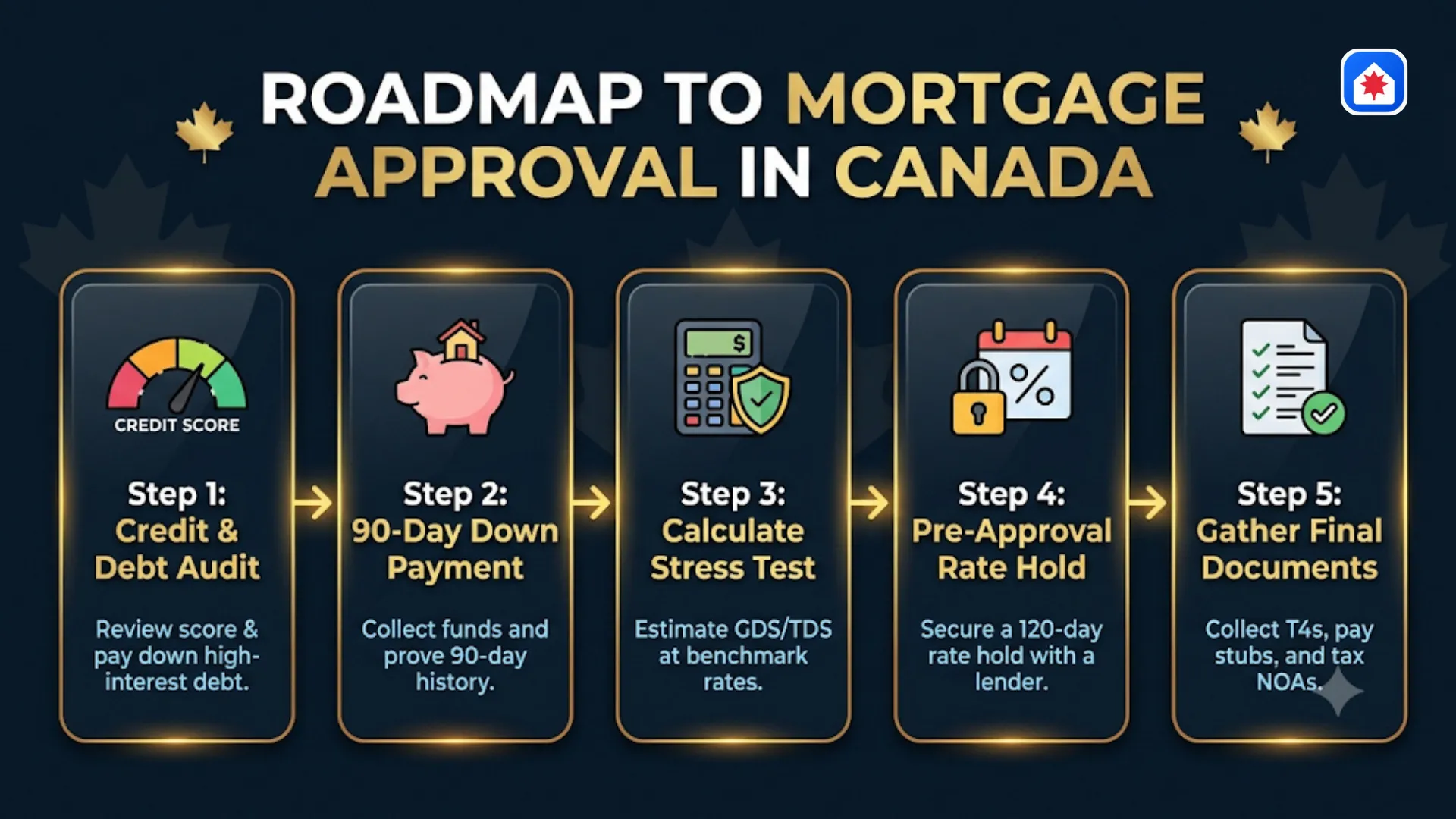
Step 1: Audit Your Credit File and Pay Down Revolving Debt
Pull your credit reports from both Equifax and TransUnion at least six months before applying. Dispute any reporting errors immediately. Aim to reduce credit card balances below 30% of your credit limits (credit utilization ratio), as this quickly boosts your score.
Step 2: Accumulate and Document Your Down Payment
Under anti-money laundering (AML) laws governed by FINTRAC, Canadian lenders require a clear 90-day bank history for all funds used in your down payment.
- Personal Savings/Investments: Bank statements showing steady accumulation.
- First Home Savings Account (FHSA): Allows eligible Canadians to contribute up to $8,000/year (to a $40,000 lifetime max) tax-free for qualifying purchases.
- Home Buyers' Plan (HBP): Permits withdrawing up to $60,000 from your RRSP tax-free.
- Gifted Down Payments: If funds originate from an immediate family member, a signed Gift Letter is mandatory, confirming the capital is a non-repayable gift without claims on the property.
Step 3: Use an Online Calculator to Estimate Your Borrowing Capacity
Do not rely on the sticker price of a listing. Input your property taxes, condo fees, heating estimates, and current interest rates into dynamic online tools to ensure your combined GDS/TDS calculations remain securely under 39% and 44% at stress-tested rates.
Step 4: Secure a Pre-Approval Rate Hold
A formal pre-approval locks in an interest rate for 90 to 120 days, protecting your buying power against rate increases while you search for a property. Remember that a pre-approval is conditional upon the property meeting lender valuation standards.
Step 5: Gather Mandatory Supporting Documentation
Assemble an approval-ready package:
- Two recent pay stubs and an official employment letter.
- T4 slips and CRA Notices of Assessment (NOAs) for the last two years.
- 90-day paper trail for all down payment accounts.
- Current statements for auto loans, student loans, and credit cards.
- MLS listing and signed Agreement of Purchase and Sale once an offer is accepted.
Common Mistakes That Derail Mortgage Qualification in Canada
Even pre-approved buyers can jeopardize their final mortgage commitment if they make avoidable errors prior to closing day:
- Financing a New Vehicle Before Closing: Taking on an auto loan or financing lease right before closing introduces a substantial monthly liability, instantly inflating your TDS ratio and potentially reducing your approved mortgage amount by tens of thousands of dollars.
- Changing Employment During the Underwriting Process: Switching from a secure salaried position to a probationary role or starting an independent business resets your verification history, causing lenders to rescind approvals.
- Unexplained Cash Deposits: Depositing cash gifts or transferring unverified funds within your down payment accounts without proper documentation triggers FINTRAC compliance audits and lender rejection.
- Neglecting Closing Costs: A mortgage down payment does not cover ancillary closing expenses. In Canada, buyers must hold at least 1.5% of the purchase price in reserve to cover Provincial Land Transfer Tax (plus municipal land transfer tax in Toronto), legal fees, title insurance, and property adjustments.
Frequently Asked Questions About Qualifying for a Canadian Mortgage
What is the minimum credit score needed to buy a house in Canada?
For an insured mortgage with an A-lender, the minimum credit score accepted by mortgage insurers is typically 600, but most major chartered banks prefer a score of 680 or higher to offer their most competitive rates. If your score is between 550 and 600, you will likely need to work with an alternative (B) lender and provide a larger down payment.
How much income do I need to qualify for a $500,000 mortgage in Canada?
Assuming a 5-year fixed rate of approximately 4.75% (stress-tested at 6.75%), a 25-year amortization, minimal other personal debts, and standard property taxes/heating costs, an individual or household generally needs a gross annual income between $115,000 and $125,000 to qualify for a $500,000 mortgage while remaining within the 39% GDS limit.
Can I qualify for a mortgage in Canada if I am on probation at work?
Most prime lenders will not finalize an unconditional mortgage approval while an applicant is on probation. They typically require an updated letter from the employer confirming that the probationary period has passed. Exceptions exist if you are working within the exact same role and industry with continuous tenure across previous employers.
Can temporary residents or work permit holders qualify for a mortgage?
Yes. Foreign nationals holding valid Canadian work permits can qualify for a mortgage under specific lender guidelines. Under federal foreign buyer regulations, valid work permit holders with sufficient remaining permit duration and documented tax compliance may qualify, typically requiring a minimum down payment of 5% to 10% from verifiable sources.
Can I use gifted funds for my entire down payment?
Yes, for residential owner-occupied properties, prime lenders permit your entire down payment to come from an immediate relative (parent, grandparent, or sibling) as a gift. The donor must sign an official gift letter affirming that the money is an absolute gift with no repayment terms, and you must verify the transfer into your account.
How does the 30-year amortization affect mortgage qualification?
Canadian regulations permit 30-year amortizations for all first-time home buyers purchasing new builds, as well as for uninsured buyers with a 20% down payment or more. Spreading the principal repayment over 30 years rather than 25 reduces monthly payments, which lowers your GDS and TDS ratios and helps you qualify for a higher loan amount.
Navigating Your Path to Canadian Homeownership
Qualifying for a mortgage in Canada demands preparation and financial awareness. By strengthening your credit score, eliminating high-interest revolving balances, saving an organized 90-day down payment, and stress-testing your numbers, you place yourself in an advantageous position when sitting down with a mortgage broker or bank specialist.
Before you begin submitting offers on prospective homes, take full advantage of professional planning resources. You can consult comprehensive real estate guides and test various financial scenarios with free tools across CanadaHomeHub.Ca. Utilizing mortgage qualification Canada tools ensures your path to property ownership in Canada is transparent, affordable, and successful.