
Navigating Canada’s immigration system can be life-changing, but it is rarely simple. Between fluctuating Comprehensive Ranking System (CRS) cutoffs, stringent documentation requirements, and evolving federal policies set by Immigration, Refugees and Citizenship Canada (IRCC), an application mistake can lead to costly delays, refusals, or even a multi-year ban for misrepresentation.
For many applicants, finding a trusted immigration lawyer in Canada is the most critical decision in their settlement journey. Whether you are applying for permanent residency via Express Entry, handling a complex Provincial Nominee Program (PNP) stream, sponsoring a spouse, or responding to a procedural fairness letter (PFL), qualified legal representation protects your rights.
This comprehensive guide breaks down how to find a reputable Canadian immigration lawyer, distinguishes lawyers from regulated consultants, explains standard legal fees across Canada, and provides actionable steps to verify credentials before signing a retainer agreement.
Why You Might Need an Immigration Lawyer in Canada
Canada does not legally mandate that you hire a representative to submit an immigration application. Thousands of applicants successfully navigate straightforward pathways on their own each year using official IRCC guides. However, immigration law is an intricate branch of administrative and constitutional law. When situations deviate from standard checklists, professional legal advice becomes invaluable.
Routine Applications vs. Complex Legal Cases
A straightforward study permit extension or a high-scoring Express Entry profile with pristine work histories and no medical or criminal flags may require minimal external assistance. Conversely, professional legal counsel is strongly recommended under the following circumstances:
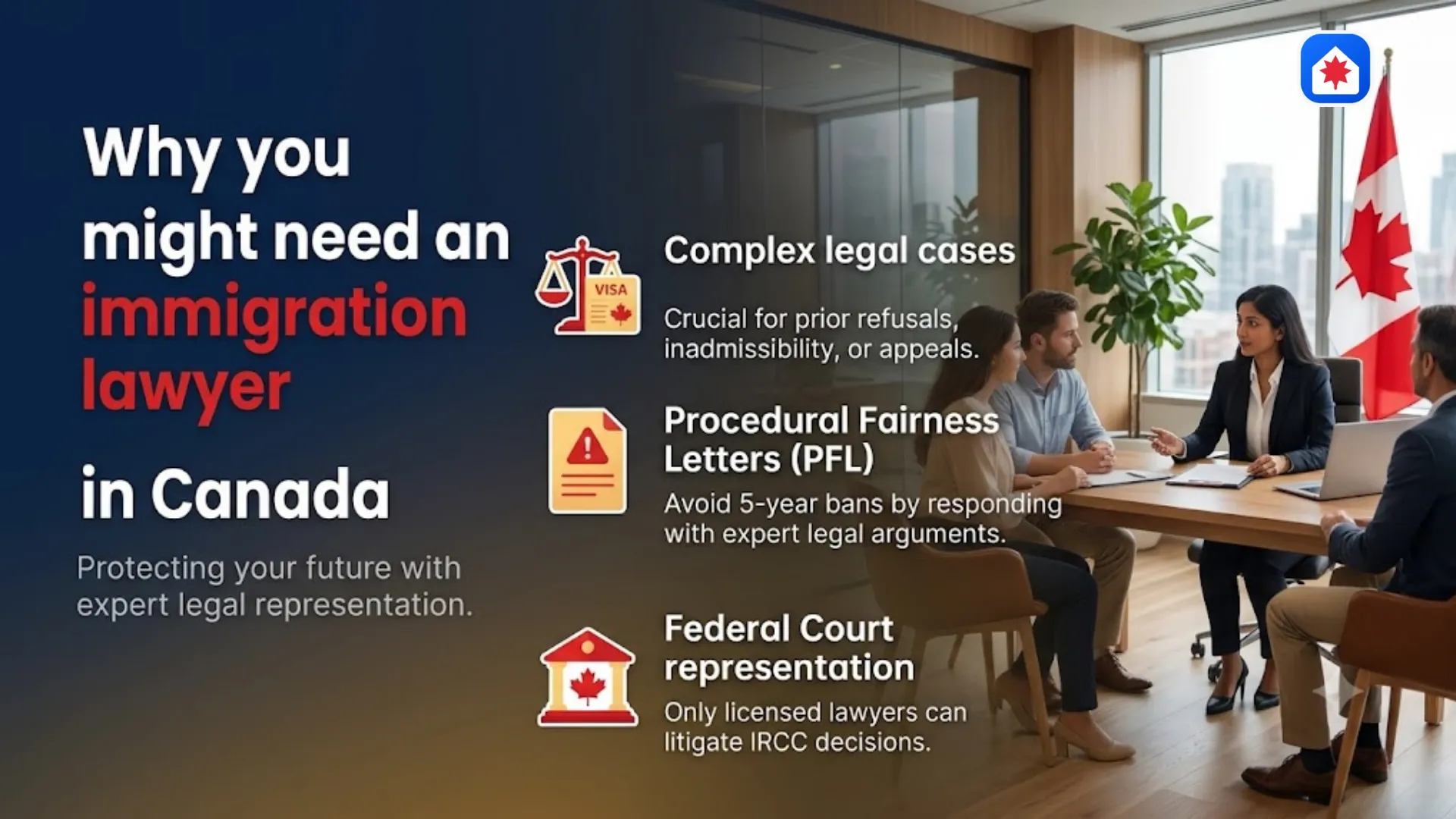
- Prior Refusals or Inadmissibility: If you have previously been refused a Canadian visa, flagged for medical inadmissibility, or have a past criminal conviction (such as an impaired driving charge), an immigration lawyer can prepare legal arguments for criminal rehabilitation or Temporary Resident Permits (TRPs).
- Procedural Fairness Letters (PFL): IRCC issues a PFL when an officer suspects misrepresentation or doubts eligibility. A poorly drafted response can result in a 5-year ban from entering Canada.
- Appeals and Inadmissibility Hearings: If a spousal sponsorship is denied or a removal order is issued, only licensed lawyers (and authorized representatives) can appear before the Immigration and Refugee Board of Canada (IRB).
- Federal Court Judicial Reviews: If an administrative decision by an immigration officer was procedurally unfair, unreasonable, or made in error, only a barrister admitted to a provincial or territorial bar can represent you in the Federal Court of Canada.
What an Immigration Lawyer Can Do That Others Cannot
A Canadian lawyer holds a Juris Doctor (JD) or Bachelor of Laws (LLB), has completed mandatory bar admission courses and articles of clerkship, and is bound by provincial Law Society ethical codes. Unlike unlicensed agents, lawyers can:
- Provide legally privileged advice protected by solicitor-client privilege.
- Formulate complex statutory arguments interpreting the Immigration and Refugee Protection Act (IRPA) and the Immigration and Refugee Protection Regulations (IRPR).
- Litigate decisions in Canadian provincial courts, the Federal Court of Canada, and the Supreme Court of Canada.
Immigration Lawyer vs. Immigration Consultant (RCIC): Understanding the Key Differences
A frequent question prospective newcomers ask is: What is the difference between an immigration consultant vs lawyer in Canada? Both can legally represent you before IRCC, but their training, scope of authority, and regulatory oversight differ substantially.
Regulatory Bodies: Law Societies vs. CICC
-
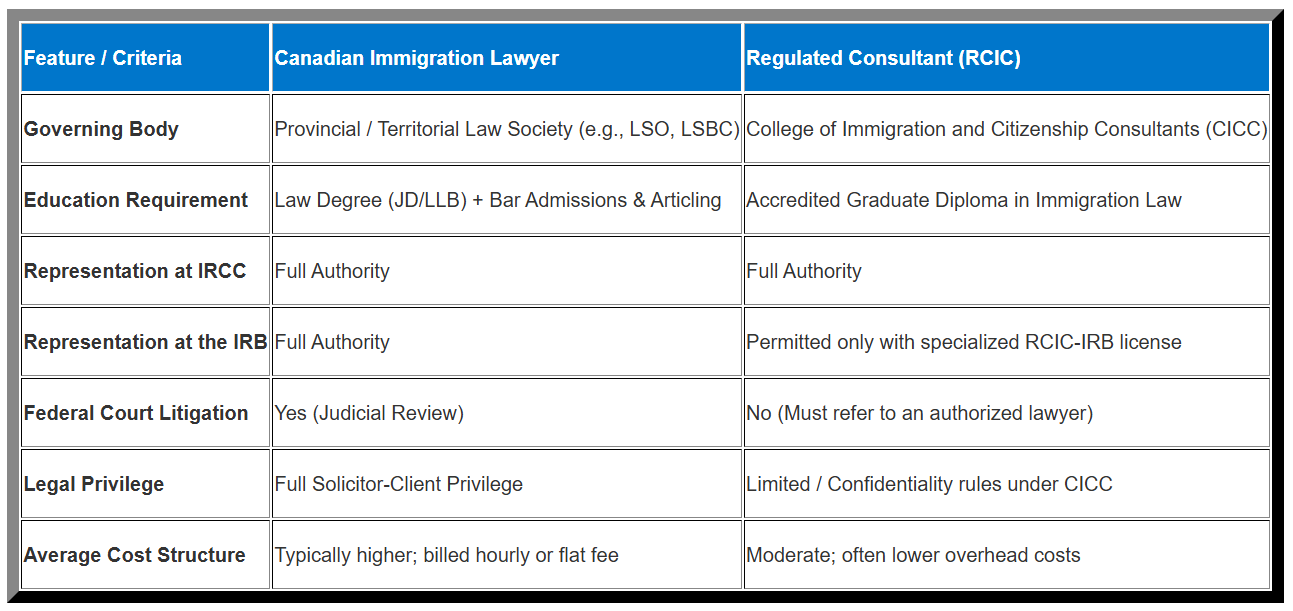
Immigration Lawyers: Must be active, licensed members of a Canadian provincial or territorial law society (such as the Law Society of Ontario, the Law Society of British Columbia, or the Barreau du Québec). Their education involves a minimum of three years of law school followed by bar examinations and supervised practical training.
- Regulated Canadian Immigration Consultants (RCICs): Must complete an accredited graduate diploma program and be licensed by the College of Immigration and Citizenship Consultants (CICC). While qualified to handle standard immigration filings and specific tribunals (if holding an RCIC-IRB class license), consultants cannot represent clients in judicial reviews before the Federal Court.
Comparison Table: Immigration Lawyer vs. RCIC at a Glance
How Much Does an Immigration Lawyer Cost in Canada? (Immigration Lawyer Fees Canada)
Legal fees vary widely across Canada depending on the lawyer's years of experience, firm size, regional cost of living (e.g., Toronto and Vancouver versus smaller municipalities), and the complexity of your file. Understanding legal billing models helps you plan your financial reserves accurately.
Typical Billing Structures: Flat Fee vs. Hourly Rate
Most Canadian immigration law practices utilize one of two billing arrangements:
- Flat-Fee Agreements: Common for defined, predictable applications (such as a standard Spousal Sponsorship, Express Entry submission, or Labour Market Impact Assessment). You pay a set fee covering legal drafting, document review, and submission.
- Hourly Billing: Common for litigation, corporate compliance audits, complex PFL responses, and Federal Court judicial reviews. Hourly rates for Canadian immigration lawyers typically range between $250 and $650+ CAD per hour, depending on seniority and expertise.
Average Fee Ranges for Common Immigration Pathways
The figures below represent estimated professional legal service fees across major Canadian urban centres. Note that government processing fees (payable directly to IRCC) and administrative disbursements (translations, courier charges, biometric fees) are billed separately.
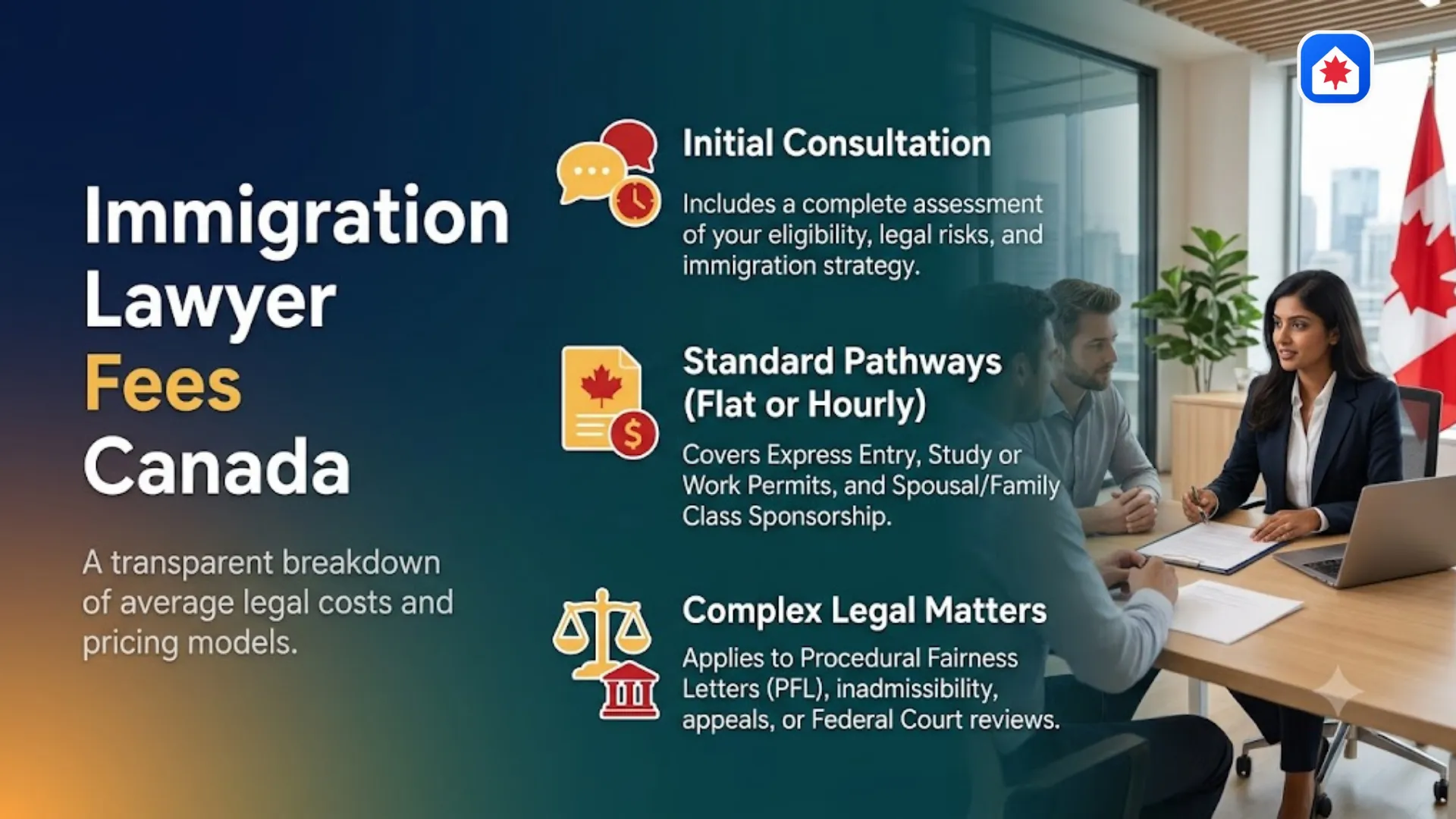
- Initial Consultation (30–60 minutes): $150 – $400 CAD (Some firms credit this fee towards your retainer if hired).
- Express Entry (PR Application Review & Submission): $2,500 – $5,500 CAD.
- Spousal / Family Class Sponsorship: $3,500 – $7,000 CAD.
- Study Permit / Work Permit (Initial or Extension): $1,500 – $3,500 CAD.
- Procedural Fairness Letter (PFL) Response: $2,000 – $5,000+ CAD.
- Federal Court Judicial Review: $6,000 – $15,000+ CAD.
Hidden Costs and Retainer Agreements Explained
Before any legal work begins, Canadian provincial law societies mandate that lawyers execute a written Retainer Agreement. This contract establishes the scope of work, fees, payment schedules, and withdrawal conditions. Ensure your agreement clearly differentiates between:
- Legal Professional Fees: Compensation for the lawyer's time and expertise.
- Applicable Taxes: Harmonized Sales Tax (HST) or Goods and Services Tax (GST), depending on your location and whether you reside inside or outside Canada when services are rendered.
- Disbursements: Out-of-pocket expenses incurred by the firm (e.g., filing fees, specialized courier fees, mandatory notarization).
Step-by-Step: How to Find and Choose the Right Canadian Immigration Lawyer
Finding counsel should not rely on unverified social media claims. Follow these systematic steps to locate, interview, and retain a qualified practitioner.
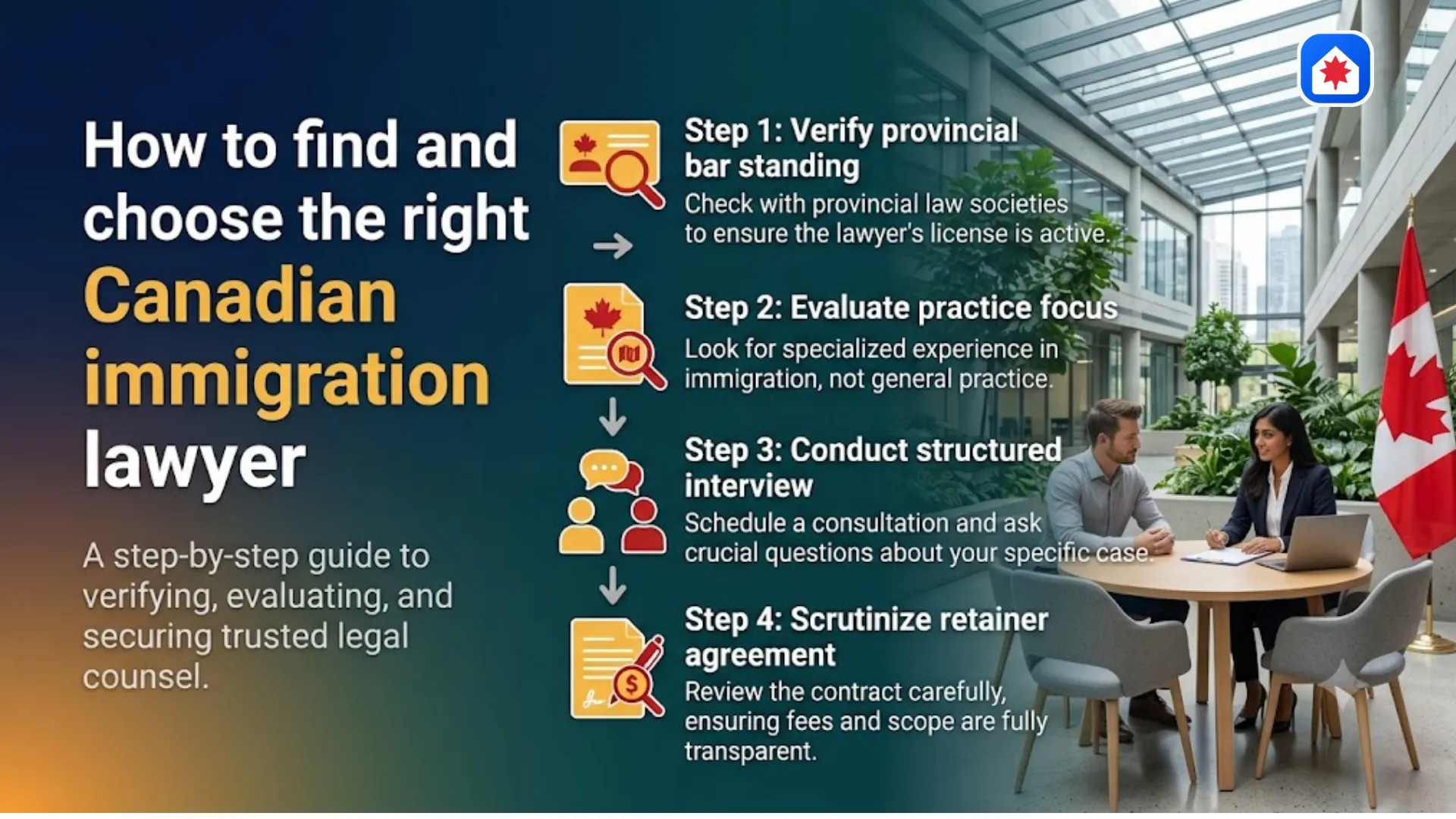
Step 1: Verify Provincial Law Society Standing
Every legitimate Canadian immigration lawyer must be in good standing with their respective provincial regulatory body. You can verify their status within minutes using public directories:
- Ontario: Law Society of Ontario (LSO) Lawyer Directory.
- British Columbia: Law Society of British Columbia Lawyer Directory.
- Alberta: Law Society of Alberta Lawyer Directory.
- Quebec: Barreau du Québec Directory of Lawyers.
Look for a license status that confirms "Practicing," "Active," and verify whether there are any disciplinary suspensions or public reprimands on their record.
Step 2: Search by Area of Specialization and Location
While many applicants search for an immigration lawyer near me, immigration law in Canada is primarily federal. A lawyer physically based in Toronto or Calgary can represent a client living in Halifax, Vancouver, or overseas, provided the matter falls under federal IRCC jurisdiction or the lawyer is authorized to handle specific provincial PNP regulations.
However, local presence is advantageous if you require in-person document signing, live hearings before a regional IRB registry, or local employer audits. Ensure the lawyer actively specializes in immigration law rather than treating it as a secondary sideline to criminal or real estate practices.
Step 3: Schedule and Prepare for Initial Consultations
An initial legal consultation provides a strategic evaluation of your eligibility and an opportunity to gauge the lawyer's transparency. Treat this as a mutual job interview. To ensure you make the most of this consultation without running up unnecessary billable hours, organize your personal records beforehand.
Before your consultation, make sure you have calculated your timelines accurately. For instance, if you are planning for long-term residency or eventual citizenship, utilizing reliable Canadian settlement resources that allows you to tally your temporary resident credits and physical days inside Canada. Having precise dates, employment letters, and educational credentials ready ensures the lawyer reviews a factual, cohesive timeline during your paid consultation.
Key Questions to Ask During Your Consultation:
- Are you an active member in good standing with a Canadian provincial law society?
- How many years have you actively practiced Canadian immigration law?
- Have you successfully handled cases with facts similar to mine (e.g., medical issues, prior refusals, or specific PNP streams)?
- Will you personally draft and review my submissions, or will the file be delegated to an articling student or paralegal?
- Do you charge a flat fee or hourly rate, and what additional disbursements should I anticipate?
Step 4: Review the Retainer Agreement Before Signing
Never transfer funds via unverified peer-to-peer payment apps or cash without an invoice. A reputable lawyer will deposit your retainer into a segregated law firm trust account. Funds are only withdrawn from trust to the operating account after specific work milestones are completed and billed.
Red Flags to Avoid: Protecting Yourself from Immigration Scams
Immigration fraud is a pervasive issue targeting newcomers. IRCC frequently reminds applicants that unauthorized representatives ("ghost consultants") operate unlawfully by charging fees under the table without accountability. Protect your application by steering clear of these red flags:
- Guaranteed Visa or PR Approvals: No representative, regardless of influence, can guarantee an approval. IRCC officers hold statutory discretion; promising a 100% success rate is unethical and directly violates provincial law society codes of conduct.
- Claims of Special Government Connections: Anyone claiming insider access to IRCC visa offices or guaranteed processing shortcuts is misleading you. Applications are processed in accordance with established departmental workflows.
- Blank Documents or Refusal to Provide Copies: You must review and sign every official IRCC form (such as the IMM 5476 Use of a Representative form). Never sign blank declarations, and always demand copies of every submission package filed on your behalf.
- Absence of a Written Retainer Agreement: If a practitioner refuses to provide a written contract specifying their identity, business address, and fee breakdown, terminate communication immediately.
How to Maximize Value and Lower Your Legal Costs
Legal representation represents an investment in your settlement security, but costs can escalate if communication is inefficient. You can keep billable expenses manageable by adopting a structured approach:
- Maintain Meticulous Chronologies: Compile a single master document detailing your foreign travel dates, residential addresses for the past 10 years, and exact employment periods. Finding gaps yourself saves hours of lawyer or clerk time.
- Translate Documents Early: Certified translations of birth certificates, police clearance records, and diplomas must meet IRCC specifications. Arranging these via certified translators in advance avoids last-minute rush billing.
- Consolidate Communications: If your legal team bills hourly, avoid sending separate emails for every minor question. Instead, compile questions into a concise, prioritized list and request a scheduled review.
- Leverage Reputable Settlement Tools: When mapping out your multi-year pathway—from arrival and rental housing to citizenship eligibility—consult transparent educational guides and calculators such as those hosted on CanadaHomeHub.Ca. Entering an attorney's office well-informed about Canadian settlement frameworks allows the consultation to focus squarely on high-level legal strategy rather than basic definitions.

Frequently Asked Questions About Canadian Immigration Lawyers
Can an immigration lawyer guarantee that my Canadian visa will be approved?
No. Under Canadian law and Law Society professional conduct rules, a lawyer is prohibited from guaranteeing any immigration outcome. Final decisions are solely at the statutory discretion of IRCC immigration officers or administrative tribunal adjudicators. A lawyer’s role is to ensure your application is legally sound, robustly documented, and thoroughly compliant with the Immigration and Refugee Protection Act.
Does an immigration lawyer need to be located in my province or city?
Not necessarily for federal immigration programs. Since immigration law is under federal jurisdiction in Canada, any lawyer licensed in a Canadian province or territory can represent you before IRCC and the Federal Court, regardless of where you or the lawyer physically reside. However, if your file involves a specific provincial nominee stream (such as Quebec's distinct immigration frameworks or Ontario's OINP), choosing a lawyer with deep local familiarity in that province’s specific regulations can be advantageous.
What is the difference between a lawyer and an unauthorized agent (ghost consultant)?
An authorized representative in Canada is either a licensed lawyer in good standing with a provincial or territorial law society, a paralegal licensed in Ontario, or a regulated consultant licensed by the CICC. An unauthorized agent (often termed a "ghost consultant") charges fees to assist with applications without being registered with a regulatory body. Using an unauthorized representative can result in IRCC refusing your application, returning it unprocessed, or opening an investigation for fraud.
Can a Canadian immigration lawyer represent me in Federal Court?
Yes. If IRCC refuses your permanent residence, work permit, or citizenship application and the decision breaches procedural fairness or contains legal errors, you can file an Application for Leave and for Judicial Review before the Federal Court of Canada. Only licensed barristers admitted to a provincial or territorial bar are authorized to represent you in these court proceedings; immigration consultants cannot represent clients in Federal Court.
Are initial consultations with Canadian immigration lawyers free?
While some practitioners offer brief 15-minute introductory screening calls to confirm if they can take your case, thorough substantive legal consultations are generally not free. Established lawyers typically charge between $150 and $400 CAD for an initial consultation because they review your documents, assess legal risks, and provide tailored legal advice. Many firms will apply the consultation fee toward your overall retainer if you proceed with retaining their full services.
Conclusion: Taking the Next Confident Step in Your Canadian Journey
Securing legal status in Canada is one of the most rewarding investments you can make for your future, but navigating complex regulatory policies requires prudence and verified facts. Whether your objective is applying for permanent residency, responding to a complex IRCC query, or appealing an adverse decision, working with a vetted immigration lawyer in Canada provides peace of mind and safeguards your legal rights.
Before engaging counsel, verify their provincial law society license, insist on a transparent retainer agreement, and prepare your documentation in advance. To streamline your broader transition—from understanding permanent residency physical presence requirements to financial planning—explore the verified guides, tools, and directories available across CanadaHomeHub.Ca. With the right legal expertise and well-organized documentation, you can embark on your Canadian immigration journey with clarity and confidence.
Thank you for reading our article!