Finding a reliable tax accountant in Canada can save you thousands of dollars, prevent costly filing mistakes, and protect you from unnecessary friction with the Canada Revenue Agency (CRA). Yet for many Canadians—whether you are a salaried employee navigating stock options, a homeowner managing rental income, a self-employed consultant, or a newcomer filing your first Canadian return—figuring out who is actually qualified to handle your taxes can feel overwhelming.
Unlike some jurisdictions where anyone can advertise themselves as an "accountant," Canada strictly regulates the Chartered Professional Accountant (CPA) designation at the provincial and territorial levels. At the same time, thousands of non-designated bookkeepers, seasonal tax preparation chains, and registered EFILE providers also offer tax preparation across Canada. Understanding who does what—and how to vet their credentials—is the key to hiring the right professional for your financial situation.
This guide walks you through everything you need to know to find, verify, and hire a qualified tax accountant in Canada, including where to search official directories, what fees to expect, and the exact questions to ask before handing over your financial documents.
When Do You Actually Need a Tax Accountant in Canada?
Before searching for an accountant for taxes in Canada, it helps to determine whether your situation requires professional oversight or whether certified tax software is sufficient. Paying for professional tax preparation makes the most sense when the potential tax savings, compliance certainty, or time saved outweighs the advisory fee.
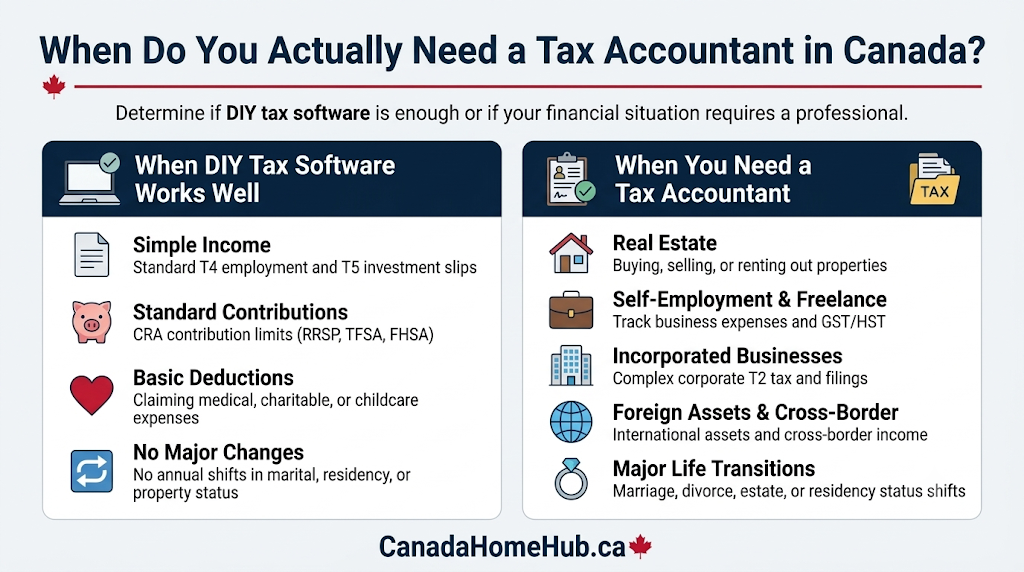
Situations Where DIY Tax Software Works Well
If your financial profile is straightforward, NETFILE-certified Canadian tax software (such as Wealthsimple Tax, TurboTax Canada, or UFile) combined with the CRA’s "Auto-fill my return" feature can handle your filing accurately at little to no cost. You likely do not need a full-service tax accountant if:
- Your income comes solely from standard T4 employment slips and basic T5 investment slips.
- You contribute to a Registered Retirement Savings Plan (RRSP), Tax-Free Savings Account (TFSA), or First Home Savings Account (FHSA) within your clearly stated CRA contribution limits.
- You claim standard deductions and credits such as charitable donations, medical expenses, or childcare costs without complex cross-border rules.
- You have had no major changes in marital status, residency, or property ownership during the tax year.
Life Events and Financial Triggers That Warrant a Professional
Once your finances move beyond standard employment slips, Canadian tax rules become significantly more nuanced. Hiring an experienced tax accountant in Canada is strongly recommended if any of the following apply to you:
- Buying, selling, or renting out real estate: Selling a property requires reporting the disposition on Schedule 3 of your T1 return to claim the Principal Residence Exemption (PRE). If you converted part of your home into a basement apartment, own a rental property (reported on Form T776), or sold a secondary cottage, rules around capital gains and Capital Cost Allowance (CCA) require careful calculation. For homeowners and buyers organizing their property and household milestones on platforms like CanadaHomeHub.Ca, aligning real estate decisions with proactive tax advice early in the year helps prevent unexpected tax bills at filing time.
- Self-employment or freelance income: Earning business or professional income requires filing Form T2125, tracking eligible business-use-of-home and vehicle expenses, and potentially registering for and remitting GST/HST (or QST in Quebec) once you cross the $30,000 small-supplier threshold.
- Operating an incorporated business: Corporations in Canada are separate legal entities requiring a T2 corporate income tax return, financial statements, and strategic decisions around salary versus dividend compensation.
- Holding foreign assets or earning cross-border income: If the total cost amount of your specified foreign property exceeded $100,000 CAD at any point in the year, you must file Form T1135 (Foreign Income Verification Statement). Failing to file this form on time carries steep automatic CRA penalties.
- Major life transitions: Marriage, common-law separation, divorce, retirement pension splitting, estate administration, or arriving in/departing from Canada (which affects tax residency status) all carry high-stakes tax rules.
Understanding Tax Professionals in Canada: CPA vs. Tax Preparer vs. Tax Lawyer
When searching for "tax preparation Canada" or "tax accountant near me," you will encounter several different titles. Knowing the regulatory boundaries behind each credential protects you from hiring someone underqualified—or overpaying for expertise you do not need.
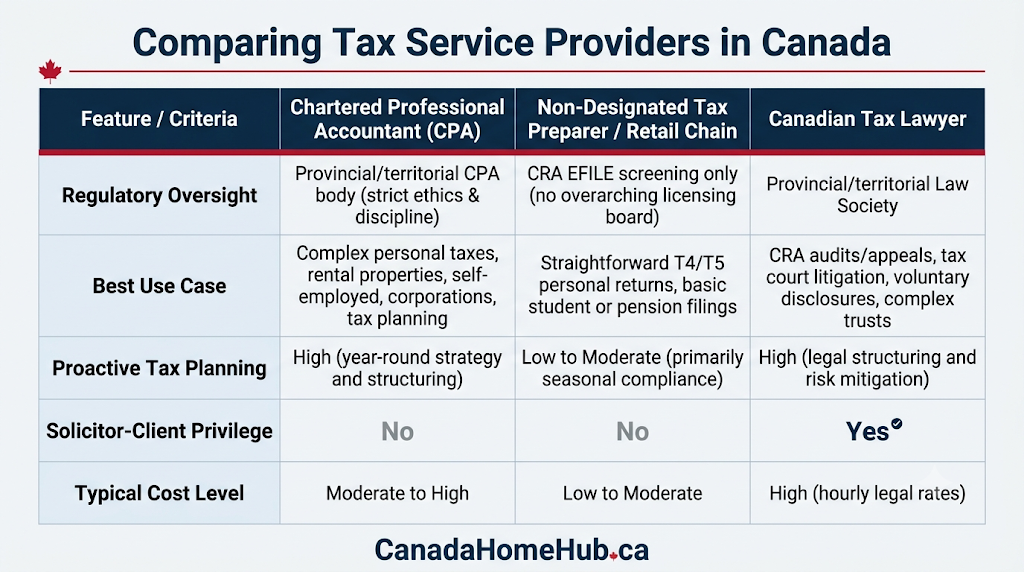
Chartered Professional Accountants (CPAs)
In Canada, CPA is the premier accounting designation, formed through the unification of the legacy Chartered Accountant (CA), Certified General Accountant (CGA), and Certified Management Accountant (CMA) bodies.
CPAs complete rigorous university prerequisites, the CPA Professional Education Program (PEP), a multi-day Common Final Examination (CFE), and documented practical experience. Importantly, CPAs are governed by provincial and territorial regulatory bodies (such as CPA Ontario, CPA British Columbia, CPA Alberta, and the Ordre des CPA du Québec), which enforce strict ethical codes, continuing professional development, and mandatory professional liability insurance.
Note on Public Accounting Licences: While any CPA can prepare personal or corporate tax returns and offer tax planning advice, only CPAs who hold a Public Accounting Licence (PAL)—or the equivalent provincial public practice permit—are authorized to perform assurance engagements such as formal financial statement audits or reviews.
Non-Designated Tax Preparers and Bookkeepers
Canada does not restrict the preparation of basic tax returns exclusively to CPAs. Bookkeepers, enrolled tax specialists at national retail chains, and independent tax preparers can legally prepare and file T1 personal returns.
However, under CRA rules, anyone who prepares more than five returns per year for a fee must register with the CRA for EFILE and pass annual suitability screening. While many seasoned non-designated preparers handle routine personal returns efficiently and affordably, they do not carry the same regulatory oversight, formal tax-planning training, or mandatory insurance protections as a CPA firm.
Canadian Tax Lawyers
Tax lawyers specialize in legal interpretation of the Income Tax Act, complex corporate reorganizations, voluntary disclosures (VDP) for past unfiled taxes, and formal tax litigation before the Tax Court of Canada. Crucially, communications with a Canadian tax lawyer are protected by solicitor-client privilege, whereas communications with an accountant are generally not privileged in the same legal sense. For routine annual filing, a CPA is ideal; for formal CRA disputes or complex legal structuring, a CPA and a tax lawyer often work together.
Comparing Tax Service Providers in Canada
Step-by-Step Guide: How to Find a Tax Accountant Near You in Canada
Rather than relying solely on generic online ads or social media recommendations, follow a structured verification process to find a trustworthy accountant for taxes in Canada.
Step 1: Define Your Specific Tax and Financial Scope
Before reaching out to firms, summarize your financial profile on a single page. Accounting practices specialize just like medical clinics—a CPA who excels at auditing mid-sized manufacturing firms may not focus on personal cross-border real estate taxes. Clearly note:
- Whether you need personal (T1), corporate (T2), or trust (T3) tax services.
- All income sources (T4 employment, T2125 self-employment, T776 rental units, capital gains, dividends, foreign income).
- Whether you need bookkeeping cleanup before tax preparation can even begin.
- Whether you want a one-time filing or ongoing year-round tax planning.
Step 2: Search Official Provincial CPA Directories
Because the accounting profession in Canada is regulated provincially, every province and territory maintains an official public directory where you can search for registered firms and verify individual credentials:
- Ontario: CPA Ontario Member & Firm Directory
- British Columbia: CPABC Public Practice Directory
- Alberta: CPA Alberta Find a CPA Directory
- Quebec: Ordre des CPA du Québec (Find a CPA)
- Manitoba, Saskatchewan, Atlantic Canada & Territories: Respective provincial CPA websites (e.g., CPA Manitoba, CPA Saskatchewan, CPA Nova Scotia, CPA New Brunswick)
Searching through an official directory confirms that the practitioner is in good standing, licensed for public practice in that province, and free of active disciplinary suspensions.
Step 3: Verify CRA EFILE Registration and Niche Experience
When reviewing candidate websites or speaking with their intake teams, confirm that the firm is an authorized CRA EFILE provider. Look for explicit experience in your specific category—for example, real estate investors, incorporated medical/tech professionals, tradespeople, or newcomers to Canada. If you earn income in multiple provinces or own U.S. property, specifically seek out a Canadian CPA firm with cross-border tax expertise.
Step 4: Shortlist and Schedule Discovery Consultations
Select three to four reputable firms and request an initial discovery call (typically 15 to 30 minutes). Many established Canadian CPA firms offer complimentary or low-cost introductory consultations to assess fit and scope. Pay close attention to communication clarity, responsiveness, and whether they ask insightful questions about your goals rather than simply quoting a flat price sight unseen.
10 Essential Questions to Ask Before Hiring an Accountant for Taxes in Canada
Use these ten questions during your discovery call to evaluate expertise, transparency, and service quality:
- Are you a licensed CPA in good standing with your provincial CPA body, and do you hold a public practice permit?
What to listen for: A direct confirmation of their designation, province of registration, and whether a licensed CPA will actually review and sign off on your return—not just a junior technician.
- What percentage of your practice focuses on clients with a tax profile similar to mine?
What to listen for: Concrete familiarity with your specific forms (e.g., T776 rental schedules, T2125 self-employment, or corporate T2 integration).
- Will you be my primary point of contact year-round, or will my file be passed to junior staff?
What to listen for: Clarity on workflow. It is normal for junior accountants to prepare workpapers, provided a senior manager or partner reviews the final return and remains accessible to you.
- Do you offer proactive tax planning, or only annual tax compliance?
What to listen for: Filing taxes reports history; tax planning shapes the future. Good advisors suggest strategies (such as RRSP vs. TFSA optimization, income splitting rules, or timing capital asset purchases) before December 31.
- How do you structure your fees, and what is included in your quote?
What to listen for: A transparent written engagement letter detailing whether billing is flat-fee or hourly, and whether answering brief CRA follow-up letters is included or billed separately.
- What happens if the CRA selects my return for a pre-assessment review or full audit?
What to listen for: Confirmation that the firm represents clients during CRA inquiries (via CRA's "Represent a Client" portal) and how audit defence fees are handled.
- How do you collect and store sensitive financial documents?
What to listen for: Encrypted client portals (such as TaxFolder, ShareFile, or Canopy) rather than sending unencrypted PDFs containing your Social Insurance Number (SIN) over standard email.
- What are your internal deadlines for receiving my tax documents?
What to listen for: Most Canadian accounting firms enforce a document cutoff (often late March or early April) to guarantee filing before the April 30 deadline without rush fees.
- Can you work with my existing bookkeeping software?
What to listen for: Compatibility with tools like QuickBooks Online, Xero, or Wave if you run a small business or track rental property expenses.
- Are you currently accepting new clients for the upcoming tax season?
What to listen for: Honest capacity management. Overloaded accountants often rush files in late April, increasing the likelihood of missed deductions.
How Much Does Tax Preparation Cost in Canada?
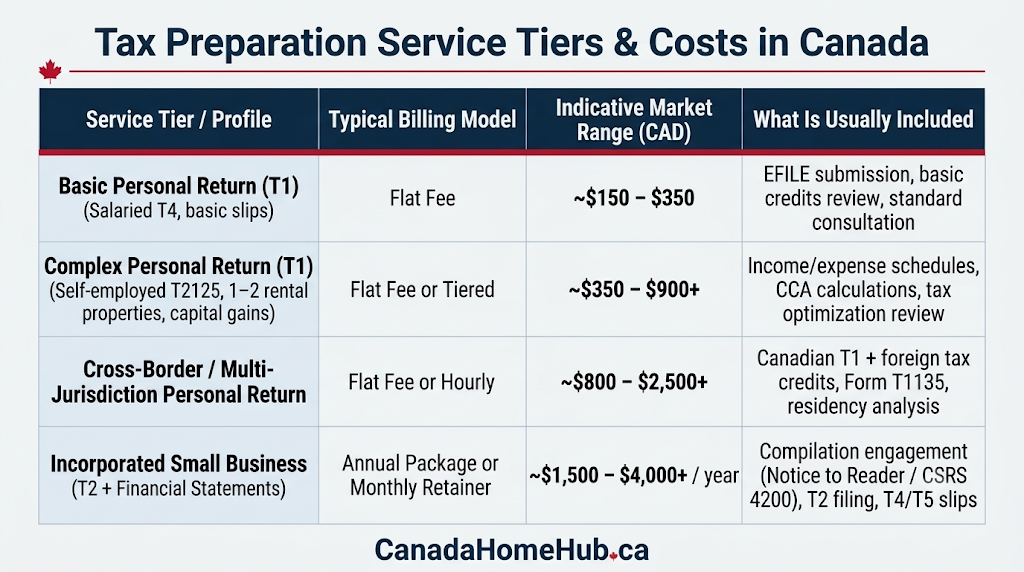
There is no fixed government tariff for accounting services in Canada. Fees vary depending on your province, metropolitan area (rates in Toronto or Vancouver are typically higher than in smaller centres), the complexity of your return, and how organized your records are.
Common Billing Models Explained
- Fixed / Flat-Fee Pricing: Common for personal T1 returns and standard corporate packages. Once the accountant reviews your prior year’s Notice of Assessment and current slips, they quote a set fee upfront.
- Hourly Billing: Frequently used when records are disorganized, when cleaning up multi-year back taxes, or during complex CRA audit representation. Hourly rates across Canada vary widely based on whether work is performed by a bookkeeper, staff accountant, or senior tax partner.
- Monthly Value-Based Packages: Popular with incorporated small businesses and active real estate investors. A predictable monthly retainer bundles bookkeeping, GST/HST filings, payroll, annual T2 corporate returns, and year-round advisory calls.
Key Factors That Influence Your Final Bill
- Number and type of schedules: Adding a T776 rental property schedule (especially with multiple units) or a T2125 business statement adds preparation time compared to a simple T4 return.
- Quality of record-keeping: Handing over a reconciled spreadsheet or clean cloud ledger keeps fees low. Delivering a shoebox of unsorted paper receipts requires paid bookkeeping hours before tax work begins.
- Prior-year adjustments or foreign reporting: Amending past returns (via T1-ADJ) or completing Form T1135 for foreign property increases technical review requirements.
Typical Fee Structures for Canadian Tax Services
(Note: The ranges below reflect general market estimates across Canada for planning purposes; always request a written quote tailored to your specific file).
Provincial Nuances: Why Location Matters for Canadian Taxes
While federal income tax rules apply nationwide through the CRA, provincial legislation introduces critical regional differences that your tax accountant must understand:
- Quebec's Dual Filing System: If you reside in Quebec on December 31, you must file two separate tax returns: a federal T1 return with the CRA and a provincial TP-1 return with Revenu Québec. Quebec also administers its own pension plan (QPP), parental insurance plan (QPIP), and provincial sales tax (QST). Hiring an accountant experienced with Revenu Québec is essential if you live or operate a business in the province.
- Provincial Tax Credits and Surtaxes: Provinces administer distinct credits—such as the Ontario Trillium Benefit, the BC Climate Action Tax Credit, or provincial tuition and homeowner grants—alongside varying provincial marginal tax brackets and surtaxes.
- Sales Tax Regimes: Navigating GST/HST versus provincial sales taxes (PST in BC, Saskatchewan, and Manitoba; QST in Quebec) directly affects self-employed professionals, e-commerce sellers, and commercial landlords.
- Real Estate Transfer and Vacancy Taxes: Municipal and provincial rules—such as Ontario's Non-Resident Speculation Tax (NRST), BC's Speculation and Vacancy Tax, or municipal vacant home taxes in cities like Toronto, Vancouver, and Ottawa—carry separate reporting obligations that good local advisors flag proactively.
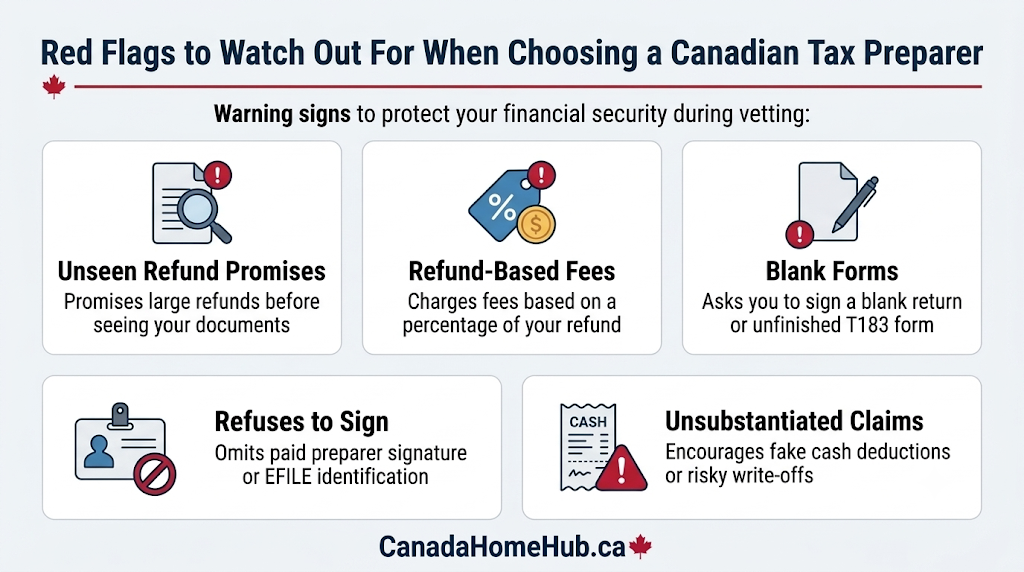
Red Flags to Watch Out For When Choosing a Canadian Tax Preparer
Protecting your financial security means walking away if you spot warning signs during your vetting process. Be cautious of any tax preparer who:
- Promises an unusually large refund before seeing your documents: Legitimate Canadian accountants calculate taxes based on verifiable slips and statutory deductions under the Income Tax Act—never guesswork or aggressive loopholes.
- Bases their fee on a percentage of your tax refund: Charging contingency fees based on refund size creates an unethical incentive to inflate deductions illegally and violates professional CPA ethical standards.
- Asks you to sign a blank tax return or T183 EFILE form: Under CRA rules, you must review your completed return and sign Form T183 (Information Return for Electronic Filing of an Individual's Income Tax and Benefit Return) after the numbers are finalized, never beforehand.
- Refuses to sign as the paid preparer or enter their EFILE number: Every paid preparer must identify themselves on the return. Preparers who file under your personal NETFILE credentials to hide their involvement are a major red flag.
- Encourages unsubstantiated cash deductions or "creative" write-offs: Remember that under Canadian tax law, you—the taxpayer—remain legally responsible to the CRA for the accuracy of your return, including penalties and interest, even if a preparer suggested the claim.
How to Prepare for Your First Meeting With a Tax Accountant
A well-organized package saves billable hours and helps your accountant spot every eligible deduction. Consider a typical scenario: a homeowner in Ontario who works full-time, contributes to an FHSA, and rents out a finished basement apartment will get far better tax advice—and a lower preparation bill—by grouping income slips separately from property utility and maintenance receipts before their appointment.
Gather the following items before your first meeting:
- Prior-Year CRA Documents: Last year’s T1 General return, your latest Notice of Assessment (NOA) (which shows your RRSP deduction limit and carry-forward balances), and any recent CRA correspondence.
- Official Tax Slips: T4 (employment), T4A (self-employed/pension/other income), T4E (Employment Insurance), T5 (investment income), T3 (trust income), and T5008 (securities transactions).
- Registered Account Receipts: RRSP contribution receipts (including contributions made in the first 60 days of the new calendar year) and FHSA contribution slips (T4FHSA).
- Deduction & Credit Receipts: Childcare expenses, medical receipts, charitable donation receipts (with official registered charity numbers), student loan interest statements, and digital news subscriptions.
- Property & Business Summaries (If Applicable): A clean summary of rental income and expenses (mortgage interest, property tax, insurance, repairs, utilities, and square-footage split for partial rentals), or a categorized profit-and-loss summary for self-employed income.
Frequently Asked Questions
Is an accountant fee tax-deductible in Canada?
For most salaried employees filing a standard personal return, accounting fees are not tax-deductible. However, if you earn self-employment/business income (Form T2125), rental property income (Form T776), or operate an incorporated business (Form T2), accounting and tax preparation fees incurred to earn that income are generally deductible as a legitimate business or rental expense.
What is the difference between a CPA and a tax preparer in Canada?
A Chartered Professional Accountant (CPA) holds a provincially regulated professional designation requiring advanced education, national exams, ongoing training, and mandatory liability insurance. A general tax preparer may have practical filing experience and CRA EFILE registration, but is not governed by a provincial CPA regulatory body and typically focuses on routine tax compliance rather than complex tax planning.
How do I check if a tax accountant is legitimate in Canada?
You can verify a CPA’s credentials directly through the online member directory of the provincial or territorial CPA body where they practice (such as CPA Ontario, CPABC, or CPA Alberta). For non-CPA tax preparers, ask for their CRA EFILE registration confirmation and verify how long their business has operated locally.
When is the best time of year to hire a tax accountant in Canada?
The best time to hire a tax accountant is between May and November—outside of the peak March–April filing rush. Engaging an accountant in the summer or fall gives them time to review your prior returns, implement year-end tax-saving strategies before December 31, and onboard you calmly before the next tax season begins.
Do I need a local tax accountant near me, or can I work with one remotely across Canada?
You do not necessarily need an accountant in the same neighbourhood. Most modern Canadian CPA firms use secure client portals and video consultations, allowing you to work seamlessly with a specialist anywhere in your province—or across Canada. Working with someone in your own province is still helpful if you deal with province-specific credits, provincial sales taxes, or Revenu Québec filings.
What happens if my tax accountant makes a mistake on my CRA return?
Under Canadian tax law, the CRA holds the individual or corporate taxpayer responsible for any unpaid taxes and statutory interest resulting from an error on a return. However, reputable CPA firms carry professional liability insurance and will typically cover penalties caused directly by their own clerical error, as well as handle the T1 adjustment filing with the CRA at no extra charge.
What documents should I bring to a tax accountant in Canada?
Bring your Social Insurance Number (SIN), your most recent CRA Notice of Assessment, a copy of last year's tax return, all current-year tax slips (T4, T5, T3, T4A), RRSP and FHSA contribution receipts, medical and charitable receipts, and organized income/expense summaries if you own rental property or run a business.
Conclusion
Hiring the right tax accountant in Canada comes down to matching the complexity of your finances with a properly credentialed professional. If you have straightforward employment income, certified Canadian tax software can serve you well. Once real estate, self-employment, investments, incorporation, or cross-border assets enter the picture, partnering with a verified CPA in good standing provides compliance peace of mind and long-term tax savings.
Start by clarifying your tax scope, verifying credentials through your provincial CPA directory, and interviewing two or three shortlisted firms using the vetting questions above. Whether you are organizing your household finances, planning a home purchase, or managing property milestones alongside resources like CanadaHomeHub.Ca, taking time to choose a proactive, transparent tax advisor well ahead of the April 30 deadline is one of the smartest financial investments you can make.