
Navigating the real estate market in British Columbia can feel like an uphill battle, especially in a world-class city known for its premium property prices. Whether you are looking to purchase a high-rise downtown condo, a heritage family home in Kitsilano, or a lucrative investment property in Surrey or Burnaby, securing the right financing is your most critical step. This is where knowing how to find a reliable mortgage broker in Vancouver becomes an invaluable asset.
Vancouver's housing market demands quick decisions, robust financial backing, and a deep understanding of federal and provincial lending rules. Unlike a traditional bank that only offers its own specific, limited loan products, an independent mortgage broker acts as your personal financial matchmaker. They shop around on your behalf, tapping into a vast network of lenders to find rates, terms, and prepayment privileges that fit your exact financial profile.
In this comprehensive, in-depth guide, we will walk you through exactly how to identify, vet, and choose the best mortgage professional in BC. We will explore the types of lenders available, the exact steps to prepare for your application, and how to ensure your journey to homeownership is as smooth and cost-effective as possible.
Understanding the Vancouver Real Estate and Mortgage Landscape
Before diving into how to find a professional, it is essential to understand why you need one. The Greater Vancouver Area (GVA) routinely ranks as one of the most expensive housing markets in North America. Consequently, the mortgages required to purchase properties here are substantial, meaning even a fraction of a percent difference in your interest rate can translate to tens of thousands of dollars saved—or lost—over the life of your mortgage.
Furthermore, Canadian homebuyers are subject to the OSFI (Office of the Superintendent of Financial Institutions) Mortgage Stress Test. This federal regulation requires you to prove you can afford your mortgage payments at a qualifying rate that is significantly higher than your actual contract rate. Passing this stress test in a high-interest-rate environment requires strategic financial structuring. A skilled Vancouver mortgage broker knows how to legally and effectively present your income, debts, and assets to maximize your borrowing power while ensuring you remain financially secure.
The Great Debate: Mortgage Broker vs. Traditional Bank in Canada
A common dilemma for property buyers is deciding whether to walk into their local bank branch or hire an independent broker. While both paths can ultimately lead to a funded mortgage, they offer entirely different experiences, product ranges, and levels of advocacy.
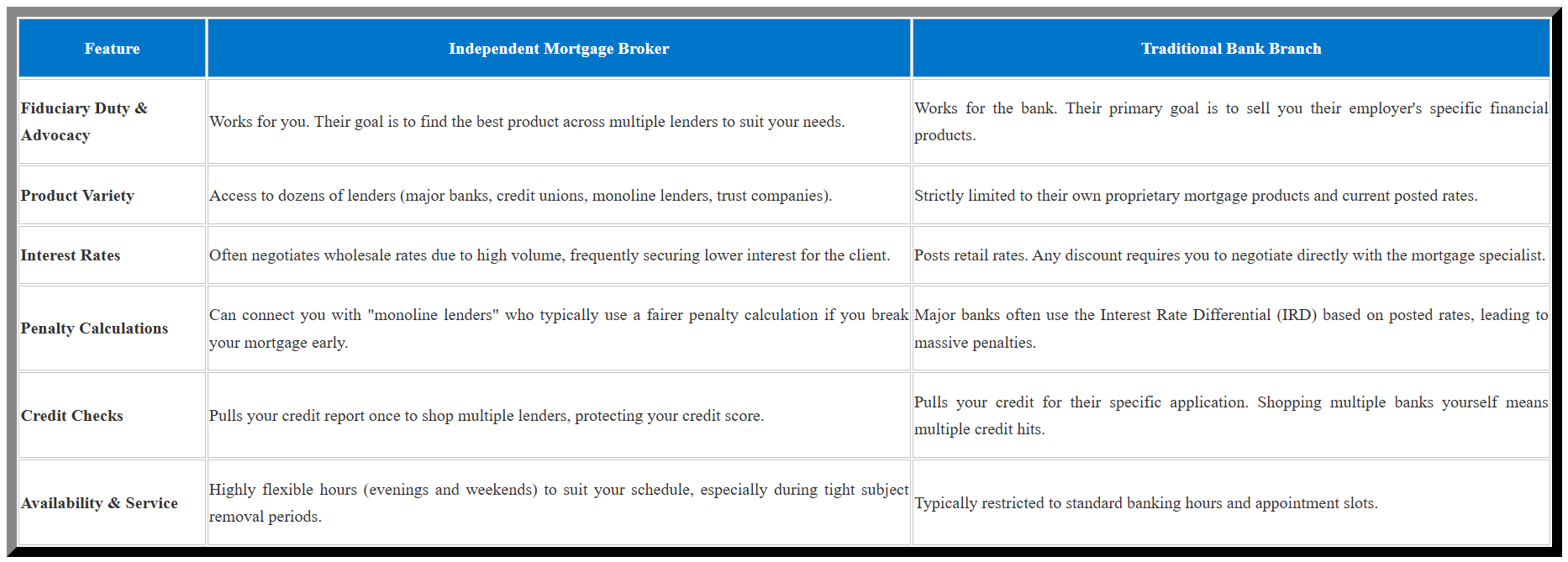
For most Vancouverites—especially those needing flexibility, navigating self-employment income, or simply looking for the absolute lowest rate and best terms—a broker is heavily favoured.
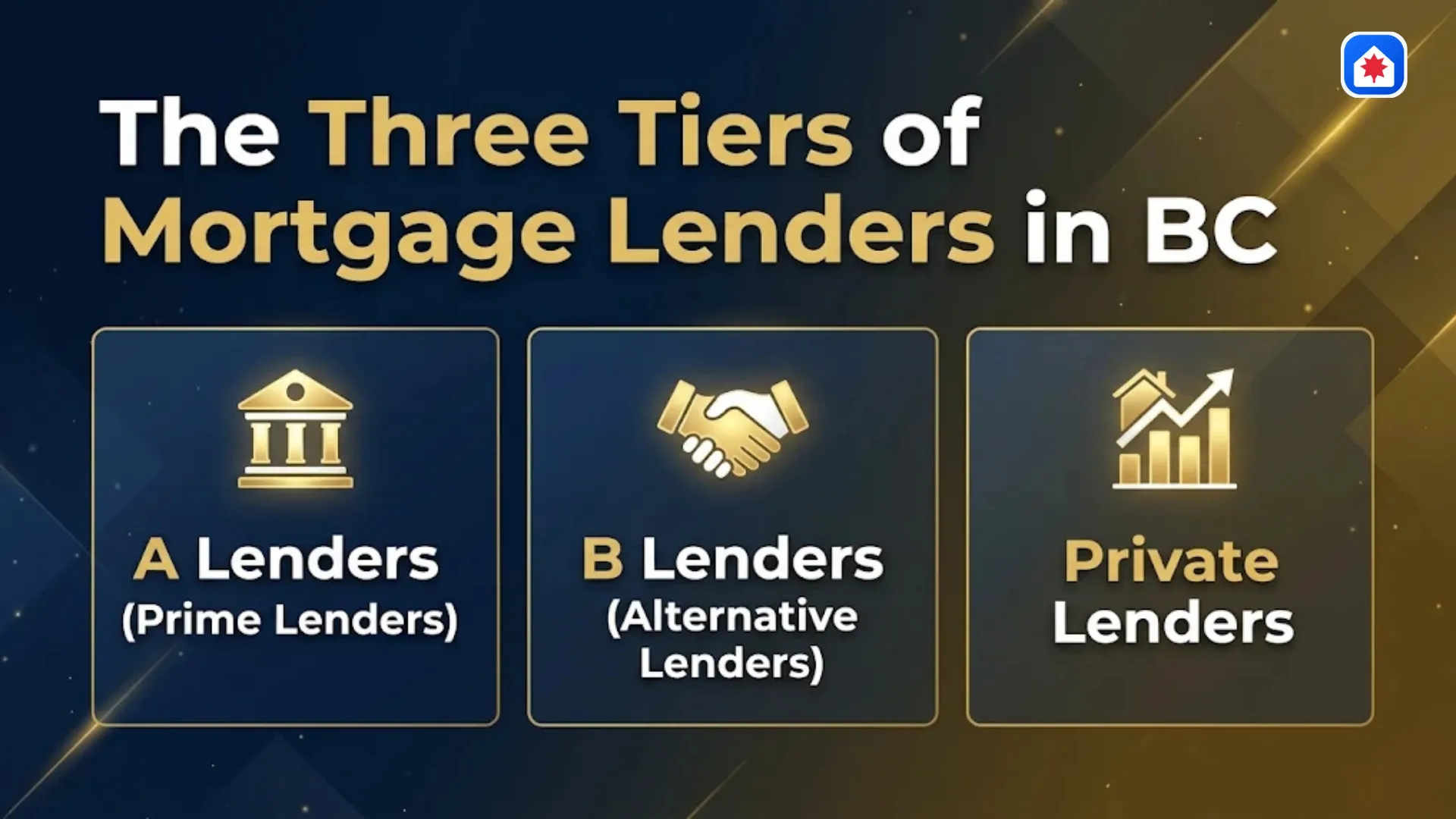
The Three Tiers of Mortgage Lenders in BC
One of the greatest advantages of working with a broker is their access to different "tiers" of lending. If you walk into a major bank and are declined, you might feel like your homeownership dreams are over. A broker, however, knows that the financial ecosystem is much larger.
"A" Lenders (Prime Lenders)
These include the big six Canadian banks, major credit unions (like Vancity or Coast Capital), and monoline lenders (lenders that only deal in mortgages, such as First National or MCAP). To qualify here, you need a strong credit score (typically 680+), verifiable standard income (T4s), and a clean financial history. They offer the lowest interest rates and standard terms.
"B" Lenders (Alternative Lenders)
Vancouver is home to a massive population of entrepreneurs, freelance tech workers, film industry contractors, and gig-economy workers. Traditional banks often struggle to qualify self-employed individuals because their taxable income (after write-offs) may appear low, even if their cash flow is excellent. "B" lenders (often trust companies or specialized credit unions) use common-sense lending. They look at your bank statements and business revenue, rather than just your Notice of Assessment (NOA). The interest rates are slightly higher, and they may charge a modest lender fee (usually 1%), but they provide a crucial stepping stone.
Private Lenders
Private lending is typically short-term (1 to 2 years). It is heavily equity-based, meaning the lender cares more about the property's value and location than your credit score. This tier is used for rapid closings, flipping properties, bridging finance gaps, or helping buyers with severe credit impairments rehabilitate their finances. Rates and fees are significantly higher. A reputable mortgage broker near Vancouver will clearly explain the exit strategy if you need to use a private lender, ensuring you can transition back to an "A" or "B" lender as soon as possible.
Step-by-Step: How to Find the Best Mortgage Broker in Vancouver
Finding the right professional isn't just about picking the first sponsored ad that pops up on a search engine. You are trusting this person with hundreds of thousands of dollars. Here is a rigorous, step-by-step process to find, vet, and partner with the right professional.
Step 1: Assess Your Own Financial Health
Before reaching out, understand your own baseline. Calculate your gross household income, itemize your monthly debts (car loans, credit cards, student lines of credit), and check your own credit score through Equifax or TransUnion Canada. Knowing your approximate Gross Debt Service (GDS) and Total Debt Service (TDS) ratios will help you have a highly productive first conversation with any broker.
Step 2: Leverage Reviews and Local Networks
Start your search by analyzing mortgage broker reviews Vancouver. Look at Google, Yelp, and the Better Business Bureau. However, do not just look at the star rating; read the context of the reviews.
- Did the broker help someone in a similar situation to yours (e.g., self-employed, newcomer to Canada, investor)?
- Do clients praise their responsiveness during the stressful "subject removal" phase?
- Are there mentions of the broker explaining complex terms clearly?
Step 3: Verify Their BCFSA License
In British Columbia, the mortgage industry is strictly regulated. Every broker and sub-mortgage broker must be registered with the BC Financial Services Authority (BCFSA). Before you sign any client agreements or share sensitive documents like your Social Insurance Number (SIN), use the BCFSA online registry to verify their active status. This guarantees they are legally compliant, insured, and bound by provincial ethical guidelines.
Step 4: Conduct a Rigorous Interview
Most brokers offer a free initial consultation. Treat this as a job interview. A top-tier professional should be transparent, patient, and highly knowledgeable. Ask the following questions:
- How many different lenders have you successfully funded mortgages with in the past 12 months? (You want a broker who actively uses many lenders, not just one or two favourites).
- How do you handle early prepayment penalties? (A great broker will explain the difference between standard penalties and bonafide sales clauses).
- Do you have experience with the specific municipality I am buying in? (Different BC cities have different property tax rates, zoning quirks, and strata regulations).
- What is your communication policy during the week of closing?
Step 5: Understand the Complete Fee Structure
In the vast majority of standard residential mortgage transactions in Canada (with "A" lenders), the broker's services are entirely free to the borrower. The broker is compensated directly by the lending institution via a finder's fee or commission once the mortgage successfully closes. However, if your file requires a "B" lender or a private lender due to poor credit or unconventional income, the broker may charge a direct brokerage fee (often a percentage of the loan amount). Always demand a full, written disclosure of any potential fees before proceeding.
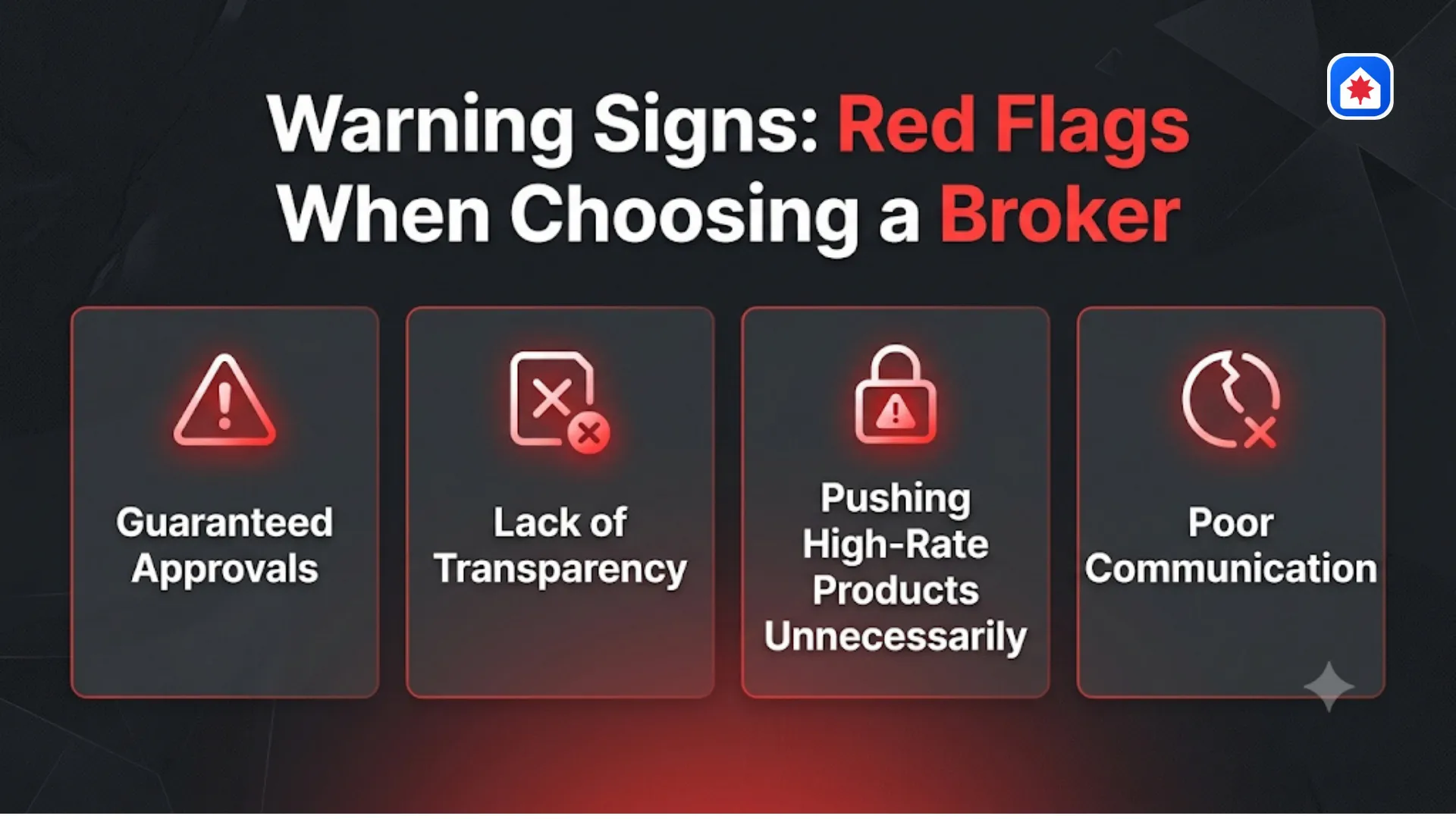
Warning Signs: Red Flags When Choosing a Broker
While the industry is heavily regulated, not all professionals offer the same level of care. Walk away if you encounter these red flags during your search:
- Guaranteed Approvals: If a broker promises 100% guaranteed approval before pulling your credit or reviewing your income documents, they are not being truthful. Final approval always rests with the lender's underwriting department.
- Lack of Transparency: If a broker dodges questions about how they are paid, or refuses to explain why they are recommending a specific lender over another, find someone else.
- Pushing High-Rate Products Unnecessarily: While alternative lending has its place, a broker should always attempt to qualify you with an "A" lender first. If you have excellent credit and standard income, but the broker is pushing a private loan, this is a major conflict of interest.
- Poor Communication: Real estate transactions in Vancouver move at lightning speed. If it takes a broker 48 hours to return your initial phone call, they will not be reliable when you have a 5-day window to remove financing subjects on a purchase contract.
Document Preparation: How to Get Ready for Your Broker
To secure a mortgage in Vancouver quickly, you need to be organized. Having your documents ready allows your broker to issue a reliable pre-approval instantly. Before your first meeting, gather:
- Proof of Identity: Government-issued photo ID (Driver's License, Passport).
- Income Verification (Employed): A recent Letter of Employment (stating your salary, tenure, and guaranteed hours) and your two most recent pay stubs.
- Tax Documents: Your last two years of T4 slips and the corresponding Notices of Assessment (NOA) from the Canada Revenue Agency (CRA) to prove you do not owe back taxes.
- Income Verification (Self-Employed): Two years of T1 Generals, NOAs, business bank statements, and Articles of Incorporation (if applicable).
- Down Payment Verification: Anti-Money Laundering (AML) laws in Canada are incredibly strict. You will need to provide a 90-day history of the bank account where your down payment is sitting, proving the source of the funds (e.g., savings, investment sale, or a gifted down payment letter from an immediate family member).
Special Considerations for a First Time Home Buyer Mortgage Broker Vancouver Search
Entering the BC real estate market for the first time is daunting. If this is your situation, seeking a first time home buyer mortgage broker Vancouver specialist is highly recommended.
A broker specializing in first-time buyers will do more than just process paperwork; they act as a financial educator. They should proactively sit down with you to explain federal and provincial incentive programs designed specifically to help you enter the market:
- First Home Savings Account (FHSA): A registered account allowing you to save up to $40,000 tax-free toward your first home. Contributions are tax-deductible, and withdrawals to buy a qualifying home are tax-free.
- The Home Buyers' Plan (HBP): Allows you to withdraw funds from your Registered Retirement Savings Plan (RRSP) to buy or build a qualifying home. As of recent federal budget updates, the withdrawal limit has been increased to $60,000.
- BC Property Transfer Tax (PTT) Exemption: In British Columbia, the PTT is calculated as 1% on the first $200,000, 2% on the balance up to $2,000,000, and 3% on the remainder. For a typical Vancouver home, this is a massive closing cost. First-time buyers may qualify for a full or partial exemption if the property's fair market value is below a specific provincial threshold.
- CMHC Mortgage Loan Insurance: If your down payment is less than 20% (a "high-ratio mortgage"), federal law requires you to purchase default insurance through CMHC, Sagen, or Canada Guaranty. Your broker will calculate exactly how this premium affects your monthly payments.
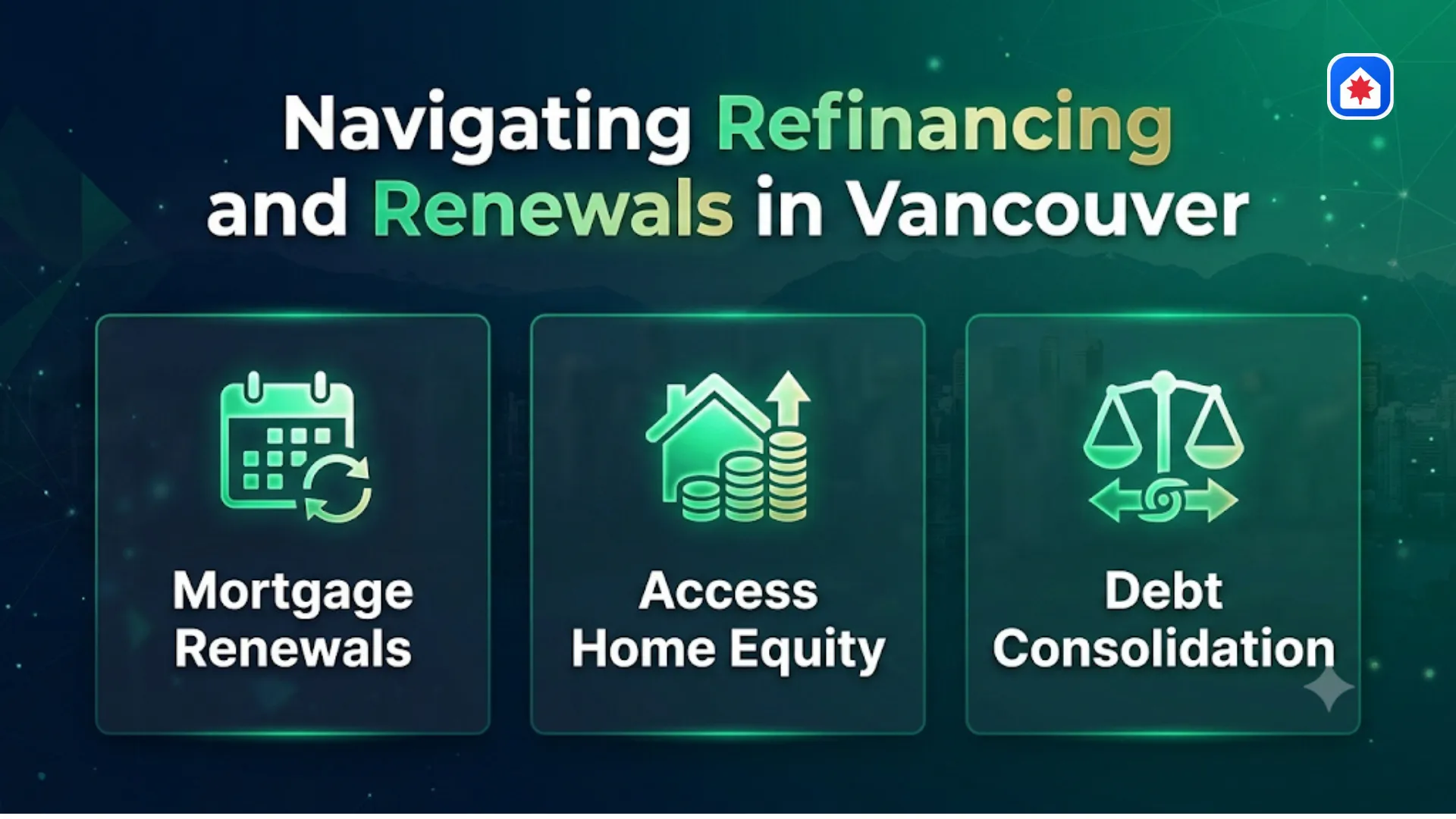
Navigating Refinancing and Renewals in Vancouver
Brokers are not just for purchases. If you already own a home in Vancouver, your mortgage will eventually come up for renewal (typically every 3 to 5 years). Statistically, over 60% of Canadians simply sign the renewal letter their current bank sends them, often accepting a higher interest rate than they could get elsewhere.
A proactive broker will contact you 120 days before your maturity date to start shopping the market. Furthermore, if you have built substantial equity in your Vancouver property (which many have, given the region's historical appreciation), a broker can help you navigate a refinance. This allows you to break your current mortgage to access cash for renovations, consolidate high-interest credit card debt, or pull equity to use as a down payment on an investment property.
Leveraging CanadaHomeHub.Ca for Your Property Journey
Finding the right financial professional is just one piece of the complex real estate puzzle. To make confident, informed decisions in the Canadian housing market, you need access to reliable, up-to-date information, local market data, and trusted industry connections.
This is where CanadaHomeHub.Ca becomes your ultimate advantage. As a comprehensive destination for Canadian real estate insights, CanadaHomeHub provides robust resources, step-by-step guides, and direct connections to help you navigate everything from complex mortgage approvals to finding the perfect neighbourhood and the right real estate agent. Utilizing a centralized, authoritative hub ensures you aren't just getting a mortgage, but building a solid, long-term foundation for your overall real estate strategy and wealth generation.
Frequently Asked Questions (FAQs)
1. Does it cost money out of pocket to use a mortgage broker in Vancouver?
No, for standard residential mortgages with "A" lenders (like major banks and credit unions), the broker's fee is paid directly by the lender. You only pay direct brokerage fees if your specific financial situation requires private lending or specialized alternative "B" lending.
2. Can a mortgage broker really get me a better rate than my own long-term bank?
Yes, in the vast majority of cases. Because brokers send a massive volume of business to various lenders, they receive discounted "wholesale" rates. They pass these rate buydowns on to their clients, frequently beating the retail rates offered at standard bank branches.
3. What credit score do I realistically need to get a mortgage in BC?
To qualify for a mortgage with a prime "A" lender in Canada, you typically need a minimum credit score of 600. However, a score of 680 or higher is strongly preferred and will give you access to the very best rates, especially if you require CMHC insurance for a down payment under 20%.
4. Should I get pre-approved by a broker before looking at houses with a realtor?
Absolutely. In Vancouver's competitive market, a pre-approval is mandatory. It tells you exactly how much you can afford, guarantees your interest rate for up to 120 days (protecting you against Bank of Canada rate hikes), and proves to realtors and sellers that you are a serious, qualified buyer.
5. What is a "monoline lender" and why do brokers use them?
Monoline lenders are financial institutions that solely focus on mortgages (they do not offer credit cards, checking accounts, or mutual funds). Brokers love them because they often offer highly competitive rates and, most importantly, use a much fairer penalty calculation if you need to break your fixed-rate mortgage before the term is up, potentially saving you thousands compared to big bank penalties.
6. I am self-employed and expense a lot of my income. Can a broker still help me buy a home?
Yes. This is one of the primary reasons to use a broker. They have access to "Stated Income" programs and alternative lenders who look at your business bank statements and gross revenue to determine your true earning power, rather than solely relying on the net income reported on your tax returns.
7. How long does the mortgage approval process take in BC?
A thorough pre-approval can be completed in 24 to 48 hours once you submit all required income and identity documents. Final, unconditional approval on a specific property usually takes a few days to a week, depending on whether the lender requires a physical appraisal of the home.
8. Can a broker help me secure a Home Equity Line of Credit (HELOC)?
Yes. If you have at least 20% equity in your home, a broker can help you set up a HELOC or a readvanceable mortgage product, giving you flexible access to funds for investments, emergencies, or renovations at a much lower interest rate than unsecured personal loans.
Your Next Steps to BC Homeownership
Finding a mortgage broker in Vancouver who deeply understands the local market dynamics, has access to top-tier lenders across all tiers, and prioritizes your long-term financial health is the key to a successful property purchase. Take your time during the research phase, verify their BCFSA credentials, read client reviews carefully, and do not hesitate to interview multiple candidates to find the perfect fit for your communication style and financial needs.
Buying real estate in British Columbia is likely the largest and most complex financial transaction of your life. Do not navigate it alone. Equip yourself with the right professional team and leverage the right educational resources, like those found on CanadaHomeHub.Ca. By doing so, you will bypass the common pitfalls of the mortgage market, secure the best possible terms, and soon be holding the keys to your new Vancouver home.
Thank you for reading our article!