
Buying a home in Canada’s largest and most dynamic city is a thrilling milestone. However, navigating the complexities of the Greater Toronto Area (GTA) housing market can feel like an overwhelming task. With fluctuating interest rates, fierce competition for properties, and strict federal borrowing regulations, securing the right financing is the most critical step in your home-buying journey.
That is where partnering with a top-tier mortgage broker in Toronto becomes your ultimate competitive advantage.
Unlike walking directly into your local bank branch—where you are only offered a single suite of financial products—a mortgage broker works exclusively for you. They act as an independent financial matchmaker, negotiating with dozens of lenders across Canada to secure the best rates, terms, and mortgage products tailored to your specific financial situation.
In this comprehensive, in-depth guide, we will break down everything you need to know about the Toronto mortgage landscape. From understanding what a broker actually does to navigating the Canadian stress test, evaluating different lender types, and avoiding common red flags, this guide will equip you with the knowledge to make confident financial decisions.
The Current Reality of the Toronto Real Estate Market
To understand why a mortgage broker is so essential, you first need to understand the environment you are entering. The Toronto real estate market is notoriously expensive and fast-paced. Whether you are looking for a compact downtown condo or a spacious detached home in Scarborough or Etobicoke, affordability is a constant challenge.
Recent years have seen shifting interest rates driven by the Bank of Canada's fight against inflation. For buyers, this means borrowing costs have become highly unpredictable. Furthermore, the federal government has tightened lending criteria to ensure buyers do not take on more debt than they can handle. In this high-stakes environment, a fraction of a percent difference in your mortgage rate can mean tens of thousands of dollars in savings (or extra costs) over the life of your loan. You need an expert who lives and breathes mortgage data every single day.
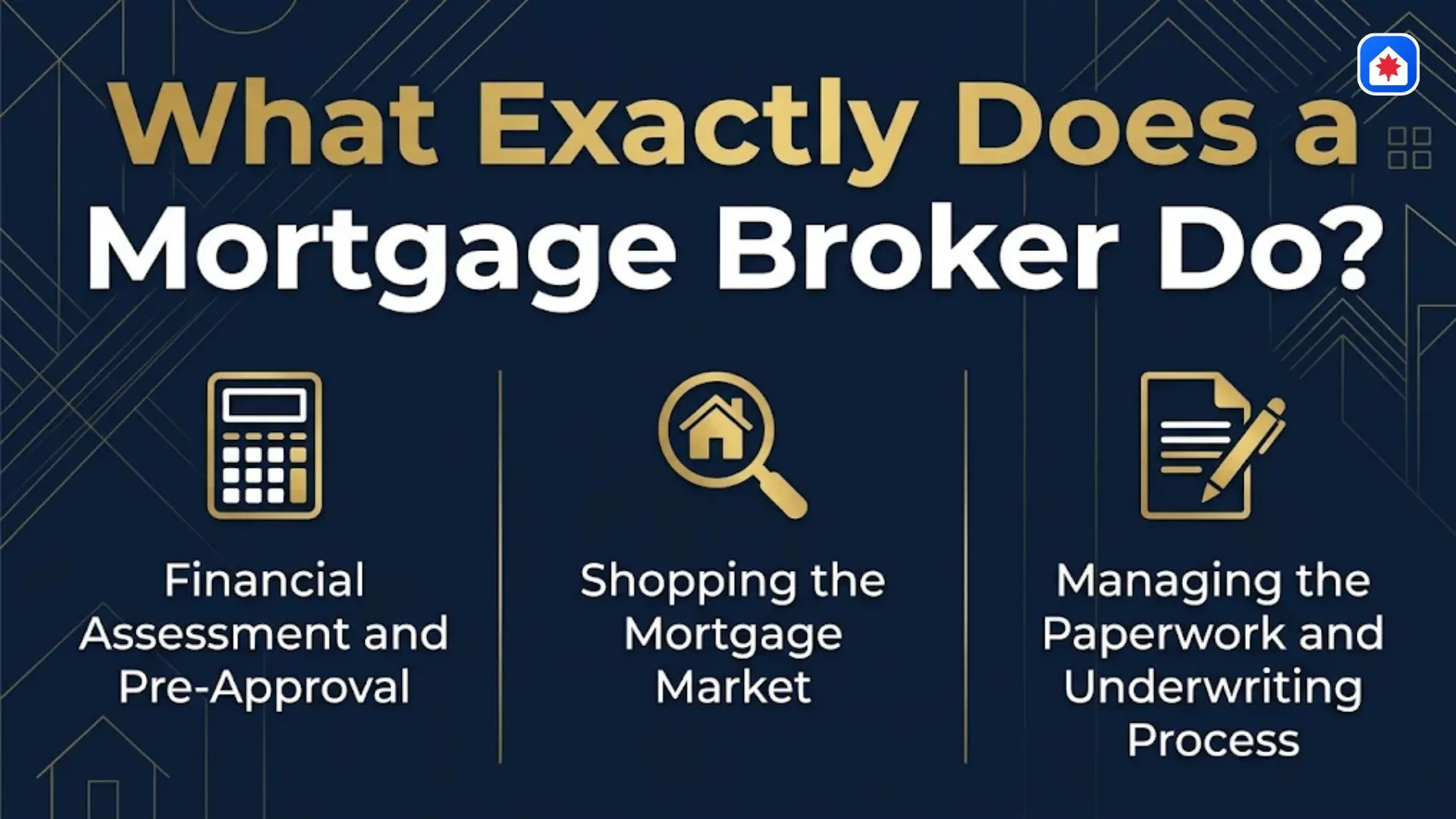
What Exactly Does a Mortgage Broker Do?
A common misconception is that a Toronto mortgage broker just “finds you a rate.” While securing a low rate is important, their job encompasses much more than that. Here is a breakdown of their primary responsibilities:
Financial Assessment and Pre-Approval
Before you even start looking at houses, a broker will conduct a deep dive into your financial health. They will review your income, employment history, down payment sources, and credit score. Based on this, they will secure a mortgage pre-approval, which locks in an interest rate for a specific period (usually 90 to 120 days) and tells you exactly how much house you can afford.
Shopping the Mortgage Market
Once they know your profile, the broker takes your application to their network of lenders. Because they are not tied to one institution, they can objectively compare products from major Canadian banks, regional credit unions, and alternative lenders.
Managing the Paperwork and Underwriting Process
Securing a mortgage requires a mountain of paperwork—from T4 slips and Notices of Assessment (NOA) to property appraisals and real estate purchase agreements. A broker organizes this documentation, packages it professionally, and submits it to the lender's underwriting team, fighting on your behalf to ensure the application gets approved smoothly.
Why Use a Mortgage Broker in Toronto Instead of Your Bank?
Many homebuyers default to the bank they have used since childhood. While convenient, this is rarely the most cost-effective choice. Here is why using an independent broker is often the smarter financial move:
Unrestricted Access to A, B, and Private Lenders
If you walk into a major bank and your credit is slightly bruised, or you are a self-employed freelancer, the bank might simply say "no." A broker, however, has relationships with different tiers of lenders. If Bank A rejects you, the broker can immediately pivot to Lender B who specializes in self-employed individuals.
Navigating the OSFI Mortgage Stress Test
The Office of the Superintendent of Financial Institutions (OSFI) requires all borrowers at federally regulated institutions to pass a "stress test." This means you must prove you can afford your mortgage payments at a rate significantly higher than the contract rate you are offered (typically 5.25% or your contract rate plus 2%, whichever is higher). A skilled broker knows which lenders interpret income most favourably, helping you maximize your borrowing capacity to pass this test.
Volume Discounts on Mortgage Rates
Because large brokerages send hundreds of millions of dollars in business to lenders annually, lenders offer them wholesale "broker-only" rates. The broker then passes these discounted rates down to you. In almost all cases, a broker can secure a better rate from a major bank than you could if you walked into that exact same bank off the street.
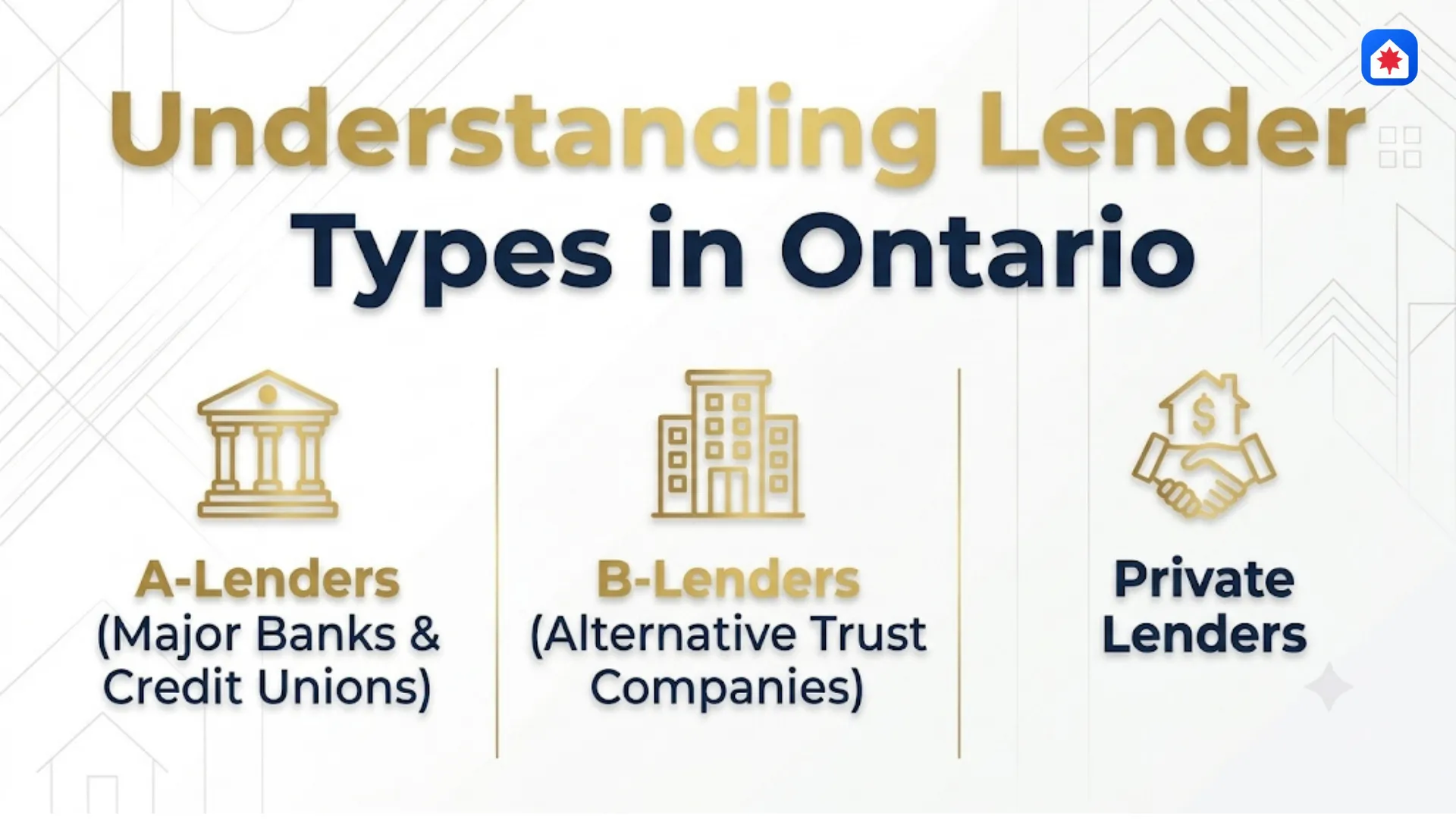
Understanding Lender Types in Ontario
When your mortgage broker near Toronto discusses potential lenders, they will usually categorize them into three tiers. Understanding these tiers will help you know where you stand.
A-Lenders (Major Banks & Credit Unions)
- Who they are: The Big Six Canadian banks (RBC, TD, Scotiabank, BMO, CIBC, National Bank), major credit unions (like Meridian), and monoline lenders (lenders who only deal in mortgages, like First National or MCAP).
- Target Borrower: Individuals with strong credit scores (typically 680+), verifiable standard income (T4 employees), and manageable debt loads.
- The Benefit: They offer the absolute lowest interest rates and best terms in the market.
B-Lenders (Alternative Trust Companies)
- Who they are: Institutions like Home Trust or Equitable Bank.
- Target Borrower: Self-employed business owners who deduct a lot of expenses, new immigrants to Canada with thin credit files, or individuals with bruised credit (scores between 550 and 650).
- The Benefit: They offer more flexible underwriting rules. The trade-off is slightly higher interest rates (usually 1% to 2% higher than A-lenders) and an upfront lender fee.
Private Lenders
- Who they are: Investment corporations or wealthy individuals who lend their own capital.
- Target Borrower: Buyers who need emergency financing, flippers needing short-term capital, or those facing foreclosure.
- The Benefit: Fast approvals based almost entirely on the equity of the property, not your personal income. The downside is significantly higher interest rates and substantial broker/lender fees.
Fixed vs. Variable Rates: What Should Toronto Buyers Choose?
One of the biggest decisions you will make with your broker is choosing between a fixed and a variable rate.
- Fixed-Rate Mortgage: Your interest rate and monthly payment remain identical for the entire term of your mortgage (typically 3 to 5 years). This offers peace of mind and protection against inflation, making it ideal for budget-conscious buyers who want zero surprises.
- Variable-Rate Mortgage: Your interest rate fluctuates based on the Bank of Canada’s prime rate. Historically, variable rates have proven to be cheaper over the 25-year life of a mortgage, but they require a tolerance for risk. If the prime rate goes up, more of your monthly payment goes toward interest rather than the principal loan amount.
A great broker will not just push you toward the lowest number; they will analyze your risk tolerance, your job security, and economic forecasts before making a recommendation.
Navigating Toronto-Specific Closing Costs with Your Broker
Buying property in Toronto comes with unique financial burdens that do not exist everywhere in Canada. Your broker will help you calculate these so you are not caught off guard on closing day.
The Double Land Transfer Tax (Municipal & Provincial)
Unlike buyers in other parts of Ontario who only pay the Provincial Land Transfer Tax (PLTT), buyers within the City of Toronto boundaries must also pay the Municipal Land Transfer Tax (MLTT). This effectively doubles your tax bill.
- Example: On a $1,000,000 home in Toronto, your total land transfer tax will be approximately $32,950. A knowledgeable broker will ensure you have the cash reserves to cover this, and they will help first-time buyers apply for the rebates available at both the municipal and provincial levels (which can save you up to $8,475).
CMHC Insurance Premiums
In Canada, if your down payment is less than 20% of the purchase price, you are legally required to purchase mortgage default insurance (often referred to as CMHC insurance). This premium is calculated as a percentage of your loan and is typically rolled into your total mortgage amount.
5 Steps to Finding a Reliable Toronto Mortgage Broker
Now that you understand the immense value they provide, how do you actually find a trustworthy mortgage broker in Toronto? Follow this rigorous 5-step vetting process.
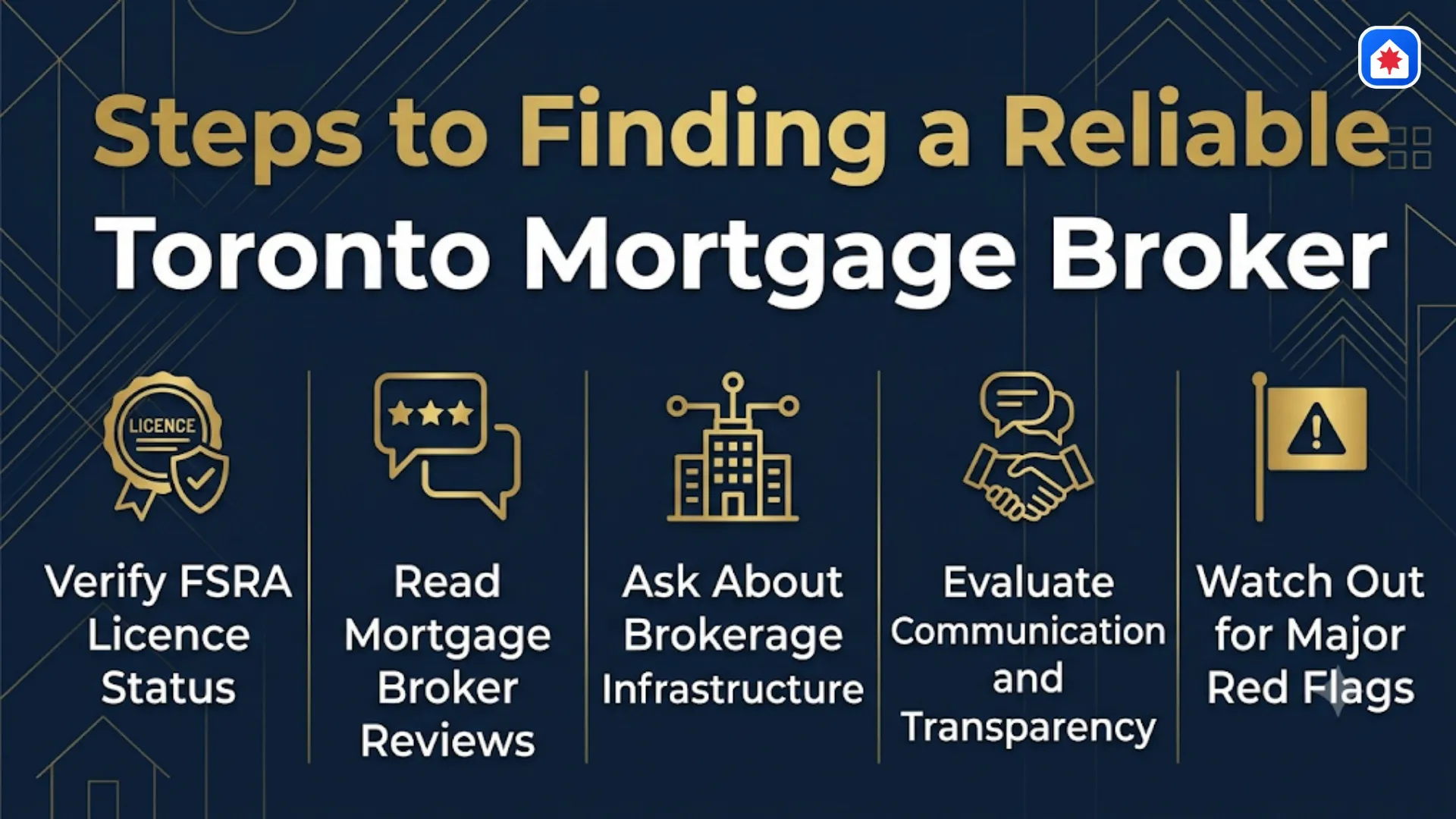
Step 1: Verify Their FSRA Licence Status
The mortgage industry in Ontario is heavily regulated to protect consumers. Every legitimate agent, broker, and brokerage must be licensed by the Financial Services Regulatory Authority of Ontario (FSRA). Before sharing your Social Insurance Number (SIN) or income documents, search their name in the FSRA public registry to confirm their licence is active and clear of disciplinary actions.
Step 2: Read Mortgage Broker Reviews in Toronto
Word of mouth and digital footprints are powerful. Search for the broker on Google Reviews, Trustpilot, and Yelp. Look beyond the star rating and read the actual comments. Pay attention to how the broker handles adversity. Do clients praise their ability to explain complex terms? Did they answer the phone during a stressful bidding war on a Saturday afternoon?
Step 3: Ask About Their Brokerage Infrastructure
A solo broker working from their kitchen table might be fantastic, but they can get overwhelmed in a hot market. Brokers who are part of larger brokerages or who have a dedicated team (like underwriting assistants and document fulfillment specialists) often provide a smoother, faster experience. Speed is critical when you only have a 5-day financing condition on a house offer.
Step 4: Evaluate Their Communication and Transparency
A mortgage is a massive financial commitment. During your initial consultation, assess the broker’s communication style. Are they rushing you off the phone? Are they guaranteeing a rate without even looking at your credit bureau? A true professional will ask you probing questions about your 5-year financial plan before they ever quote you a rate.
Step 5: Watch Out for Major Red Flags
Be cautious if a broker exhibits any of the following behaviours:
- Asking for upfront fees: Standard residential mortgage brokers are paid by the lender. You should not be paying them out of pocket unless you are entering into a B-lender or private mortgage agreement (which they should explain clearly beforehand).
- Pushing you to falsify income: Never work with a broker who suggests altering documents or exaggerating your income. This is mortgage fraud and can result in severe legal consequences and the immediate cancellation of your loan.
First-Time Home Buyer Mortgage Broker in Toronto: Key Considerations
If you are a first-time buyer, the landscape can feel particularly alienating. A specialized first time home buyer mortgage broker in Toronto should serve as an educator.
They should proactively walk you through modern Canadian tax advantages, such as:
- The First Home Savings Account (FHSA): A brilliant registered account that allows you to contribute up to $8,000 per year (up to $40,000 lifetime) tax-free in, and tax-free out, to be used for your down payment.
- The Home Buyers' Plan (HBP): Allowing you to withdraw up to $60,000 from your RRSP tax-free to buy your first home (must be repaid over 15 years).
For individuals just beginning to explore these programs, spending time on trusted real estate resource platforms like CanadaHomeHub.Ca is an excellent way to build your foundational knowledge before your first broker meeting.
Essential Questions to Ask Before Signing Anything
To help you interview potential candidates, keep this checklist of critical questions handy for your initial consultation:
- How are you compensated for this transaction? (Ensure transparency about lender finder fees).
- What lenders do you primarily send business to? (You want a broker with a diversified portfolio, not one who just sends all clients to one specific bank to win a volume bonus).
- What are the prepayment privileges on this specific mortgage? (How much extra can you pay off each year without a penalty?).
- How is the penalty calculated if I need to break this mortgage early? (This is crucial. Some low-rate mortgages come with astronomical penalties known as the Interest Rate Differential).
- Is this a "bona fide sales clause" mortgage? (Some heavily discounted mortgages strictly prohibit you from breaking the mortgage unless you physically sell the house).
FAQs About Toronto Mortgage Brokers
Do I have to pay a mortgage broker in Toronto? For standard A-lender mortgages (banks and credit unions), the service is entirely free to you. The broker receives a commission directly from the lender once the mortgage funds. You will only pay a broker fee if your financial situation requires an alternative or private lender, and this fee must be disclosed upfront.
Can a broker get me a better rate than my own bank? Yes, in almost all cases. Because brokerages deal in massive volumes, banks provide them with wholesale rates that are lower than the "retail" rates offered to standard branch customers.
Does getting a mortgage pre-approval hurt my credit score? A pre-approval requires a "hard pull" on your credit history, which can temporarily lower your score by a few points. However, the advantage of a broker is that they pull your credit once, and can use that single report to shop multiple lenders. If you went to three different banks yourself, it would result in three separate hard hits on your credit profile.
What is the minimum down payment required in Toronto? In Canada, for homes under $500,000, the minimum is 5%. For homes between $500,000 and $999,999, it is 5% on the first $500k, and 10% on the remainder. For homes priced at $1 million or more (which is common in Toronto), a strict 20% minimum down payment is required, and CMHC insurance is not available.
Should I use a broker when it is time to renew my mortgage? Absolutely. Nearly 60% of Canadians simply sign the renewal letter their current bank sends them, often accepting a higher rate than the market average. A broker will shop your renewal around 120 days before your term ends to ensure your current lender is offering a competitive rate, or switch you to a new lender to save you money.
Conclusion: Your Next Steps in the GTA Housing Market
Finding the right mortgage broker in Toronto is arguably the most impactful financial decision you will make in your real estate journey. The right professional will not only save you thousands of dollars in interest over the life of your mortgage but will also act as a shield, protecting you from punitive contract clauses and hidden penalties.
Take your time. Verify their credentials with FSRA, read their reviews meticulously, and ask hard questions about how they plan to help you navigate the complexities of Toronto’s Land Transfer Taxes and the OSFI stress test.
By taking an educated, proactive approach, you can step into the competitive Toronto housing market with absolute financial confidence. For more insights on navigating the Canadian housing market, neighborhood guides, and home-buying strategies, continue exploring the comprehensive resources available at CanadaHomeHub.Ca.
Thank you for reading our article!