
Choosing the right mortgage broker in Ottawa can save you thousands of dollars over the life of your loan—not just through a competitive interest rate, but through flexible prepayment terms, lower penalty structures, and a smooth closing when timelines are tight. Yet for many buyers, the search starts and ends with a quick glance at five-star ratings or the first name a friend suggests.
Ottawa’s housing market has its own nuances. Between federal public service and military relocations, diverse urban condos and suburban freeholds, rural properties with wells and septic systems, and cross-river interest in Gatineau, financing here is rarely one-size-fits-all. A strong broker understands both Ontario’s regulatory rules and how specific lenders treat Ottawa properties and borrower profiles.
This guide walks you through how to verify Ontario licensing, evaluate local broker reviews, compare brokers against banks, ask the right interview questions, and select a professional who fits your financial situation..
Understand Ontario Mortgage Licensing Before You Start
In everyday conversation, homebuyers use the term "mortgage broker" to describe anyone who arranges a mortgage outside a bank. In Ontario, however, mortgage professionals are strictly regulated by the Financial Services Regulatory Authority of Ontario (FSRA) under the Mortgage Brokerages, Lenders and Administrators Act, 2006 (MBLAA), and exact titles carry specific legal meaning.
Ontario uses a tiered licensing framework that defines which types of lenders a professional is authorized to work with:
Ontario Mortgage Licence Tiers (FSRA Framework)
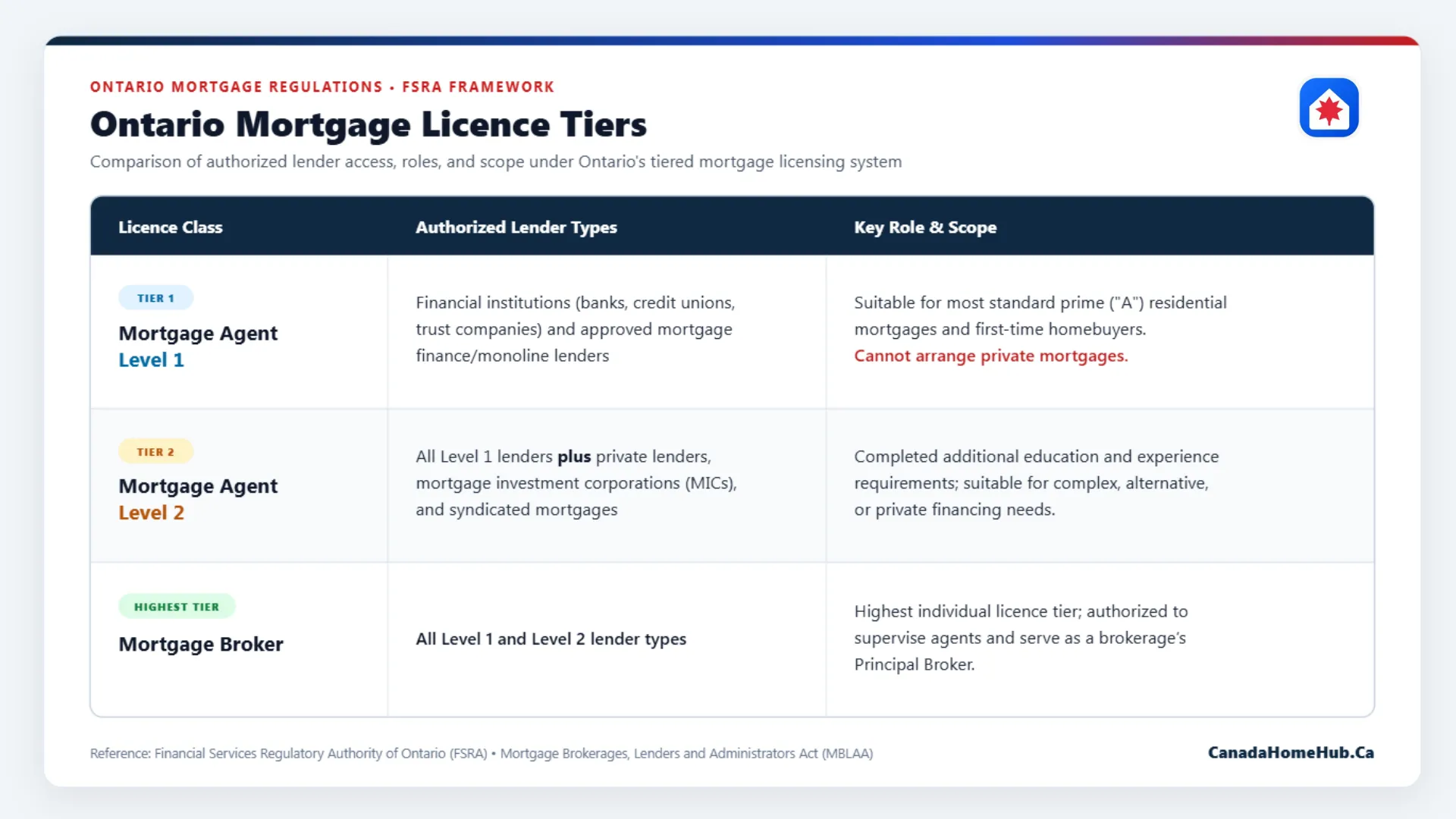
Knowing these distinctions prevents surprises. If you have strong credit and a standard down payment for a home in Ottawa, a knowledgeable Mortgage Agent Level 1 backed by a reputable brokerage may serve you well. If your situation involves bruised credit, short-term bridge financing, construction draws, or private second mortgages, you should work specifically with a Mortgage Agent Level 2 or a licensed Mortgage Broker.
Buying Across the River? The Ottawa–Gatineau Licensing Rule
Because Ottawa sits directly across the Ottawa River from Gatineau, Quebec, many buyers compare neighbourhoods on both sides of the provincial border—for example, weighing Aylmer or Hull against Orléans or Centretown.
Mortgage licensing in Canada is provincial. An Ontario FSRA licence does not automatically authorize a broker to arrange a mortgage for a property located in Quebec. Financing a home in Gatineau requires a broker licensed in Quebec through the Autorité des marchés financiers (AMF). If you are actively shopping on both sides of the river, ask upfront whether your broker holds dual Ontario and Quebec licensing or works within a team that covers both jurisdictions seamlessly.
Step-by-Step: How to Find the Right Mortgage Broker in Ottawa
Finding the right financing partner works best when you treat it like a structured vetting process rather than a rushed phone call after falling in love with a listing.
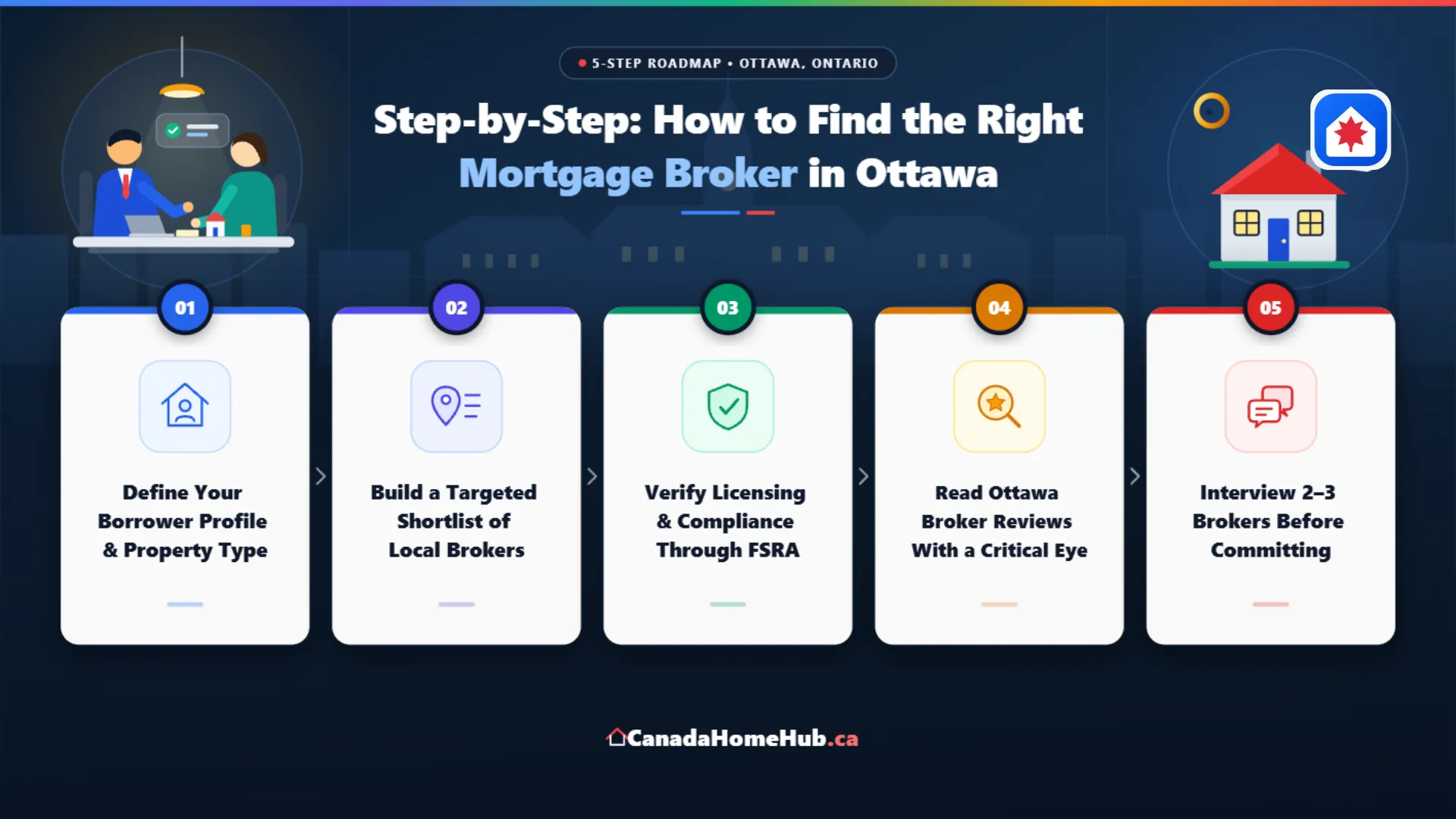
Step 1. Define Your Borrower Profile and Ottawa Property Type
Before contacting anyone, outline the key variables of your transaction. Brokers specialize differently, and clarity upfront helps you spot whether a broker has relevant experience:
- Transaction goal: First-time purchase, move-up purchase with a sale, mortgage renewal, or refinance/equity take-out.
- Income structure: Salaried federal or municipal employee, tech sector employee with RSUs or bonuses, military/RCMP member on a relocation directive, commissioned earner, or incorporated/sole-proprietor self-employed borrower.
- Property characteristics: Downtown high-rise condo (where condo status certificates and reserve funds matter), suburban freehold townhome in Kanata or Barrhaven, multi-unit duplex/triplex, or rural acreage in areas such as Manotick, Carp, or Cumberland (where lenders may require potability water tests and septic inspections).
If you are still mapping out the broader homebuying journey—budgeting for closing costs, understanding down payment rules, and coordinating real estate professionals—exploring Canadian homeownership resources such as CanadaHomeHub.Ca can help you organize your priorities before you begin broker interviews.
Step 2. Build a Targeted Shortlist of Local Brokers
Start with three to five candidates rather than reaching out to a dozen at once. Strong sources for your shortlist include:
- Local real estate professionals: Experienced Ottawa real estate agents and real estate lawyers see firsthand which brokers meet five-business-day financing conditions reliably and which ones scramble at closing. Treat referrals as a starting point—still do your own vetting.
- Targeted local search: Searching for a mortgage broker near Ottawa helps identify brokerages with an established footprint in the National Capital Region. While much of the Canadian mortgage process now happens securely online, a broker familiar with Ottawa appraisers, local property tax norms, and regional condo corporations adds practical value.
- Personal network referrals: Ask colleagues or friends whose financial situation resembled yours (for instance, another self-employed buyer or first-time purchaser), rather than relying solely on someone who had a completely different transaction type.
Step 3. Verify Licensing and Compliance Through FSRA
Never skip credential verification. Before sharing sensitive financial documents such as T4s, Notices of Assessment (NOAs), or bank statements, confirm that both the individual and their brokerage are actively licensed in Ontario.
You can check credentials on FSRA’s public registry of licensed mortgage brokerages, brokers, and agents in Ontario. When checking a profile, verify four items:
- Active licence status: Confirm the licence has not expired, been suspended, or been revoked.
- Licence class: Check whether the individual holds a Mortgage Agent Level 1, Level 2, or Mortgage Broker licence.
- Brokerage affiliation: Verify that the brokerage listed on the registry matches the company name on their website and email signature.
- Enforcement or disciplinary history: Review whether any public regulatory actions or conditions are attached to the licence.
Step 4. Read Mortgage Broker Reviews in Ottawa With a Critical Eye
Checking mortgage broker reviews in Ottawa on Google, social platforms, or independent review sites is a smart filter, but raw star averages rarely tell the whole story. Almost every established broker has positive testimonials; what you want are specific patterns in how they handle pressure.
Look for detailed reviews that mention:
- Responsiveness during tight deadlines: Did the broker return calls quickly during an offer period or conditional financing window?
- Clarity of explanation: Did clients understand their prepayment privileges, fixed vs. variable trade-offs, and closing costs without feeling rushed?
- Problem-solving under underwriting scrutiny: Look for mentions of how the broker handled appraisal shortfalls, last-minute lender document requests, or complex income verification.
- Post-closing support: Strong brokers check in ahead of renewals or when market rate shifts create opportunities to adjust strategy.
Be cautious of profiles filled exclusively with vague, one-line reviews posted in sudden clusters, or repeated complaints about surprise fees, missed closing deadlines, or radio silence once documents were submitted.
Step 5. Interview Two to Three Brokers Before Committing
A 15- to 20-minute introductory call with two or three shortlisted brokers quickly reveals who communicates clearly and who is simply pitching a headline rate. Pay attention to whether the broker asks thoughtful questions about your five-year plans—such as whether you might move, renovate, or make lump-sum payments—before quoting a rate.
A broker who quotes the lowest teaser rate in the first two minutes without asking about your income, down payment size, or future plans may be quoting a restricted "no-frills" mortgage with harsh exit clauses.
Essential Questions to Ask a Prospective Ottawa Mortgage Broker
Bring a consistent set of questions to each introductory call so you can compare answers side by side:
- How many lenders do you actively work with, and which types? Confirm whether they have access to major banks, credit unions, and monoline lenders—not just one narrow tier.
- How are you compensated on my specific file, and could any broker or lender fees apply? A transparent broker will clearly state whether the lender pays their commission or whether an alternative/private lender scenario would carry disclosed borrower fees.
- Will you explain the full mortgage terms—including prepayment penalties and collateral vs. standard charges—not just the interest rate? Understanding the difference between a standard charge (easier to switch lenders at renewal) and a collateral charge (allows re-borrowing equity but can involve legal fees to switch lenders) is crucial in Canada.
- How long is your rate hold, and do you automatically monitor for rate drops before closing? Most Canadian lenders offer 90- to 120-day rate holds on pre-approvals. Ask whether the broker proactively requests a lower rate if market rates fall before your closing date.
- Who will be my main point of contact from application to closing? Some high-volume Ottawa brokerages hand files off to underwriting assistants after the initial call. A team model can be very efficient, provided you know who is responsible for urgent questions during a conditional offer period.
- What happens if a lender declines or counters my file during the financing condition window? Experienced brokers always have a Plan B lender identified before you waive financing conditions.
Choosing a First-Time Home Buyer Mortgage Broker in Ottawa
Buying your first home comes with a steeper learning curve than a standard renewal. If you are searching for a first-time home buyer mortgage broker in Ottawa, look for someone who prioritizes education and upfront underwriting over quick online estimates.
Programs and Local Rules Your Broker Should Walk You Through
A well-informed Ottawa broker should proactively review how federal and Ontario-specific rules affect your purchasing power and cash-to-close budget:
- Down payment tiers and default insurance: In Canada, mortgages with less than a 20% down payment require mortgage default insurance (provided through CMHC, Sagen, or Canada Guaranty). Minimum down payment rules start at 5% on the first $500,000 of the purchase price and 10% on the portion above $500,000, subject to current federal insured price caps and amortization eligibility rules—your broker should confirm the exact federal limits applicable at the time you buy.
- The OSFI Mortgage Stress Test: Federally regulated lenders must qualify borrowers at the Minimum Qualifying Rate (historically the greater of 5.25% or your contract rate plus 2%). A good broker calculates your true debt-service ratios (GDS and TDS) under stress-test rules before you start touring homes.
- Registered savings tools: Ask how to coordinate withdrawals from the First Home Savings Account (FHSA) and the Home Buyers’ Plan (HBP) via your RRSP, including required holding periods (such as the 90-day RRSP contribution rule for HBP funds) so your down payment clears lender anti-money-laundering checks smoothly.
- Ontario Land Transfer Tax (LTT) refund: Eligible first-time buyers in Ontario can claim a provincial Land Transfer Tax refund of up to $4,000. Unlike buyers in Toronto, Ottawa homebuyers do not pay an additional municipal land transfer tax—an important local cost distinction when estimating closing funds.
Document-Verified Pre-Approval vs. Online Pre-Qualification
Not all pre-approvals carry the same weight. A basic online pre-qualification relies on self-reported income and debt numbers with zero document verification. When you submit an offer on an Ottawa property and the lender finally reviews your pay stubs, employment letter, or down payment trail, an unverified pre-qualification can fall apart.
Look for a broker who conducts a full document-verified pre-approval before you shop: reviewing your recent pay stubs, employment verification letter, two years of T4s/NOAs (if variable or self-employed income applies), 90-day bank account history for your down payment, and a live credit bureau pull.
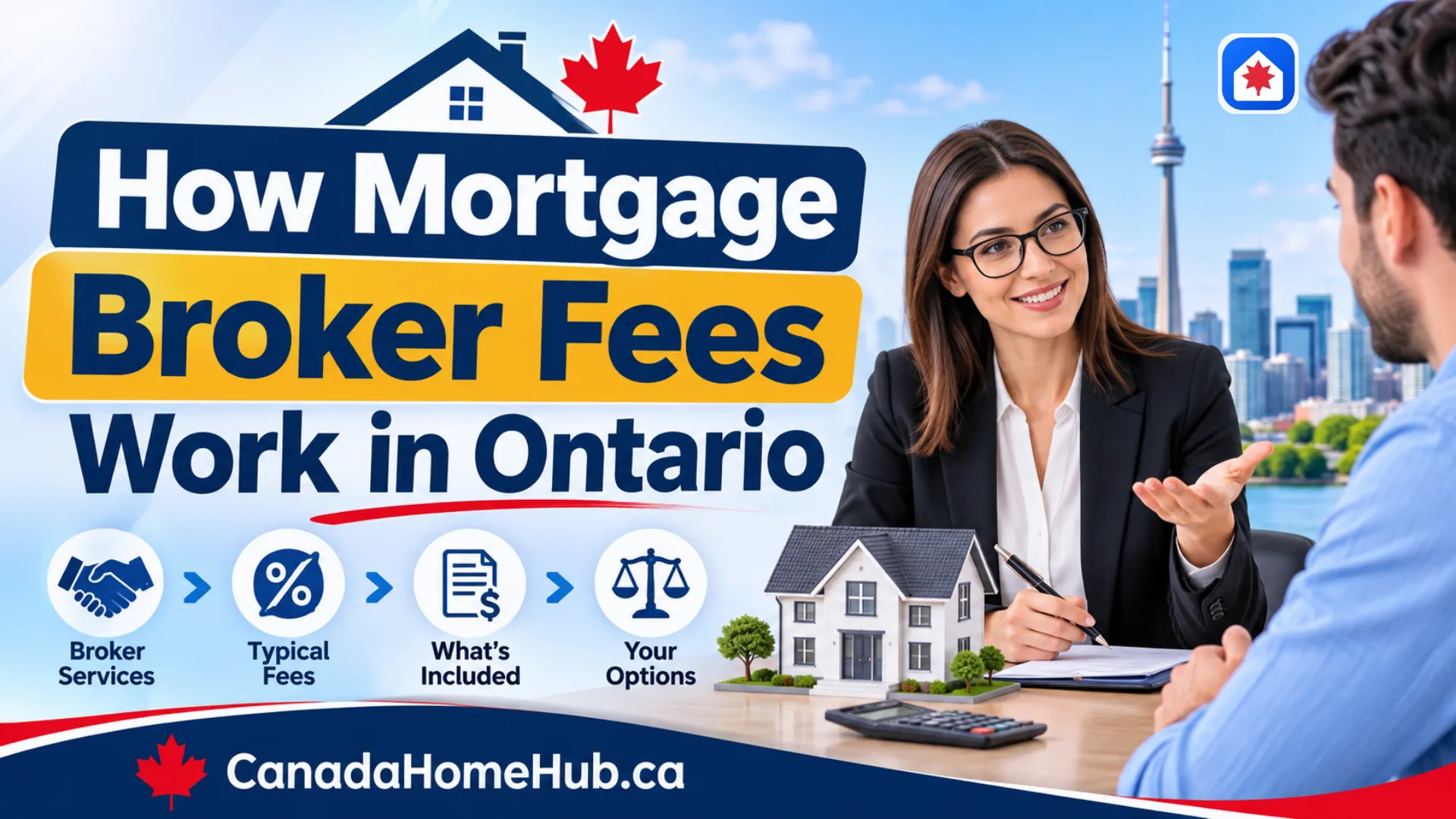
How Mortgage Broker Fees Work in Ontario
One of the most common misconceptions among Canadian homebuyers is that hiring a mortgage broker automatically adds an extra bill at closing. In reality, compensation depends on the tier of lender funding your mortgage:
- Prime ("A") Lenders (Banks, Credit Unions, Monoline Lenders): For the vast majority of standard residential mortgages, the borrower pays $0 in direct broker fees. Once your mortgage closes, the lender pays the brokerage a finder’s fee (commission) based on the loan amount and term length. Because brokerages receive volume-based pricing from lenders, this commission does not mean you pay a higher interest rate than walk-in retail borrowers.
- Alternative ("B") Lenders: If your file requires a B-lender due to bruised credit, non-traditional self-employed income, or higher debt ratios, a lender fee and/or brokerage fee often applies—commonly around 1% of the mortgage amount (though exact percentages vary by lender and complexity).
- Private Mortgages: Short-term private financing typically involves both lender and brokerage fees, plus legal fees for both sides.
Under Ontario’s regulatory rules, any fee charged directly to the borrower must be disclosed clearly in writing upfront before you commit to the mortgage. Never work with a broker who is vague about fees or asks for unexplained upfront retainers on a standard prime residential mortgage.
Practical Scenarios: Seeing the Difference in Ottawa’s Market
The following illustrative scenarios show how choosing the right broker affects real-world outcomes in Ottawa. (Note: These are hypothetical examples created to illustrate typical Canadian mortgage mechanics, not actual client case studies.)
Scenario 1: Comparing Fixed-Rate Prepayment Penalties on a Barrhaven Townhome
Consider a couple buying their first freehold townhome in Barrhaven with a 10% down payment. One lender offers a five-year fixed rate that is 0.05% lower than a competing monoline lender, saving roughly $15 per month.
However, the couple knows one partner works in the federal public service and may pursue a career move or upgrade to a detached home within three to four years. A thorough Ottawa mortgage broker compares the Interest Rate Differential (IRD) penalty formulas of both contracts—and checks whether the lower-rate product includes a bona fide sales clause (which prohibits breaking the mortgage unless you actually sell the home to an unrelated third party). By choosing a fair-penalty monoline lender with portable mortgage features instead of chasing a 0.05% headline discount, the buyers protect themselves against a potentially hefty five-figure break penalty if their plans change.
Scenario 2: Financing a Rural Property Near Carp With Self-Employed Income
Imagine an incorporated IT consultant purchasing a detached bungalow on a two-acre lot near Carp. The property operates on a drilled well and septic system, and the buyer retains a significant portion of earnings inside their corporation rather than drawing a high personal T4 salary.
Approaching a single retail bank branch could lead to a quick decline if that bank’s automated underwriting only counts personal Line 15000 income or applies restrictive rural acreage caps. An experienced Ottawa mortgage broker who understands corporate add-backs, retained earnings policies, and rural appraisal guidelines can direct the file straight to lenders that accommodate incorporated self-employed borrowers and rural Ottawa properties—avoiding unnecessary credit hits and missed closing dates.
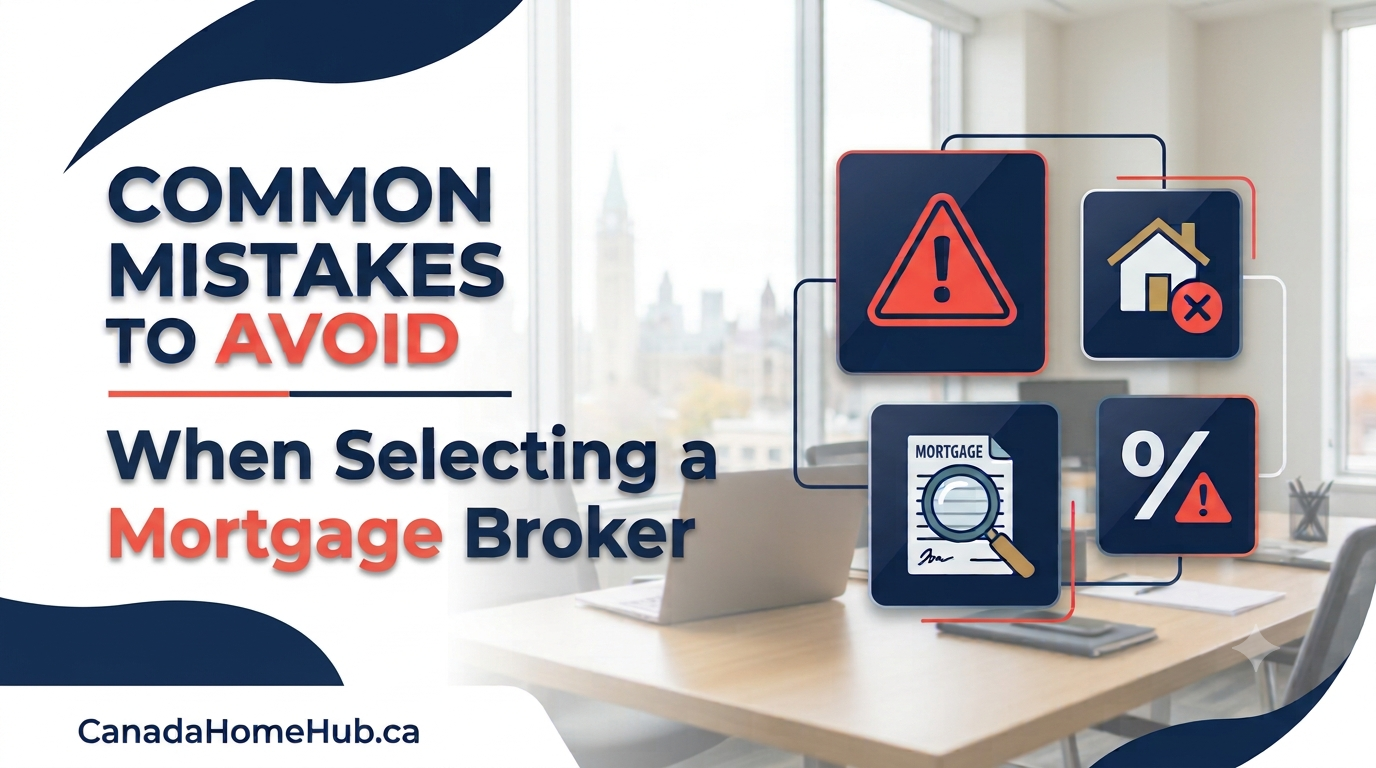
Common Mistakes to Avoid When Selecting a Mortgage Broker
Even well-prepared buyers can run into avoidable setbacks during their search. Keep these pitfalls off your list:
- Shopping strictly on the lowest advertised rate: Online teaser rates frequently apply only to insured mortgages (under 20% down), restricted "no-frills" products with high break penalties, or quick-close promotions. Always evaluate the total cost of borrowing and contract flexibility alongside the rate.
- Letting multiple brokers pull your credit: You can interview several brokers and discuss scenarios without authorizing a hard credit check. Wait until you have selected one broker before consenting to a credit pull.
- Waiting until after your offer is accepted: In competitive Ottawa neighbourhoods, financing conditions are commonly set at five business days—sometimes less. Securing a document-verified pre-approval weeks before making an offer gives your broker time to resolve credit discrepancies or down payment paperwork well ahead of deadlines.
- Ignoring local Ottawa property nuances: An out-of-market call-centre agent may overlook local details such as Ottawa condo reserve fund issues, heritage property insurance requirements in older neighbourhoods like The Glebe or Sandy Hill, or rural well/septic lender conditions.
- Changing your financial profile mid-process: Even after securing a great broker and pre-approval, financing a new car, opening retail credit cards, or switching jobs before closing day can derail final lender funding. Always consult your broker before making major financial moves prior to closing.
Frequently Asked Questions About Mortgage Brokers in Ottawa
Do I have to pay a mortgage broker in Ottawa?
For most standard residential mortgages funded through prime ("A") lenders—including major banks, credit unions, and monoline lenders—you typically pay $0 to the broker, as the lender pays the brokerage a commission upon closing. If your situation requires an alternative ("B") or private lender, brokerage and/or lender fees may apply and must be disclosed to you in writing upfront under Ontario regulations.
Does working with a mortgage broker hurt my credit score?
Working with a single mortgage broker generally requires only one hard credit inquiry, which has a minor, temporary impact on your credit score. That single report can then be shared across multiple lenders in the broker’s network, protecting your credit profile compared to submitting separate applications at multiple banks.
Can a mortgage broker get me a lower rate than my own bank?
Often, yes—though not in every single case. Brokers access wholesale rate sheets from monoline lenders, credit unions, and multiple banks, and they can sometimes secure lower rates or better prepayment terms than a bank’s initial retail quote. Comparing a broker’s recommendation against your existing bank’s offer gives you clear leverage and peace of mind.
How early should I contact an Ottawa mortgage broker before making an offer?
Ideally, connect with a broker three to six months before you plan to buy. This gives you enough time to review your credit report, organize down payment documentation (including FHSA or RRSP funds), address any debt-ratio bottlenecks, and lock in a 90- to 120-day rate hold once you begin touring homes seriously.
Should I choose a broker with a physical office near Ottawa or an online-only brokerage?
Both models can work well, provided the professional is licensed by FSRA in Ontario and responsive. Choosing a broker based in or deeply familiar with Ottawa offers practical advantages—such as established relationships with local appraisers, Ottawa real estate lawyers, and insight into local condo buildings or rural properties—while still giving you the convenience of digital document uploads and video meetings.
What is the difference between a mortgage brokerage and an individual mortgage broker?
In Ontario, a mortgage brokerage is the licensed business entity authorized to deal in mortgages, while individual mortgage agents (Level 1 or 2) and mortgage brokers are licensed professionals who work on behalf of a single brokerage. When verifying credentials on FSRA’s registry, you should check both the individual’s licence and the standing of the brokerage they represent.
Can an Ottawa mortgage broker help with a mortgage renewal or refinance?
Yes. You do not need to automatically sign the renewal letter your current lender mails you. Speaking with an Ottawa mortgage broker 120 days before your renewal date lets you compare competing lenders, potentially secure a better rate or product structure, and review whether switching lenders triggers any legal or appraisal fees (which some incoming lenders cover on standard transfers).
Taking the Next Step Toward Your Ottawa Mortgage
Finding the right mortgage broker in Ottawa comes down to preparation and verification rather than guesswork. Start by clarifying your income profile and target neighbourhood, verify every candidate’s active licence tier through FSRA, read local reviews for evidence of communication and problem-solving, and interview two or three brokers using the same set of questions.
Whether you are purchasing your first home, relocating to the National Capital Region, or preparing for an upcoming renewal, taking an extra hour to vet your financing partner can pay dividends for years to come. As you plan the rest of your homebuying checklist—from budgeting closing costs to comparing neighbourhoods—you can continue exploring practical Canadian real estate guides at CanadaHomeHub.Ca.