
Choosing the right financial advisor in Canada can shape how efficiently you save for a home, optimize taxes across your RRSP and TFSA, protect your family, and build long-term retirement wealth. Yet for many Canadians, the search process quickly becomes confusing. Across the country, professionals working at major banks, independent wealth management firms, and insurance agencies may all call themselves "financial advisors," even though their qualifications, product offerings, and legal obligations differ significantly.
Whether you are searching for a financial advisor Canada wide or looking for local expertise in your province, knowing how the Canadian regulatory system works is the best way to protect your money. This guide walks you through the types of financial professionals in Canada, the credentials that actually matter, how fees are structured, and a clear six-step process to verify and hire an advisor who fits your goals.
Understand the Different Types of Financial Professionals in Canada
Before searching for a "financial advisor near me," it helps to understand that "financial advisor" is a broad industry label rather than a single standardized job title. Depending on where a professional works and how they are licensed, their role may focus narrowly on selling mutual funds or broadly on building a multi-year wealth plan.
Financial Advisor vs. Financial Planner: What Is the Difference?
While people often use these two titles interchangeably, they typically serve different purposes:
- Financial Planner: A financial planner takes a holistic view of your entire financial life. They help you coordinate cash flow, debt repayment, homeownership goals, tax planning, retirement projections (RRSP, TFSA, CPP/OAS timing), insurance coverage, and estate planning. Many hold a recognized planning designation such as Certified Financial Planner (CFP).
- Financial Advisor: A financial advisor generally focuses more on investment management and selecting financial products—such as mutual funds, exchange-traded funds (ETFs), segregated funds, or guaranteed investment certificates (GICs)—to help grow your portfolio. Some advisors also offer basic financial planning, while others act primarily as licensed salespeople for a specific institution.
Portfolio Managers and Investment Representatives
If you are looking specifically for investment management, you will encounter two main regulatory categories overseen by the Canadian Investment Regulatory Organization (CIRO) and provincial securities commissions:
- Dealing Representatives (Investment or Mutual Fund Advisors): Licensed to buy and sell securities or mutual funds on your behalf based on your instructions. Under Canadian securities rules, they are legally required to ensure that recommended investments are suitable for your risk tolerance, time horizon, and financial situation.
- Portfolio Managers (Advising Representatives): Licensed at a higher regulatory tier to make discretionary investment decisions—meaning they can buy and sell assets in your account without calling you before every trade, within an agreed Investment Policy Statement. Crucially, registered Portfolio Managers in Canada owe you a statutory fiduciary duty, legally obligating them to act in your best interest at all times.
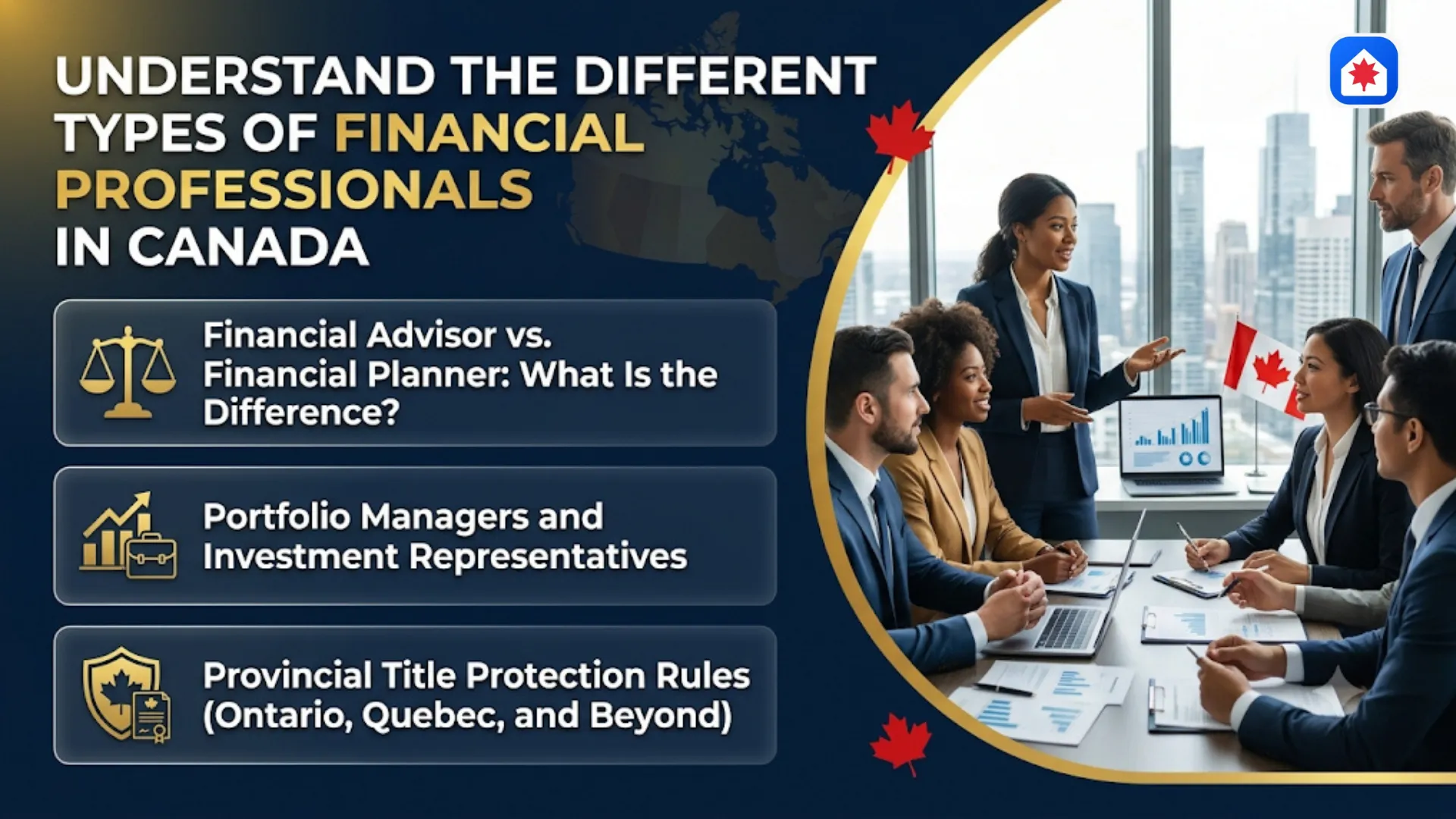
Provincial Title Protection Rules (Ontario, Quebec, and Beyond)
In Canada, financial regulation is largely managed at the provincial and territorial level, meaning rules around who can use certain titles vary depending on where you live:
- Quebec: Quebec has long enforced strict statutory title protection. To legally use the title Planificateur financier (Pl. Fin. or Financial Planner), an individual must hold a diploma from the Institut de planification financière (IPF) and a valid certificate from the Autorité des marchés financiers (AMF).
- Ontario: Under Ontario's Financial Professionals Title Protection Act, individuals cannot use the titles "Financial Planner" or "Financial Advisor" (or confusingly similar variations) unless they hold an approved credential from a credentialing body overseen by the Financial Services Regulatory Authority of Ontario (FSRA).
- Other Provinces: Several provinces—including Saskatchewan, New Brunswick, and Manitoba—have introduced or progressed toward title protection frameworks, whereas in jurisdictions without active title protection, virtually anyone can print "financial advisor" on a business card. Checking formal credentials and regulatory registration is therefore essential nationwide.
Key Financial Credentials and Designations to Look For
Because marketing titles vary across institutions, verifiable designations provide a much clearer picture of an advisor's training, ethical standards, and ongoing continuing education requirements. When evaluating a certified financial planner Canada wide or an investment specialist, look for these established credentials:
- CFP® (Certified Financial Planner): Administered by FP Canada, the CFP designation is widely regarded as the benchmark for comprehensive financial planning in Canada. Earning it requires post-secondary education, rigorous financial planning coursework, passing national exams, at least three years of qualifying experience, and adherence to a strict code of ethics.
- QAFP® (Qualified Associate Financial Planner): Also overseen by FP Canada, the QAFP credential designates professionals trained to provide holistic financial planning for everyday financial needs, particularly for individuals and families with straightforward financial situations.
- Pl. Fin. (Planificateur financier): The mandatory legal credential for financial planners operating in Quebec, regulated through the IPF and AMF.
- CIM® (Chartered Investment Manager): Offered through the Canadian Securities Institute (CSI), the CIM designation equips professionals with advanced portfolio management skills and is a common pathway to registering as a discretionary Portfolio Manager.
- CFA® (Chartered Financial Analyst): A globally recognized credential focused deeply on institutional investment analysis, asset valuation, and portfolio strategy.
- CPA (Chartered Professional Accountant): While CPAs are accounting and tax experts rather than investment advisors, many work alongside financial planners—or hold dual CPA/CFP credentials—to structure tax-efficient corporate and personal wealth strategies.
How Financial Advisor Fees Work in Canada
Understanding financial advisor fees Canada wide is one of the most important parts of your search. Advisors are never "free," even when you do not receive a direct invoice. How an advisor is compensated directly affects both your long-term returns and potential conflicts of interest.
Fee-Only (Advice-Only) Planners
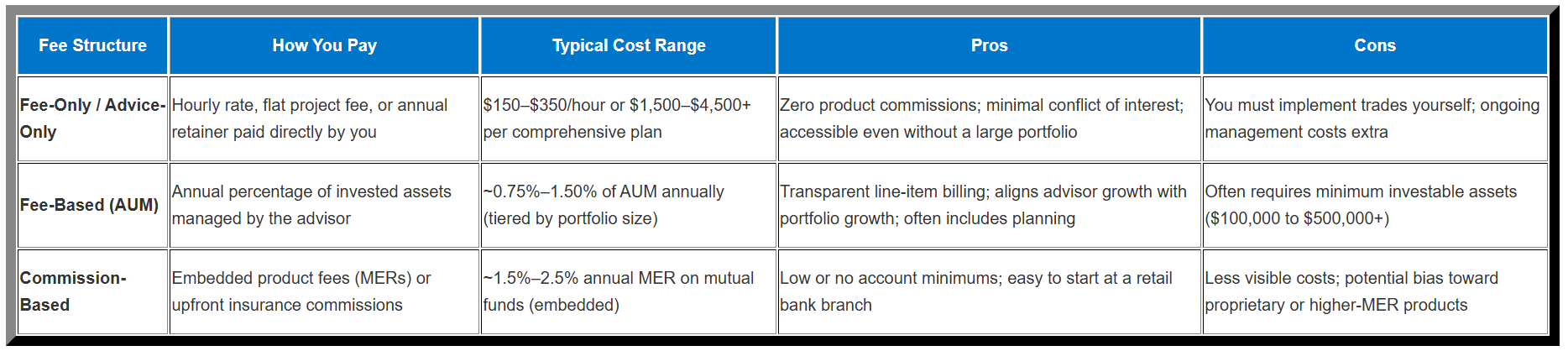
A fee-only financial planner Canada wide is paid strictly by you—via an hourly rate, a flat project fee (for example, $1,500 to $4,500 for a comprehensive written plan), or an annual retainer—and accepts zero commissions from investment or insurance companies.
- Best for: Canadians who want an unbiased financial roadmap, tax strategy, or second opinion while managing their own investments through a discount brokerage, or those whose wealth is tied up in real estate rather than liquid investment accounts.
- Important note: Advice-only planners provide written recommendations and coaching, but unless they also hold securities or insurance registrations, they do not execute trades or sell insurance policies for you.
Fee-Based Advisors (Assets Under Management)
A fee-based advisor charges a transparent percentage of the investment assets they manage for you—known as Assets Under Management (AUM)—typically ranging from 0.75% to 1.50% per year, often on a sliding scale that decreases as your portfolio grows.
- Best for: Investors who want ongoing portfolio management paired with continuous financial planning, rebalancing, and behavioural coaching.
- Tax note: In Canada, investment management fees paid directly on non-registered accounts are generally tax-deductible, whereas fees paid inside registered accounts (such as an RRSP or TFSA) are not.
Commission-Based Advisors and Bank Representatives
Commission-based advisors earn income when you purchase specific financial products, such as mutual funds, segregated funds, or life insurance policies. With mutual funds, this compensation is typically embedded in the fund's Management Expense Ratio (MER) - which often ranges between 1.5% and 2.5% annually - and paid to the dealer firm as a trailing commission.
- Best for: Beginner investors with smaller starting balances who may not meet the minimum portfolio thresholds required by fee-based wealth managers.
- Watch out for: Because compensation is tied to product sales, advisors may face incentives to recommend higher-fee in-house funds over low-cost index ETFs. Under Canadian Client Relationship Model (CRM2) rules, dealers must send you an annual report showing the exact dollar amount of fees and trailing commissions paid to the firm.
Comparison Table: Financial Advisor Compensation Models in Canada
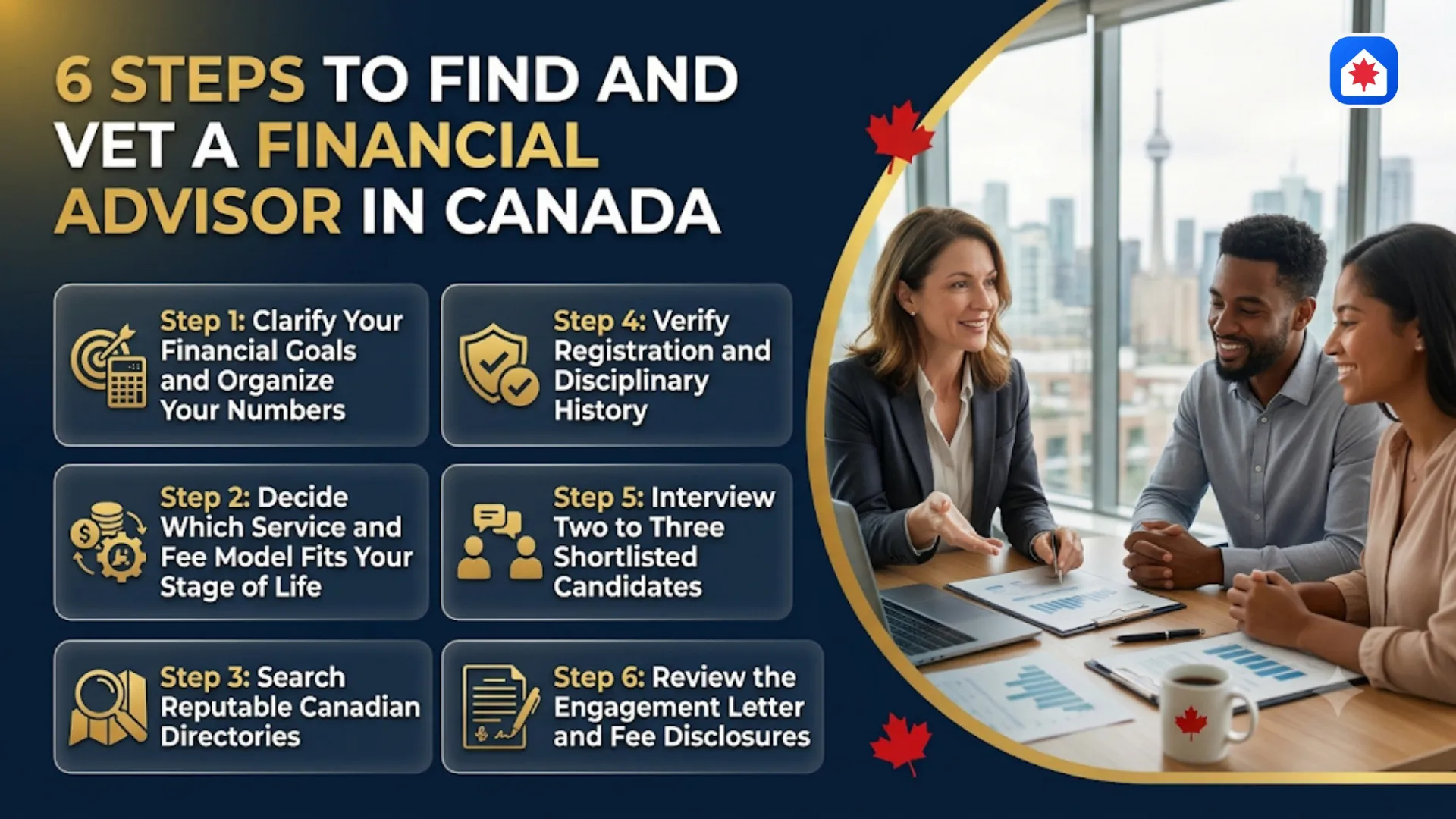
6 Steps to Find and Vet a Financial Advisor in Canada
Follow this practical checklist to narrow your options and verify every candidate before handing over your personal financial information.
Step 1: Clarify Your Financial Goals and Organize Your Numbers
Start by defining what problem you actually want to solve. Are you trying to balance saving for a down payment in a First Home Savings Account (FHSA) while paying down student loans? Are you preparing to transition from accumulating wealth to drawing retirement income? Or do you need cross-border tax and estate coordination?
Before booking consultations, gather a snapshot of your net worth, annual income, monthly cash flow, and existing registered accounts (RRSP, TFSA, FHSA, RESP). If buying or refinancing a home is part of your near-term plan, you can explore the free Canadian housing and financial calculators on CanadaHomeHub.Ca to estimate your mortgage payments, stress-test affordability, and closing costs ahead of time. Walking into an initial meeting with realistic housing and debt numbers allows an advisor to give you much more specific guidance from day one.
Step 2: Decide Which Service and Fee Model Fits Your Stage of Life
Match your needs to the right professional structure:
- Building a foundation or buying your first home: A flat-fee advice-only CFP® can help you structure your budget, prioritize FHSA vs. TFSA vs. RRSP contributions, and evaluate mortgage vs. investing trade-offs without pressuring you to buy high-fee funds.
- Growing a mid-to-large investment portfolio ($150,000+): A fee-based CFP® or registered Portfolio Manager can manage asset allocation, tax-loss harvesting, and multi-year retirement projections under one transparent fee.
- Complex business, estate, or incorporated professional needs: Look for a multidisciplinary wealth team that includes a CFP®, a Portfolio Manager, and access to CPA tax specialists.
Step 3: Search Reputable Canadian Directories
Rather than relying solely on sponsored search ads or unsolicited social media pitches, start with credible Canadian directories:
- FP Canada ("Find a Planner" Directory): Allows you to search for verified CFP® and QAFP® professionals by city, province, and specialty.
- The Financial Planning Association of Canada (FPAC): Features members committed to fiduciary-aligned, transparent financial planning.
- Independent Advice-Only Directories: Platforms such as Value of Simple or MoneySense's vetted planner lists highlight fee-only planners across Canada who do not sell financial products.
- Referrals from Trusted Professionals: Ask your real estate lawyer, accountant, or mortgage broker if they work with reputable planners in your province.
Step 4: Verify Registration and Disciplinary History
Never skip regulatory due diligence. Every individual or firm that sells securities, manages investments, or uses protected titles in Canada leaves an official regulatory trail.
- Canadian Securities Administrators (CSA) National Registration Search: Visit the official CSA database (info.securities-administrators.ca) to confirm whether an individual or firm is registered to advise or deal in securities in your province, and check any terms or conditions on their registration.
- CIRO AdvisorReport: If the advisor works for an investment dealer or mutual fund dealer, run their name through the CIRO AdvisorReport tool (ciro.ca) to view their employment history, approved categories, exams completed, and any regulatory disciplinary actions.
- Provincial Registries: In Ontario, check FSRA's credential verification tool for protected titles; in Quebec, verify registration through the AMF's public register; and for insurance advisors, check your provincial insurance council (such as the Insurance Council of British Columbia or the Alberta Insurance Council).
Step 5: Interview Two to Three Shortlisted Candidates
Most reputable advisors offer a complimentary 20- to 30-minute introductory discovery call. Treat this meeting like a job interview—you are hiring them, not the other way around. Pay attention to whether they ask thoughtful questions about your life goals and family priorities before mentioning any investment products.
Step 6: Review the Engagement Letter and Fee Disclosures
Before signing an agreement, ask for a written scope of services and a clear breakdown of all costs in both percentages and estimated annual dollars. Under Canadian regulatory rules (including Relationship Disclosure Information requirements), a registered advisor must clearly explain what products they can offer, how they are compensated, and any potential conflicts of interest.
10 Essential Questions to Ask a Financial Advisor Before Hiring
Bring these ten questions to your introductory meetings to compare candidates objectively:
- What credentials and regulatory licenses do you hold, and which provinces are you registered in?
- Are you legally held to a fiduciary standard, or do you operate under a suitability standard?
- How are you compensated—flat fee, hourly, percentage of assets, or product commissions?
- What will my total all-in annual cost be, including your advisory fee and any underlying fund MERs?
- Are you restricted to proprietary products from one institution, or can you recommend investments across the entire market?
- What does your typical client profile look like (income range, portfolio size, life stage)?
- Does your service include comprehensive financial planning (taxes, retirement, insurance, estate), or investment management only?
- How often will we meet to review and update my plan, and how can I reach you between scheduled reviews?
- What is your investment philosophy, and how do you help clients stay disciplined during market downturns?
- If I decide to leave in the future, are there any deferred sales charges, transfer-out fees, or lock-in periods?
Red Flags to Watch Out For When Choosing an Advisor
Walk away immediately if you encounter any of these warning signs:
- Unregistered status: The person cannot be found on the CSA National Registration Search, CIRO AdvisorReport, or relevant provincial insurance/title registries despite claiming to offer investment or regulated planning services.
- Promises of guaranteed high returns: No legitimate Canadian advisor can guarantee market-beating returns with zero risk.
- Evasive answers about fees: If an advisor tells you their advice is "free" or avoids putting total MERs and advisory fees in writing, they are not being transparent.
- High-pressure sales tactics: Pushing you to sign paperwork on the first call, move your entire pension immediately, or leverage your home equity without a comprehensive written plan.
- One-size-fits-all product pitches: Recommending complex insurance policies or proprietary mutual funds before thoroughly reviewing your cash flow, tax bracket, and debts.

Frequently Asked Questions (FAQs)
How much money do I need to hire a financial advisor in Canada?
There is no single legal minimum across Canada. Retail bank advisors and commission-based mutual fund representatives often work with clients starting with as little as $1,000 to $25,000. Fee-only financial planners charge a flat or hourly fee regardless of your net worth. By contrast, independent fee-based wealth managers and Portfolio Managers commonly set minimum investable asset thresholds between $100,000 and $500,000, though some firms offer lower minimums for younger professionals with strong savings trajectories.
Are financial advisor fees tax-deductible in Canada?
According to Canada Revenue Agency (CRA) guidelines, fees paid for investment counsel or portfolio management on non-registered (taxable) investment accounts are generally tax-deductible on Line 22100 of your T1 tax return, provided the fees are paid directly by you rather than embedded in a mutual fund's MER. However, fees paid for registered accounts (such as RRSPs, TFSAs, FHSAs, and RESPs) and fees charged solely for general financial planning advice are typically not tax-deductible. Always confirm your specific situation with a Canadian tax professional.
What is the difference between a fiduciary duty and a suitability standard in Canada?
A fiduciary duty legally requires the professional to put your financial interests ahead of their own and disclose or avoid conflicts of interest—a standard that applies to registered Portfolio Managers in Canada. A suitability standard, which applies to most mutual fund and investment dealing representatives, requires that a recommended investment fit your risk profile and objectives, even if another comparable product might cost less or pay the advisor a lower commission.
Should I use a bank financial advisor or an independent planner?
Both options have trade-offs. Big Five bank branches offer convenience and low minimums, making them accessible when you are just starting out. However, bank advisors are employees of the bank and are typically limited to recommending their institution's proprietary mutual funds and GICs. Independent financial planners and wealth firms generally offer broader access to third-party investments, deeper tax and estate planning, and lower turnover—meaning you are less likely to be reassigned to a new advisor every year or two.
How do I find a reputable financial advisor near me in Canada?
Start by searching the FP Canada "Find a Planner" directory by postal code or city to locate verified CFP® and QAFP® professionals in your area. Once you shortlist two or three local or virtual planners, verify their registration on the CSA National Registration Search or CIRO AdvisorReport, and schedule introductory calls to compare their communication style, planning process, and fee transparency.
Can a Canadian financial advisor help me if I live in a different province?
Yes, in many cases—thanks to remote video consultations and Canada's regulatory "passport system" for securities registration. However, an investment or insurance advisor must be properly registered or licensed in your province of residence to give regulated product advice or execute trades for you. Note also that Quebec enforces distinct licensing and language rules under the AMF, so out-of-province advisors generally cannot market financial planning services to Quebec residents without Quebec credentials.
Conclusion
Finding the right financial advisor in Canada comes down to clarity and verification: knowing whether you need a holistic financial planner Canada wide or a dedicated investment manager, choosing a transparent fee structure that aligns with your goals, and verifying every credential through official regulators like CIRO, the CSA, FSRA, or the AMF.
Before scheduling your first consultation, take time to organize your household budget, savings targets, and housing plans using the free calculators at CanadaHomeHub.Ca. When you understand your baseline numbers and ask the right questions upfront, you can partner with a qualified Canadian advisor with confidence.