Understanding how to file taxes in Canada comes down to five core actions: confirming your residency and filing obligations, gathering your official tax slips, selecting an approved filing method, claiming eligible deductions and credits, and submitting your T1 Income Tax and Benefit Return to the Canada Revenue Agency (CRA) before the deadline.
While tax season can feel intimidating - especially if you are filing for the first time, navigating self-employment income, or adjusting to major life changes like buying a home - Canada’s tax system is largely self-assessed and heavily digitized. Most Canadians complete and submit their returns online in a single afternoon. This guide walks you through the process, key dates, provincial nuances, and homeowner tax breaks you need to file accurately and keep more of your money.
Do You Need to File a Tax Return in Canada?
In Canada, your obligation to file an income tax return is based primarily on your residency status for tax purposes, not your citizenship or immigration status. You must file a return for a given tax year (which runs from January 1 to December 31) if any of the following apply:
- You owe income tax to the federal or provincial/territorial government.
- The CRA sends you a formal request to file a return.
- You and your spouse or common-law partner want to split pension income.
- You disposed of capital property (such as stocks, investment real estate, or even your principal residence) during the year.
- You need to repay Employment Insurance (EI) or Old Age Security (OAS) benefits.
- You are self-employed and need to pay Canada Pension Plan (CPP) or Quebec Pension Plan (QPP) contributions, or EI premiums on self-employed earnings.
- You withdrew funds from your Registered Retirement Savings Plan (RRSP) under the Home Buyers' Plan (HBP) or Lifelong Learning Plan (LLP) and have an unpaid balance.
Determining Your Tax Residency Status
The CRA determines tax residency based on residential ties to Canada. Significant residential ties include owning or leasing a home in Canada, having a spouse or common-law partner in Canada, and having dependants in Canada. Secondary ties include Canadian bank accounts, credit cards, a provincial driver's licence, and provincial health insurance. If you establish significant residential ties—such as arriving in Canada as a permanent resident, work permit holder, or international student—you are generally considered a factual or deemed resident for tax purposes from the date you arrive.
Why You Should File Tax Canada Even If You Earned Zero Income
Even if you had little or no income, filing a tax return in Canada is one of the smartest financial habits you can maintain. Many federal and provincial benefit programs use information from your annual return to calculate your eligibility and payment amounts automatically. Without an assessed return on file, you risk missing out on:
- The GST/HST Credit: A tax-free quarterly payment for individuals and families with low and modest incomes.
- The Canada Child Benefit (CCB): A tax-free monthly payment made to eligible families to help with the cost of raising children under 18.
- Provincial and Territorial Credits: Programs such as the Ontario Trillium Benefit (OTB), the BC Climate Action Tax Credit, or Quebec’s Solidarity Tax Credit.
- RRSP Contribution Room: Earned income reported on your return builds your RRSP deduction limit for future years.
Key Canadian Tax Deadlines You Cannot Miss
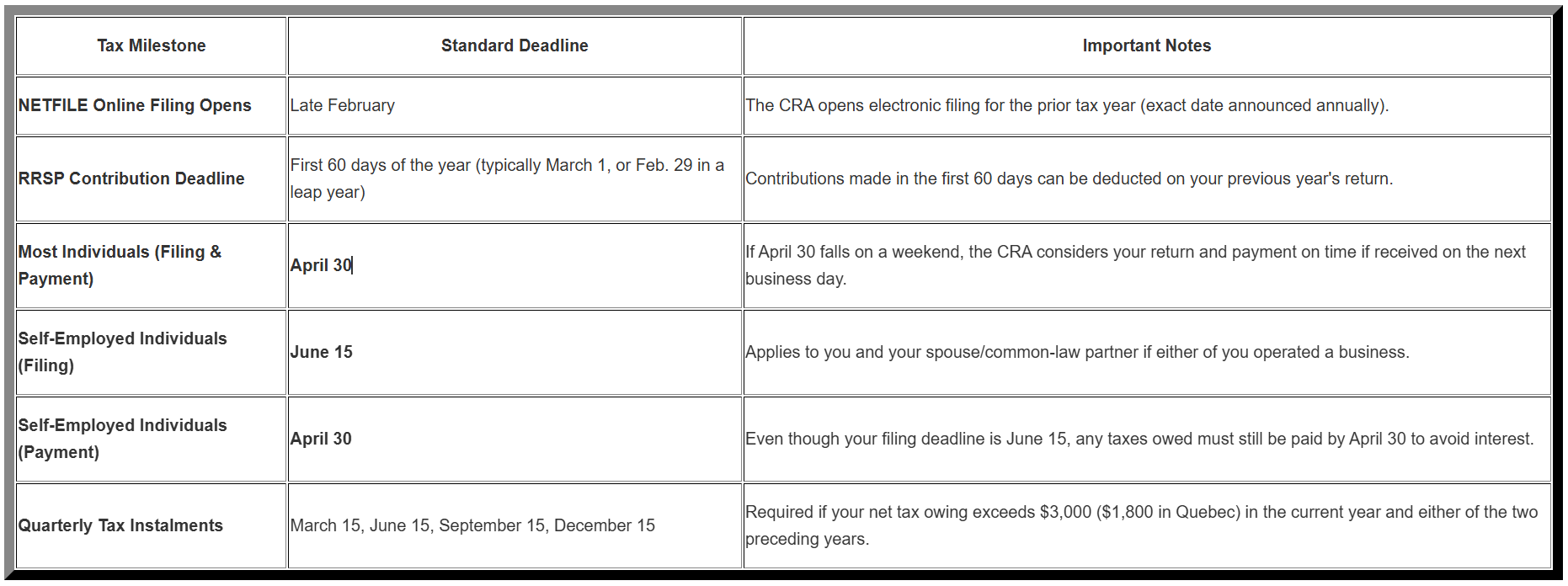
Missing a tax return deadline in Canada can trigger late-filing penalties and daily compound interest on any unpaid balance. Even if you cannot afford to pay your full tax bill right away, filing your return on time avoids the automatic late-filing penalty (which starts at 5% of your balance owing, plus 1% for each full month your return is late, up to 12 months).
How to File Taxes Canada: Step-by-Step Guide
Step 1: Gather Your Personal Information and Tax Slips
Before opening tax software or booking an appointment with an accountant, organize your documents. Employers, banks, and government agencies generally have until the end of February (or March 31 for certain trust and partnership slips like T3s) to issue tax slips.
Essential Identification and CRA Access
-
Social Insurance Number (SIN): Required for yourself, your spouse or common-law partner, and any dependants.
- Prior Year’s Notice of Assessment (NOA): Helpful for checking your RRSP deduction limit, unused tuition credits, or capital loss carry-forwards.
- CRA My Account Credentials: Registering for CRA My Account allows you to view digital copies of your tax slips, check benefit dates, update direct deposit details, and use the Auto-fill my return feature inside certified tax software. (Note: If you are filing for the very first time, you typically cannot register for full CRA My Account access until after your first return is assessed.)
Common Income Slips (T-Slips) to Collect
Depending on your income sources, look for these official forms:
- T4 (Statement of Remuneration Paid): Summarizes your employment income, income tax deducted, CPP/QPP contributions, and EI premiums.
- T4A (Statement of Pension, Retirement, Annuity, and Other Income): Covers freelance commissions, self-employment income, scholarships, bursaries, and Registered Education Savings Plan (RESP) withdrawals.
- T4E (Statement of Employment Insurance and Other Benefits): Issued if you received EI regular, maternity, parental, or sickness benefits.
- T5 (Statement of Investment Income): Reports interest earned from savings accounts, GICs, and dividends from investments held outside registered accounts (like TFSAs or RRSPs).
- T3 (Statement of Trust Income Allocations and Designations): Covers income from mutual funds, exchange-traded funds (ETFs), or estates.
- T5008 (Statement of Securities Transactions): Details capital gains or losses from selling stocks, bonds, or mutual funds.
- T4RSP / T4RIF: Issued if you withdrew funds from an RRSP or Registered Retirement Income Fund.
Receipts for Deductions and Credits
Keep supporting receipts organized in case the CRA selects your return for a post-assessment review (do not mail receipts with an electronic return, but keep them for at least six years):
- RRSP and First Home Savings Account (FHSA) contribution receipts
- Childcare expense receipts (including summer camps and daycare)
- Out-of-pocket medical and dental expense receipts
- Charitable donation and political contribution receipts
- Tuition and Enrolment Certificates (T2202)
- Moving expense receipts (if you relocated for work or post-secondary school)
- Home office expense records (Form T2200 signed by your employer, if eligible)
Step 2: Choose How You Will File Your Tax Return
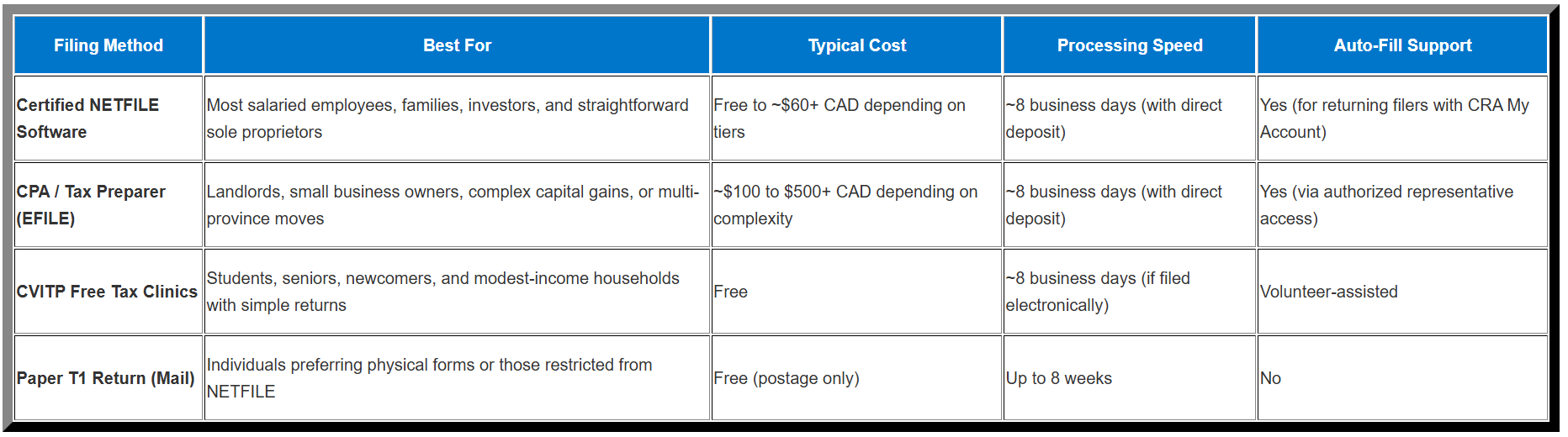
There is no single mandatory way to do taxes in Canada. Your ideal method depends on the complexity of your finances, your comfort with digital tools, and your budget.
Certified Tax Software (NETFILE)
Over 90% of Canadians file electronically. You can use CRA-certified NETFILE software—ranging from pay-what-you-want platforms like Wealthsimple Tax to established programs like TurboTax, UFile, StudioTax, and H&R Block Online. These programs guide you through plain-language questionnaires, flag missed credits, and connect directly to the CRA’s Auto-fill my return service to import your T-slips automatically.
Hiring a Tax Professional or CPA (EFILE)
If you have complex tax situations—such as rental property income, cross-border U.S./Canada income, unincorporated business expenses, or estate filings—working with a Chartered Professional Accountant (CPA) or registered tax preparer is often worth the fee. Professionals transmit returns electronically via EFILE.
Free Community Volunteer Tax Clinics (CVITP)
If you have a modest income and a simple tax situation, volunteers at the Community Volunteer Income Tax Program (CVITP) (or the Income Tax Assistance – Volunteer Program in Quebec) can complete and file your taxes for free, either in person or virtually.
Paper Filing and CRA Simplified Options
You can still download the T1 Income Tax Package from Canada.ca, fill it out by hand, and mail it to your designated CRA tax centre. Additionally, eligible individuals with lower or fixed incomes may receive an invitation from the CRA to use SimpleFile (by phone, digital form, or paper), which lets you confirm basic details in minutes without full tax software.
Comparison of Tax Filing Methods in Canada - How to File Taxes Canada
Step 3: Claim Deductions and Tax Credits (Including Homeowner Breaks)
Knowing the difference between a deduction and a credit is essential for maximizing your Canadian income tax return.
Tax Deductions vs. Tax Credits: How They Differ
-
Tax Deductions reduce your taxable income. Because Canada uses a progressive marginal tax bracket system, a deduction saves you tax at your highest marginal tax rate. For example, if your combined federal and provincial marginal tax rate is 30%, a $1,000 RRSP deduction reduces your tax bill by $300.
- Non-Refundable Tax Credits directly reduce the tax you owe, usually calculated at the lowest federal tax bracket (15%) plus the lowest provincial bracket. If your tax owing drops to zero, non-refundable credits will not generate a cash refund on their own.
- Refundable Tax Credits (such as the Canada Workers Benefit) pay out money to you even if you owe zero income tax.
Popular Credits and Deductions for Canadian Households and Homeowners
Housing and relocation are among the largest financial milestones in Canada, and the tax code offers several targeted provisions worth reviewing - especially if you are exploring neighbourhoods, comparing mortgage readiness, or planning a move through resources like CanadaHomeHub.Ca:
- First Home Savings Account (FHSA) Deduction: If you opened an FHSA to save for your first home, your contributions (up to $8,000 per year, with a $40,000 lifetime limit) are tax-deductible - just like an RRSP - while qualifying withdrawals for a first home purchase are completely tax-free, like a TFSA.
- First-Time Home Buyers' Tax Credit (HBTC / Home Buyers' Amount): If you or your spouse/common-law partner bought a qualifying home and did not live in another home owned by either of you in the current year or the four preceding years, you can claim a $10,000 non-refundable credit, providing up to $1,500 in federal tax relief.
- Home Accessibility Tax Credit (HATC): Seniors (65+) and individuals eligible for the Disability Tax Credit can claim up to $20,000 per year in eligible home renovation expenses that improve safety, mobility, or accessibility.
- Multigenerational Home Renovation Tax Credit (MHRTC): Provides a refundable credit for eligible renovation costs (up to $50,000) to create a self-contained secondary unit for a senior or an adult with a disability to live with a qualifying relative.
- Moving Expenses (Form T1-M): If you moved within Canada to start a new job, run a business, or attend post-secondary school full-time, and your new home is at least 40 kilometres closer to your new workplace or school, you can deduct moving costs - including movers, travel, temporary lodging, and real estate commissions or lease cancellation fees on your old residence.
- Childcare Expenses (Form T778): Typically claimed by the spouse or partner with the lower net income, covering daycare, before - and after-school programs, and day camps.
- Medical Expenses: You can claim eligible out-of-pocket medical, dental, prescription, and vision expenses paid in any 12-month period ending in the tax year, provided they exceed the lesser of 3% of your net income or the CRA's annual dollar threshold.
- Canada Employment Amount & Basic Personal Amount: Automatic non-refundable credits claimed on every eligible resident's return to shield a baseline portion of income from federal tax.
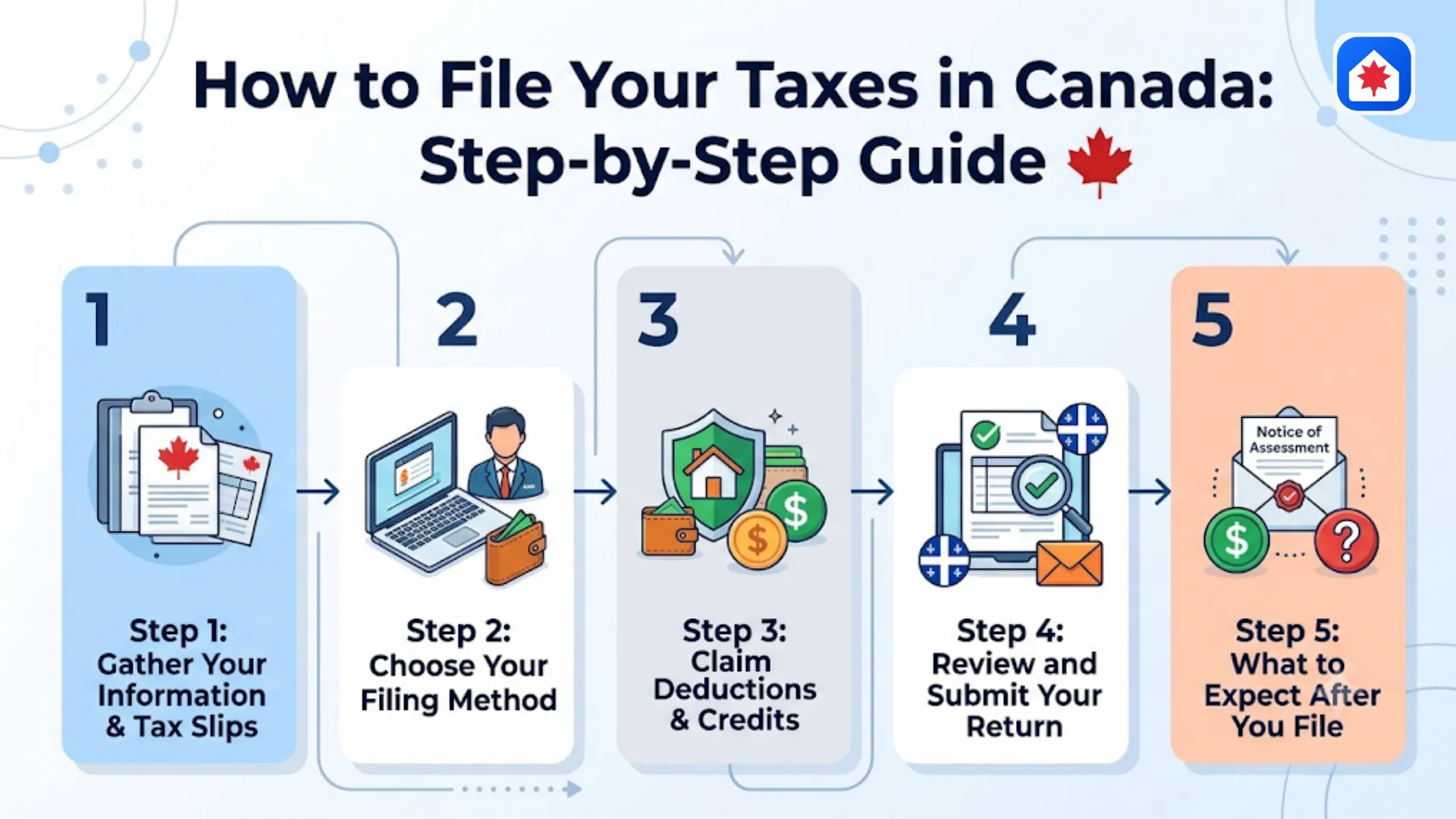
Step 4: Review and Submit Your Return (Federal vs. Quebec Rules) - How to File Taxes Canada
Before hitting submit, run through a final verification check:
- Verify Your Marital Status: Update your status accurately (married, common-law, separated, divorced, widowed, or single). For tax purposes, the CRA considers two people common-law after living together in a conjugal relationship for 12 continuous months (or immediately if you share a child).
- Check Direct Deposit Information: Ensure your bank transit, institution, and account numbers are up to date so refunds and quarterly benefits arrive without postal delays.
- Understand Quebec’s Dual-Filing Requirement: In every Canadian province and territory except Quebec, the CRA collects both federal and provincial/territorial taxes through a single T1 return. However, if you were a resident of Quebec on December 31 of the tax year, you must file two separate returns:
- A federal return with the CRA.
- A provincial return (TP-1) with Revenu Québec (using RL-slips, such as the RL-1 alongside your federal T4). Most major NETFILE-certified tax software packages handle both returns simultaneously and transmit them to each agency separately.
When you transmit via NETFILE, you will receive an immediate confirmation number. Save a PDF copy of your completed return and your confirmation receipt for your records.
Step 5: What to Expect After You File
Submitting your return is not quite the final step; you still need to review the CRA's official response.
Understanding Your Notice of Assessment (NOA) - How to File Taxes Canada
Once the CRA processes your return, it issues a Notice of Assessment (NOA). If you use NETFILE and are registered for CRA My Account, you may receive an Express NOA directly inside your tax software within seconds of filing. Your NOA confirms:
- Whether the CRA accepted your figures as filed or made adjustments.
- Your exact refund amount or balance owing.
- Your updated RRSP deduction limit and FHSA participation room for the next tax year.
Receiving a Refund or Paying a Balance Owing
-
Refunds: The CRA aims to process online returns within two weeks (often in as little as 8 business days via direct deposit) and paper returns within eight weeks.
- Paying a Balance Owing: If you owe taxes, pay on or before April 30. You can pay through your Canadian bank’s online bill payment service (add "CRA (revenue) – tax amount owing" as a payee using your SIN as the account number), via CRA’s My Payment portal using Visa Debit or Interac Debit, or by cheque at a financial institution.
How to Fix a Mistake After Submitting
If you realize you forgot a T5 slip or missed a medical receipt after filing, do not submit a second tax return. Wait until you receive your Notice of Assessment, then use the Change my return feature in CRA My Account, use the ReFILE service in your certified tax software, or mail Form T1-ADJ (T1 Adjustment Request).
Practical Example: Filing a Return as a Salaried First-Time Homebuyer
To see how these steps work together, consider an illustrative example of a Canadian resident filing an annual T1 return (note: figures below are simplified for educational purposes; actual tax rates vary by province and tax year):
- Profile: Maya lives in Ontario, earned $72,000 in salaried employment income (reported on her T4), and had $11,800 in federal and provincial income tax withheld by her employer throughout the year.
- Housing Milestone: During the tax year, Maya contributed $6,000 to her First Home Savings Account (FHSA) and closed on her first condo in October.
- Step-by-Step Application:
- Income Reported: Maya imports her T4 via CRA Auto-fill my return, recording $72,000 in total income.
- Deduction Applied: Her $6,000 FHSA contribution is deducted directly from her income, lowering her taxable income from $72,000 to $66,000. At her marginal tax bracket in Ontario (~29.65% combined federal/provincial), that deduction alone reduces her tax liability by roughly $1,779.
- Credits Claimed: She claims the Basic Personal Amount, the Canada Employment Amount, her CPP/EI credits, and the $10,000 First-Time Home Buyers' Tax Credit, which knocks an additional $1,500 directly off her federal tax payable.
- Result: Because her employer already deducted $11,800 from her paycheques based on a $72,000 salary without accounting for her FHSA or home purchase, Maya receives a substantial tax refund via direct deposit within two weeks of filing via NETFILE.
6 Common Tax Filing Mistakes Canadians Should Avoid
-
Filing Too Early Before All Slips Arrive: Filing in mid-February before investment firms issue T5s or T3s (which can arrive as late as March 31) often results in an automatic CRA reassessment—and penalties if you omit slips across multiple years.
- Forgetting to Report the Sale of a Principal Residence: Even though gains on your primary home are generally exempt from capital gains tax under the Principal Residence Exemption, you are legally required to report the sale on Schedule 3 and complete Form T2091 for the tax year you sold the property. Failing to report it can trigger late-designation penalties.
- Assuming Self-Employed Payments Are Due June 15: While self-employed filers have until June 15 to submit paperwork, CRA interest on unpaid balances starts accruing on May 1.
- Confusing TFSA and RRSP Rules: Contributions to a Tax-Free Savings Account (TFSA) are not tax-deductible on your return, whereas RRSP and FHSA contributions are.
- Ignoring CRA Review Letters: Receiving a letter requesting medical, donation, or moving receipts does not mean you are being audited—it is usually a routine processing review. Upload the documents promptly through CRA My Account before the letter’s deadline to prevent the CRA from disallowing the claim.
- Falling for CRA Phishing Scams: The CRA will never demand payment via gift cards, cryptocurrency, or Interac e-Transfer, nor will it send refund links via text message. Always log directly into Canada.ca to check messages.
Frequently Asked Questions About Filing Taxes in Canada
When can I start filing my taxes in Canada?
The CRA typically opens its NETFILE electronic filing system in late February each year. While you can begin entering your receipts into tax software earlier, it is best practice to wait until mid-to-late March so all T4, T5, and T3 slips have been issued and uploaded to your CRA My Account.
How long does it take to get a tax refund from the CRA?
If you file online using NETFILE and are enrolled in direct deposit, the CRA generally issues refunds within two weeks (often in as little as 8 business days). Paper returns mailed to a tax centre typically take up to eight weeks to process, though processing times can lengthen during peak April volume.
What happens if I miss the Canadian tax deadline?
If you file after April 30 (or June 15 for self-employed individuals) and owe money, the CRA charges a 5% late-filing penalty on your balance owing, plus an additional 1% for each full month your return is late (up to 12 months). Daily compound interest also applies to unpaid balances starting May 1. If you are owed a refund or have a zero balance, there is no late-filing penalty, though benefit payments like the CCB or GST/HST credit may be delayed.
Can I file my taxes in Canada for free?
Yes. Several CRA-certified NETFILE software providers offer genuinely free tiers (including pay-what-you-want models or free versions for students and lower-income filers). Additionally, eligible individuals with modest incomes and simple tax situations can have their returns prepared and filed at no cost through the CRA’s Community Volunteer Income Tax Program (CVITP).
Conclusion: Preparing for a Smooth Tax Season
Mastering how to file taxes in Canada boils down to early organization, knowing which deductions and credits fit your household, and respecting the April 30 deadline. By collecting your T-slips by March, leveraging certified NETFILE software with CRA Auto-fill my return, and carefully accounting for life transitions like buying a first home or relocating, you can turn an annual obligation into an opportunity to strengthen your financial position.
As your housing plans, family needs, or living arrangements evolve across Canada, staying informed on both real estate milestones and annual tax rules helps you plan ahead with confidence. For more practical guides on navigating Canadian homeownership, relocation, and everyday living, explore additional resources at CanadaHomeHub.Ca.
Thank you for reading our article!