
Purchasing or selling a home in Canada represents one of the most consequential financial decisions of your lifetime. Whether you are navigating competitive offer presentations in the Greater Toronto Area, evaluating strata bylaws and depreciation reports in Metro Vancouver, or exploring burgeoning markets across Calgary, Edmonton, or Halifax, the professional in your corner directly impacts your bottom line, legal protections, and transaction security.
Yet, far too many Canadians select their representative based on a street bench billboard, a casual social media clip, or a passing recommendation from a family member who transacted in a completely different market cycle.
Finding the right realtor in Canada demands an objective, systematic evaluation process. You need a licensed advocate equipped with hyper-local transactional data, advanced contract structuring skills, and an uncompromising fiduciary commitment to your best interests.
This comprehensive guide breaks down the essential steps to screen and interview candidates, navigate modern provincial regulations (including Ontario’s updated TRESA framework), decode commission mechanics under Canadian competition law, and select the ideal representative for your property journey.
What Is a REALTOR® in Canada? (And How They Differ from Agents and Brokers)
In everyday conversation, the terms "real estate agent," "broker," and "realtor" are frequently used interchangeably. However, distinct legal and professional boundaries separate these designations across Canada.
The Legal Distinction: Agent, Broker, and REALTOR®
-
Real Estate Salesperson / Agent: An individual who has completed the mandated provincial pre-licensing curriculum and is legally authorized to trade in real estate under the supervision of a licensed brokerage.
- Real Estate Broker: A professional who has completed advanced real estate coursework, fulfilled statutory multi-year experience requirements, and passed comprehensive broker examinations. Brokers hold the qualifications to manage brokerage compliance, supervise agents, or operate their own firm as a Broker of Record.
- REALTOR®: A registered certification mark owned in Canada by the Canadian Real Estate Association (CREA). A REALTOR® is a licensed agent or broker who maintains active membership in CREA, their respective provincial association, and their local real estate board. Beyond statutory provincial requirements, all REALTORS® are held to the enforceable national CREA Code of Ethics.

Provincial Regulatory Bodies Across Canada
While CREA establishes nationwide ethical guidelines, licensing and consumer protection laws fall strictly under provincial jurisdiction. There is no single federal real estate regulator in Canada. Each province and territory operates an independent regulatory authority that enforces real estate legislation, investigates consumer complaints, and disciplines non-compliant licensees:
- Ontario: Real Estate Council of Ontario (RECO), enforcing the Trust in Real Estate Services Act (TRESA).
- British Columbia: BC Financial Services Authority (BCFSA), administering the Real Estate Services Act (RESA).
- Alberta: Real Estate Council of Alberta (RECA).
- Quebec: Organisme d'autoréglementation du courtage immobilier du Québec (OACIQ).
- Nova Scotia: Nova Scotia Real Estate Commission (NSREC).
Before entering into detailed property discussions with any candidate, verify that their licence is active and in good standing via your province’s public regulatory registry.
Why Choosing the Right Realtor Can Make or Break Your Transaction
Real estate transactions in Canada involve legally binding purchase contracts, provincial and municipal land transfer taxes, statutory disclosures, title searches, and mortgage contingencies. Partnering with the right representative provides vital strategic advantages:
Fiduciary Duty vs. Customer Service
In Canadian common law jurisdictions, establishing a formal client relationship creates a strict fiduciary duty. This legal obligation requires your representative to act with undivided loyalty, absolute confidentiality, full disclosure of all relevant facts, and reasonable skill and care.
Under modern Canadian real estate statutes, unrepresented consumers no longer receive casual "customer service" advice from an opposing agent. Your representative acts as your fiduciary shield—protecting your maximum budget from the opposing side, scrutinizing comparable neighborhood sales, and tailoring protective clauses to keep your hard-earned deposit safe.
Pricing Precision, Hyper-Local Trends, and Offer Strategy
National and provincial average price headlines offer little practical utility when evaluating a specific home. Canadian real estate is hyper-local. A variance of three blocks can encompass distinct municipal zoning overlays, transit expansion levies, school catchment boundaries, or heritage preservation restrictions.
An experienced local representative analyzes off-market activity, detects whether a listing is deliberately underpriced to engineer a bidding frenzy, and constructs offers with terms that provide maximum leverage without overpaying.
Step-by-Step Guide: How to Find and Vet Candidates - REALTOR® in Canada
Securing an exceptional representative requires a structured, four-step vetting sequence.
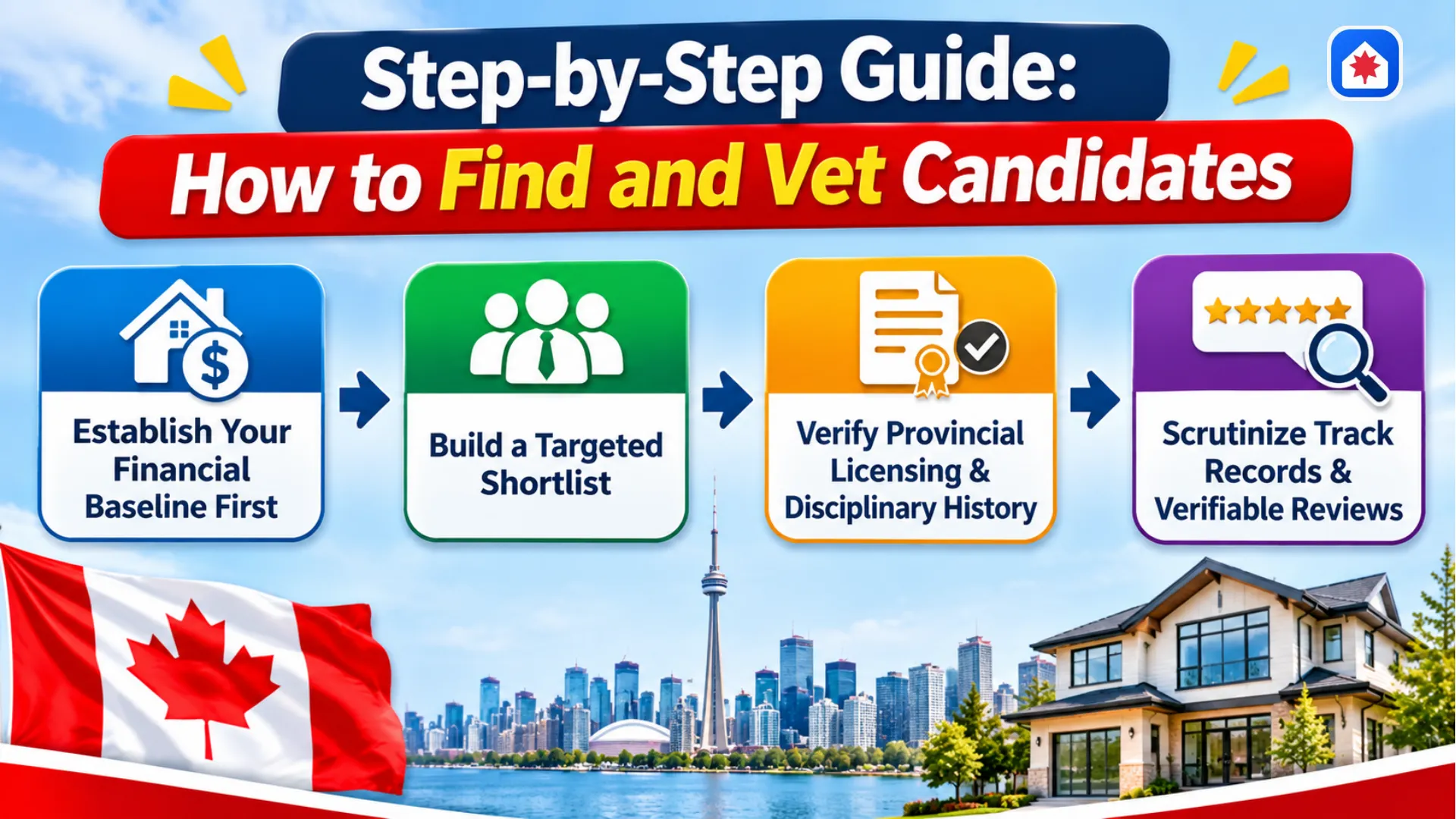
Step 1: Establish Your Financial Baseline First
Before interviewing prospective real estate professionals, you must establish an accurate, verified picture of your purchasing power, borrowing limits, down payment sources, and anticipated closing adjustments.
To model realistic monthly payments, test different mortgage rates against federal stress-test standards, and evaluate municipal tax burdens, run your preliminary figures through the CanadaHomeHub Mortgage Calculator. Arriving at your candidate interviews with clear financial parameters allows prospective agents to propose tailored, actionable market strategies.
Step 2: Build a Targeted Shortlist (Referrals, Open Houses, Verified Portals)
Never settle for the first marketing flyer in your mailbox. Assemble a candidate shortlist of three to five candidates through multiple complementary channels:
- Word-of-Mouth from Recent Transactors: Interview colleagues, friends, or neighbors who successfully bought or sold in your immediate area within the last 12 to 18 months. Ask specific questions about negotiation performance, proactive communication, and problem resolution under tight closing deadlines.
- Attending Local Open Houses: Visiting active open houses provides an unvarnished preview of agents at work. Observe their product knowledge, whether they know detailed neighborhood municipal planning data, and whether they respect unrepresented visitors without using high-pressure tactics.
- Digital Property Portals: Research verified regional listings on property platforms such as CanadaHomeHub.Ca, alongside official MLS® board directories. Pay close attention to agents who consistently handle properties matching your exact property style and price tier.
Step 3: Verify Licensing and Disciplinary Records
Never rely solely on an agent’s polished social media presence. Always cross-reference candidates against public provincial registries:
- Search their full legal name on the provincial regulator’s registry (e.g., RECO’s Public Register in Ontario or BCFSA’s Licensee Search in British Columbia).
- Verify their current licensing status and registration tier (Salesperson vs. Broker).
- Confirm their registered brokerage affiliation.
- Review public records for formal cautions, disciplinary committee decisions, licensing conditions, or suspensions.
Step 4: Analyze Real Client Reviews and Recent Transaction History
Examine independent platforms, Google Business Profiles, and localized consumer forums. Look past generic five-star accolades and assess detailed narrative feedback:
- How did the representative handle unexpected home inspection problems or low bank appraisals?
- Were they personally accessible throughout the escrow period, or did they disappear once the agreement was signed?
- Do their past transactions demonstrate continuous activity in your target neighborhoods?
10 Critical Questions to Ask a Realtor Before Signing an Agreement
Conduct formal, structured interviews with at least three shortlisted professionals. Use these ten targeted questions to assess their capabilities:
1. "Are you a full-time real estate professional in this specific municipality?"
Part-time agents or those whose primary market lies across the province cannot monitor fast-moving daily listing shifts or maintain the working broker relationships needed to secure off-market access.
2. "How many properties have you personally closed in my property category over the past year?"
A suburban detached-home specialist may lack familiarity with urban condominium status certificates, reserve fund health, commercial mixed-use rules, or strata depreciation reports. Match the agent to your exact property classification.
3. "Will I work directly with you, or be handed off to an administrative team?"
Senior team leads frequently pitch your business, only to pass property tours, contract drafting, and negotiation onto newly licensed associates. Obtain written clarity on who answers your calls, attends showings, and sits at the negotiation table.
4. "How do you calculate a property's fair market value?"
Listen carefully to their analytical methodology. An elite agent does not rely on listing prices (which can be arbitrary). They evaluate recent sold comps, adjust for square footage variances, lot grading, renovation quality, and macro-financial conditions like Bank of Canada benchmark rate shifts.
5. "How do you handle designated versus multiple representation under our provincial laws?"
Whether under Ontario's TRESA or British Columbia's strict dual agency restrictions, your prospective representative must explain clearly how they safeguard your confidential pricing bottom lines if a conflict of interest arises.
6. "What specific services are covered under your commission fee?"
For home sellers, determine whether professional architectural photography, virtual walkthroughs, floor plans, professional staging consultations, and targeted digital advertising are covered within the fee or billed as separate disbursements.
7. "Can you provide references from three recent clients?"
Contact previous clients and ask: "Did the final sale or purchase price align with initial guidance?" and "Were there any surprises or communication gaps during the closing process?"
8. "What is your primary communication protocol?"
Align expectations early. If you prefer structured daily email updates and your agent relies solely on late-night voice notes, friction will inevitably arise during offer negotiations.
9. "What contractual conditions do you recommend inserting to protect me?"
A dependable buyer’s representative will advise including tailored financing, structural inspection, and document review conditions, resisting the pressure to submit unconditional ("clean") offers without thoroughly evaluating the risks.
10. "What is your policy if I wish to terminate our representation agreement?"
Representation contracts are legally binding brokerage agreements. Confirm whether the brokerage will grant an unconditional mutual release if performance benchmarks are not met, or whether you will remain locked in until the contract expires.
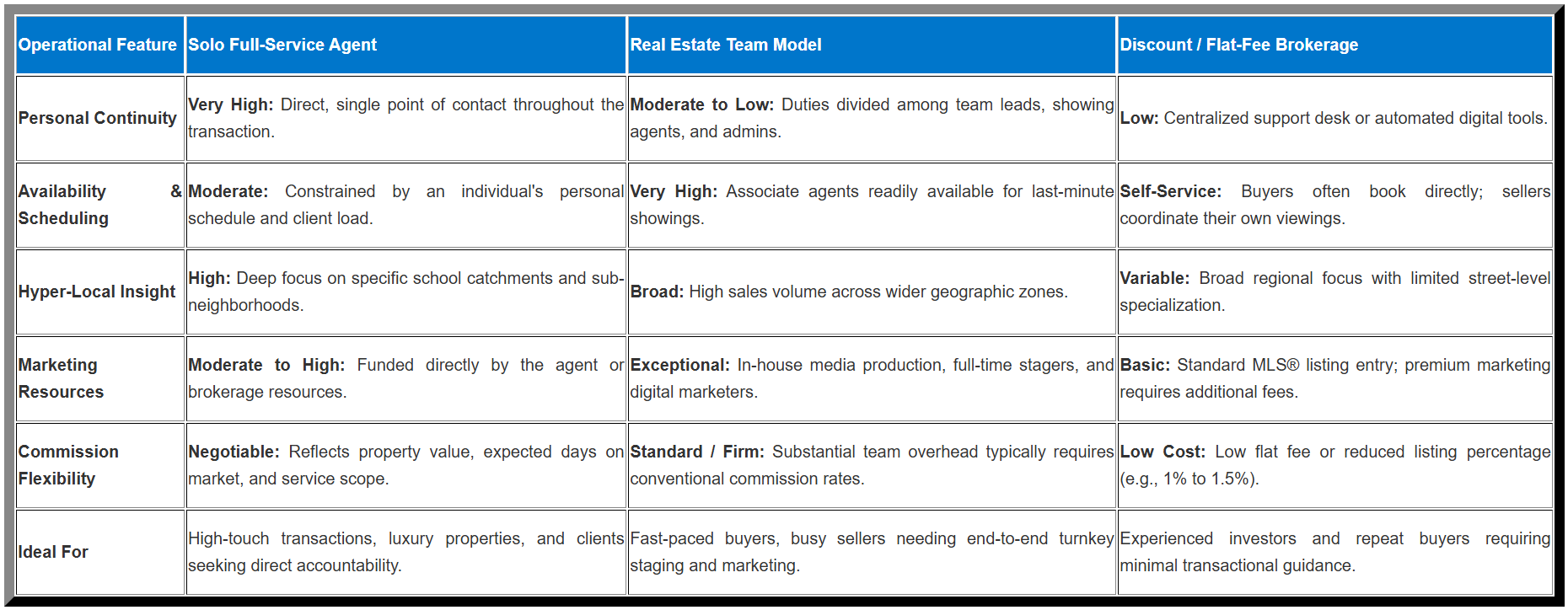
Solo Agent vs. Real Estate Team vs. Discount Brokerage
Canadian brokerages offer diverse service and fee structures. Understanding the operational trade-offs ensures you select the model that best matches your budget and transaction complexity.
Comparison Matrix: Choosing the Right Service Model
Buyer’s Agent vs. Listing Agent: Tailoring Your Criteria
Your vetting criteria should shift depending on whether you are acquiring or marketing real estate:
What to Look for in a Buyer's Agent
- Patience and Restraint: An outstanding buyer's agent is prepared to view multiple properties with you and will actively point out red flags—such as foundational settling, aging roof lines, kitec plumbing, or unpermitted renovations.
- Contingency Expertise: They know how to draft precise conditions for financing, home inspections, well/septic verifications in rural areas, and condo documentation reviews (such as Status Certificates in Ontario or Form B disclosures in BC).
- Access to Off-Market Leads: They leverage localized agent networks to locate properties before they appear on public portals.
What to Look for in a Listing (Seller’s) Agent
- Premium Marketing Execution: Insist on reviewing recent listing portfolios. High-resolution photography, architectural floor plans, high-end video tours, and targeted social ad campaigns maximize buyer engagement.
- Strategic Pricing Disciplines: Avoid agents who suggest an inflated list price simply to secure your listing ("buying the listing"). Demand documented comparable sales to substantiate every suggested price band.
- Command of Multiple Offer Procedures: Your listing representative must manage competing bids with complete integrity, complying fully with provincial disclosure and offer-tracking regulations.
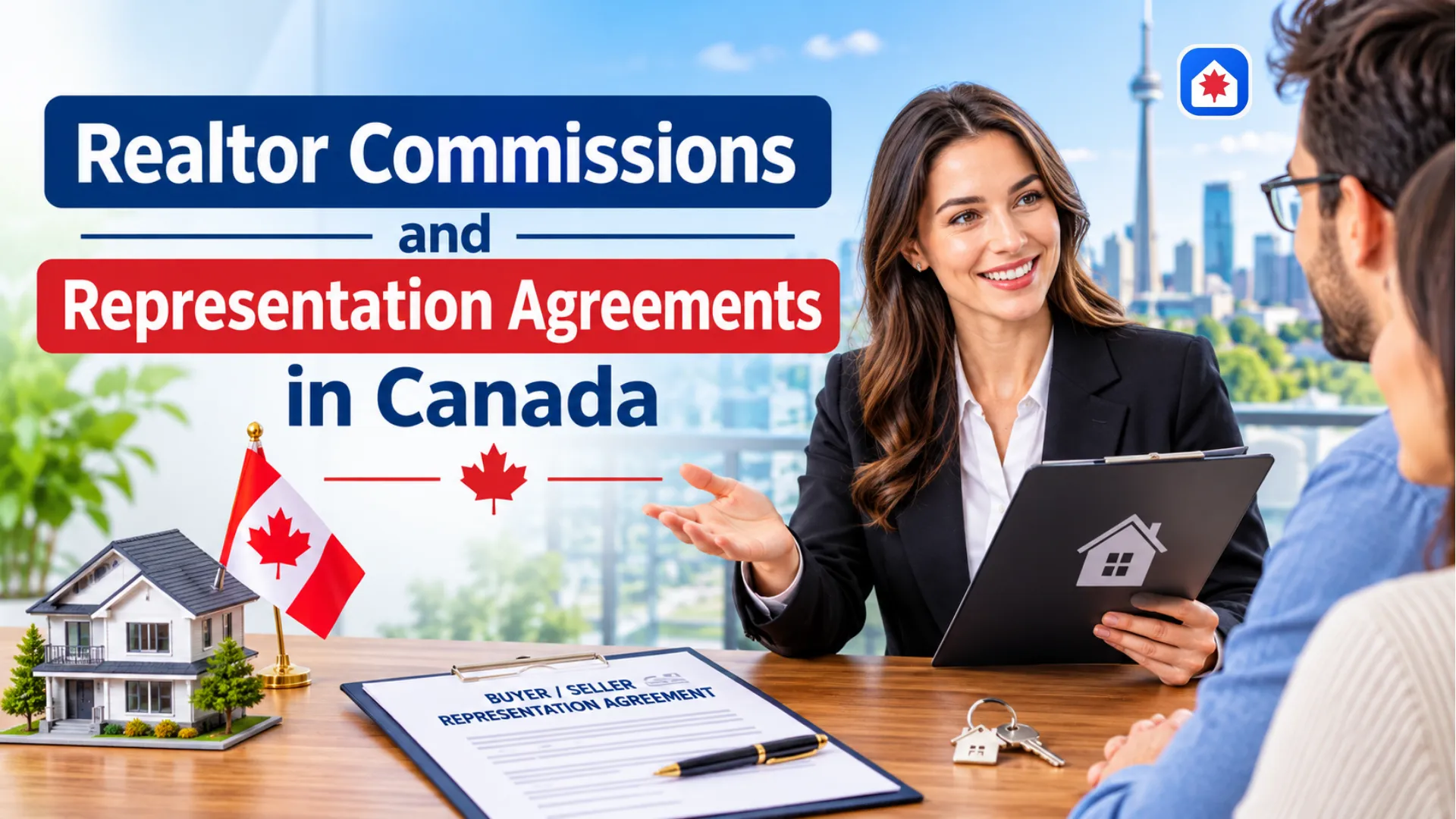
Understanding Realtor Commissions and Representation Agreements in Canada
Clear financial terms avoid unexpected closing disputes. Here is how compensation and legal contracts operate under current Canadian law:
How Real Estate Commissions Work in Canada
-
Commissions Are Fully Negotiable: Under Canada’s Competition Act, real estate commissions are not fixed by law, government regulation, or real estate boards. All fees and commission structures are 100% negotiable between consumers and their chosen brokerage.
- Typical Market Structure: In traditional transactions, the total fee (often ranging between 3% and 5% of the final sale price, depending on region, property type, and service level) is paid by the seller from the gross sale proceeds at closing.
- Brokerage Splits: The total agreed fee is typically divided between the listing brokerage and the cooperating (buyer's) brokerage (e.g., a total 4% commission split 2% to the listing side and 2% to the buyer's side).
- Mandatory Sales Taxes: Real estate brokerage fees are taxable professional services. You must account for applicable provincial and federal sales taxes on top of the commission (e.g., 13% HST in Ontario, 5% GST in Alberta, 12% GST/PST in British Columbia).
- Emerging Buyer Obligations: Modern representation agreements explicitly state that if a seller offers a cooperating brokerage commission lower than the percentage agreed upon in your representation agreement, you as the buyer may be contractually responsible for paying the difference to your brokerage upon closing. Always review the compensation terms thoroughly before signing.
Understanding Representation Agreements
Before drafting an offer or listing a property on an MLS® system, your brokerage will ask you to execute a binding representation agreement (such as a Buyer Representation Agreement or Listing Agreement):
- Exclusivity: Standard representation contracts designate that brokerage as your exclusive representative for a specified geographic scope and time frame.
- Negotiable Duration: While boilerplate agreements often propose three to six months, contract length is entirely negotiable. You can specify a one-month trial term or limit representation exclusively to specific property addresses.
- The Holdover Clause: This term protects the brokerage if you purchase or sell a property within a defined period (commonly 30 to 90 days) following contract termination to a party introduced to the home during the agreement's term. Ensure you understand these parameters before signing.
Modern Provincial Rules: TRESA (Ontario) and Dual Agency
Representation rules have evolved significantly across Canada to heighten consumer transparency and address conflicts of interest:
- British Columbia (BCFSA): The province has effectively banned dual agency, permitting it only under rare, narrow exceptions in remote communities where a second independent agent is physically unavailable.
- Ontario (Trust in Real Estate Services Act - TRESA Phase 2):
- Designated Representation: Brokerages can now designate individual agents within the same firm to represent the buyer and seller independently. This allows each party to retain full, undivided fiduciary loyalty, individual advice, and price confidentiality without triggering multiple representation.
- Multiple Representation Limits: Multiple representation now primarily occurs when the same individual agent (or dedicated team) represents both buyer and seller in the same transaction, or multiple competing buyers for the same property. Under this arrangement, the agent must remain strictly neutral and cannot provide pricing or negotiation advice to either party.
- Open Offer Process (Open Bidding): Sellers now hold the legal authority to direct their brokerage in writing to disclose the contents of competing offers (such as offer price, closing dates, or attached conditions) to other bidders. However, all personal identifying information (names, personal details) of competing buyers must remain strictly protected and redacted.
- Abolition of "Customer" Status: The ambiguous "customer service" classification has been eliminated. In Ontario, you are either a Client (holding an exclusive representation agreement with full fiduciary advocacy) or a Self-Represented Party (SRP). If you choose to be an SRP, licensed agents representing the other side are legally prohibited from providing you with real estate opinions, pricing guidance, or negotiation assistance.
- Mandatory RECO Information Guide: Before providing services or receiving confidential information, an agent in Ontario is legally required to provide you with the official RECO Information Guide and obtain written acknowledgment that they have walked you through its contents.
- Alberta (RECA): Enforces designated agency and transaction brokerage frameworks, requiring comprehensive written disclosures whenever representation relationships limit traditional fiduciary advocacy.
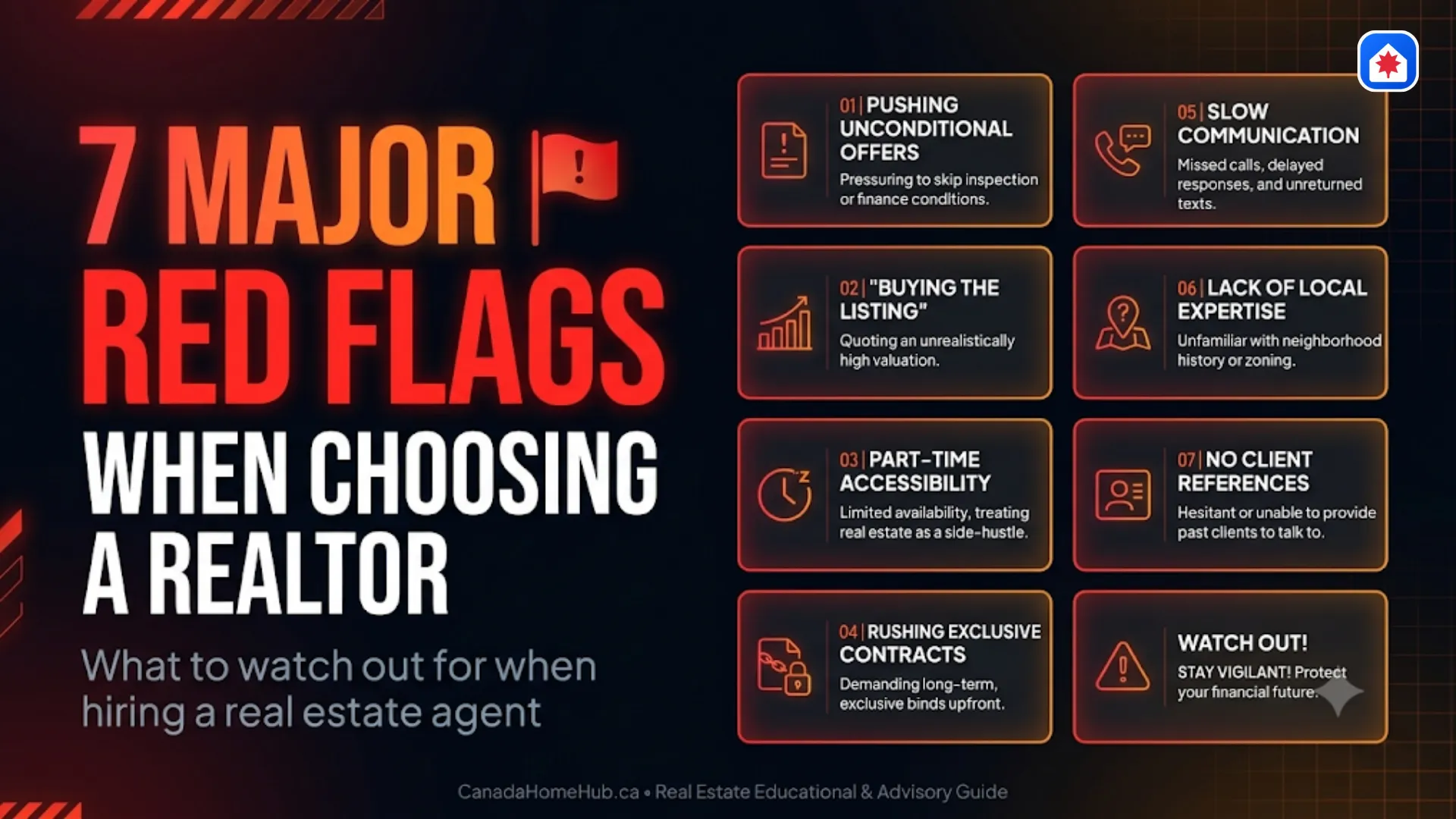
7 Major Red Flags When Choosing a Realtor
If you encounter any of the following warning signs during your initial evaluation, proceed with caution or look for another professional:
- Inflating Valuations ("Buying the Listing"): An agent who proposes a listing valuation significantly above other candidates without supporting comps is often flattering you to win an exclusive contract. Once listed, the property sits stagnant, necessitating aggressive price cuts that erode market interest.
- Rushing You into Unconditional Offers: While competitive markets occasionally require strategic, streamlined offers, a prudent representative will never pressure you to waive financing or inspection protections without clearly outlining the severe legal and financial risks involved.
- Part-Time Commitment: Real estate moves quickly. An agent who treats trading as a weekend hobby while balancing another full-time career cannot act rapidly enough to secure time-critical opportunities.
- Dismissing Contract Terms as "Standard Fine Print": If an agent minimizes representation contracts as mere paperwork and rushes you to sign without reading, insist on a thorough clause-by-clause review.
- Lack of Hyper-Local Depth: An agent boasting high transaction volume across an entire region may possess little insight into local school catchments, municipal zoning amendments, or micro-market trends in your neighborhood.
- Slow and Disorganized Communication: If a candidate takes 24 hours to return messages during the introductory phase, their responsiveness will likely deteriorate once an exclusive contract is locked in.
- Reluctance to Connect You with References: High-performing professionals readily provide verifiable references. Any hesitation or deflection is a clear warning sign.
Frequently Asked Questions About Hiring a Realtor in Canada
What is the practical difference between a real estate agent and a REALTOR® in Canada?
A real estate agent is an individual licensed by their provincial regulatory authority to trade in real property. A REALTOR® is a licensed agent or broker who holds an active membership with the Canadian Real Estate Association (CREA) and is legally bound by CREA’s enforceable Code of Ethics.
Are real estate commissions fixed by law in Canada?
No. Under the Canadian Competition Act, real estate commissions and fees are not set by law, government regulation, or real estate associations. All commissions, fee splits, and service models are 100% negotiable between consumers and brokerages.
How do modern Ontario TRESA rules affect my representation?
Under TRESA Phase 2, the outdated "customer" status has been abolished; you interact with brokerages either as an official Client (with full fiduciary loyalty) or as a Self-Represented Party (SRP) without agent advocacy. Furthermore, brokerages can utilize Designated Representation to represent both buyers and sellers in the same transaction through separate agents while preserving complete confidentiality and fiduciary protection.
How does the Open Offer Process work in Canada?
In jurisdictions like Ontario, sellers can instruct their listing brokerage in writing to share the details of competing purchase offers (such as offered price, deposit amounts, closing timelines, or conditions) with other bidders. However, personal identifying information of the buyers must remain strictly confidential.
Can I cancel a representation agreement if I am dissatisfied with the service?
Yes, but cancellation typically requires mutual written consent unless your contract includes a specific pre-negotiated termination clause. If a brokerage refuses to execute a mutual release, you remain bound by the terms until the contract expires. This is why agreeing upon a reasonable contract duration upfront is essential.
Should I hire the listing agent directly to purchase a property?
In most scenarios, no. The listing agent holds a primary fiduciary obligation to obtain the highest price and best terms for the seller. Engaging them directly means you forfeit dedicated negotiation advocacy, price confidentiality, and objective condition advice.
Making Your Final Decision
Selecting a real estate representative should be a measured, evidence-based business decision. Take the time to interview multiple professionals, verify their licensing histories with provincial regulators, and ensure representation contracts match your expectations.
When you align yourself with an ethical, knowledgeable, and proactive representative, you gain an invaluable strategic partner who protects your financial interests, navigates complex legal paperwork, and positions you for success.
Before beginning candidate interviews, ensure your financial baseline is established. Stress-test your borrowing numbers, assess amortization options, and establish your purchase limits. With clear financial parameters in hand, you can partner with the right real estate professional on CanadaHomeHub.Ca and enter the Canadian property market with clarity and confidence.