
Buying a home is one of the most significant financial milestones in Canadian life. Yet, with fluctuating interest rates, stringent qualification rules, and diverse regional markets, determining your realistic budget can feel overwhelming. Many prospective home buyers ask a simple question: "Based on my salary, how much house can I afford in Canada?"
The short answer: in Canada, your purchasing power is not determined solely by your income or what a real estate agent estimates. Federally regulated lenders evaluate your borrowing capacity using rigid mathematical formulas, strict debt-service caps, and the mandatory federal mortgage stress test.
Whether you are saving for your first condominium in Calgary or planning for a detached family home in the Greater Toronto Area, understanding how home affordability Canada is measured will save you time, prevent mortgage application rejections, and protect your long-term personal balance sheet.
The Golden Rule of Home Affordability in Canada: How Lenders Actually Evaluate You
When you walk into a Canadian chartered bank, credit union, or mortgage broker’s office, underwriters look past your gross income and examine your debt service ratios. Federally regulated financial institutions follow guidelines established by the Office of the Superintendent of Financial Institutions (OSFI) and default insurers such as the Canada Mortgage and Housing Corporation (CMHC), Sagen, and Canada Guaranty.
Canadian lenders calculate two fundamental affordability thresholds:
Gross Debt Service (GDS) Ratio: The 39% Benchmark
The Gross Debt Service (GDS) ratio measures the percentage of your pre-tax (gross) household income required to cover essential housing costs. For default-insured mortgages (purchases with less than a 20% down payment), OSFI and CMHC set the standard maximum GDS ratio at 39%.
Your qualifying shelter expenses include:
- Mortgage Principal & Interest: Calculated using the qualifying stress test rate (not your contract rate).
- Property Taxes: Estimated annual municipal property taxes divided by 12.
- Heating Costs: Standardized monthly home heating expenses (typically estimated between $75 and $150 depending on property size).
- Condo/Maintenance Fees: If purchasing an apartment or townhouse, exactly 50% of the monthly strata/condominium fee is added to your housing expenses.
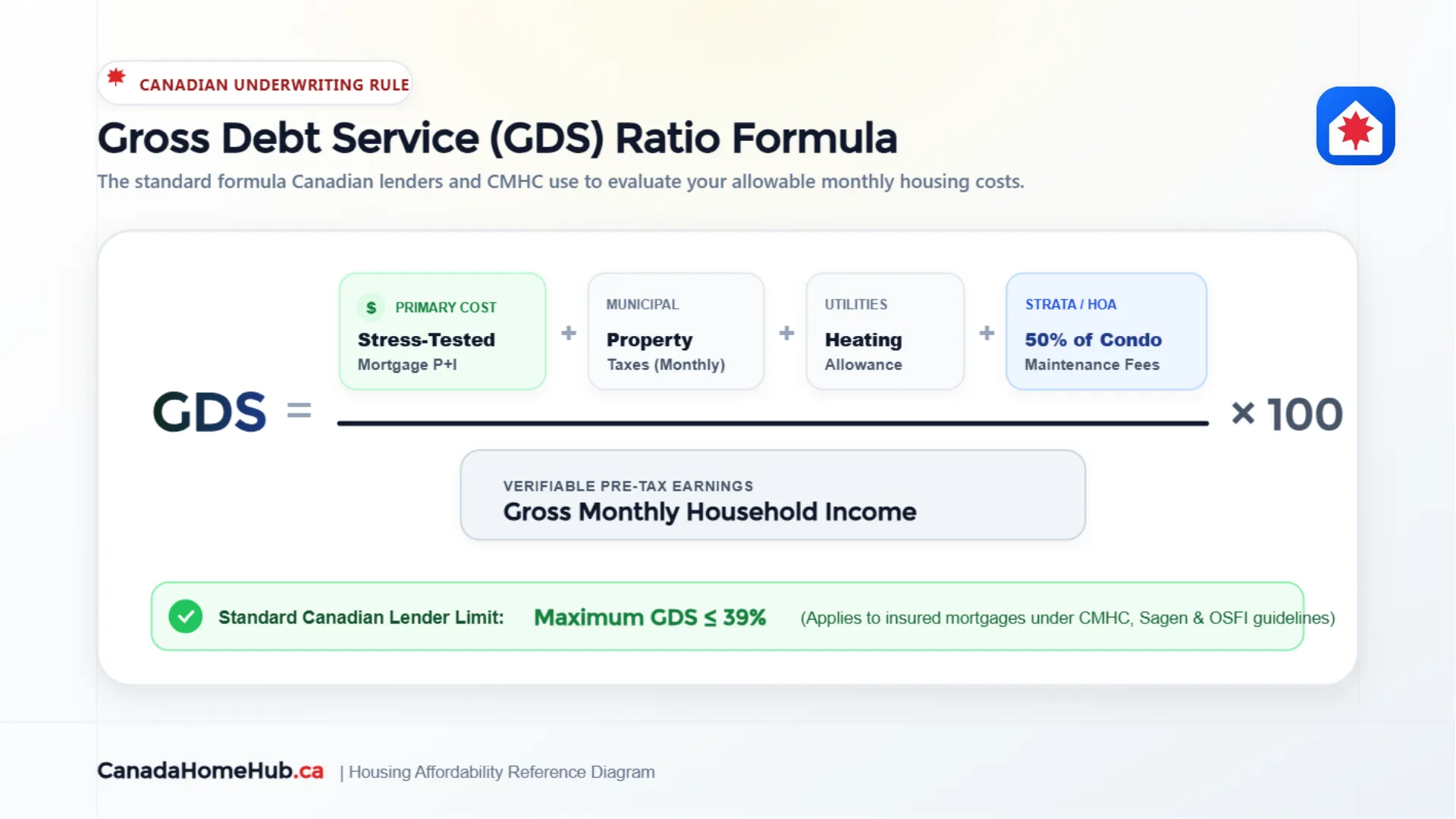
Gross Debt Service (GDS) Ratio - Home Affordability Canada
Total Debt Service (TDS) Ratio: The 44% Ceiling
The Total Debt Service (TDS) ratio takes your housing costs and adds all other outstanding debt obligations. In Canada, your cumulative monthly debt payments generally cannot exceed 44% of your gross monthly income.
Additional debts factored into the TDS calculation include:
- Minimum monthly credit card payments (typically calculated at 3% of the outstanding balance).
- Auto loan or vehicle lease payments.
- Personal loans and student loan lines of credit.
- Existing child or spousal support commitments.
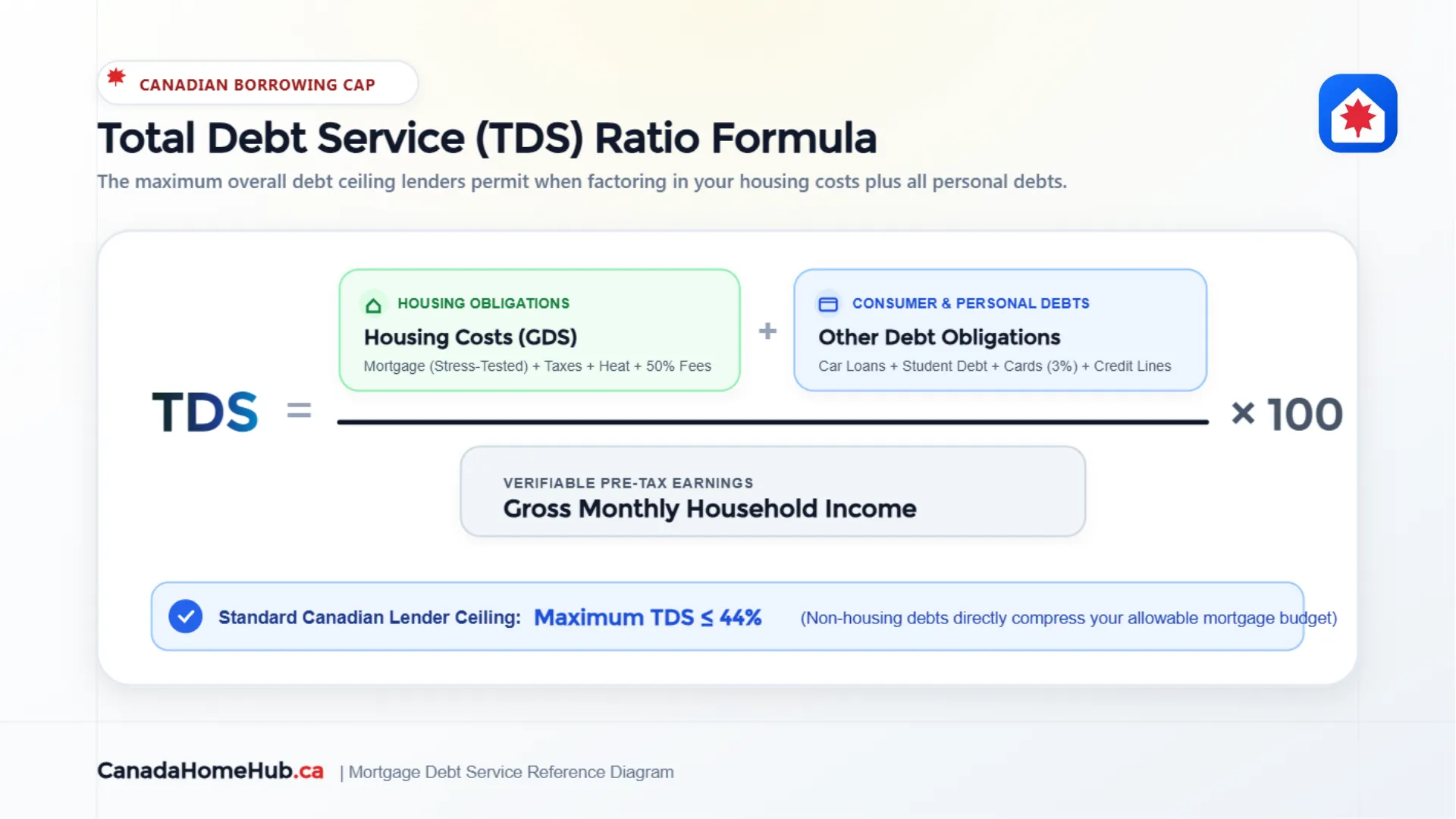
Total Debt Service (TDS) Ratio - Home Affordability Canada
If your student loan or car payments eat up 15% of your income, your allowable budget for housing is compressed to 29% (44% minus 15%), significantly reducing your borrowing capacity even if your salary is substantial.
The Canadian Mortgage Stress Test: What It Is and How It Limits Your Budget
The mortgage stress test is an underwriting safeguard introduced by OSFI to guarantee that Canadian borrowers can continue servicing their debt if interest rates climb during their term.
How the Qualifying Benchmark Rate Works
Under current Canadian mortgage regulations, every borrower applying for an insured or uninsured mortgage through a federally regulated lender must qualify at the higher of two figures:
- 5.25% (the federal minimum qualifying rate), OR
- Your negotiated contract rate + 2.00%.
For example, if a lender offers you a 5-year fixed rate of 4.60%, you will not be evaluated on your ability to make payments at 4.60%. You must demonstrate sufficient income to service the loan at 6.60% (4.60% + 2.00%).
This requirement reduces typical purchasing power by 15% to 20% compared to non-stress-tested borrowing conditions.
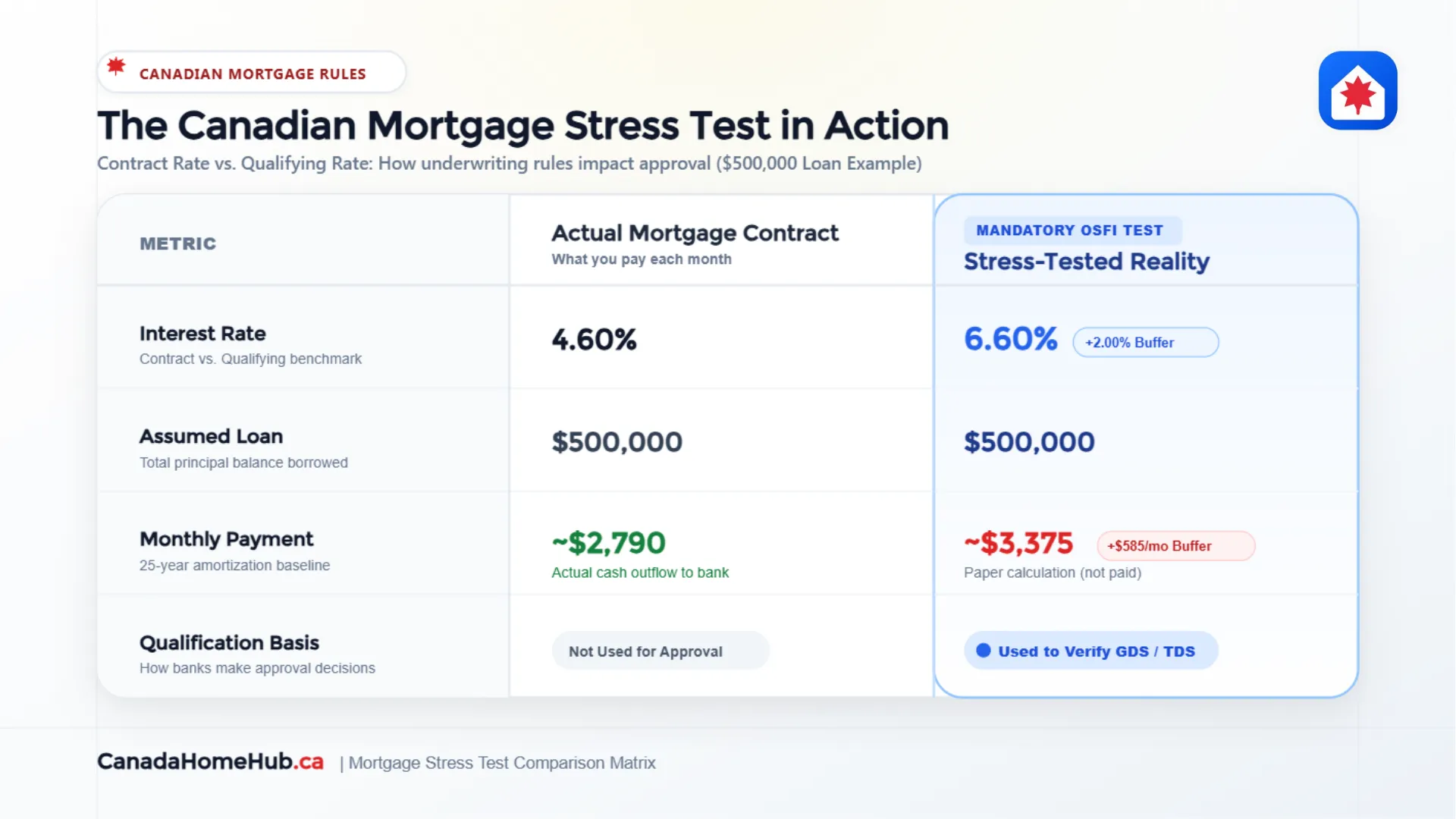
How the Qualifying Benchmark Rate Works - Home Affordability Canada
25-Year vs. 30-Year Amortization Rules for Canadian Buyers
Traditionally, default-insured mortgages in Canada carried a maximum amortization limit of 25 years. However, recent federal policy changes expanded access to 30-year amortizations on insured mortgages for:
- All first-time home buyers purchasing any residential property.
- Any buyer purchasing a newly constructed home.
Opting for a 30-year amortization schedule spreads payments across an extra 5 years. This lowers monthly debt service obligations and reduces the qualifying payment under the stress test by approximately 6% to 7%, providing a modest boost to your borrowing capacity when entering competitive housing markets.
Down Payment Requirements and the Insured Mortgage Rules
Your mortgage borrowing power represents only one half of the affordability equation; the other half is your accumulated cash savings for a down payment.
The Tiered Minimum Down Payment Formula
Under Canadian federal real estate regulations, you cannot put down an arbitrary percentage. Down payments are calculated using a tiered system:
- Purchase price up to $500,000: The minimum down payment is 5%.
- Example: A $400,000 condo requires a minimum of $20,000.
- Purchase price between $500,000 and $1,499,999: The minimum down payment is 5% on the first $500,000 plus 10% on the portion exceeding $500,000.
- Example: A $750,000 home requires:
- 5% of $500,000 = $25,000
- 10% of $250,000 = $25,000
- Total minimum down payment = $50,000.
- Example: A $750,000 home requires:
- Purchase price of $1.5 million or more: Properties priced at or above $1.5 million require a minimum down payment of 20%.
CMHC Mortgage Default Insurance Explained
If your down payment is less than 20% of the home’s purchase price, your loan is considered a high-ratio mortgage and legally requires mortgage default insurance. This insurance protects the lender if you default on the loan, enabling Canadian banks to offer lower competitive mortgage interest rates to high-ratio borrowers.
Insurance premiums range from 2.80% to 4.00% of the borrowed loan amount (plus a 0.20% surcharge if utilizing a 30-year amortization). The premium is rolled directly into your mortgage principal balance, slightly increasing your monthly obligations.
Income vs. Home Price: What Can You Afford in 2026?
To demonstrate how the stress test, debt service ratios, and income intersect, review the estimated baseline scenarios below.
Assumptions: Standard benchmark stress-tested qualifying rate (~6.75%), property taxes estimated at $350/month, heating costs at $100/month, clean credit history, 25-year amortization, and minimal non-housing debts (under $200/month).
Affordability Breakdown by Household Income - Income to Buy a House Canada
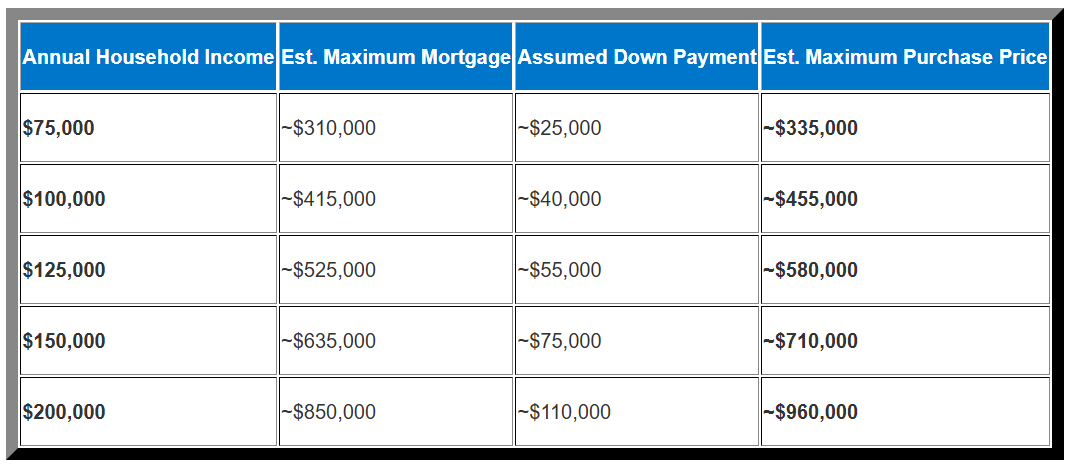
Affordability Breakdown by Household Income - Mortgage Affordability Canada
Note: These estimates serve as illustrative guidelines. Specific lender policies, variable condo fees, credit score tiers, and personal vehicle debts will shift your final maximum qualification.
Regional Realities: What Your Dollar Buys Across Provinces
The national median home price in Canada often obscures extreme regional discrepancies. Knowing how much house you can afford depends heavily on the geographic location you plan to call home.
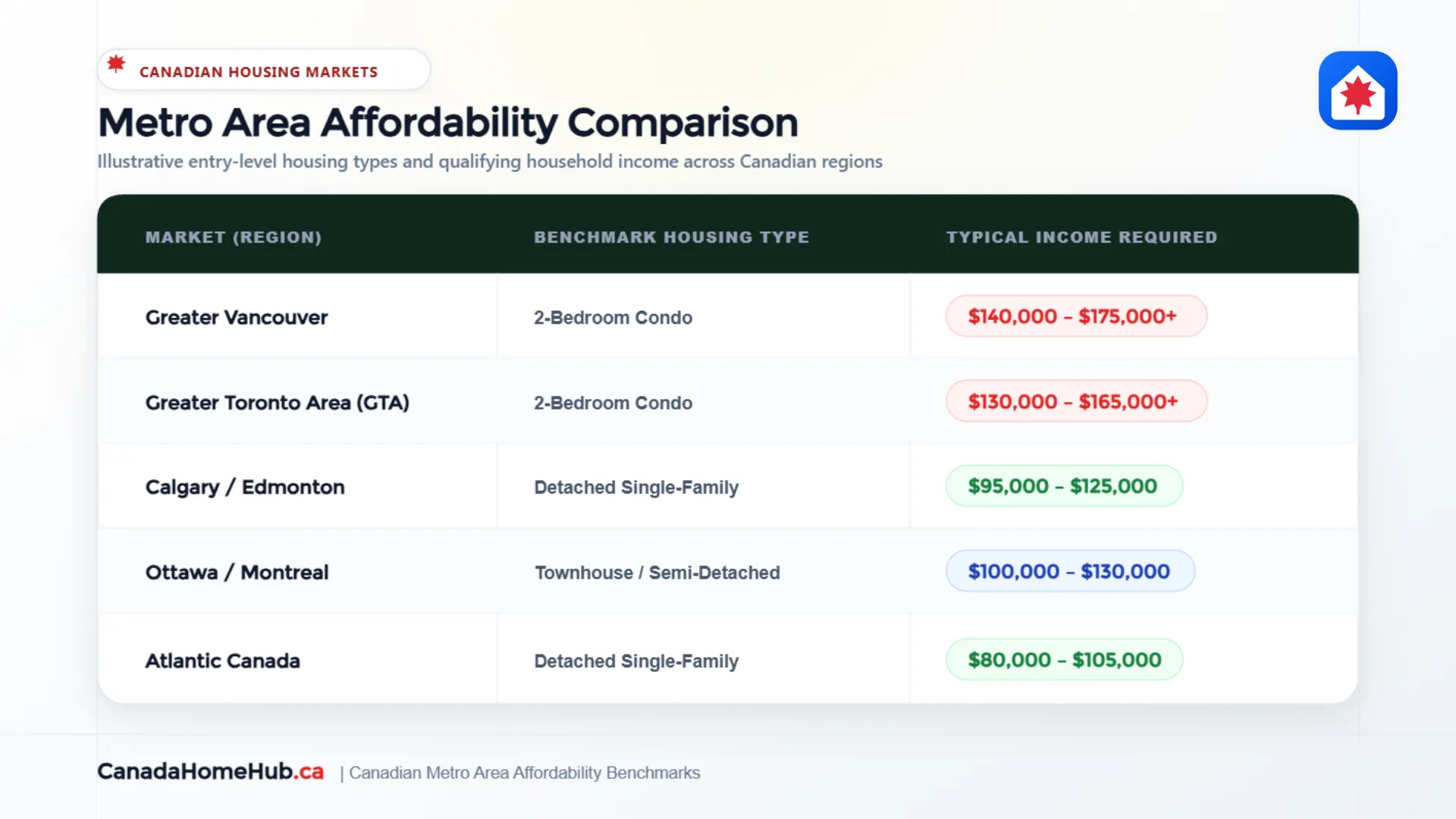
Regional Realities What Your Dollar Buys Across Provinces - Mortgage Affordability Canada
- British Columbia & Ontario: High benchmark prices mean first-time buyers in Vancouver and Toronto often stretch their GDS/TDS ratios to the statutory maximums, making condo living the primary entry point for median household earners.
- Alberta & The Prairies: Cities like Edmonton, Calgary, Regina, and Winnipeg offer significantly greater purchasing power relative to average median incomes. A $120,000 household salary can comfortably finance a detached single-family home with modest debt obligations.
- Quebec & Atlantic Canada: Montreal balances moderate urban pricing against slightly higher provincial income tax structures, whereas Halifax and Moncton continue to provide accessible suburban options despite recent regional price growth.
The Hidden Costs That Impact Your True Buying Power
One of the costliest mistakes prospective buyers make is allocating every spare dollar toward their down payment while neglecting closing costs. In Canada, closing costs typically require an additional 1.5% to 4% of the property’s total purchase price in liquid cash.
Provincial and Municipal Land Transfer Taxes
Every province handles property transfer fees differently:
- Ontario: Levies a progressive provincial Land Transfer Tax (LTT). If you buy within the City of Toronto, you must pay both the Ontario Provincial LTT and the Toronto Municipal LTT (often referred to as the "double transfer tax").
- British Columbia: Enforces the Property Transfer Tax (PTT) with progressive rates, though first-time home buyer exemptions apply under specific price thresholds.
- Alberta & Saskatchewan: Do not charge a traditional Land Transfer Tax; instead, they impose modest land title registration and transfer transfer fees, saving buyers thousands in upfront capital.
Provincial Sales Tax (PST) on Default Insurance
While CMHC, Sagen, or Canada Guaranty insurance premiums can be added to your mortgage principal, the provincial sales tax on that premium (e.g., 8% in Ontario, 9.975% in Quebec, 6% in Saskatchewan) must be paid in cash at the closing table through your real estate lawyer.
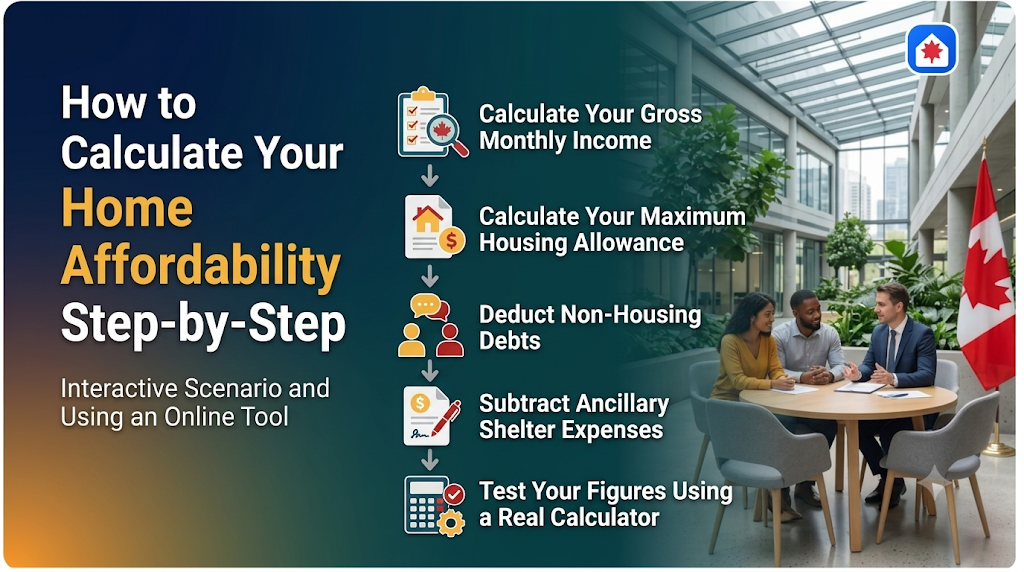
How to Calculate Your Home Affordability Step-by-Step
Before submitting documentation to a mortgage underwriter, prospective buyers can forecast their borrowing limits using a step-by-step assessment:
Step 1: Calculate Your Gross Monthly Income
Sum all verifiable income sources (base salary, guaranteed bonuses, average self-employed earnings over two years via T4 / Notice of Assessment records).
- Example: $120,000 annual salary = $10,000/month.
Step 2: Calculate Your Maximum Housing Allowance (GDS: 39%)
Multiply your monthly gross income by 0.39.
- $\$10,000 \times 0.39 = \mathbf{\$3,900/\text{month}}$ available for your mortgage payment, property taxes, heating, and 50% condo fees.
Step 3: Deduct Non-Housing Debts (TDS: 44%)
Multiply your monthly gross income by 0.44.
- $\$10,000 \times 0.44 = \mathbf{\$4,400/\text{month}}$ total allowable debt payments.
- If you have a $450/month car payment and $150/month in student loans ($600 total debt), your remaining housing cap under TDS is $\$4,400 - \$600 = \mathbf{\$3,800/\text{month}}$.
- Because TDS produces the stricter limit ($3,800 vs $3,900), your maximum housing payment is capped at $3,800/month.
Step 4: Subtract Ancillary Shelter Expenses
From your $3,800 ceiling, deduct:
- Estimated property taxes: $350
- Heating allowance: $100
- Condo fees: $0 (assuming freehold)
- Maximum allowable monthly mortgage payment (at qualifying stress rate): $\$3,800 - \$450 = \mathbf{\$3,350/\text{month}}$.
Step 5: Test Your Figures Using a Real Calculator
Manual calculations provide a rough estimate, but mortgage amortization schedules and changing interest rates introduce complex compounding interest variables.
How to Calculate Your Home Affordability
To model your exact debt load, municipal taxes, and prospective interest rates across Canadian lenders, you can evaluate your numbers with a home affordability calculator Canada. Using an intuitive online home affordability calculator Canada helps you stress-test different down payment scenarios and visualize your realistic monthly commitments before scheduling an in-person bank appointment.
5 Proven Strategies to Increase Your Purchasing Power in Canada
If your initial affordability estimate falls short of target home prices in your preferred neighbourhood, several practical levers can help improve your borrowing capacity:
- Aggressively Pay Down Revolving and Instalment Debts: Because every $100 of recurring monthly debt payment reduces your borrowing capacity by roughly $15,000 to $18,000 under current stress-testing rules, wiping out an outstanding auto loan or credit card balance creates immediate room in your TDS ratio.
- Leverage the First Home Savings Account (FHSA) and RRSP Home Buyers' Plan (HBP): The Canadian FHSA allows first-time buyers to contribute up to $8,000 annually ($40,000 lifetime limit) tax-free in and tax-free out. When paired with the federal Home Buyers’ Plan (HBP), which permits tax-free withdrawals of up to $60,000 from your RRSP, a purchasing couple can pool substantial pre-tax savings to bolster their down payment.
- Bring on a Qualified Co-Signer or Guarantor: Adding a parent or close relative with strong credit and reliable income blends their financial profile with yours. Underwriters factor in both incomes, allowing you to qualify for larger loan amounts, provided the co-signer carries manageable personal debt.
- Utilize 30-Year Amortization Windows: As a first-time home buyer or purchaser of a newly built residential unit, taking advantage of a 30-year insured amortization lowers your stress-tested qualifying payment, giving your income extra leverage.
- Boost Your Beacon/FICO Credit Score: While a credit score of 600 meets baseline CMHC guidelines, tier-one Canadian prime lenders reserve their most competitive promotional interest rates for borrowers scoring above 680–720. A lower contract rate softens the stress test hurdle rate, directly expanding your mortgage capacity.
Frequently Asked Questions About Home Affordability in Canada
How much income do I need to buy a $600,000 house in Canada?
To qualify for an average $600,000 Canadian property with a minimum 5% to 10% down payment (approximately $35,000) and prevailing mortgage interest rates, an individual or combined household typically needs an annual gross income between $125,000 and $140,000, assuming minimal existing personal vehicle or consumer debts and standard property taxes.
Can I buy a house in Canada if my GDS ratio is 40%?
Under standard insured mortgage underwriting rules set by CMHC, the strict ceiling for the GDS ratio is 39%. If your GDS reaches 40%, federally regulated lenders cannot approve you for an insured high-ratio loan. However, some non-bank alternative lenders (B-lenders) or provincial credit unions operating outside federal OSFI mandates may permit higher ratios on uninsured mortgages, albeit typically with slightly higher interest rates and administrative fees.
What is the maximum mortgage amount for a high-ratio insured mortgage?
The federal ceiling for default-insured mortgages is $1.5 million. Any property purchased above $1.5 million cannot be insured through CMHC, Sagen, or Canada Guaranty, requiring buyers to supply an upfront down payment of at least 20%.
How do condo fees affect my mortgage qualification?
Condominium fees have a direct impact on your borrowing budget. Canadian mortgage rules dictate that exactly 50% of the monthly condo/strata fee is added directly to your housing cost calculation for the GDS ratio. A $600 monthly condo fee adds $300 to your qualifying housing expenses, reducing the mortgage principal amount you can borrow by approximately $35,000 to $45,000.
Does the mortgage stress test apply when renewing my mortgage?
If you are simply renewing your mortgage contract with your existing lender at the end of your term, you do not need to re-take the mortgage stress test. Furthermore, federal rules allow borrowers with insured and many uninsured mortgages to perform a "straight switch" to a new lender without re-qualifying under the stress test, provided the principal loan amount and remaining amortization period remain unchanged.
Conclusion: Taking Your Next Steps Toward Canadian Homeownership
Figuring out home affordability Canada is not about guessing how high home prices might climb - it is about understanding the mathematical boundaries that Canadian banks and federal regulators use to evaluate risk. By grounding your plans in verified GDS/TDS ratios, budgeting for the mortgage stress test, and setting aside adequate funds for closing costs, you put yourself in control of the purchasing process.
Before you begin touring properties or contacting real estate agents, sit down with your exact financial statements. Map out your monthly debt obligations, determine your available savings, and test your borrowing power across realistic interest rate environments.
For an objective, transparent assessment of what your income can purchase in today’s real estate environment, start by running your budget through the CanadaHomeHub platform. With clear numbers and realistic expectations, you can make informed decisions and step confidently into the Canadian housing market.