Moving to Canada is an extraordinary life milestone, but establishing yourself in a new country brings significant initial expenses. Between paying upfront rent deposits, purchasing household essentials, and navigating local transportation, the first twelve months demand careful cash-flow management.
To help ease this transition, the Canadian government operates one of the world's most supportive social safety nets. A wide array of federal, provincial, and territorial programs offer non-repayable financial credits, income supplements, and free integration resources specifically designed to support new residents.
Understanding what benefits for newcomers Canada provides, who qualifies, and how to apply will ensure you do not leave thousands of dollars on the table during your settlement journey.
Understanding How Government Benefits Work for New Residents in Canada
Many immigrants arrive under the impression that government benefits are strictly reserved for multi-generational citizens or individuals receiving social welfare. In Canada, this is a misconception. Most key credits are structured as refundable tax credits or income-tested transfers. They are designed to support middle- and modest-income families, offset consumption taxes, and ensure children have equitable opportunities regardless of household background.
Status Eligibility: Permanent Residents vs. Temporary Residents
Eligibility for Canadian government support depends largely on your immigration status and your tax residency classification:
- Permanent Residents (PRs) & Protected Persons: Permanent residents and convention refugees enjoy immediate access to most federal and provincial benefit programs from the day they officially land in Canada.
- Temporary Residents (Work Permit & Study Permit Holders): Temporary residents become eligible for select federal benefits—such as the Canada Child Benefit (CCB)—only after residing in Canada for 18 consecutive months, provided their permit remains valid in the 19th month. However, certain sales tax credits and provincial rebates can be accessed much sooner once tax residency is established.
- Tax Residency vs. Immigration Status: For benefit purposes, the Canada Revenue Agency (CRA) evaluates your factual residency. If you establish significant residential ties—such as signing a long-term lease, opening Canadian bank accounts, or moving your spouse and dependants to Canada—you are deemed a resident for tax purposes and are subject to benefit rules accordingly.
The Critical Role of the Canada Revenue Agency (CRA) and Social Insurance Number (SIN)
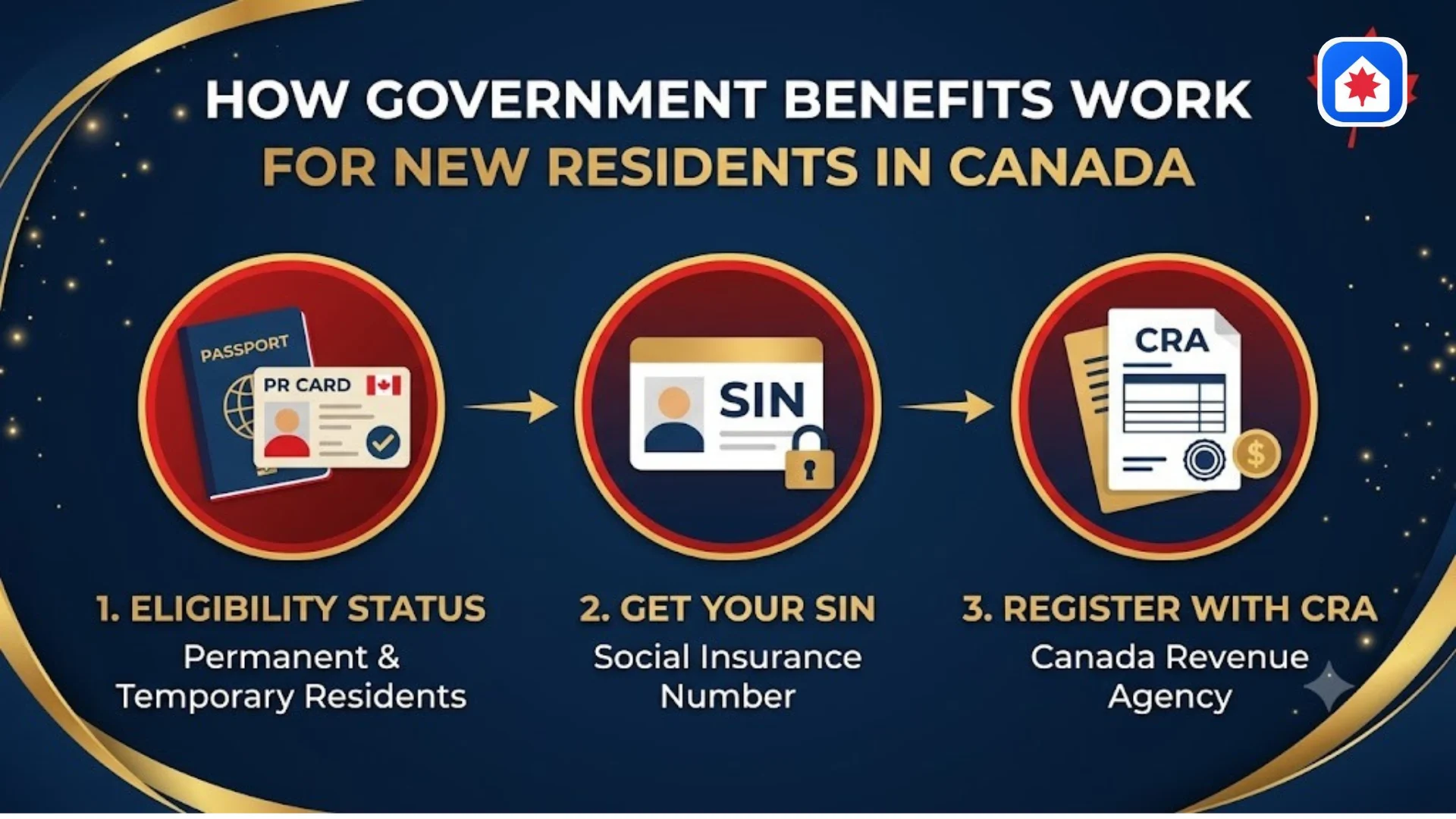
Every benefit payment issued by the federal government requires two foundations:
- A valid Social Insurance Number (SIN): Issued by Service Canada, this 9-digit number enables government agencies to identify you and track your entitlements.
- CRA Registration: The Canada Revenue Agency administers federal and most provincial cash transfers. Even if you arrive mid-year and earn zero income, reporting your arrival date and global income to the CRA is the mandatory legal mechanism that unlocks your payments.
Key Federal Cash Benefits and Tax Credits for Newcomers
Federal benefits are uniform across the country and provide direct, tax-free financial deposits straight into your Canadian bank account.
Canada Child Benefit (CCB)
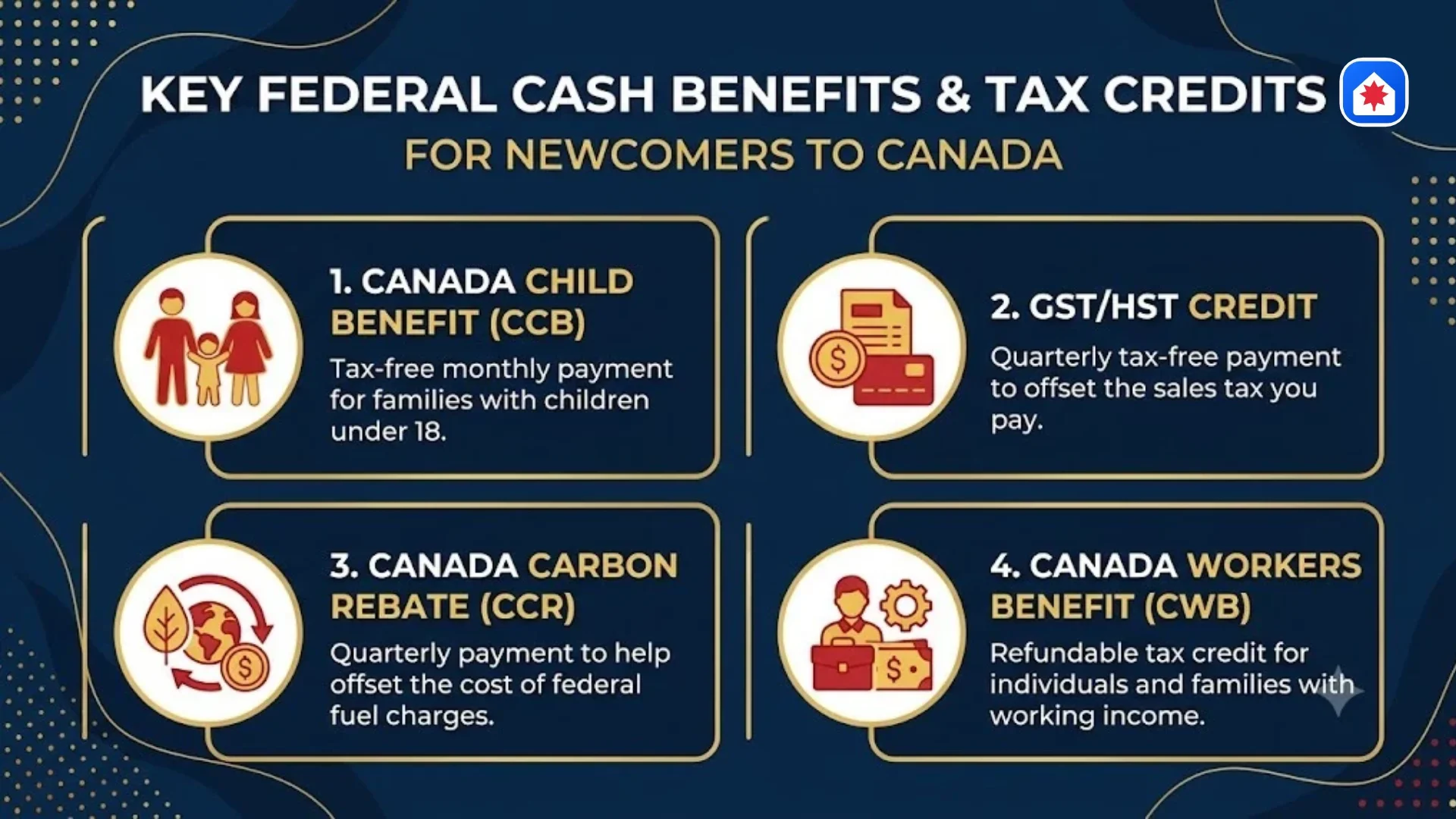
The Canada Child Benefit is arguably the most substantial financial support mechanism available to immigrant families. Administered by the CRA, the CCB is a tax-free monthly payment made to eligible families to assist with the cost of raising children under the age of 18.
- How Payment Amounts Are Calculated: Payments are recalculated every July based on your adjusted family net income (AFNI) reported on the previous year's tax return. For your first year in Canada, the CRA calculates your entitlement based on the world income you report for the year of arrival and the preceding tax year.
- Maximum Benefit Thresholds: Depending on family income, the CCB can deliver up to several thousand dollars per child annually (with higher payments for children under age 6 than for children aged 6 to 17).
- Application Requirement: Newcomers must file Form RC66 (Canada Child Benefits Application) along with Form RC66SCH (Status in Canada and Income Information) immediately upon arrival.
GST/HST Credit
The Goods and Services Tax / Harmonized Sales Tax (GST/HST) credit is a tax-free quarterly payment designed to offset the consumption tax paid by low- and modest-income individuals and families living in Canada.
- Payment Schedule: The CRA distributes payments four times a year: January, April, July, and October.
- Why Newcomers Qualify Early: Because your eligibility during your arrival year is assessed against your declared income, many newcomers qualify for the maximum base amount during their initial months while searching for Canadian employment.
- Application Mechanism: Before filing your first official Canadian tax return, you can claim this credit immediately after arrival by submitting Form RC151 (GST/HST Credit and Canada Carbon Rebate Application for Individuals Who Become Residents of Canada).
Canada Carbon Rebate (CCR)
Formerly known as the Climate Action Incentive Payment, the Canada Carbon Rebate is an inflation-adjusted, tax-free payment intended to return the direct proceeds of federal fuel charges to households in participating provinces (including Ontario, Alberta, Saskatchewan, Manitoba, Nova Scotia, New Brunswick, Prince Edward Island, and Newfoundland and Labrador).
Like the GST/HST credit, new permanent residents in applicable provinces can access the CCR shortly after arrival by completing Form RC151.
Canada Workers Benefit (CWB)
If you secure an entry-level or transitional position during your first months in Canada, you may qualify for the Canada Workers Benefit. The CWB is a refundable tax credit that tops up the earnings of low-income workers.
- The credit includes a basic amount and a disability supplement for eligible individuals.
- Part of the benefit can be received via advance payments (the Advanced Canada Workers Benefit - ACWB) throughout the year, rather than waiting entirely for tax filing season.
Provincial and Territorial Family & Cost-of-Living Supplements
In addition to federal disbursements, Canada's ten provinces and three territories fund regional programs. In most cases, you do not need to submit a separate application; filing your federal paperwork automatically enrolls you in provincial equivalents.
Ontario Child Benefit (OCB) & Ontario Trillium Benefit (OTB)
- Ontario Child Benefit: Provides an additional monthly allowance per child to low-income families, seamlessly combined into your single monthly CCB payment.
- Ontario Trillium Benefit: Bundles three credits—the Northern Ontario Energy Credit, the Ontario Energy and Property Tax Credit, and the Ontario Sales Tax Credit—helping renters and homeowners manage energy expenses and sales taxes.
British Columbia Family Benefit & Climate Action Tax Credit
- B.C. Family Benefit: Delivered alongside the federal CCB on the 20th of each month, offering an income-tested boost for children under 18.
- B.C. Climate Action Tax Credit: A tax-free quarterly payment combined with the GST/HST credit to offset carbon taxation for B.C. residents.
Alberta Child and Family Benefit (ACFB)
- The ACFB provides direct financial contributions to working families with children. The benefit is paid quarterly in August, November, February, and May, scaling upward as parents transition into the workforce.
Housing Assistance and Settlement Services for New Immigrants
Securing safe, comfortable, and affordable accommodation represents the single greatest hurdle for newcomers. Housing prices, strict lease standards, and credit history requirements can feel intimidating when landing in Canada's primary arrival hubs.
Canada Housing Benefit & Rent-Relief Initiatives
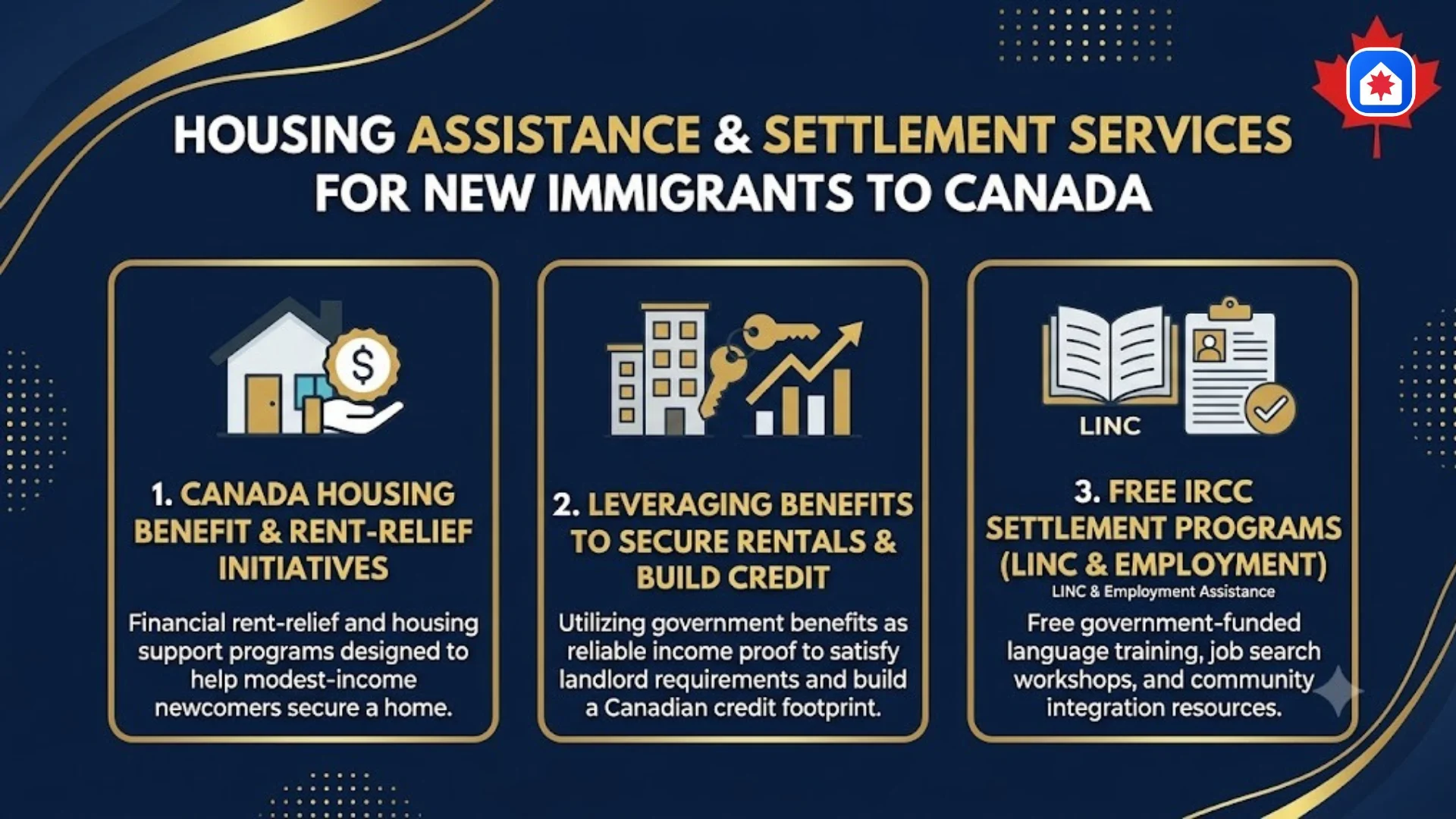
The Canada Housing Benefit is a co-funded federal-provincial initiative created under the National Housing Strategy. Rather than attaching subsidies to specific public housing units, it provides direct rent supplements to low-income renters spending an excessive proportion of their household income on housing.
Because provincial housing authorities manage local delivery (such as the Housing Stability Benefit in Ontario or BC Housing's Rental Assistance Program), income limits and qualifying thresholds vary significantly across regional rental markets.
Leveraging Benefits to Secure Rental Housing and Build Canadian Credit
A persistent challenge for recent arrivals is demonstrating financial reliability to prospective landlords without a established Canadian credit score.
Here is where understanding your government benefits transforms your rental search:
- Proof of Reliable Cash Flow: Official benefit confirmation letters from the CRA (such as your CCB entitlement notice) can be submitted as documented supplementary income alongside employment offers or bank statements when completing lease applications.
- Budgeting for Security Deposits: Guaranteed quarterly tax credits give you predictable funds to cover utility connection deposits, tenant insurance policies, or moving fees.
- Navigating the Local Property Market: Knowing the real cost of living across Canadian neighbourhoods prevents costly mistakes. To explore housing market trends, understand tenant obligations, and research regional housing insights, newcomer-focused resources such as CanadaHomeHub.Ca provide practical guidance on navigating rental markets, understanding lease agreements, and transitioning over time toward sustainable homeownership.
Free IRCC Settlement Programs (LINC & Employment Assistance)
Not all government benefits come as monetary checks. Immigration, Refugees and Citizenship Canada (IRCC) allocates hundreds of millions of dollars each year to third-party immigrant settlement organizations:
- Language Instruction for Newcomers to Canada (LINC): Free, government-funded English and French training for permanent residents and protected persons, ranging from basic literacy to workplace communication. Many centers even offer complimentary childcare while you attend classes.
- Foreign Credential Recognition Support: Guidance sessions helping doctors, engineers, accountants, and tradespeople map international credentials to Canadian regulatory frameworks.
- Job Search & Resume Canadianization Workshops: Free access to employment specialists who review your resume, stage mock Canadian interviews, and introduce you to prospective local employers.
Healthcare Coverage and the Interim Federal Health Program
Access to essential healthcare protects your family from catastrophic out-of-pocket medical debt during settlement.
- Provincial Health Insurance Plans: Most provinces—such as Ontario (OHIP), British Columbia (MSP), and Alberta (AHCIP)—cover medically necessary physician and hospital services. While several provinces historically enforced a 3-month waiting period before coverage kicked in, most jurisdictions have waived or minimized these delays for new permanent residents. You must register for your provincial health card as soon as you have a residential address.
- Interim Federal Health Program (IFHP): Specifically reserved for resettled refugees, protected persons, and refugee claimants, the IFHP supplies temporary health coverage for emergency medical services, prescription medications, vision care, and emergency dental care until provincial insurance takes effect.
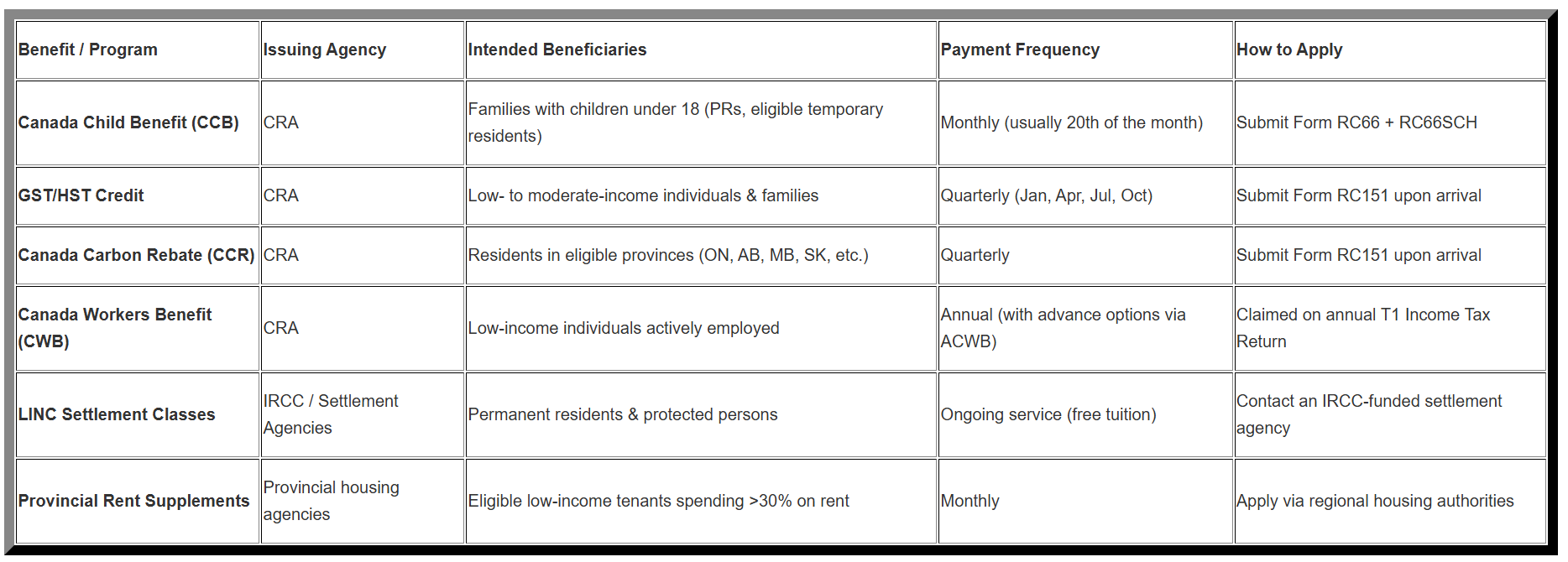
Comparison Table: Major Canadian Government Benefits for Newcomers
How to Apply for Your Benefits: Step-by-Step Roadmap
Accessing government benefits in Canada does not happen automatically upon passing border control. You must complete a sequence of procedural steps to open your profile with government registries.
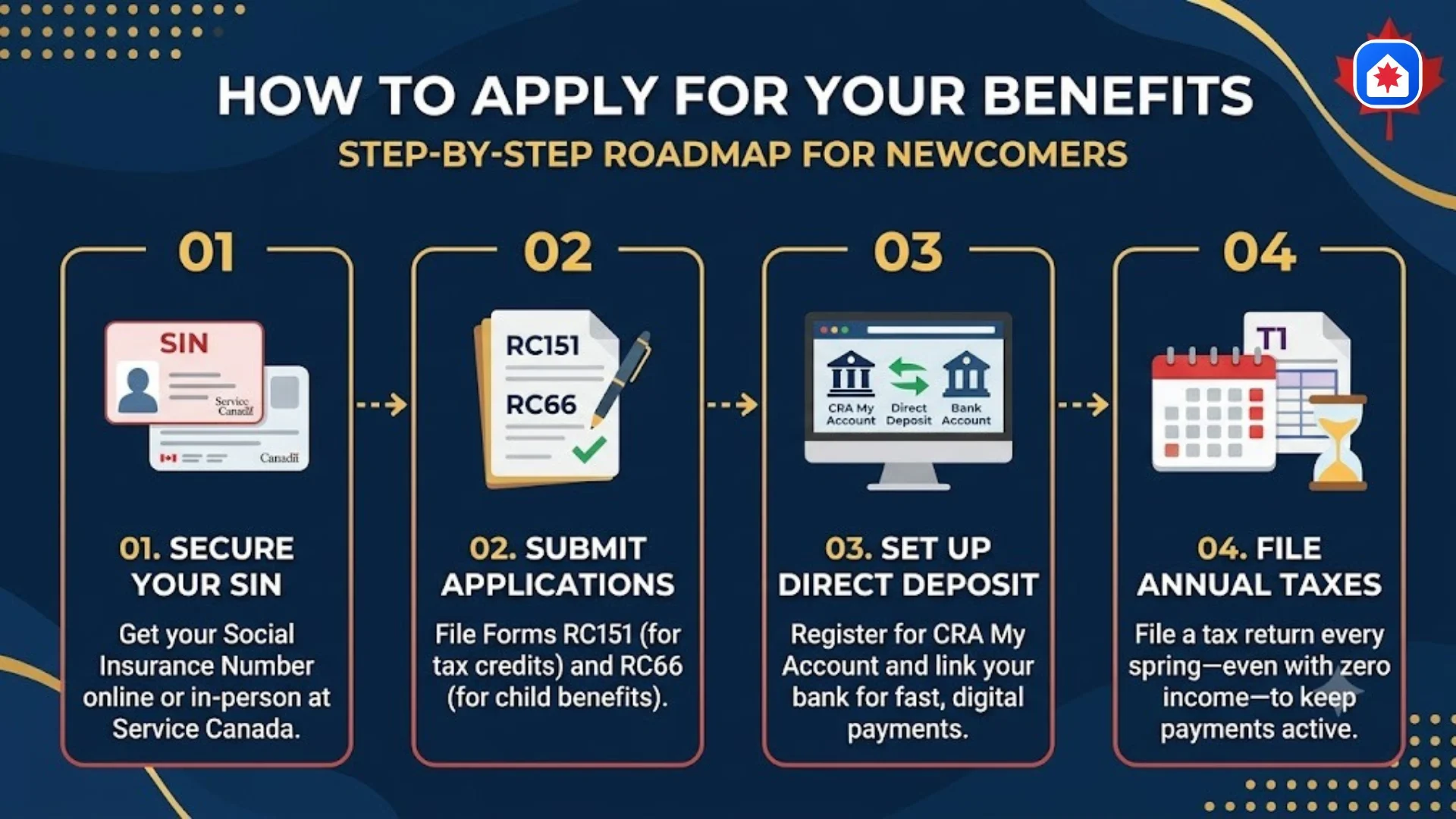
Step 1: Secure Your Social Insurance Number (SIN)
Within your first few days, visit a local Service Canada Centre with your Confirmation of Permanent Residence (COPR) or permanent resident card and passport. Alternatively, apply through the Service Canada online portal. You will receive your SIN on the spot if you apply in person.
Step 2: File Form RC151 and Form RC66 (Before Your First Tax Return)
Do not wait until the annual spring tax season to start claiming your money:
- Fill out Form RC151 to trigger your GST/HST Credit and Canada Carbon Rebate.
- If you have children under 18, complete Form RC66 and attach Form RC66SCH detailing your citizenship status and your world income for the prior two calendar years before moving to Canada.
- Mail these forms alongside certified copies of your identification and landing papers to your regional CRA Tax Centre.
Step 3: Set Up Your CRA My Account & Direct Deposit
Once your initial forms are processed, set up CRA My Account. This secure online portal allows you to track benefit payment dates, verify your mailing address, and view CRA statements.
Link your Canadian bank account for Direct Deposit. Receiving funds via direct deposit is substantially faster than waiting for mailed paper cheques, which risk delivery delays or theft.
Step 4: File an Annual Canadian Tax Return (Even with Zero Income)
This is the single most vital rule of the Canadian benefits system: Your benefits stop if you do not file an annual tax return.
Every year between February and April, Canadian residents must file a T1 General Income Tax Return. The CRA uses this filing to calculate your entitlement for the upcoming benefit cycle (which runs from July of the current year to June of the following year). Even if you had zero employment income in Canada, filing your return is legally required to verify your income status and trigger uninterrupted monthly CCB and quarterly tax credits.
Practical Case Study: Maximizing First-Year Financial Support
To understand how these programs fit together in everyday life, consider this realistic settlement scenario:
The Situation: Amir and Fatima arrived in Calgary, Alberta, as permanent residents in September with their two children, aged 4 and 8. During their initial six months, Amir attended full-time English classes (LINC) while Fatima worked part-time as a customer service associate earning $22,000 annually.
Actions Taken:
- Within one week of landing, both parents acquired their SIN cards at a Service Canada Centre.
- They immediately submitted Form RC66 (CCB) and Form RC151 (GST/HST & CCR) to the CRA, reporting their prior international income.
- Fatima registered for direct deposit through her newly opened Canadian credit union account.
The Outcome:
- Within 8 to 11 weeks, the family began receiving monthly Canada Child Benefit payments exceeding $1,000 per month for both children combined, complemented by the Alberta Child and Family Benefit.
- In October and January, they received quarterly GST/HST credit and Canada Carbon Rebate deposits totaling several hundred dollars per quarter.
- These predictable monthly deposits helped the family cover their monthly utility bills, transit passes, and food costs, freeing up Fatima's earnings to cover their apartment lease without depleting their savings.
Common Mistakes Newcomers Make When Claiming Benefits
Avoiding procedural traps will save you months of administrative backlogs and stressful appeals:
- Failing to Report Global Income Accurately: When claiming benefits for your first year, you must disclose your worldwide income earned prior to entering Canada. Misrepresenting your income—or leaving the field blank—will trigger automated reviews and freeze your benefit processing.
- Assuming Stay-at-Home Spouses Do Not Need to File Taxes: Both spouses must file their tax returns every spring, even if one parent did not work a single hour during the year. If one spouse fails to file, the CRA automatically suspends CCB payments for the entire household.
- Forgetting to Update Your Address with the CRA: If a mailed cheque or official verification letter is returned to the CRA as undeliverable, all accounts are placed on temporary administrative hold. Always update your address immediately via CRA My Account whenever you relocate.
- Neglecting Free Settlement Services: Many immigrants pay hundreds of dollars to private agencies for basic resume reformatting, language tutoring, or tax preparation, unaware that the Canadian government funds these identical services for free through local non-profit settlement providers.
Frequently Asked Questions (FAQs)
Are government benefits for newcomers in Canada taxable?
No, the primary federal cash benefits—including the Canada Child Benefit (CCB), the GST/HST Credit, and the Canada Carbon Rebate—are completely tax-free. You do not have to report these payments as taxable income on your annual tax return, and they will not reduce your eligibility for other public programs.
Can international students or work permit holders get the Canada Child Benefit?
Temporary residents holding valid study or work permits can qualify for the CCB only after living in Canada for 18 consecutive months, provided their permit is still active in the 19th month. However, work permit holders who become Permanent Residents qualify immediately upon landing without any waiting period.
Will receiving Canadian government benefits hurt my chances of citizenship?
No. Receiving statutory benefits like the CCB, GST/HST credit, or provincial tax supplements will not negatively impact your eligibility for Canadian citizenship or future sponsorship applications. These are universal legal entitlements funded through the tax system, not social welfare disqualifiers.
How long does it take for my first benefit payment to arrive?
Processing paper applications (such as Forms RC151 or RC66) generally takes between 8 and 12 weeks from the date the CRA receives your documents. Once your profile is active, enrolling in direct deposit ensures subsequent payments arrive in your bank account on the exact scheduled distribution dates.
Do I need to hire an accountant to claim my newcomer benefits?
No. You can easily complete and mail Form RC151 and Form RC66 on your own for free. Additionally, during tax season, free volunteer tax clinics operating under the Community Volunteer Income Tax Program (CVITP) assist newcomers with modest incomes in filing their returns at zero cost.
What happens to my benefits if my family moves to another province?
Your federal benefits (like the base CCB and GST/HST credit) continue uninterrupted, but your provincial supplements will be recalculated to match your new province of residence. You must notify the CRA of your change of address and relocation date immediately to ensure your provincial tax credits remain accurate.
Building Your Long-Term Foundation in Canada
Canadian government benefits are designed to serve as a reliable springboard, offering crucial financial breathing room while you find your footing, secure meaningful employment, and build a fulfilling life. By taking prompt administrative action—getting your SIN, submitting your entry forms to the CRA, and maintaining annual tax compliance—you can access thousands of dollars in legitimate, non-repayable support during your critical initial years.
As your family settles into your chosen community, financial stability opens the door to broader lifestyle decisions, from finding the right school district to securing long-term rental housing or even preparing to buy your first home. Utilizing specialized educational guides, community resources, and dedicated real estate hubs like CanadaHomeHub.Ca will empower you to make informed, confident choices as you turn your Canadian dreams into lasting reality.
Thank you for reading our article!