Preparing with a reliable G1 practice test is the fastest way to walk into an Ontario DriveTest Centre ready to pass on your first attempt. In Ontario, a Class G1 licence is the entry stage of the province's Graduated Licensing System. Every new passenger-vehicle applicant must pass a vision screening and a 40-question multiple-choice written exam based on the Official Ministry of Transportation (MTO) Driver's Handbook.
Because driver licensing in Canada is regulated provincially, Ontario's G1 road signs, demerit point rules, and expressway restrictions differ from learner permits in British Columbia, Alberta, or Quebec. Even experienced drivers relocating from abroad frequently miss Ontario-specific rules on flashing traffic signals, school bus distances, or novice driver sanctions.
This guide combines everything you need in one place: exam scoring and DriveTest fees, 10 free G1 test questions with explanations, the highest-yield MTO study topics, DriveTest ID rules, G1 restrictions, and a seven-day study plan. For additional interactive drills after reading, you can continue with our G1 practice test.
How the Ontario G1 Knowledge Test Works
Understanding how DriveTest administers and grades the exam eliminates unnecessary test-day surprises and helps you target your G1 knowledge test practice effectively.
Test Structure, Passing Score, and Time Rules
The Ontario G1 written exam is divided into two equally weighted sections:
- Section 1 — Road Signs (20 multiple-choice questions): Tests regulatory, warning, temporary construction, and information signs, plus railway crossings and pavement markings.
- Section 2 — Rules of the Road (20 multiple-choice questions): Tests right-of-way, intersections, speed limits, following distances, sharing the road with streetcars and pedestrians, alcohol/drug rules, and demerit points.
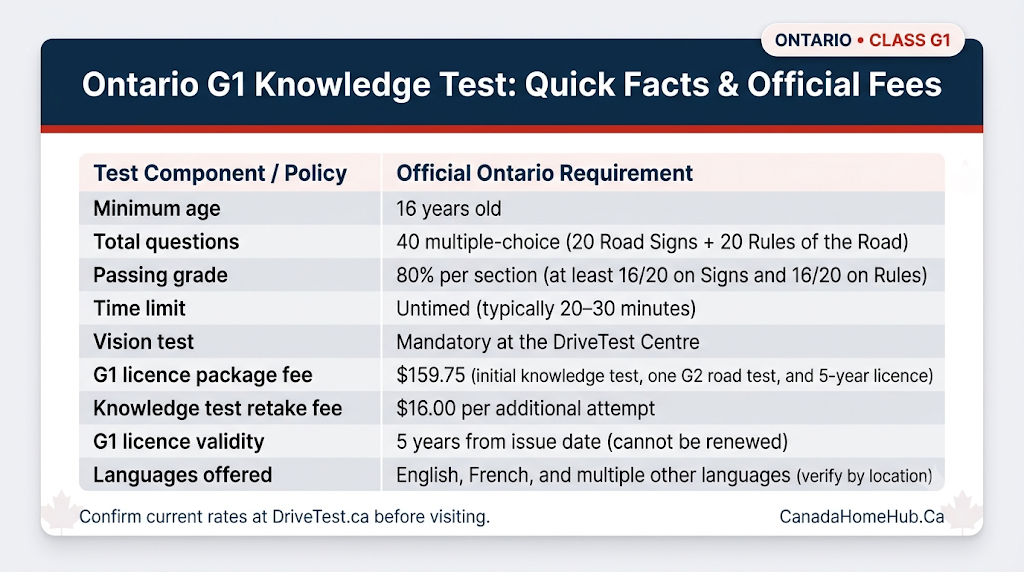
To pass, you must score at least 80% on each section separately—a minimum of 16 out of 20 on Road Signs and 16 out of 20 on Rules of the Road. A perfect score in one section cannot compensate for a failing score in the other. However, passing results stay valid for one year: if you pass one section and fail the other, you only pay the retake fee and redo the failed section within that year.
The exam is untimed (finish before the centre closes; most applicants take 20–30 minutes) and is delivered on a touch-screen computer or paper depending on the location. Audio or verbal testing is available for applicants with reading or writing difficulties.
Ontario G1 Knowledge Test Quick Facts and Official Fees
Government fees can change, so confirm current rates on DriveTest.ca before visiting. Based on published DriveTest Ontario schedules:
Free Ontario G1 Practice Test Questions (With Answers and Explanations)
The 10 sample questions below reflect the wording and MTO handbook concepts tested on the official G1 test Ontario applicants take at DriveTest. Choose your answer before checking the explanation underneath.
Part 1: Rules of the Road Practice Questions
Question 1: You are driving behind a school bus on a road without a median, and the bus stops with flashing red lights and its stop arm extended. At what minimum distance behind the bus must you stop?
- A) 5 metres
- B) 10 metres
- C) 20 metres
- D) 30 metres
Correct Answer: C) 20 metres.Explanation: Under Ontario's Highway Traffic Act, vehicles approaching a stopped school bus from behind must stop at least 20 metres away and wait until the bus moves or the red lights stop flashing. Passing a stopped school bus carries 6 demerit points.
Question 2: When driving at night with high-beam headlights on, when must you switch to low beams?
- A) Within 150 metres of an oncoming vehicle, and within 60 metres when following another vehicle
- B) Within 60 metres of an oncoming vehicle, and within 150 metres when following another vehicle
- C) Within 100 metres of any vehicle in either direction
- D) Only when another driver flashes their headlights
Correct Answer: A) Within 150 metres of an oncoming vehicle, and within 60 metres when following another vehicle.Explanation: Dimming your high beams within 150 metres of oncoming vehicles and 60 metres behind vehicles ahead prevents glare that temporarily blinds other drivers.
Question 3: As a novice driver holding a Class G1 or G2 licence in Ontario, how many demerit points trigger a 60-day licence suspension?
- A) 4 or more points
- B) 6 or more points
- C) 9 or more points
- D) 15 or more points
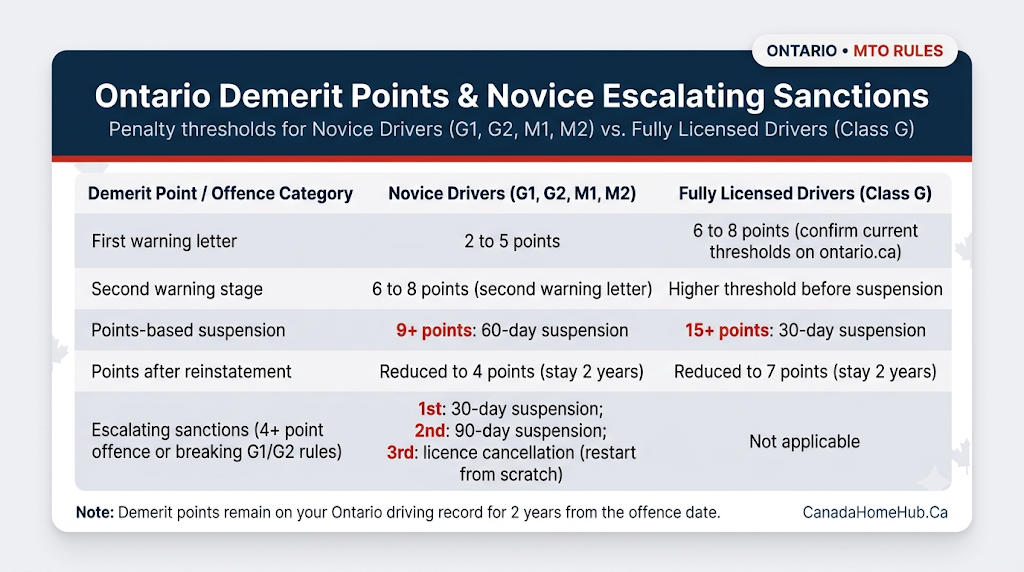
Correct Answer: C) 9 or more points.Explanation: Novice drivers (G1, G2, M1, M2) face a 60-day suspension at 9 or more demerit points, compared to 15 or more points for fully licensed Class G drivers. Separately, any single 4-or-more-point conviction or breach of a G1 condition triggers Ontario's escalating sanctions (starting with a 30-day suspension).
Question 4: When approaching a stopped streetcar whose doors are open for passengers (with no safety island), where must you stop?
- A) Parallel to the front doors
- B) At least 2 metres behind the rear doors where passengers are boarding or exiting
- C) At least 10 metres behind the streetcar
- D) You may pass slowly on the right at 10 km/h
Correct Answer: B) At least 2 metres behind the rear doors where passengers are boarding or exiting.Explanation: Ontario law requires drivers to stop at least 2 metres behind the rear doors of a stopped streetcar and wait until all passengers have boarded or safely reached the curb.
Question 5: Under normal, dry road conditions, what is the minimum safe following distance recommended by the MTO Driver's Handbook?
- A) One car length
- B) At least two seconds behind the vehicle ahead
- C) At least five seconds behind the vehicle ahead
- D) Ten metres regardless of speed
Correct Answer: B) At least two seconds behind the vehicle ahead.Explanation: Use a fixed roadside marker and count "one-thousand-one, one-thousand-two" after the vehicle ahead passes it. Increase this gap in rain, snow, fog, or heavy traffic.
Part 2: Road Signs, Traffic Signals, and Pavement Markings Questions
Question 6: You approach an Ontario intersection and see a flashing green traffic light (with no separate red light). What does it mean?
- A) Proceed cautiously; the signal is malfunctioning
- B) You may turn left, go straight, or turn right from the proper lane while oncoming traffic faces a red light
- C) Pedestrians have immediate right-of-way
- D) Come to a complete stop before entering
Correct Answer: B) You may turn left, go straight, or turn right from the proper lane while oncoming traffic faces a red light.Explanation: In Ontario, a flashing green light acts as an advance green, giving your direction priority while oncoming traffic holds at red. Pedestrians must not cross on a flashing green unless a walk signal instructs them to.
Question 7: What must you do at a flashing red traffic light?
- A) Slow down and proceed if the intersection looks clear
- B) Yield only to vehicles on your left
- C) Come to a complete stop and proceed only when it is safe
- D) Treat it like a yellow warning light
Correct Answer: C) Come to a complete stop and proceed only when it is safe.Explanation: A flashing red light carries the exact same legal obligation as a stop sign: stop completely at the stop line, crosswalk, or intersection edge, then go only when the way is clear.
Question 8: On Ontario roads, how do yellow and white pavement lines differ?
- A) Yellow marks parking zones; white marks bike lanes
- B) Yellow separates traffic travelling in opposite directions; white separates traffic travelling in the same direction
- C) White prohibits passing; yellow permits passing
- D) Yellow appears only on 400-series highways
Correct Answer: B) Yellow separates traffic travelling in opposite directions; white separates traffic travelling in the same direction.Explanation: Checking line colour immediately tells you whether adjacent lanes carry oncoming traffic (yellow) or same-direction traffic (white).
Question 9: Within what distance of a marked pedestrian crossover is passing another vehicle prohibited in Ontario?
- A) 10 metres
- B) 15 metres
- C) 30 metres
- D) 50 metres
Correct Answer: C) 30 metres.Explanation: Passing within 30 metres of a pedestrian crossover is illegal because a stopped vehicle ahead could block your view of a crossing pedestrian. Failing to stop at a pedestrian crossover also carries 4 demerit points.
Question 10: What category of road sign is a diamond-shaped sign with an orange background and a black symbol?
- A) Permanent regulatory sign
- B) Highway exit direction sign
- C) Temporary condition sign warning of road work, construction zones, or detours
- D) School zone regulatory sign
Correct Answer: C) Temporary condition sign warning of road work, construction zones, or detours.Explanation: Orange diamonds alert drivers to temporary construction zones, lane closures, or road crews ahead, signalling that you must slow down and follow traffic-control personnel.
To build consistency across both exam sections, continue practising with G1 test questions on CanadaHomeHub.Ca.
Ontario G1 Study Guide: High-Priority Topics to Master
Most applicants who fail an Ontario G1 practice test or the official exam lose marks on exact legal numbers, sign categories, and novice driver rules rather than basic driving judgment. Concentrate your study time on the four high-weight topics below.
Recognizing Ontario Road Signs by Shape and Colour
Learn Ontario's sign framework before memorizing individual symbols:
- Red and white octagon: Stop sign (full stop required).
- Inverted red-bordered triangle: Yield sign (slow or stop and give right-of-way).
- White rectangles/squares: Regulatory signs stating traffic laws (speed limits, turn or parking rules). A red circle with a slash prohibits an action; a green circle permits it.
- Yellow diamonds: Permanent hazard warnings (curves, slippery bridges, deer crossings, merging lanes).
- Fluorescent yellow-green pentagons: School zones and school crossings.
- Orange diamonds: Temporary construction and road work zones.
- Blue or green rectangles: Services, hospitals, and highway destination directions.
Right-of-Way, Intersections, and Sharing the Road
-
All-way stops: The first vehicle to stop completely goes first. If two vehicles arrive simultaneously, the vehicle on the right goes first.
- Uncontrolled intersections: Yield to vehicles already inside the intersection and to traffic approaching from your right.
- Left turns on red: Permitted only when turning from a one-way street onto another one-way street after a full stop, provided no sign prohibits it and the path is clear.
- U-turns: Never make a U-turn unless you can see clearly for at least 150 metres in both directions and no sign or hazard (curve, hill crest, bridge, tunnel, railway crossing) prohibits it.
- Transit priority signals: A round signal showing a white vertical bar lets transit vehicles proceed while other vehicles and pedestrians yield.
- Emergency vehicles and Move Over law: Pull safely to the right and stop when emergency vehicles approach with lights and sirens. On multi-lane roads, slow down and move into another lane (if safe) when passing stopped emergency vehicles or tow trucks with flashing lights.
Demerit Points and Novice Driver Escalating Sanctions
In Ontario, drivers start with zero demerit points. Points are added upon conviction and remain on your record for two years from the offence date.
High-frequency point values to memorize for your exam:
- 6 points: Careless driving, racing, failing to stop for a school bus, speeding 50 km/h+ over the limit (or 40 km/h+ on roads under 80 km/h).
- 4 points: Following too closely, failing to stop at a pedestrian crossover, speeding 30–49 km/h over the limit.
- 3 points: Failing to yield right-of-way, speeding 16–29 km/h over the limit, bypassing a railway barrier, driving the wrong way on a divided road, or viewing an unrelated display screen while driving.
Safe Following Distances, Night Driving, and Weather Rules
-
Adjust speed so you can always stop safely within your clear sight distance.
- Dim high beams within 150 metres of oncoming vehicles and 60 metres when following another vehicle.
- If your vehicle skids or hydroplanes, ease off the accelerator, steer smoothly in the direction you want the front of the car to travel, and avoid slamming on the brakes.
Step-by-Step Guide to Applying for Your G1 Licence in Ontario
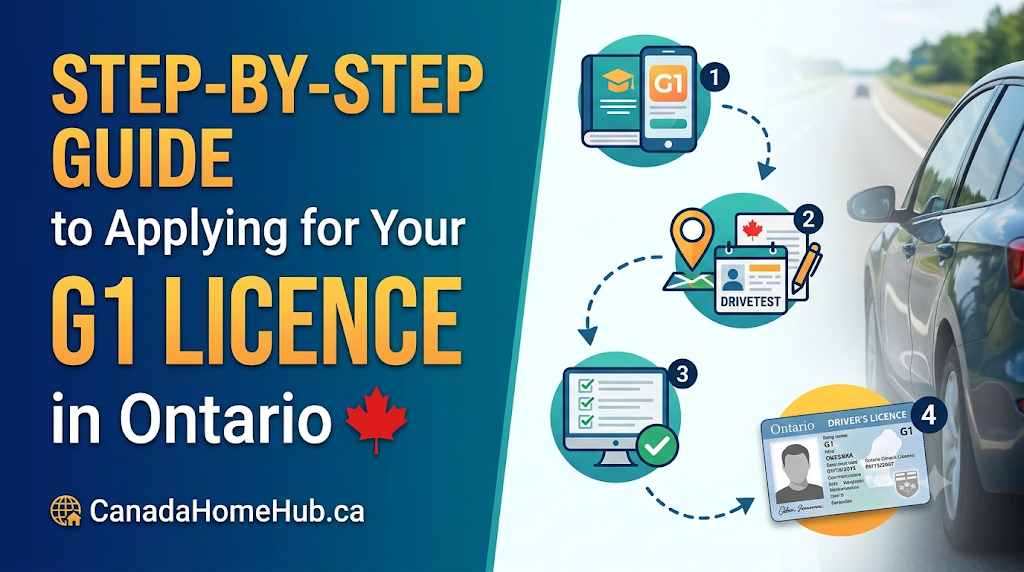
Passing an Ontario G1 practice test at home prepares you for the exam; preparing the right original paperwork ensures you are not turned away at the DriveTest counter.
Eligibility and Acceptable Identification Documents
To apply, you must be at least 16 years old and present original, valid identification proving your legal name and full date of birth (photocopies and phone photos are rejected). Accepted primary documents include:
- Valid Canadian or foreign passport (temporary residents presenting an IMM 1442 Study Permit, Work Permit, or Visitor Record generally must pair it with a valid passport or required immigration documents)
- Canadian Permanent Resident (PR) Card
- Canadian or U.S. birth certificate (Quebec birth certificates issued before January 1, 1994, are not accepted)
- Canadian Citizenship Certificate (with photo)
- Confirmation of Permanent Residence (IMM 5292) with a valid passport
If your name changed across documents, bring an original linking document such as a certified marriage certificate or court order. Always check DriveTest.ca before going for any updated residency or declaration rules.
What to Expect on Test Day at a DriveTest Centre
-
Verify walk-in rules and hours: Most DriveTest Centres accept walk-ins for the G1 written test (no appointment needed), though select ServiceOntario locations such as Bay and College in Toronto require booking. Arrive early—lines can close before posted hours when daily capacity fills.
- Bring test-day essentials: Carry your original ID, glasses or contact lenses (if needed for driving), and payment for the $159.75 package fee.
- Register and complete the vision test: Staff verify your ID, take your photo, collect payment, and conduct a quick vision screening.
- Complete the G1 knowledge test: Take your time—there is no timer.
- Receive your temporary G1: Upon passing both sections, you leave with a temporary paper G1 licence while your photo card arrives by mail.
Newcomers to Ontario and Foreign Driving Experience Credits
Newcomers holding a valid foreign licence may qualify for a direct licence exchange (for reciprocal jurisdictions) or driving experience credits that shorten or waive the mandatory G1 waiting period. Claiming over 12 months of foreign experience typically requires your valid original foreign licence, an original authentication letter in English or French from your embassy, consulate, or licensing authority (dated within six months), and MTO-recognized translations where needed.
Applicants from non-reciprocal countries must still pass the vision and G1 knowledge tests. If you are coordinating driving licensing alongside housing budgets or settlement planning in Ontario, CanadaHomeHub.Ca gathers Canadian calculators, study tools, and settlement guides in one platform.
Ontario G1 Licence Restrictions and the Path to G2 and Full G
A Class G1 licence comes with strict conditions. Violating any restriction triggers Ontario's escalating sanctions (starting with a 30-day suspension), so know these rules both for your exam and on the road.
Mandatory Rules Every G1 Driver Must Follow
-
Zero (0.00%) blood-alcohol concentration (BAC) at all times (zero drug impairment rules also apply).
- Mandatory supervising driver: You must drive with a fully licensed Class G (or higher) driver who has at least four years of experience and a BAC under 0.05%. They must sit in the front passenger seat and be the only other person in the front seat.
- Seatbelt limit: Every occupant must have a working seatbelt.
- No restricted expressways: You cannot drive on 400-series highways posted over 80 km/h or expressways such as the QEW, Don Valley Parkway, Gardiner Expressway, E.C. Row Expressway, or Conestoga Parkway—unless accompanied by a licensed driving instructor.
- No midnight–5:00 a.m. driving.
Ontario Graduated Licensing Comparison: G1 vs. G2 vs. Full Class G
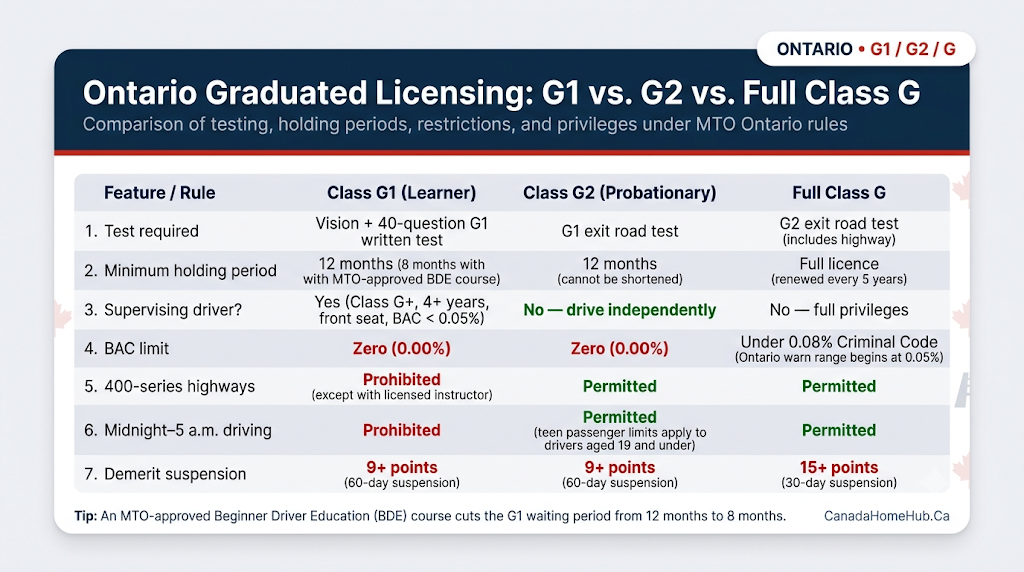
Completing a government-approved Beginner Driver Education (BDE) course reduces your G1 wait from 12 months to 8 months and may help you qualify for a novice driver insurance discount.
A 7-Day Study Plan and Common G1 Test Mistakes to Avoid
Spreading your preparation across one focused week improves recall far better than last-minute cramming.
Practical 7-Day G1 Knowledge Test Study Plan
-
Day 1: Read the Official MTO Driver's Handbook sections on licensing, G1 restrictions, seatbelts, and alcohol/drug rules.
- Day 2: Learn road sign shapes and colours; complete two road-sign quizzes.
- Day 3: Review right-of-way, flashing traffic signals, 4-way stops, streetcars, and pedestrian crossovers.
- Day 4: Memorize key Ontario numbers (20 m school bus, 150 m/60 m headlights, 150 m U-turn, 30 m crossover ban, 2 m streetcar, 2-second gap).
- Day 5: Study novice demerit thresholds (2–5, 6–8, 9+ points) and escalating sanctions (30 days / 90 days / cancellation).
- Day 6: Take at least three full 40-question Ontario G1 practice test simulations until you consistently hit 90%+ in both sections.
- Day 7: Review missed questions only, double-check your original ID documents, and confirm DriveTest hours.
Five Common Mistakes That Cause Applicants to Fail
-
Ignoring Rules of the Road after mastering Road Signs: Many applicants score 19/20 on signs and miss 16/20 on rules due to demerit points and exact distances.
- Relying on driving rules from another province or country: Ontario's flashing green light, streetcar stops, and novice sanctions often catch experienced newcomers off guard.
- Rushing through an untimed exam: Skimming past qualifiers like "except," "must not," or "minimum" leads to avoidable errors.
- Using U.S. DMV apps: Non-Ontario apps use miles, feet, and different laws that teach incorrect answers.
- Forgetting original ID or glasses: Photocopies and missing corrective lenses will delay your test.
Frequently Asked Questions About the Ontario G1 Practice Test
What score do I need to pass the Ontario G1 test?
You must score at least 80% on each section individually—at least 16/20 on Road Signs and at least 16/20 on Rules of the Road. An overall score of 80% across 40 questions does not pass if either section is below 16/20.
How much does the G1 test cost in Ontario, and what is the retake fee?
The initial G1 package costs $159.75 (covering your first written test, one G2 road test, and a five-year licence). Each written retake costs $16.00. Verify current fees on DriveTest.ca before visiting.
If I fail only one section of the G1 test, do I have to retake both?
No. Your passing score in the other section stays valid for one year, so you only pay the $16.00 retake fee and redo the section you missed. Many centres allow same-day retakes if capacity permits.
Do I need an appointment to take the G1 written test?
Most Ontario DriveTest Centres offer G1 written tests on a walk-in basis. However, select ServiceOntario locations (such as Bay and College in Toronto) require appointments, so check your local centre's rules before travelling.
How long is a G1 licence valid in Ontario?
A Class G1 licence is valid for five years and cannot be renewed. If it expires before you pass your G2 road test, you must reapply, retake the G1 exam, pay fees again, and restart the waiting period.
Can I take the G1 knowledge test in another language?
Yes. Ontario offers the exam in English, French, and numerous additional languages, though availability can vary by paper versus computer location. Check DriveTest's Translators & Languages page beforehand.
Next Steps to Pass Your Ontario G1 Test With Confidence
Passing the Ontario G1 knowledge test comes down to pairing the Official MTO Driver's Handbook with consistent multiple-choice practice until scoring well above 80% in both sections feels routine. Double-check Ontario's exact stopping distances, flashing signals, and novice demerit rules, and bring your original ID to DriveTest.
When you are ready for more drills beyond the sample questions above, visit Ontario G1 practice test for topic-by-topic questions and explanations. You can also explore free Canadian settlement guides and tools anytime on CanadaHomeHub.Ca.