Are you planning a relocation to Southwestern Ontario and researching the true cost of living Windsor offers? Positioned directly across the Detroit River from Detroit, Michigan, Windsor has earned a reputation as one of Ontario's most accessible, culturally diverse, and economically evolving mid-sized cities. Whether you are a remote worker priced out of the Greater Toronto Area (GTA), an international student enrolling at the University of Windsor or St. Clair College, or a young family searching for a detached home with a backyard, understanding your monthly numbers is the foundation of a successful move.
While housing affordability remains a major challenge across much of Canada, Windsor continues to provide a markedly lower barrier to entry. Average monthly rents sit roughly 12% below the Canadian national average, and single-family home prices remain roughly half of what buyers face in Toronto. In this complete guide, we break down the Windsor Ontario cost of living—covering current rental rates, neighbourhood price differences, groceries, utilities, transit, property taxes, and the exact salary needed to live comfortably in Canada's southernmost city.
Why Windsor Is Attracting Newcomers and Homebuyers
Windsor's appeal goes well beyond inexpensive housing. As Canada's southernmost city, it enjoys a distinct geographic and economic profile that sets it apart from other mid-sized Ontario communities such as London, Kitchener-Waterloo, or Hamilton.
First, Windsor offers unmatched cross-border connectivity. Sitting immediately opposite downtown Detroit, residents have quick access to major league sporting events, international concerts, world-class museums, and Detroit Metropolitan Wayne County Airport (DTW)—a major international hub located roughly 35 to 45 minutes from Windsor by car. Thousands of Windsor residents also commute daily across the border to work in Michigan's healthcare, engineering, and automotive sectors while enjoying Canadian healthcare, public safety, and community life.
Second, major infrastructure and industrial projects have reshaped the local economy. The opening of the six-lane Gordie Howe International Bridge in July 2026 established a direct highway-to-highway link between Ontario's Highway 401 and Michigan's Interstate 75, easing commercial freight congestion and strengthening Windsor's position as North America's busiest land border crossing. Alongside ongoing investments in electric vehicle (EV) battery manufacturing and clean-tech supply chains, the region continues to attract skilled tradespeople, engineers, and logistics professionals.
Third, climate plays a meaningful role. Because Windsor lies at roughly the same latitude as Northern California, it experiences milder winters, earlier springs, and longer, warmer summers than most other Ontario cities—translating into lower winter heating demands and more months of outdoor recreation along the riverfront.
Average Monthly Living Expenses in Windsor
Before examining individual bills, it helps to establish a realistic baseline for monthly expenses Windsor residents experience across different household sizes. Your total spending will depend primarily on whether you rent or own, whether you commute by car or public transit, and whether you have childcare expenses.
Estimated Monthly Budget for a Single Person
For a single adult living alone in Windsor, essential living expenses excluding rent typically range between CAD 1,250 and CAD 1,450 per month. This covers groceries, utilities, high-speed internet, a mobile phone plan, local transportation, personal care, and modest entertainment.
Once you add a one-bedroom apartment rental—averaging between CAD 1,345 and CAD 1,520 per month across the city—a single resident should plan on a total baseline monthly budget of CAD 2,600 to CAD 2,970. If you choose a newly built, amenity-rich apartment downtown or own a financed vehicle with full Ontario auto insurance, your monthly outlay can easily reach CAD 3,200 to CAD 3,500.
Estimated Monthly Budget for a Couple Without Children
Couples benefit substantially from sharing fixed housing and utility costs. Two adults sharing a one- or two-bedroom apartment in Windsor can expect non-housing expenses of roughly CAD 2,100 to CAD 2,450 per month (including groceries for two, two mobile plans, utilities, internet, and entertainment). Including rent for a spacious two-bedroom unit at roughly CAD 1,650 to CAD 1,825 per month, a couple's combined baseline budget sits around CAD 3,750 to CAD 4,275 per month.
Estimated Monthly Budget for a Family of Four
Raising a family in Windsor remains noticeably more budget-friendly than in the Golden Horseshoe, though food, transportation, and housing add up quickly. Excluding mortgage or rent payments and private childcare, a family of four typically spends between CAD 4,200 and CAD 4,800 per month on groceries, household supplies, utilities for a larger home, two vehicles, clothing, and extracurricular activities.
When you factor in renting a three-bedroom house or townhouse (averaging CAD 2,025 to CAD 2,300 per month) or carrying a mortgage and property taxes on a detached home, a family of four should budget approximately CAD 6,400 to CAD 7,300 per month for a comfortable, balanced lifestyle. Families with toddlers should also verify availability at daycare centres enrolled in the Canada-Wide Early Learning and Child Care (CWELCC) system, which caps eligible licensed childcare fees in Ontario far below historical market rates.
Housing and Rent in Windsor: Neighbourhoods, Leases, and Home Prices
Housing represents the largest line item in almost every Canadian household budget. Fortunately, rent Windsor rates and residential purchase prices give newcomers considerably more breathing room than almost any other major urban corridor in Southern Ontario.
Average Rent Prices by Unit Size and Property Type
Windsor's rental market stabilized after rapid pandemic-era growth, with average rents easing slightly over the past year as new purpose-built rental apartments came onto the market. Across all property types, the overall average rent in Windsor sits between CAD 1,520 and CAD 1,700 per month, compared to a Canadian national average exceeding CAD 1,930.
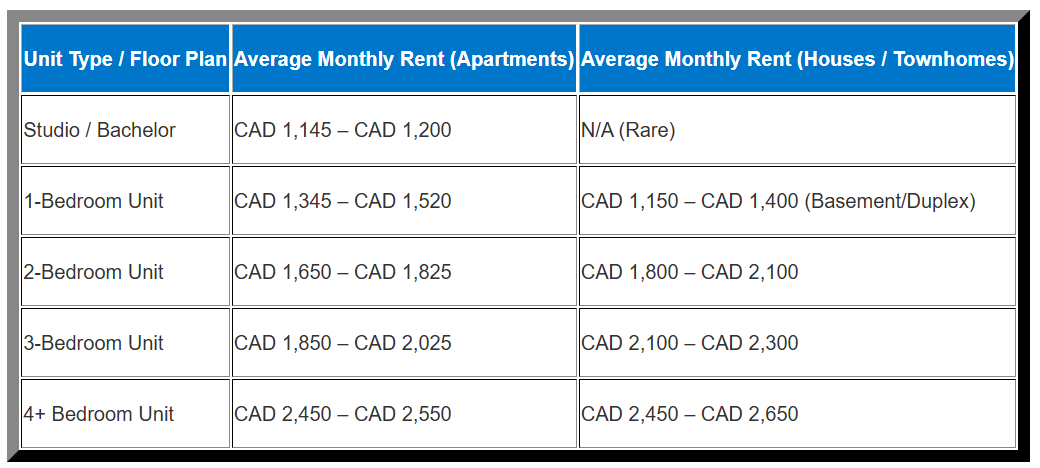
(Note: Figures reflect market averages across Windsor, ON. Newly constructed luxury buildings with in-suite laundry, underground parking, and fitness centres typically command CAD 200 to CAD 400 above city-wide averages, whereas older low-rise apartments often include heat and water in the base rent.)
Ontario Tenant Rules to Remember: In Ontario, landlords are legally permitted to request first and last month's rent as a deposit upon signing a lease under the Residential Tenancies Act, but security or damage deposits are not permitted. Additionally, residential units first occupied for residential purposes on or before November 15, 2018, are subject to Ontario's annual provincial rent increase guideline, whereas newer buildings constructed after that date are exempt from rent control caps. Always confirm a building's occupancy date before signing a lease.
Neighbourhood Breakdown: Where to Rent or Buy
Like any city, Windsor's housing costs vary noticeably by neighbourhood character, school districts, and proximity to the waterfront or Highway 401:
- Walkerville and Olde Walkerville: Located just east of downtown, Walkerville is one of Windsor's most walkable, character-rich neighbourhoods. Famous for its historic Tudor and Victorian homes, tree-lined avenues, independent coffee shops, and local restaurants, it is a top choice for young professionals and couples. One-bedroom apartments here generally range from CAD 1,450 to CAD 1,750, while renovated heritage homes frequently sell above the city median.
- South Windsor: Widely regarded as Windsor's premier family-oriented suburban district, South Windsor features quiet crescents, larger lots, strong public and Catholic school catchments, and quick access to the Ambassador Bridge, Highway 401, and Devonshire Mall. Detached two-storey homes and ranches here regularly trade between CAD 600,000 and CAD 850,000+.
- Riverside and East Windsor: Stretching along the Detroit River toward Tecumseh, Riverside offers scenic waterfront trails, marinas, and mid-century brick homes. East Windsor provides more affordable single-family homes and newer townhouse developments close to major manufacturing employers.
- Sandwich Town and West Windsor: Home to the University of Windsor and the Canadian approach to the Gordie Howe International Bridge, West Windsor has a high concentration of student rentals, multi-unit homes, and starter properties. Shared student housing rooms often rent for CAD 650 to CAD 850 per month, making it budget-friendly for students.
- Suburban Essex County (LaSalle, Tecumseh, Amherstburg): Many families working in Windsor choose adjacent municipalities for larger lot sizes and newer subdivisions. According to Windsor-Essex County Association of Realtors (WECAR) data, median sold prices in nearby communities sit higher than inside Windsor proper—around CAD 645,000 in LaSalle, CAD 652,500 in Tecumseh, and CAD 660,000 in Amherstburg.
Buying a Home and Property Taxes in Windsor
For newcomers aiming to transition from renting to homeownership, Windsor remains one of the most attainable real estate markets in Ontario. Market data from WECAR indicates a median sold price of approximately CAD 515,000 and an average sold price of roughly CAD 564,000 for single-family residential homes in Windsor-Essex, while condominiums and attached units average roughly CAD 376,000.
However, prospective buyers must budget carefully for two Ontario-specific ownership costs:
- Municipal Property Taxes: Windsor's residential property tax rate is approximately 2.0965% of a property's Municipal Property Assessment Corporation (MPAC) assessed value. While that percentage appears higher than Toronto's nominal tax rate, MPAC assessments in Ontario generally lag behind current market sale prices. As a result, a home purchased for CAD 525,000 might carry an MPAC assessed value closer to CAD 250,000–CAD 320,000, translating into an annual property tax bill of roughly CAD 5,200 to CAD 6,700 (or CAD 430 to CAD 560 per month). Always verify the exact current tax bill on the MLS listing before submitting an offer.
- Closing Costs and Stress-Test Qualification: Canadian mortgage rules require buyers to qualify under the federal Office of the Superintendent of Financial Institutions (OSFI) stress test while keeping Gross Debt Service (GDS) ratios at or below 39% and Total Debt Service (TDS) ratios at or below 44%. Before touring homes, you can run your exact numbers using the free Canadian mortgage payment, CMHC down payment, and Ontario Land Transfer Tax closing cost calculators on CanadaHomeHub.Ca—or connect with verified local realtors and mortgage brokers through CanadaHomeHub.Ca to map out your true purchase budget.
Everyday Living Costs: Groceries, Utilities, and Transportation
Once your housing cost is locked in, day-to-day operational bills determine how much money remains in your savings account at the end of each month.
Grocery and Dining Costs
Food prices in Windsor track slightly below the Ontario average, particularly if you shop strategically across discount banners and local Essex County produce markets. Because Essex County is one of Canada's premier agricultural and greenhouse-growing regions, fresh tomatoes, cucumbers, peppers, berries, and sweet corn are abundant and competitively priced from spring through autumn.
- Single Adult Monthly Grocery Budget: CAD 350 – CAD 475
- Family of Four Monthly Grocery Budget: CAD 1,050 – CAD 1,350
Typical retail prices at mainstream Windsor supermarkets (such as No Frills, FreshCo, Food Basics, Zehrs, and Metro) include:
- Milk (4-litre bag, standard in Ontario): CAD 5.89 – CAD 6.49
- Large Eggs (1 dozen): CAD 3.99 – CAD 4.49
- Loaf of Sliced Bread (675g): CAD 2.99 – CAD 3.79
- Boneless, Skinless Chicken Breasts (1 kg): CAD 14.50 – CAD 17.50
- Fresh Apples or Bananas (1 kg): CAD 2.20 – CAD 4.50
- Casual Restaurant Meal (per person, before tax & tip): CAD 18.00 – CAD 26.00
- Mid-Range Three-Course Dinner for Two: CAD 80.00 – CAD 110.00
(Tip: Remember that Ontario applies a 13% Harmonized Sales Tax (HST) to restaurant meals, prepared hot foods, and most non-essential retail goods, whereas basic groceries such as fresh produce, dairy, meat, and bread are zero-rated for HST.)
Utilities, Heating, Cooling, and Telecom
Windsor's humid continental climate means you will rely on natural gas or electric heating from November through March and central air conditioning during warm, humid summer months from June through September.
- Electricity and Water (ENWIN Utilities): Electricity in Ontario operates largely on Time-of-Use (TOU) or Tiered pricing regulated by the Ontario Energy Board. For a standard two-bedroom apartment, combined electricity and water bills average CAD 120 to CAD 175 per month; for a detached three-bedroom house, expect CAD 180 to CAD 260 per month depending on summer air-conditioning usage.
- Natural Gas Heating (Enbridge Gas): Most detached homes and many townhouses in Windsor use forced-air natural gas furnaces and gas water heaters. Monthly bills average CAD 85 to CAD 140 on an equal-billing plan (higher in January/February, lower in July).
- High-Speed Home Internet: Unlimited fibre or cable internet (150 Mbps to 1 Gbps) costs roughly CAD 65 to CAD 85 per month through major carriers or independent Ontario resellers like TekSavvy (which is headquartered nearby in Chatham-Kent).
- Mobile Phone Plan: Bring-your-own-device (BYOD) plans with 20GB to 50GB of 5G data typically run CAD 45 to CAD 65 per month per line.
Transportation: Owning a Car vs. Transit Windsor
Windsor is a geographically spread-out, auto-oriented city, though public transit serves major corridors and post-secondary campuses.
- Public Transit (Transit Windsor): Transit Windsor uses the Umo smart-fare system across city bus routes. A single adult cash or Umo wallet fare is CAD 3.95 (including a two-hour transfer window). A 30-day adult Umo pass costs CAD 124.00, while youth passes (ages 13–19) cost CAD 85.00 and senior/Affordable Pass Program (APP) monthly passes are CAD 63.00. Full-time University of Windsor and St. Clair College students generally receive discounted transit access via their mandatory U-Pass or Saints Pass programs.
- Owning a Vehicle: If you live outside the downtown-Walkerville-University core or work in suburban industrial parks, owning a car saves substantial commuting time. Regular gasoline in Windsor generally tracks near the Ontario average (around CAD 1.55 to CAD 1.75 per litre). One major financial advantage over the GTA is Ontario auto insurance: while GTA drivers routinely pay CAD 250 to CAD 350+ per month, Windsor drivers with clean records often pay between CAD 135 and CAD 195 per month. If you commute across the Detroit River, also factor in round-trip bridge or tunnel tolls (typically CAD 12 to CAD 18 round-trip depending on the crossing and commuter transponder discounts).
Salary Needed to Live in Windsor Comfortably
Understanding expenses is only half of the equation; the other half is knowing the salary needed to live in Windsor without financial stress.
Minimum Wage and Typical Local Earnings
Effective October 1, 2026, Ontario's general minimum wage is CAD 17.95 per hour (indexed annually to the Ontario Consumer Price Index). A full-time worker earning minimum wage at 40 hours per week generates a gross annual income of roughly CAD 37,336 (approximately CAD 2,520 per month net after federal/provincial income taxes, CPP, and EI deductions). Living alone on a single minimum-wage income in Windsor is tight and usually requires sharing a two- or three-bedroom apartment with roommates or qualifying for subsidized transit and tax credits.
Across Windsor's broader workforce—spanning automotive and EV battery manufacturing, healthcare (Windsor Regional Hospital and cross-border nursing), education, skilled trades, and logistics—individual full-time salaries more commonly range between CAD 52,000 and CAD 85,000 per year, while median after-tax household incomes sit comfortably above single-earner thresholds.
Recommended Income Benchmarks by Household Type
To follow a healthy 50/30/20 budgeting framework (50% toward essential needs like housing, food, and utilities; 30% toward lifestyle and discretionary spending; 20% toward savings, RRSP/TFSA investments, or debt repayment), aim for the following gross annual income benchmarks:
- Single Person Renting a 1-Bedroom Apartment:
- Target Gross Salary: CAD 52,000 to CAD 60,000 per year
- Estimated Net Monthly Take-Home Pay (Ontario): ~CAD 3,350 to CAD 3,800
- Why It Works: Keeps rent (CAD 1,450) near 30% of gross income and leaves room for utilities, groceries, transit or a modest car payment, and monthly savings.
- Couple Sharing a 2-Bedroom Rental:
- Target Combined Gross Income: CAD 85,000 to CAD 95,000 per year
- Estimated Net Monthly Take-Home Pay: ~CAD 5,500 to CAD 6,150
- Why It Works: Allows two working adults—even in early-career roles—to live comfortably, run one or two vehicles, travel occasionally, and save aggressively toward a home down payment.
- Family of Four Owning a Median-Priced Home:
- Target Combined Gross Income: CAD 115,000 to CAD 135,000 per year
- Estimated Net Monthly Take-Home Pay: ~CAD 7,300 to CAD 8,400
- Why It Works: Comfortably covers a mortgage on a CAD 515,000–CAD 550,000 home (assuming 10% to 20% down), Windsor property taxes, utilities, groceries for four, two cars, and children's activities.
Windsor vs. Toronto and London: Cost of Living Comparison
Many newcomers evaluating Windsor are deciding between relocating down Highway 401 from Toronto or choosing another Southwestern Ontario hub such as London. The comparison table below highlights how Windsor's core costs stack up against both cities.
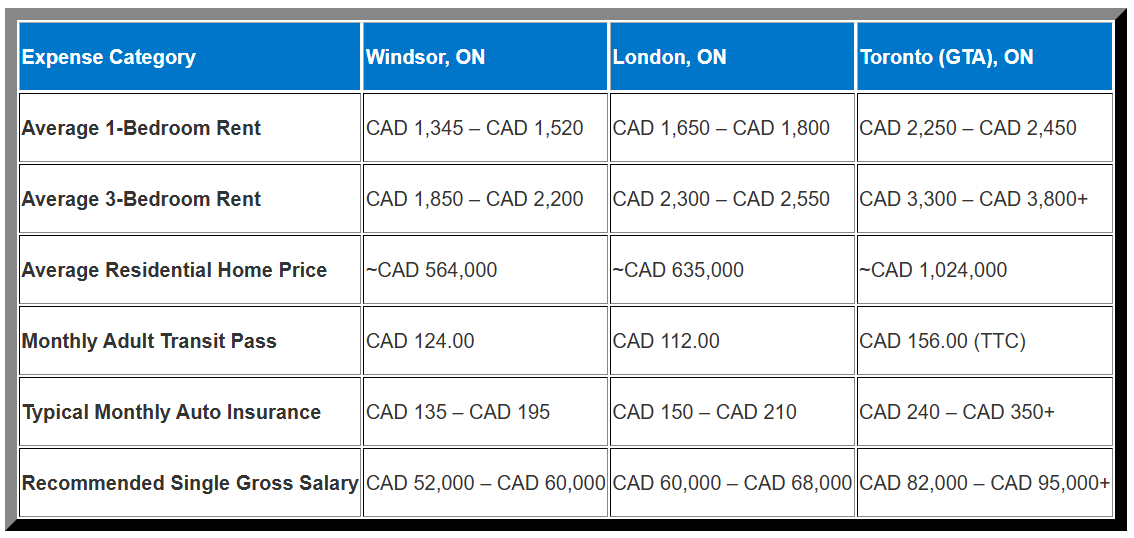
The Key Takeaway: Moving from Toronto to Windsor typically reduces housing costs by 30% to 45%, whether you rent or buy. Even if your local salary in Windsor is 10% to 15% lower than a comparable corporate role in Toronto, your net disposable income—and your ability to own a detached home—is dramatically stronger in Windsor. The primary trade-off is career depth: Toronto dominates finance, tech headquarters, and media, whereas Windsor excels in manufacturing, engineering, healthcare, cross-border trade, and remote work.
Practical Tips to Lower Your Monthly Expenses in Windsor
Whether you are arriving in Canada for the first time or relocating from another province, a few local strategies can save you hundreds of dollars every month:
- Prioritize All-Inclusive Older Low-Rise Rentals: Many brick walk-up apartment buildings built in the 1960s and 1970s in Walkerville, South Windsor, and Riverside include radiant hot-water heating and water in the monthly rent. Saving CAD 120 to CAD 160 per month on winter heating bills makes a noticeable difference—plus, buildings occupied prior to November 2018 benefit from Ontario rent control protections.
- Shop Local Produce Stands and Ethnic Grocers: Along Wyandotte Street, Ottawa Street, and Erie Street ("Via Italia"), independent bakeries, butcher shops, and international grocers frequently offer better prices on fresh meat, spices, and produce than large national chains. During summer and fall, roadside farm markets in nearby Kingsville, Harrow, and Leamington offer farm-direct produce at steep discounts.
- Maximize Canadian First-Time Home Buyer Programs: If you plan to buy in Windsor, combine the federal First Home Savings Account (FHSA)—which offers tax-deductible contributions and tax-free withdrawals for a first home—with the Ontario Land Transfer Tax Refund (worth up to CAD 4,000 for eligible first-time buyers). You can model how different down payment tiers affect CMHC mortgage default insurance premiums and closing cash requirements on CanadaHomeHub.Ca.
- Watch Exchange Rates Before Cross-Border Shopping: While driving across to Michigan for groceries, clothing, or outlet shopping is a classic Windsor pastime, always factor in the USD-to-CAD exchange rate, credit card foreign transaction fees, and Canada Border Services Agency (CBSA) personal exemption limits before assuming an item is cheaper across the river.
Frequently Asked Questions (FAQs)
Is Windsor, Ontario cheaper to live in than Toronto?
Yes, significantly. Overall living costs in Windsor are roughly 15% to 25% lower than in Toronto, driven primarily by housing. Average one-bedroom rents in Windsor are roughly CAD 800 to CAD 950 lower per month than in Toronto, and average home prices are nearly half of Toronto's average. Auto insurance and parking costs are also substantially lower.
What is the average rent for a 1-bedroom apartment in Windsor?
Average monthly rent for a one-bedroom apartment in Windsor ranges between CAD 1,345 and CAD 1,520. Basement apartments and older low-rise units outside the downtown core can sometimes be found for CAD 1,150 to CAD 1,350, while newer luxury apartments with modern amenities often rent for CAD 1,750 to CAD 1,950.
What salary do you need to live alone in Windsor, Ontario?
A single person renting a one-bedroom apartment can live comfortably in Windsor on a gross annual salary of CAD 52,000 to CAD 60,000. This provides roughly CAD 3,350 to CAD 3,800 per month in net after-tax income in Ontario, easily covering rent, utilities, groceries, transportation, and modest savings.
Are property taxes high in Windsor compared to other Ontario cities?
Windsor's residential property tax rate (roughly 2.0965% of MPAC assessed value) is higher as a percentage than in Toronto or Mississauga. However, because MPAC assessed values in Windsor are much lower than actual market values, the total annual dollar amount paid by most Windsor homeowners—typically CAD 4,500 to CAD 6,800 per year—is comparable to or lower than property tax bills in the GTA.
Is Windsor a good city for international students and newcomers to Canada?
Yes. Windsor is one of the most multicultural cities in Canada, with over a quarter of its population born outside Canada. With two major post-secondary institutions (the University of Windsor and St. Clair College), active settlement agencies, diverse grocery options, and lower rent than Toronto or Vancouver, it is a welcoming and practical landing spot for newcomers.
Can you live in Windsor without a car?
You can live without a car if you choose your neighbourhood carefully—specifically near Downtown, Walkerville, the University of Windsor, or along major Transit Windsor bus routes such as the Transway 1C or Crosstown 2. However, for families or workers commuting to suburban industrial parks in East Windsor, Tecumseh, or LaSalle, owning a vehicle is much more convenient.
Conclusion: Making the Move to Windsor, Ontario
The cost of living Windsor offers makes it one of the most compelling value propositions in Ontario. By pairing rents roughly 12% below the national average with attainable home prices, mild Canadian weather, and direct cross-border access to Detroit, Windsor allows individuals and families to build genuine financial stability without sacrificing urban amenities.
If you earn around CAD 55,000 as a single resident or CAD 115,000+ as a household, you can afford a comfortable lifestyle, own a home, and still set money aside for your future. As you plan your budget or compare neighbourhoods, explore the free Canadian mortgage, affordability, and closing cost calculators - or connect with verified local real estate and mortgage professionals - at CanadaHomeHub.Ca to take your next step with confidence.
Thank you for reading our article!