
Understanding the real estate market in Canada requires looking well beyond national headline numbers. While news reports frequently spotlight a single national average home price or a sudden shift in monthly sales volume, Canada does not operate as one unified housing market. Home values, inventory levels, and buyer competition can move in opposite directions at the same time between Vancouver, Calgary, Toronto, Montreal, and Halifax—and even between downtown condominiums and suburban detached houses within the same city.
For homebuyers, sellers, and investors, making sound decisions means understanding the mechanics behind home prices in Canada: how prices are measured, how monetary policy and federal lending rules influence borrowing capacity, why regional supply dynamics diverge so sharply, and how provincial regulations affect total transaction costs. This guide breaks down the structural drivers and housing market trends in Canada so you can evaluate local conditions with clarity rather than relying on broad national averages.
How the Canadian Real Estate Market Is Measured
Before interpreting any market forecast or monthly board release, it helps to understand the core metrics published by the Canadian Real Estate Association (CREA) and local real estate boards. Misreading these indicators is one of the most common reasons buyers and sellers misjudge market momentum.
MLS® Home Price Index (HPI) vs. National Average Sale Price
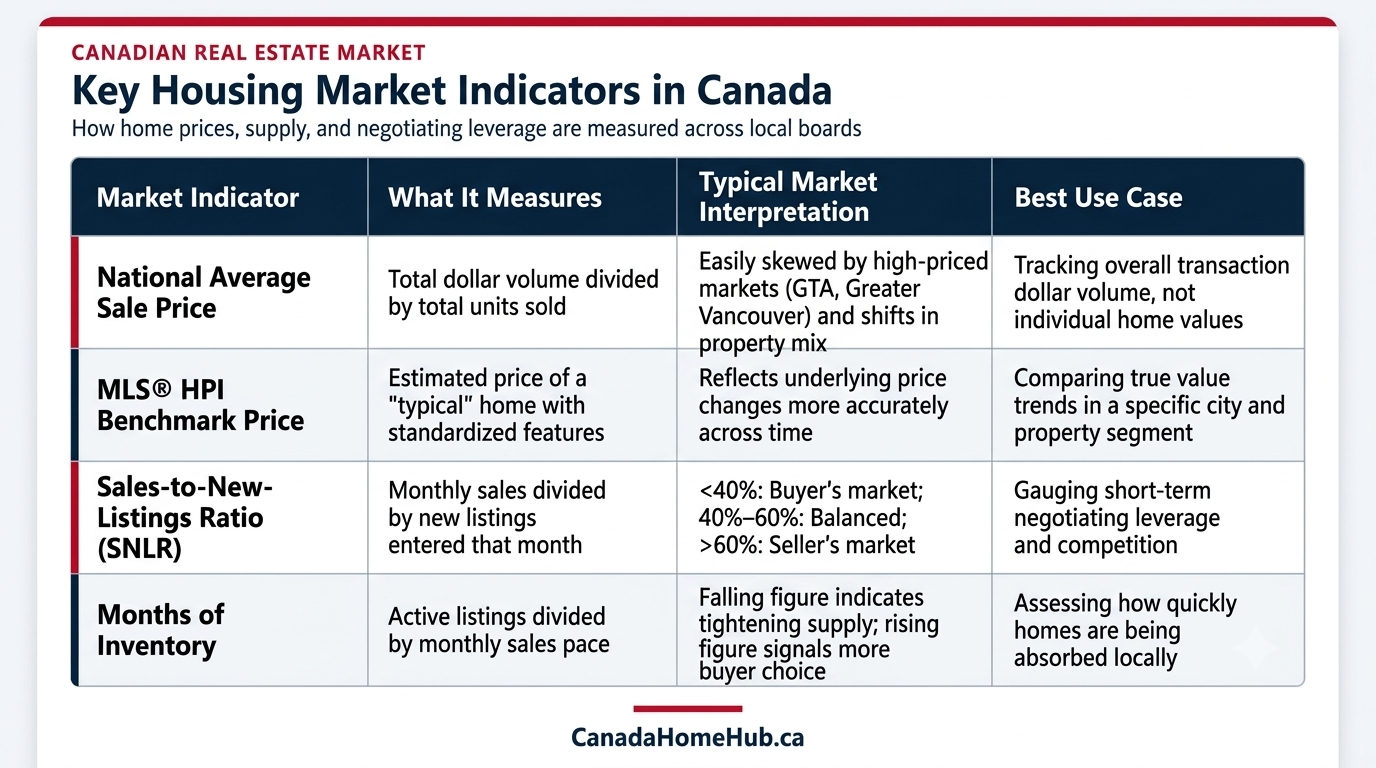
The national average sale price is calculated by adding the total dollar value of all homes sold in a given month and dividing by the number of sales. Because it is a simple arithmetic average, it is heavily skewed by changes in the mix of properties sold. For example, if luxury home sales in Greater Toronto and Greater Vancouver temporarily surge while entry-level condo sales slow down, the national average price can appear to jump sharply—even if the actual market value of an individual home barely moved.
By contrast, the MLS® Home Price Index (HPI) tracks a "benchmark" home with consistent, typical attributes (such as square footage, number of bedrooms, and neighbourhood profile) over time. Economists and mortgage analysts favour the MLS® HPI for tracking true price appreciation or softening because it filters out compositional distortions. When researching the housing market in Canada, always check your local real estate board's benchmark price by property type rather than relying solely on the national average.
Sales-to-New-Listings Ratio (SNLR) and Months of Inventory
Price trends rarely change in isolation; they follow shifts in supply and demand. Two inventory indicators signal where leverage sits between buyers and sellers:
- Sales-to-New-Listings Ratio (SNLR): Measures the percentage of newly listed properties that sell during a given period. According to standard CREA guidelines, an SNLR below 40% generally indicates a buyer's market (more supply than demand, giving buyers negotiating room), 40% to 60% represents a balanced market, and above 60% points to a seller's market (tight supply, faster sales, and greater likelihood of multiple-offer scenarios).
- Months of Inventory: Estimates how many months it would take to sell all currently listed properties at the current pace of sales, assuming no new listings enter the market. Lower months of inventory signal tighter conditions and upward price pressure, while rising inventory points to cooling demand or increased seller competition.
Core Economic and Policy Forces Shaping Home Prices in Canada
Short-term swings in the Canadian real estate market are driven largely by financing costs and buyer sentiment, while long-term price trajectories reflect structural supply, demographic demand, and government policy.
Bank of Canada Policy Rates and Government Bond Yields
Interest rates are the most immediate lever affecting home prices in Canada, yet many buyers misunderstand how different mortgage products respond to rate changes:
- Variable-Rate Mortgages and HELOCs: Directly linked to lenders' prime rates, which move in tandem with the Bank of Canada's overnight policy rate. When the central bank cuts or raises its policy rate, variable-rate borrowing costs adjust quickly.
- Fixed-Rate Mortgages: Primarily priced off Government of Canada bond yields (especially the 5-year bond yield for Canada's popular 5-year fixed term), plus a lender spread. Because bond markets constantly price in future inflation and economic expectations, fixed mortgage rates often rise or fall weeks or months before the Bank of Canada formally announces a policy rate change.
Lower borrowing costs expand purchasing power and typically bring sidelined buyers back into the market. However, rate cuts do not automatically make homes more affordable if renewed demand pushes sale prices higher faster than monthly interest savings accumulate.
The Federal Mortgage Stress Test and Insured Lending Rules
Federal underwriting standards set by the Office of the Superintendent of Financial Institutions (OSFI) act as a built-in ceiling on household leverage. Under the federal Minimum Qualifying Rate (MQR)—commonly called the mortgage stress test—borrowers applying at federally regulated lenders must prove they can afford payments at the higher of 5.25% or their contract mortgage rate plus 2%.
Alongside the stress test, Canada's mortgage default insurance framework—administered through the Canada Mortgage and Housing Corporation (CMHC) and private insurers Sagen and Canada Guaranty—shapes entry-level demand:
- Buyers putting less than 20% down must obtain mortgage default insurance, which adds an insurance premium (typically rolled into the mortgage balance) and imposes federal caps on maximum purchase prices and amortization periods.
- Recent federal housing policy updates have focused on expanding insured mortgage price caps and extending 30-year amortizations for eligible buyers (such as first-time buyers and purchasers of newly built homes) to ease monthly payment pressure. Because federal eligibility criteria and insured price caps can change through annual federal budgets, prospective buyers should always verify current rules directly with CMHC or a licensed Canadian mortgage broker.
Population Growth, Housing Supply, and Construction Costs
Long-term housing market trends in Canada remain tightly tied to the balance between household formation and new housing completions. Research from CMHC has consistently highlighted a structural gap between Canada's pace of residential construction and the volume of housing required to restore historical affordability levels.
Several bottlenecks keep new supply slow to respond to demand:
- High Construction Financing and Input Costs: Elevated borrowing costs for developers, along with skilled trades labour shortages and material costs, can delay or cancel pre-construction condo and purpose-built rental projects when pre-sales stall.
- Municipal Approvals and Development Charges: Lengthy rezoning timelines and rising municipal development charges add significant upfront cost to new builds, particularly in high-growth Ontario and British Columbia municipalities.
- Demographic Shifts: Changes to federal permanent immigration targets and temporary resident policies directly influence rental vacancy rates first, and eventually filter into investor demand and entry-level home sales.
Federal, Provincial, and Municipal Housing Policies Explained
A frequent mistake when analysing the real estate market in Canada is assuming that housing rules apply uniformly from coast to coast. In practice, three levels of government regulate different parts of a transaction:
- Federal Level: Controls monetary policy (Bank of Canada), federally regulated mortgage underwriting (OSFI), mortgage insurance (CMHC), national tax-advantaged savings programs like the First Home Savings Account (FHSA) and Home Buyers' Plan (HBP), and nationwide restrictions such as the Prohibition on the Purchase of Residential Property by Non-Canadians Act (subject to specific exemptions and legislative timelines).
- Provincial Level: Governs real estate licensing, contract law, landlord-tenant regulations, rent control rules, cooling-off periods (such as British Columbia's Home Buyer Rescission Period), provincial speculation or foreign-buyer taxes, and provincial land transfer taxes.
- Municipal Level: Controls local zoning bylaws (including recent shifts toward multiplexes and transit-oriented density), annual property tax rates, vacant home taxes in selected cities, and—in the case of the City of Toronto—an additional Municipal Land Transfer Tax (MLTT) charged on top of Ontario's provincial tax.
Regional Housing Market Trends Across Canada
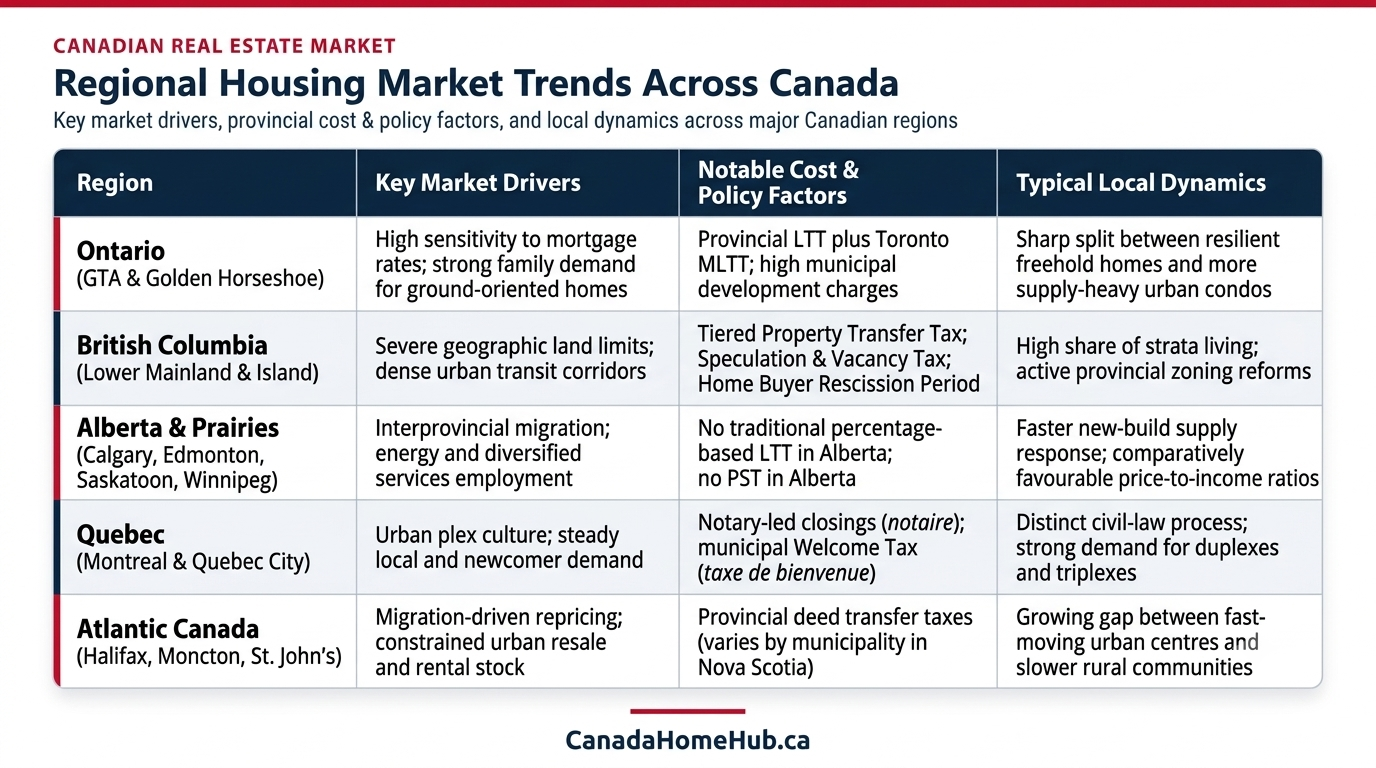
Because local economies, land availability, migration patterns, and provincial taxes vary dramatically, national trends rarely tell the full story. Examining Canada's five major regional markets illustrates why local due diligence is indispensable.
Ontario: Interest-Rate Sensitivity and Urban-Suburban Shifts
Ontario—led by the Greater Toronto Area (GTA), Ottawa, Hamilton, and Kitchener-Waterloo—carries some of the highest home prices and household debt loads in the country. As a result, Ontario tends to react sharply to interest-rate cycles.
A defining feature of Ontario's market is the divergence between freehold homes and condominiums. Well-located detached houses and freehold townhouses continue to attract move-up families facing limited low-rise land supply, whereas dense urban condo markets have periodically absorbed heavy waves of new completions alongside more cautious investor demand. Buyers in the City of Toronto must also account for dual land transfer taxes (provincial and municipal), though eligible first-time buyers receive partial rebates on both.
British Columbia: Land Constraints and Density Policies
Greater Vancouver, the Fraser Valley, and Victoria face unique geographic constraints: ocean, mountains, and the protected Agricultural Land Reserve sharply limit outward suburban sprawl. Consequently, strata properties (condominiums and strata townhomes) represent a much larger proportion of transactions than in most other provinces.
British Columbia has also enacted some of Canada's most active provincial housing policies, including the Property Transfer Tax (PTT) with tiered rates on higher-value homes, the Speculation and Vacancy Tax in designated regions, short-term rental restrictions, and legislation encouraging small-scale multi-unit housing and higher density near transit hubs. Buyers also benefit from a statutory Home Buyer Rescission Period, which allows a short window to cancel an accepted residential offer subject to a statutory rescission fee.
Alberta and the Prairies: Affordability and Interprovincial Migration
Calgary, Edmonton, Saskatoon, and Winnipeg have historically maintained far stronger price-to-income ratios than Toronto or Vancouver. When affordability tightens in Ontario and British Columbia, interprovincial migration frequently redirects demand toward Alberta in particular.
Two structural factors distinguish Alberta's housing market:
- Lower Transaction Friction: Alberta has no provincial sales tax (PST) and does not charge a percentage-based provincial land transfer tax comparable to Ontario or BC; instead, buyers pay relatively modest land title and mortgage registration fees.
- More Elastic New Supply: Fewer geographic barriers around major Prairie cities allow builders to expand suburban supply more quickly, which helps moderate runaway price spikes over multi-year cycles—though oil, gas, and broader economic cycles still create periods of local volatility.
Quebec: Distinct Legal Norms and Multiplex Culture
Greater Montreal and Quebec City combine relatively moderate entry prices (compared to Toronto and Vancouver) with a distinctive real estate environment rooted in Quebec's civil law system. Unlike common-law provinces where real estate lawyers handle closings, real estate transactions in Quebec are finalized by a notary (notaire). Standard offers are drafted using regulated promesse d'achat forms overseen by the Organisme d'autoréglementation du courtage immobilier du Québec (OACIQ).
Quebec also stands apart architecturally: duplexes, triplexes, and larger "plexes" are deeply embedded in urban neighbourhoods, offering owner-occupiers a widely used path to offset mortgage costs through rental income. Buyers should budget for the municipal transfer duty—commonly nicknamed the Welcome Tax (taxe de bienvenue)—which is billed by the municipality after closing.
Atlantic Canada: Repricing and Inventory Constraints
Halifax, Moncton, Saint John, Charlottetown, and St. John's experienced substantial repricing during the early 2020s due to remote-work relocations, interprovincial migration, and population growth that outpaced local housing starts. While benchmark prices remain lower than in Canada's largest metros, local wages have not always risen at the same pace, creating sharper affordability pressures for resident buyers and tight rental conditions in major urban centres. Outside provincial capitals, rural and coastal markets can display much slower liquidity and wider seasonal swings.
Property Type Trends: Detached Homes, Townhouses, and Condos
Within the same metropolitan area, housing market trends in Canada often split along property-type lines:
- Detached Houses: Carry the highest land-value component, which generally supports stronger long-term appreciation in supply-constrained cities. However, they also require the largest down payments and expose owners to full roof, foundation, landscaping, and utility maintenance costs.
- Townhouses and Semi-Detached Homes: Serve as the primary "missing middle" option for buyers transitioning out of apartments. Buyers must carefully distinguish between freehold townhouses (where you own the structure and land with no monthly condo fee) and condo or strata townhouses (which carry monthly fees covering shared roofs, driveways, or exterior upkeep).
- Condominiums: Provide the lowest upfront entry price and a lock-and-leave lifestyle, making them popular with first-time buyers, downsizers, and investors. However, condo buyers must review the status certificate (Ontario) or strata documents (BC), reserve fund study, and meeting minutes to assess building health, rising monthly fees, and potential special assessments.
Why Entry Price Does Not Equal Monthly Affordability (Illustrative Example)
Many first-time buyers focus almost exclusively on sticker price when comparing a downtown condo with a suburban freehold townhouse. Yet monthly ownership expenses—and how lenders calculate your Gross Debt Service (GDS) and Total Debt Service (TDS) ratios—can narrow the gap considerably.
Consider the following illustrative hypothetical scenario comparing two insured purchases with a 10% down payment, a 25-year amortization, and an illustrative 4.50% mortgage rate (using standard Canadian semi-annual compounding and a 3.10% default insurance premium added to the mortgage):
- Option A — Illustrative Downtown Condo ($600,000 purchase price):
- Down payment (10%): $60,000 | Base loan: $540,000 | Insured mortgage (with 3.10% premium): $556,740
- Estimated monthly mortgage principal & interest: ~$3,080
- Monthly condo/strata fee (illustrative): $650
- Estimated property tax ($280) + condo insurance & utilities/upkeep ($220): $500
- Estimated total monthly carrying cost: ~$4,230
- Option B — Illustrative Suburban Freehold Townhouse ($750,000 purchase price):
- Down payment (10%): $75,000 | Base loan: $675,000 | Insured mortgage (with 3.10% premium): $695,925
- Estimated monthly mortgage principal & interest: ~$3,850
- Monthly condo/strata fee: $0
- Estimated property tax ($360) + home insurance, utilities & maintenance reserve ($450): $810
- Estimated total monthly carrying cost: ~$4,660
Even though the freehold townhouse costs $150,000 more upfront, the estimated monthly carrying-cost difference narrows to roughly $430 per month once condo fees are included. Moreover, Canadian lenders generally include 50% of monthly condo fees inside GDS/TDS debt-service calculations, meaning high condo fees directly reduce maximum mortgage qualification. Comparing total monthly carrying costs alongside commuting expenses and long-term maintenance reserves yields a far more accurate picture of true affordability.

Practical Strategies for Navigating the Housing Market in Canada
Whether the local market favours buyers, sellers, or balanced negotiations, disciplined preparation outperforms speculation. Readers researching regional shifts, affordability considerations, and local housing guides can review educational resources on CanadaHomeHub.Ca alongside official releases from CREA, CMHC, and their provincial real estate board.
Guidance for First-Time Homebuyers
-
Secure a Full Mortgage Pre-Approval Early: A true pre-approval (backed by verified income, credit, and down payment documentation) typically locks in an interest rate hold for 90 to 120 days, protecting you if fixed rates rise while you shop.
- Coordinate Registered Tax Accounts: Eligible Canadian buyers can combine the First Home Savings Account (FHSA)—which offers tax-deductible contributions and tax-free qualifying withdrawals—with the Home Buyers' Plan (HBP) from an RRSP to accelerate down payment savings. Confirm current annual and lifetime contribution caps via the Canada Revenue Agency (CRA).
- Budget Realistically for Closing Costs: Set aside roughly 1.5% to 4% of the purchase price for closing costs, including provincial/municipal land transfer taxes (net of any first-time buyer rebates), legal or notary fees, title insurance, home inspection, and property tax adjustments.
- Never Skip Due Diligence: Even in competitive neighbourhoods, build in financing, home inspection, and status-certificate/strata-document review conditions whenever local market conditions allow—or arrange pre-offer inspections and document reviews with qualified professionals.
Guidance for Move-Up Buyers and Homeowners Facing Mortgage Renewal
-
Match Your Buy/Sell Sequence to Local SNLR: In a buyer's market (SNLR below 40%), selling your current home first reduces the risk of carrying two properties if your listing takes longer to sell. In a tight seller's market (SNLR above 60%), buying first can protect you from being priced out while searching—provided you qualify for bridge financing and set conservative sale-price expectations for your existing property.
- Start Renewal Shopping 120 Days Ahead: Homeowners rolling off lower pandemic-era interest rates into higher renewal rates should begin comparing lender offers three to four months before maturity. Remember that switching lenders at renewal may trigger a new stress-test qualification depending on current OSFI rules for insured vs. uninsured mortgages, so verify transfer requirements early.
- Understand Mortgage Portability and Penalties: If you move mid-term, ask your lender whether your existing mortgage is portable and check how prepayment penalties are calculated—especially Interest Rate Differential (IRD) penalties on fixed-rate mortgages, which can be substantially higher than the standard three-month interest penalty on variable-rate loans.
Guidance for Residential Real Estate Investors
Investing in the real estate market in Canada has shifted away from relying purely on rapid short-term price appreciation toward disciplined cash-flow and balance-sheet analysis:
- Stress-Test Cash Flow Under Realistic Scenarios: Model rental properties using conservative rent assumptions, a 5%–10% vacancy and maintenance buffer, property management fees, rising insurance premiums, and potential rate adjustments at renewal.
- Know Provincial Tenancy Laws Before Buying: Rent-increase guidelines, eviction procedures, and dispute-resolution timelines vary dramatically across provinces—from Ontario's Landlord and Tenant Board (LTB) and BC's Residential Tenancy Branch (RTB) to Quebec's Tribunal administratif du logement (TAL) and Alberta's more flexible rent-adjustment rules.
- Factor in Tax Treatment: Rental income is taxable, capital gains on non-principal residences are subject to federal and provincial tax rules, and short-term rentals face strict municipal licensing and federal income-tax deduction rules in non-compliant jurisdictions. Always consult a Canadian Chartered Professional Accountant (CPA) before structuring an investment purchase.
Common Mistakes to Avoid When Analysing Home Prices in Canada
Even experienced buyers and sellers regularly fall into predictable analytical traps when following the Canadian real estate market:
- Treating National Averages as Local Pricing: A 5% national move tells you almost nothing about a three-bedroom bungalow in Edmonton or a one-bedroom condo in downtown Toronto. Always drill down to city, neighbourhood, and property-type MLS® HPI data.
- Trying to Time the Exact Bottom of Interest Rates: Waiting for the lowest possible interest rate often backfires if thousands of sidelined buyers re-enter the market simultaneously, driving up sale prices and eroding the benefit of a slightly lower rate. Focus on whether the monthly payment fits your budget comfortably today rather than chasing a theoretical market bottom.
- Underestimating Non-Mortgage Ownership Costs: Property taxes, municipal utilities, rising home insurance premiums, condo special assessments, and major capital repairs (roofs, furnaces, windows) can easily add hundreds of dollars per month beyond mortgage payments.
- Assuming Rules From One Province Apply Elsewhere: Moving from Toronto to Montreal or Calgary introduces entirely different closing professionals, transfer tax structures, disclosure forms, and cooling-off rights. Work with locally licensed real estate and legal professionals in your destination province.

Frequently Asked Questions About the Real Estate Market in Canada
How can I tell whether my local Canadian city is in a buyer's or seller's market?
Check the local real estate board's monthly Sales-to-New-Listings Ratio (SNLR) and months of inventory for your specific property type. Generally, an SNLR below 40% signals a buyer's market with more room to negotiate price and conditions, 40% to 60% reflects balanced conditions, and above 60% indicates a seller's market where competing offers are more common.
What is the minimum down payment required to buy a home in Canada?
Under federal rules for owner-occupied residential properties, buyers generally need 5% on the first $500,000 of the purchase price and 10% on the portion above $500,000 up to the federal insured mortgage threshold. Homes priced above the insured threshold—as well as most non-owner-occupied investment properties—require at least 20% down. Because federal insured caps can be updated, confirm exact thresholds with CMHC or your mortgage lender before making an offer.
How does the Canadian mortgage stress test affect borrowing power?
Under OSFI's Minimum Qualifying Rate rules, borrowers applying at federally regulated lenders must qualify at the higher of 5.25% or their contract mortgage rate plus 2%. This buffer reduces the maximum mortgage amount a household can borrow compared to qualifying at the contract rate alone, helping ensure borrowers can absorb potential interest rate increases at renewal.
What government programs help first-time homebuyers in Canada?
Key federal programs include the First Home Savings Account (FHSA), the Home Buyers' Plan (HBP) allowing tax-free RRSP withdrawals subject to repayment rules, and the First-Time Home Buyers' Tax Credit. Several provinces and municipalities—including Ontario, British Columbia, and the City of Toronto—also offer partial land or property transfer tax rebates for qualifying first-time buyers.
Conclusion
Navigating the real estate market in Canada comes down to separating broad national noise from neighbourhood-level fundamentals. While Bank of Canada interest rates, OSFI lending guidelines, and national demographic trends set the overall backdrop, your real buying or selling power depends on local inventory balance, provincial closing rules, and the total monthly carrying cost of the specific property type you choose.
Before making a move, review your local real estate board's latest MLS® HPI and SNLR figures, secure a fully underwritten mortgage pre-approval, and verify current federal and provincial program rules with qualified mortgage and legal professionals. To continue building your knowledge of regional price drivers and Canadian homeownership essentials, explore additional guides and updates on CanadaHomeHub.Ca.