Reading Discover Canada from cover to cover is essential, yet passive reading rarely prepares you for exam-day pressure. The real Immigration, Refugees and Citizenship Canada (IRCC) test asks you to recall specific constitutional, historical, and geographic facts against a live countdown clock.
Using a Canadian citizenship test simulator closes that gap. A realistic simulator recreates the official exam environment: 20 mixed multiple-choice and true-or-false questions, a 45-minute timer, and a 75% passing threshold built around the official study guide.
Below, you will learn how the current IRCC format works, which Discover Canada topics cause the most mistakes, how to apply a structured simulation loop, and what technical rules govern the online test.
How the Real Canadian Citizenship Test Works
Before relying on any practice citizenship test, verify that it matches IRCC's current rules. Citizenship testing procedures have changed over the years, and outdated study tools can train you for the wrong conditions.
Official IRCC Format, Timing, and Eligibility
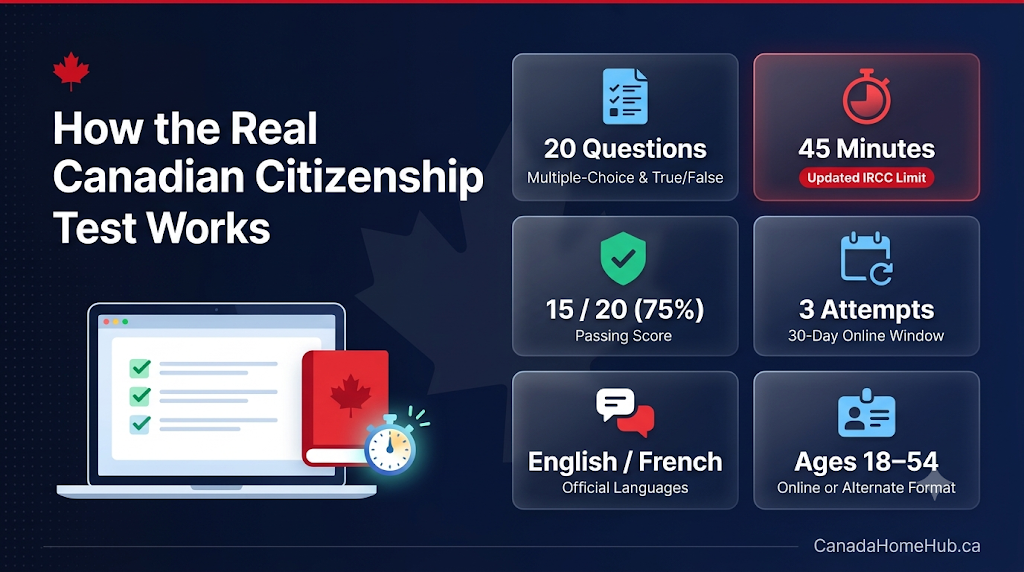
Under current IRCC guidelines, the Canadian citizenship knowledge test follows a standard structure:
- Questions: 20 total, mixing multiple-choice and true-or-false formats.
- Time limit: 45 minutes, with an automated warning at the 5-minute mark. Once started, the clock cannot be paused and auto-submits when time runs out.
- Passing score: At least 15 correct answers out of 20 (75%).
- Languages: English or French.
- Attempts: Up to 3 chances to pass within your 30-day testing window.
- Official source: Every question is drawn from Discover Canada: The Rights and Responsibilities of Citizenship.
Applicants aged 18 to 54 on the day they sign their application generally must take the test. Most are invited to complete the citizenship test online in Canada—or from outside Canada, provided they meet all technical and monitoring rules. Applicants who need accessibility accommodations (such as Braille, large print, or an oral format) can request an alternate testing arrangement from IRCC.
Why Outdated 30-Minute Practice Quizzes Mislead Test Takers
Many older websites and mobile apps still set their citizenship test 20 questions timer to 30 minutes, reflecting an older IRCC standard. Today's 45-minute limit gives you an average of 2 minutes and 15 seconds per question. Practising under an artificial 30-minute rush trains you to skim and miss subtle phrasing in true-or-false items, whereas pacing yourself for 45 minutes lets you read carefully and review flagged answers.
Why Use a Canadian Citizenship Test Simulator Instead of Plain Quizzes?
Chapter flashcards help you learn individual facts, but a dedicated Canadian citizenship test simulator builds the exact test-taking skills needed on exam day.
Replicating Context-Switching and Active Recall
In a single-chapter quiz, your brain already knows the topic. On the real IRCC exam, questions jump freely from the Magna Carta to Prairie economies to the role of the Governor General. A full-length citizenship exam simulator for Canada trains you to switch topics accurately while managing a live clock.
More importantly, testing yourself before re-reading triggers active recall, which improves long-term retention far more than highlighting pages. When every missed answer links back to Discover Canada, each 20-question mock exam functions as a diagnostic check. Platforms such as CanadaHomeHub.Ca pair timed 20-question simulations with a structured Discover Canada study loop and a free progress dashboard, keeping your scores and study history organized in one place.
Comparison: Full Exam Simulator vs. Chapter Quizzes vs. Reading Alone
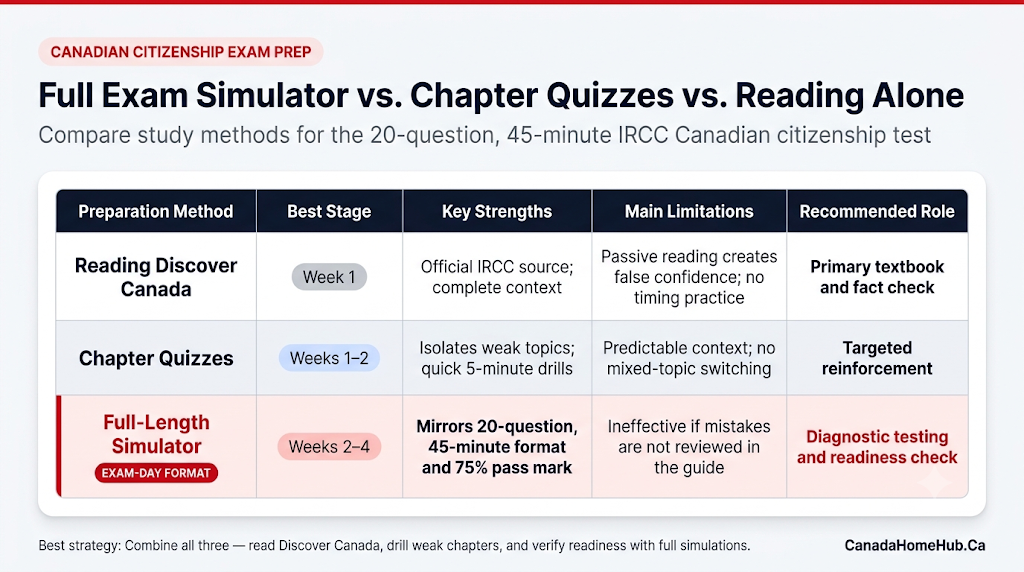
The best approach combines all three: read Discover Canada for accuracy, drill weak chapters, and verify readiness with full simulations.
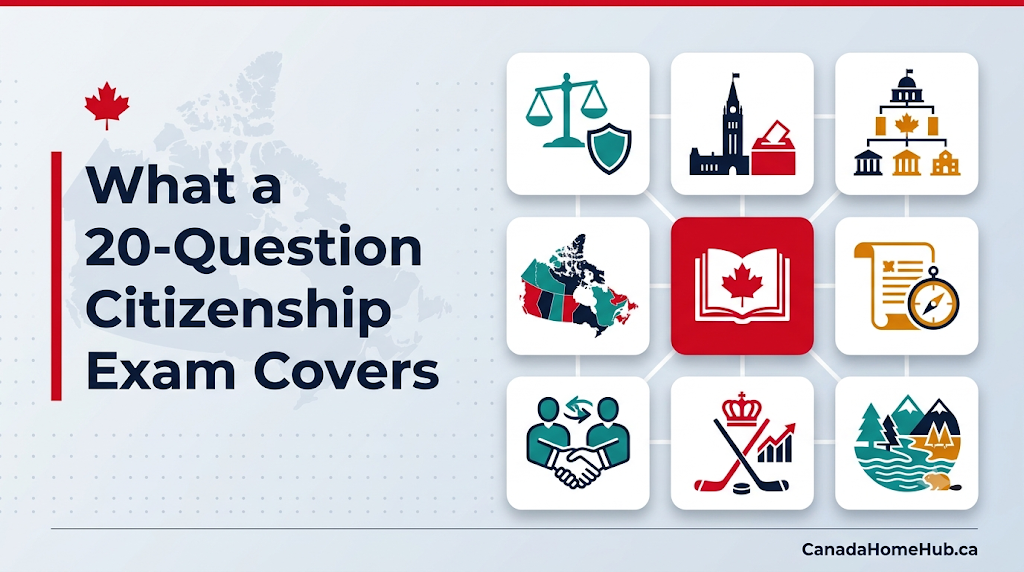
What a 20-Question Citizenship Exam Covers
Every official question comes from Discover Canada, assessing your knowledge of Canadian citizenship rights and responsibilities alongside Canada's history, government, laws, symbols, economy, and geography.
Core Discover Canada Study Domains
A reliable citizenship test 20 questions simulator draws evenly across all chapters rather than overemphasizing dates. The foundation rests on Rights and Responsibilities and Who We Are. Expect questions on the Magna Carta (1215), the Canadian Charter of Rights and Freedoms (1982), mobility rights, obeying the law, jury duty, and voting—where test takers often confuse constitutional rights (like freedom of expression) with civic responsibilities (like serving on a jury). IRCC also tests Canada's identity through its three founding peoples—Indigenous peoples (referred to as Aboriginal peoples in Discover Canada: First Nations, Inuit, and Métis), the French, and the British—along with bilingualism and multiculturalism. Mixing up First Nations, Inuit, and Métis definitions is a frequent mistake.
Canada's History and Modern Canada form a second core pillar. Historical items cover early Indigenous presence, Jacques Cartier and Samuel de Champlain, the War of 1812, Confederation on July 1, 1867, Sir John A. Macdonald, the World Wars (including Vimy Ridge and D-Day), and women's suffrage. A classic trap is confusing the original four provinces of Confederation (Ontario, Quebec, New Brunswick, and Nova Scotia) with later additions. Modern topics highlight post-war trade growth, the Quiet Revolution, the Official Languages Act, and Canadian achievements in arts, science, and sports—such as Terry Fox and Rick Hansen—where rushed candidates often mix up dates or notable figures.
Civic institutions are heavily tested across How Canadians Govern Themselves, Federal Elections, and The Justice System. You must understand Canada's constitutional monarchy, parliamentary democracy, and federal state—including the Sovereign, Governor General, Prime Minister, Cabinet, Senate, and House of Commons. One of the most common errors is confusing the Head of State (the Sovereign) with the Head of Government (the Prime Minister). Election questions cover the secret ballot, electoral districts (ridings), voter eligibility, majority versus minority governments, the Official Opposition, and Elections Canada. Justice system questions focus on the presumption of innocence, due process, the rule of law, the Supreme Court of Canada, and the distinct roles of RCMP, provincial, and municipal police—confirming you know that politicians cannot direct court rulings.
Finally, full simulations test Canadian Symbols, Canada's Economy, and Canada's Regions. Symbol items cover the maple leaf, the 1965 national flag, the Crown, the beaver, the Coat of Arms, O Canada, national colours (red and white), the Victoria Cross, and official sports—be careful not to swap Canada's winter sport (ice hockey) and summer sport (lacrosse). Economic questions test Canada's three main industries (service, manufacturing, and natural resources) and major trading relationships, where applicants frequently underestimate the dominance of the service sector. Regional questions span Canada's five regions—Atlantic Canada, Central Canada, the Prairie Provinces, the West Coast, and the Northern Territories—and routinely catch candidates who mistake a province's largest city for its capital, such as Vancouver instead of Victoria (British Columbia), Montreal instead of Quebec City (Quebec), or Moncton instead of Fredericton (New Brunswick).
Federal, Provincial, and Municipal Distinctions You Must Know
Because Canada is a federal state, powers are divided across three levels of government rather than applied uniformly across the country:
- Federal government (Ottawa): National defence, foreign policy, citizenship and immigration, criminal law, currency, banking, and interprovincial trade. Led by the Prime Minister; the Sovereign is represented by the Governor General.
- Provincial and territorial governments: Education, health care, natural resources, property and civil rights, highways, and provincial policing (such as the Ontario Provincial Police and Sûreté du Québec). Led by a Premier; provinces have a Lieutenant Governor representing the Sovereign, while territories have a Commissioner representing the federal government.
- Municipal governments: Local policing, firefighting, public transit, waste collection, water supply, snow removal, and local land-use planning. Led by a Mayor (or Reeve) and councillors.
Whenever a mock question asks which level of government handles a service, check whether it is national, provincial/territorial, or local before answering.
Practical Examples: Sample Questions and How to Analyse Them
These four original examples reflect the style and logic of a quality Canadian citizenship mock exam (they are study illustrations grounded in Discover Canada, not leaked IRCC questions).
Example 1 — Canadian History (Multiple Choice)
Question: Which four provinces originally joined Confederation on July 1, 1867? A) Ontario, Quebec, Manitoba, and Nova Scotia B) Ontario, Quebec, New Brunswick, and Nova Scotia C) Ontario, Quebec, New Brunswick, and Prince Edward Island D) Ontario, Quebec, British Columbia, and Nova Scotia
- Answer: B) Ontario, Quebec, New Brunswick, and Nova Scotia.
- Why applicants miss it: Prince Edward Island hosted the 1864 Charlottetown Conference, leading many to assume it joined in 1867. In reality, Manitoba joined in 1870, British Columbia in 1871, and PEI in 1873.
Example 2 — Government (Multiple Choice)
Question: What is the distinction between Canada's Head of State and Head of Government? A) The Prime Minister is Head of State; the Governor General is Head of Government. B) The Governor General is elected by Parliament to hold both roles. C) The Sovereign is Head of State; the Prime Minister is Head of Government. D) The Chief Justice serves as Head of State during federal elections.
- Answer: C) The Sovereign is Head of State; the Prime Minister is Head of Government.
- Why applicants miss it: Candidates from presidential republics often assume the Prime Minister is Head of State. In Canada's constitutional monarchy, the Sovereign (represented by the Governor General) is Head of State, while the Prime Minister leads the government in Parliament.
Example 3 — Rights and Responsibilities (True or False)
Question: True or False: Voting in a Canadian federal election is optional, whereas serving on a jury when legally summoned is a responsibility of citizenship.
- Answer: True.
- Why applicants miss it: Discover Canada highlights voting as both a right and a civic duty, so some test takers assume voting is legally compulsory. Citizens are not fined for not voting, but jury duty is legally required when summoned unless formally excused. Always check qualifier words like optional, only, or always in true-or-false questions.
Example 4 — Regions (Multiple Choice)
Question: Which Canadian province is the country's only officially bilingual province? A) Quebec B) Ontario C) Manitoba D) New Brunswick
- Answer: D) New Brunswick.
- Why applicants miss it: Because Quebec is predominantly French-speaking with a major English-speaking community in Montreal, many pick Quebec automatically. However, Quebec's sole official provincial language is French; New Brunswick is Canada's only officially bilingual province.
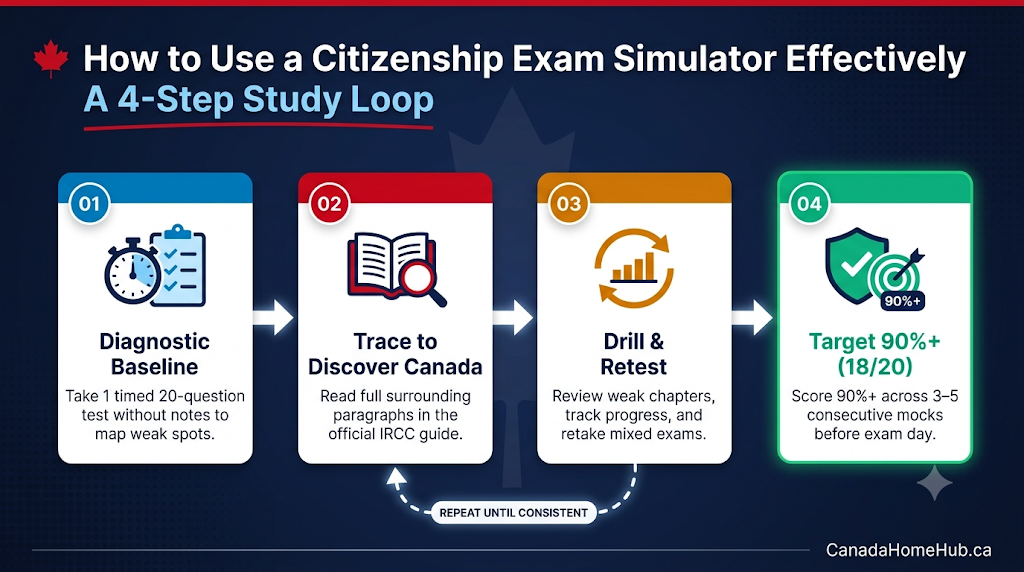
How to Use a Citizenship Exam Simulator Effectively: A 4-Step Study Loop
Running repeated mock exams without reviewing mistakes mostly trains you to recognize phrasing rather than learn Canadian civics. Follow this four-step routine instead:
- Take a diagnostic baseline test: Run one full 20-question timed simulation without checking notes. Your first score simply maps which chapters you already know and which need work.
- Trace every mistake back to Discover Canada: For each missed or guessed question, read the entire surrounding paragraph in the official guide (available free from IRCC in HTML, PDF, eBook, audio, and print). Official questions often test adjacent details from the same passage.
- Drill weak chapters, then retest: Review your lowest-scoring domains and summarize complex systems—like how a bill becomes law—in your own words before taking another mixed 20-question simulation. To keep review and testing connected, CanadaHomeHub.Ca links its timed simulator with a Canadian citizenship test simulator so you can track scores and weak topics over time.
- Target 90%+, not 75%: Although 15/20 (75%) is the official pass mark, aim for at least 18/20 (90%) across three to five consecutive full simulations before taking the real test. That buffer protects you against unfamiliar wording and exam-day nerves.
Preparing for the Citizenship Test Online in Canada: Technical & Test-Day Rules
Because IRCC monitors online tests via webcam and reviews identity photos before making scores official, preventable technical errors can invalidate a passing attempt.
Setup and Verification Requirements
Before clicking your invitation link, confirm your setup meets current IRCC rules:
- Browser: Use Google Chrome or Safari only.
- No VPN or extra tabs: Turn off any VPN and close all other browser tabs and background applications.
- Webcam and lighting: Use a working webcam in a bright room where your full face stays clearly visible.
- Private environment: Take the test alone in the same spot where you take your pre-test photos, with personal documents removed from the background.
- Valid ID: Keep your Permanent Resident (PR) card or another valid ID with your photo and signature (such as a provincial driver's licence or health card) within reach.
Test-Day Flow and Invalidation Triggers
When your 30-day window opens, check your invitation PDF for your Application Number and Unique Client Identifier (UCI). Sign in, accept the terms, and click "Email me the test link"—the link expires after 15 minutes, though you can request another if needed. Re-enter your details, capture sharp photos of your ID and face (religious head coverings and prescription glasses are allowed if your face remains visible), and click "Start the test" to begin your 45-minute countdown. Save or email your temporary score before closing the browser.
IRCC may invalidate an online attempt—even a high score—if your ID or face photo is blurry, someone enters the room, you leave the webcam frame, you look away repeatedly at notes or a second device, or you run extra tabs or a VPN. If your connection drops mid-exam, the timer keeps running; if you cannot reconnect, follow the troubleshooting contact steps in your invitation email with your Application Number and UCI ready.
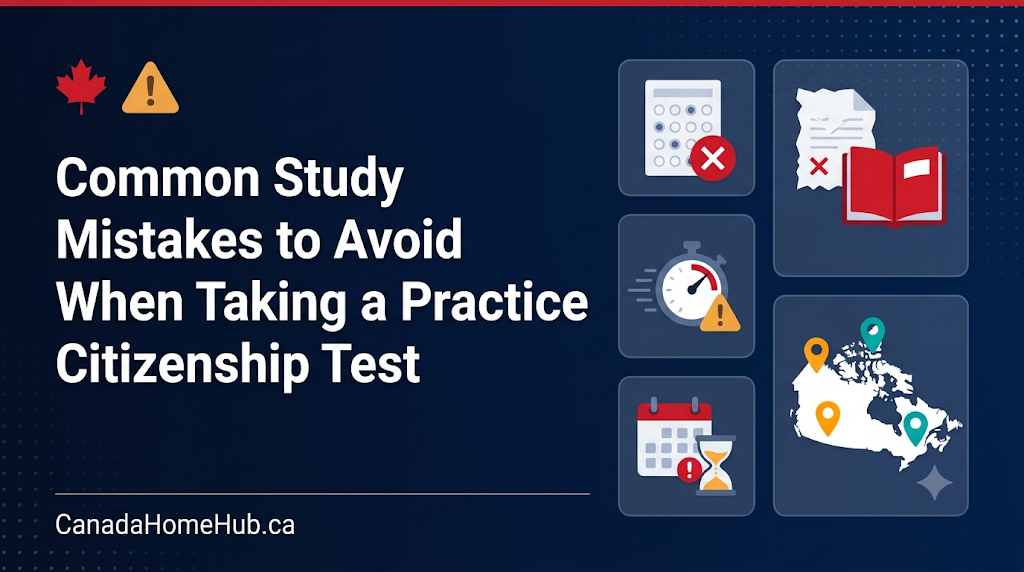
Common Study Mistakes to Avoid When Taking a Practice Citizenship Test
-
Memorizing answer patterns instead of facts: No third-party simulator has IRCC's confidential question bank. Learn the underlying concept so reworded questions never throw you off.
- Relying only on condensed cheat sheets: Unofficial summaries often omit Indigenous history, regional details, and civic distinctions that IRCC regularly tests. Always verify facts in Discover Canada.
- Rushing through the 45 minutes: Finishing in 5 or 6 minutes leads to misreading negative questions (such as "Which of the following is NOT..."). Use your time to double-check flagged items.
- Skipping smaller regions: Don't focus solely on Ontario and Quebec; capitals and industries across Atlantic Canada, the Prairies, British Columbia, and the North are easy marks once reviewed.
- Waiting until the end of your 30-day window: Taking your first attempt early leaves breathing room for technical issues or a quick retake if needed.
What Happens After Your Official Exam (Pass, Retake, or Hearing)
-
Unofficial vs. official results: The score shown on screen right after an online test is temporary. An IRCC officer must review your exam and identity verification before marking the result official, which can take days to several weeks.
- If you pass: Your tracker updates to completed, and IRCC will either invite you directly to your citizenship ceremony (to take the Oath of Citizenship) or schedule a brief document-verification interview.
- If you do not pass on attempt 1 or 2: You receive up to 3 chances within your 30-day window. Review missed chapters in Discover Canada, practise with timed simulations, and try again.
- If you fail all 3 attempts: IRCC invites you to a citizenship hearing (roughly 30 to 90 minutes) with a citizenship official, who asks 20 oral knowledge questions (15 needed to pass) and may assess residence or language requirements (up to 9 language questions, 6 needed to pass). Passing moves you toward the ceremony; failing results in application refusal, requiring a new application and fee.
Frequently Asked Questions About Canadian Citizenship Test Simulators
How many questions are on the Canadian citizenship test, and what is the passing score?
The official test has 20 questions (multiple-choice and true-or-false). You need at least 15 correct answers (75%) to pass.
Is the Canadian citizenship test 30 minutes or 45 minutes long?
Under current IRCC rules, the test is 45 minutes long. Older apps still use the outdated 30-minute limit, so configure your simulator for 45 minutes to match official pacing.
Do simulators use the exact official IRCC questions?
No. IRCC keeps its live test bank confidential. Reliable simulators write original questions directly from Discover Canada, the sole official source for the real exam.
How many chances do I get to pass the online citizenship test?
Most applicants get up to 3 attempts within their 30-day invitation window. Failing all 3 leads to an oral citizenship hearing rather than immediate refusal.
Can I take the online Canadian citizenship test from outside Canada?
Yes. IRCC permits taking the online test from abroad as long as you follow all browser, webcam, and identity-verification requirements within your 30-day window.
Does the citizenship test assess my English or French language skills?
No. The knowledge test does not contain language-assessment questions. Language ability for applicants aged 18–54 is verified separately through your application proof or during an interview or hearing.
What score should I aim for on a simulator before taking the real test?
Aim to score 18/20 (90%) or higher consistently across multiple full timed simulations to ensure a safe margin above the 75% pass mark.
Conclusion: Turn Simulation Practice Into Exam-Day Confidence
Passing the Canadian citizenship exam comes down to understanding how Canada's history, institutions, regions, and civic responsibilities connect—and recalling those facts calmly under exam conditions. A realistic Canadian citizenship test simulator turns passive reading into measurable progress, pinpointing weak chapters well before your 45-minute IRCC timer starts.
Run a diagnostic 20-question test, trace every missed concept back to Discover Canada, and repeat the loop until you hit 90% consistently. Whenever you are ready to start practising, explore the timed simulations and Canadian newcomer resources on CanadaHomeHub.Ca—and approach your official test day prepared and confident.
Thank you for reading our article!